
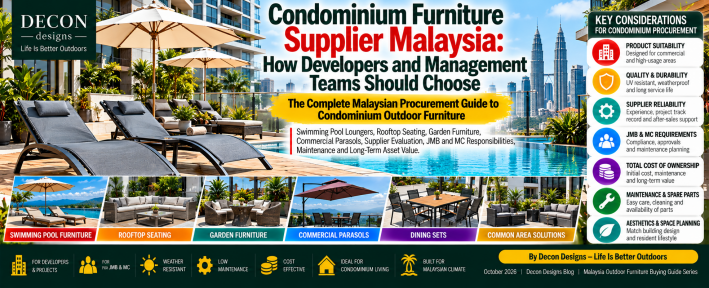
The Complete Malaysian Procurement Guide to Condominium Outdoor Furniture, Swimming Pool Loungers, Rooftop Seating, Garden Furniture, Commercial Parasols, Supplier Evaluation, JMB and MC Responsibilities, Maintenance and Long-Term Asset Value
By Decon Designs – Life Is Better Outdoors | Condominium Furniture Supplier Malaysia | Outdoor Furniture Malaysia | Condominium Management | JMB & MC | Property Developers | Pool Furniture | Rooftop Furniture | Commercial Parasols | Property Maintenance | Hospitality & Residential Furniture
October 2026 | Decon Designs Blog | Malaysia Outdoor Furniture Buying Guide Series
Introduction: Condominium Furniture Is Not Just Decoration. It Is Part of Property Management.
Modern condominiums in Malaysia are no longer defined only by their residential units.
Swimming pools, rooftop terraces, landscaped gardens, barbecue areas, outdoor lounges, children’s recreational areas and shared dining spaces have become important elements of many residential developments.
These facilities influence how residents experience their living environment.
A well-furnished swimming pool provides space for relaxation.
Comfortable garden seating encourages residents to use landscaped areas.
Appropriate rooftop furniture supports social activities.
Practical outdoor dining furniture makes shared recreational facilities more functional.
However, furniture installed in condominium common areas is different from furniture purchased for an individual household.
It is shared by many users.
It may be exposed to rain, humidity and sunlight.
It requires cleaning and maintenance.
Damaged products may need repair or replacement.
And purchasing decisions often involve several stakeholders.
These may include property developers, Joint Management Bodies (JMBs), Management Corporations (MCs), property managers, facility managers, committees, contractors and furniture suppliers.
For these stakeholders, the important question is not simply:
Which furniture looks best?
It is:
Which supplier can provide suitable furniture, clear specifications, dependable delivery and practical long-term support for the condominium’s common facilities?
At Decon Designs – Life Is Better Outdoors, with more than two decades serving Malaysia’s outdoor and hospitality furniture market, we believe condominium furniture procurement should be approached as an asset-management decision rather than a one-time decoration exercise.
This guide explains how developers and condominium management teams can evaluate suppliers, choose suitable products, compare quotations, plan maintenance and manage replacement costs.
1. Understanding the Condominium Furniture Market in Malaysia
Malaysia’s condominium and serviced-apartment developments vary considerably.
Some properties offer basic common facilities.
Others include extensive lifestyle amenities.
Common outdoor and semi-outdoor facilities may include:
- Swimming pools.
- Children’s pools.
- Rooftop gardens.
- Sky lounges.
- Outdoor dining areas.
- Barbecue facilities.
- Landscaped courtyards.
- Garden seating areas.
- Recreational decks.
- Covered terraces.
- Multipurpose outdoor spaces.
Each facility may require different furniture.
A swimming pool may need sun loungers and side tables.
A rooftop lounge may require outdoor sofas and coffee tables.
A barbecue area may need dining tables and chairs.
A landscaped garden may benefit from benches.
A covered terrace may accommodate a different furniture collection from a fully exposed deck.
This creates purchasing opportunities for specialized condominium furniture suppliers.
However, suppliers should understand that shared residential facilities involve different operational requirements from private home furniture.
2. Who Purchases Condominium Furniture in Malaysia?
Condominium furniture procurement may involve different parties depending on the development’s stage and management arrangements.
Property Developers
Developers may purchase furniture during construction, completion or facility preparation.
Their priorities may include:
- Design coordination.
- Project schedules.
- Budget.
- Product consistency.
- Delivery.
- Installation.
- Handover documentation.
Joint Management Bodies (JMBs)
A JMB may be responsible for managing and maintaining common property during the relevant statutory management period.
Furniture purchasing decisions should follow the applicable legal framework, approved budgets, management authority and internal procedures.
Management Corporations (MCs)
An MC may manage common property after the relevant statutory transition.
Its responsibilities can include maintenance and appropriate replacement of common-area assets, subject to applicable law and governance requirements.
Property Management Companies
Property managers may coordinate quotations, supplier evaluation, purchasing and maintenance on behalf of the authorized management body.
Facility Managers
Facility managers may identify damaged furniture, maintenance requirements and replacement needs.
Why the Buyer Matters
A developer furnishing a newly completed condominium may require a coordinated project supply.
An established MC replacing damaged loungers may need only a small number of products.
A property manager may need supplier quotations for committee review.
The procurement process should reflect the buyer’s actual authority and requirements.
3. Condominium Furniture Is a Shared Asset
Furniture purchased for common facilities is generally intended for collective use.
Unlike privately owned household furniture, common-area products may be used by many residents and visitors.
This creates additional responsibilities.
Management teams should consider:
- Safety.
- Product suitability.
- Maintenance.
- Cleaning.
- Inventory records.
- Repair.
- Replacement.
- Budgeting.
The furniture should be selected according to its intended function.
A visually attractive sofa may not be appropriate for an exposed poolside area.
A lightweight chair may be easy to move but unsuitable for a particular rooftop environment.
A large parasol may provide shade but require site-specific assessment.
Shared furniture should be purchased with shared-use requirements in mind.
4. Residential Furniture Versus Commercial-Use Furniture
One of the most important procurement distinctions is the difference between furniture intended for private residential use and furniture suitable for frequent shared use.
A private garden chair may be used by a small household.
A condominium poolside chair may be used by many different residents.
Common-area furniture may experience:
- More frequent use.
- Regular cleaning.
- Repeated movement.
- Greater environmental exposure.
- Higher maintenance demands.
However, the term commercial grade should not be accepted without supporting information.
Buyers should request relevant specifications and, where appropriate, evidence of testing or suitability for the intended application.
5. Swimming Pool Furniture: A Major Condominium Procurement Category
Swimming pools are among the most recognizable amenities in many condominium developments.
Typical poolside furniture includes:
- Sun loungers.
- Side tables.
- Outdoor chairs.
- Parasols.
- Selected lounge furniture.
However, not every pool deck has sufficient space for large furniture collections.
What Management Teams Should Evaluate
- Available deck area.
- Circulation.
- Product dimensions.
- Furniture stability.
- Exposure to moisture.
- Cleaning.
- Maintenance.
- Storage.
- Replacement availability.
Poolside furniture should not obstruct emergency access, circulation or other required facilities.
The layout should be reviewed against the property’s applicable safety and operational requirements.
6. Pool Lounger Supplier Malaysia: What to Ask
Pool loungers are frequently used in shared recreational areas.
They may be manufactured using aluminium, suitable polymers, synthetic wicker or other materials.
Before purchasing, management teams should ask:
- What is the frame material?
- What is the seating material?
- Is the product suitable for the intended poolside environment?
- Does it have an adjustable backrest?
- Is it stackable?
- What are the dimensions?
- What cleaning is required?
- Are replacement parts available?
- What warranty applies?
- Can the supplier provide consistent quantities?
These questions help compare products beyond appearance.
7. Stackable Versus Non-Stackable Pool Loungers
Stackable loungers may be useful where furniture needs to be stored or rearranged.
However, not every product is designed for stacking.
Improper stacking can damage furniture or create safety risks.
Stackable Loungers
Potential advantages include:
- Storage convenience.
- Easier seasonal or operational rearrangement.
- More flexible space management.
Non-Stackable Loungers
Potential advantages may include:
- Different design options.
- Alternative comfort features.
- Different construction approaches.
Neither category is universally better.
The correct choice depends on the property and product specifications.
8. Rooftop Furniture: A Special Procurement Challenge
Rooftop amenities may include:
- Outdoor sofas.
- Lounge chairs.
- Dining sets.
- Coffee tables.
- Parasols.
- Garden benches.
However, rooftop environments require careful assessment.
Wind exposure, access restrictions, surface conditions and building rules can influence furniture suitability.
Important Considerations
- Site-specific wind conditions.
- Product stability.
- Furniture weight and dimensions.
- Safe placement.
- Maintenance access.
- Storage arrangements.
- Building management requirements.
Do not assume that furniture suitable for a ground-level patio is automatically appropriate for a high-rise rooftop.
Large freestanding parasols require particular caution.
Appropriate professional assessment may be necessary.
9. Commercial Parasols for Condominium Facilities
Parasols can provide shade in suitable outdoor environments.
Potential applications include:
- Swimming pool decks.
- Garden seating.
- Outdoor dining.
- Recreational terraces.
However, shade products must be selected according to site conditions.
Supplier Questions
- What canopy size is appropriate?
- What base is required?
- What operating limitations apply?
- Is the location suitable?
- What maintenance is necessary?
- How should the parasol be stored or secured?
- What warranty applies?
Parasols should be operated according to manufacturer guidance.
They should not be treated as permanent structures capable of withstanding all weather conditions.
10. Garden Furniture for Condominium Landscaped Areas
Condominium gardens may require furniture that complements landscaping.
Common products include:
- Garden benches.
- Lounge chairs.
- Outdoor sofas.
- Small tables.
- Selected dining furniture.
The objective should be to provide functional seating without overcrowding landscaped areas.
Furniture should not obstruct:
- Walking paths.
- Drainage.
- Maintenance access.
- Emergency routes.
- Garden care.
The best arrangement depends on the available space and resident needs.
11. Outdoor Dining Furniture for Barbecue and Recreational Areas
Barbecue areas and shared outdoor dining facilities require practical furniture.
Management teams should consider:
- Table dimensions.
- Seating capacity.
- Chair movement.
- Cleaning.
- Material suitability.
- Circulation.
- Maintenance.
Large dining sets may not always be appropriate.
Smaller tables may offer more flexible arrangements.
The correct configuration depends on how residents use the facility.
12. Outdoor Sofas for Sky Lounges and Common Areas
Outdoor sofas can create comfortable gathering spaces.
Potential applications include:
- Sky lounges.
- Covered terraces.
- Garden seating.
- Recreational decks.
However, sofas with cushions may require additional maintenance.
Management teams should ask:
- Are cushions removable?
- What fabric is used?
- How should cushions be cleaned?
- Can replacement cushions be ordered?
- Is the sofa suitable for the intended exposure?
Furniture should be selected according to maintenance capability, not only appearance.
13. Material Selection for Malaysian Condominium Environments
Malaysia’s tropical conditions influence furniture selection.
Common considerations include sunlight, rainfall, humidity and moisture.
Material Comparison
| Material | Common applications | Important considerations |
|---|---|---|
| Aluminium | Loungers, dining sets, sofas | Construction, finish, fittings |
| Synthetic wicker | Sofas, lounge chairs | Weave quality, frame, exposure |
| Suitable hardwood | Benches, dining furniture | Maintenance, finishing |
| Outdoor rope | Contemporary seating | Material specification, cleaning |
| Polymers | Selected chairs and loungers | UV suitability, construction |
| Outdoor fabric | Cushions and upholstery | Drying, cleaning, replacement |
No single material is automatically suitable for every condominium facility.
Product-specific information is essential.
14. Tropical Weather: Why Maintenance Must Be Planned Before Purchase
Condominium furniture may be exposed to:
- Strong sunlight.
- Heavy rain.
- Humidity.
- Moisture.
- Wind.
- Frequent use.
These conditions can influence product performance and maintenance.
Management teams should request care instructions before purchasing.
For example, cushions may need suitable drying and storage.
Frames may require inspection.
Parasols may need to be closed during unsuitable weather.
Maintenance responsibilities should be clearly assigned.
15. Coastal Condominiums: Additional Furniture Considerations
Condominiums located near coastal environments may face additional exposure to salt-laden air and moisture.
These conditions can affect some metals, finishes and fittings.
Buyers should evaluate:
- Frame specifications.
- Fasteners.
- Protective finishes.
- Maintenance.
- Intended exposure.
- Warranty conditions.
A supplier should avoid making unsupported claims that every outdoor furniture product is suitable for coastal use.
16. How to Evaluate a Condominium Furniture Supplier
Supplier selection should be structured.
Important factors include:
Business Reliability
Verify the supplier’s identity and contact details.
Product Specifications
Request accurate material and dimensional information.
Commercial Suitability
Confirm that products match the intended application.
Delivery Capability
Evaluate the supplier’s ability to fulfil the order.
Installation
Clarify assembly and placement responsibilities.
Warranty
Review coverage and exclusions.
After-Sales Support
Ask about repairs and replacement components.
Price
Compare equivalent products and services.
A supplier should be evaluated on overall capability rather than price alone.
17. The Condominium Furniture Supplier Evaluation Scorecard
Management teams may use a weighted evaluation framework.
| Evaluation category | Illustrative weighting |
|---|---|
| Product suitability and specifications | 25% |
| Supplier reliability | 20% |
| Price and total value | 15% |
| Warranty and after-sales support | 15% |
| Delivery and installation | 10% |
| Maintenance requirements | 10% |
| Product availability | 5% |
| Total | 100% |
These weights are illustrative and should be adjusted to the project’s requirements.
Safety and mandatory compliance requirements should be treated as essential conditions, not merely scored preferences.
18. Request Comparable Written Quotations
Condominium management teams may need to compare several suppliers.
However, quotations are only meaningfully comparable when specifications are clear.
Example Quotation Comparison
| Item | Supplier A | Supplier B |
|---|---|---|
| Product model | Confirm | Confirm |
| Quantity | Confirm | Confirm |
| Dimensions | Confirm | Confirm |
| Frame material | Confirm | Confirm |
| Cushion specification | Confirm | Confirm |
| Warranty | Confirm | Confirm |
| Delivery | Confirm | Confirm |
| Installation | Confirm | Confirm |
| Lead time | Confirm | Confirm |
| Total price | Confirm | Confirm |
Written quotations should clearly identify inclusions and exclusions.
19. Developer Procurement: Furniture for New Condominium Projects
Developers furnishing new projects may require coordinated purchasing.
Important considerations include:
- Design specifications.
- Product selection.
- Quantity.
- Colour consistency.
- Delivery schedules.
- Site access.
- Installation.
- Inspection.
- Handover records.
Furniture should be selected early enough to align with the project’s completion and facility preparation.
However, ordering too early may create unnecessary storage or handling costs.
Procurement planning should reflect actual project requirements.
20. JMB and MC Procurement: Replacing Existing Furniture
Established condominiums may need to replace furniture gradually.
Common reasons include:
- Wear.
- Damage.
- Changes in facility usage.
- Maintenance concerns.
- Product discontinuation.
- Refurbishment.
Management teams should inspect existing furniture before deciding on replacement.
Some products may be suitable for repair.
Others may need complete replacement.
Purchasing should follow the relevant management body’s authority, approved budget and applicable requirements.
21. Understanding Malaysia’s Strata Management Framework
Condominium common-property management in Peninsular Malaysia and the Federal Territory of Labuan is principally governed by the Strata Management Act 2013 (Act 757) and related regulations, subject to their applicable scope.
This framework addresses matters including management bodies, common property, maintenance and financial administration.
However, the exact authority and approval process for a furniture purchase depend on the property’s management stage, applicable law, governing documents and the nature of the expenditure.
Management teams should not assume that every furniture purchase can be approved through the same procedure.
Practical Recommendation
Before committing to a major furniture order:
- Confirm the purchasing authority.
- Check the applicable budget.
- Review internal procurement procedures.
- Document quotations and approvals.
- Obtain appropriate professional advice where necessary.
This article is general procurement guidance, not legal advice.
22. Furniture Procurement and Management Accountability
Transparent procurement is important for shared-property management.
Residents may want to understand how common funds are used.
Management teams can improve accountability by documenting:
- Furniture requirements.
- Supplier quotations.
- Product specifications.
- Evaluation criteria.
- Approval records.
- Delivery confirmation.
- Warranty documents.
Clear documentation can also support future maintenance and replacement decisions.
23. Budgeting for Condominium Furniture Replacement
Furniture replacement should ideally be planned rather than handled only when products fail.
Management teams can maintain an inventory of existing furniture.
Useful records include:
- Product type.
- Quantity.
- Location.
- Purchase date.
- Supplier.
- Warranty.
- Condition.
- Maintenance history.
This information can help identify future replacement requirements.
Budget allocation and use of maintenance or sinking-fund monies must follow applicable legal and governance requirements.
Not every expenditure is automatically chargeable to the same fund.
24. Illustrative Condominium Pool Furniture Budget
Consider a hypothetical condominium planning a poolside furniture upgrade.
| Product | Quantity | Illustrative unit price | Total |
|---|---|---|---|
| Pool loungers | 20 | RM650 | RM13,000 |
| Outdoor side tables | 10 | RM180 | RM1,800 |
| Commercial parasols | 6 | RM1,200 | RM7,200 |
| Outdoor sofa sets | 3 | RM3,000 | RM9,000 |
| Dining sets | 4 | RM1,500 | RM6,000 |
| Illustrative subtotal | RM37,000 |
This is a hypothetical budget, not an actual Decon Designs quotation or market-price benchmark.
It excludes delivery, installation, applicable taxes, site works and future maintenance.
The example demonstrates how different furniture categories can contribute to a condominium procurement budget.
25. Total Cost of Ownership: A Better Way to Compare Furniture
The initial purchase price is not the only cost.
Additional expenses may include:
- Delivery.
- Installation.
- Cleaning.
- Repairs.
- Replacement cushions.
- Storage.
- Replacement furniture.
- Disposal.
A lower-cost product may require more frequent replacement under certain conditions.
A higher-cost product may also be unsuitable if its maintenance requirements exceed the property’s capabilities.
Management teams should compare realistic ownership costs.
26. Illustrative Five-Year Cost Comparison
Consider two hypothetical outdoor chairs.
| Cost component | Chair A | Chair B |
|---|---|---|
| Initial purchase | RM250 | RM400 |
| Initial delivery and installation | RM30 | RM30 |
| Five-year maintenance | RM100 | RM80 |
| Additional replacement purchase | RM250 | RM0 |
| Illustrative five-year total | RM630 | RM510 |
This example is hypothetical.
It does not establish actual product lifespans or market prices.
It illustrates why procurement decisions should consider potential maintenance and replacement costs.
27. Maintenance Responsibilities: Who Should Do What?
Condominium furniture maintenance may involve several parties.
| Activity | Potential responsible party |
|---|---|
| Routine cleaning | Housekeeping or cleaning contractor |
| Visual inspection | Facility management |
| Technical assessment | Qualified maintenance personnel |
| Repair coordination | Property management |
| Supplier warranty claims | Procurement or management |
| Replacement approval | Authorized management body |
| Asset records | Property management or finance |
Actual responsibilities depend on the property’s management structure and contracts.
Clear assignments can reduce neglected maintenance.
28. Establish a Furniture Inspection Programme
Furniture should be inspected according to its use and condition.
Inspections may identify:
- Loose fittings.
- Damaged frames.
- Torn upholstery.
- Deteriorated wicker.
- Unstable tables.
- Damaged lounger mechanisms.
- Parasols requiring attention.
Unsafe furniture should be removed from use pending appropriate assessment.
Inspection frequency should reflect usage and environmental exposure.
29. Repair, Refurbishment or Replacement?
Not every damaged furniture product requires complete replacement.
Potential refurbishment activities include:
- Cushion replacement.
- Upholstery renewal.
- Selected component replacement.
- Appropriate surface repairs.
However, structural safety must remain a priority.
Management teams should not attempt to extend furniture life through unsuitable repairs.
Decision Factors
- Safety.
- Repair feasibility.
- Cost.
- Remaining useful life.
- Appearance.
- Replacement availability.
- Operational disruption.
30. Why Replacement Parts Matter
Condominium furniture may be purchased in coordinated collections.
When one product becomes damaged, management may want to replace only that item.
However, matching products may no longer be available.
Before purchasing, ask suppliers about:
- Replacement cushions.
- Spare fittings.
- Matching products.
- Product continuity.
- Warranty support.
No supplier can necessarily guarantee indefinite availability.
Nevertheless, discussing these issues before purchase can improve planning.
31. Delivery and Installation in High-Rise Properties
High-rise furniture delivery may involve:
- Loading-bay arrangements.
- Lift access.
- Security registration.
- Delivery scheduling.
- Protective handling.
- Assembly.
- Packaging removal.
Large furniture may not fit through certain access routes.
Before ordering, confirm product dimensions and site access.
Management teams should coordinate delivery with the supplier and building operations.
32. Common Condominium Furniture Procurement Mistakes
Mistake 1: Selecting Furniture Only by Appearance
The product may not suit its intended environment.
Mistake 2: Comparing Incomplete Quotations
Delivery and installation may be excluded.
Mistake 3: Ignoring Commercial Suitability
Residential products may not meet shared-use requirements.
Mistake 4: Overcrowding Common Areas
Furniture may obstruct movement.
Mistake 5: Buying Parasols Without Site Assessment
Wind exposure and base requirements may be overlooked.
Mistake 6: Not Planning Maintenance
Furniture may deteriorate unnecessarily.
Mistake 7: Ignoring Replacement Availability
Future repairs or matching purchases may become difficult.
Mistake 8: Purchasing Without Clear Approval
Management governance requirements may not be followed.
Mistake 9: Not Recording Furniture Assets
Replacement planning becomes harder.
Mistake 10: Choosing Only the Lowest Price
Long-term ownership costs may be ignored.
33. Condominium Furniture Procurement Checklist
Before approving a furniture purchase, confirm:
-
The intended application is clearly defined.
-
The available space has been measured.
-
Furniture dimensions are confirmed.
-
Product materials are identified.
-
Commercial suitability has been assessed.
-
Environmental exposure has been considered.
-
Supplier details are verified.
-
Written quotations are available.
-
Warranty terms are understood.
-
Delivery and installation are clarified.
-
Maintenance requirements are documented.
-
Replacement parts have been discussed.
-
Budget and purchasing authority are confirmed.
-
Relevant approvals are recorded.
-
Asset records will be maintained.
This checklist can support a more disciplined procurement process.
34. What Condominium Developers and Management Teams Should Prepare for in 2027
As properties plan future maintenance and upgrades, outdoor furniture should be reviewed as part of common-area asset management.
Priority 1: Better Product Specifications
Avoid vague purchasing descriptions.
Priority 2: Stronger Supplier Evaluation
Compare reliability, specifications and support.
Priority 3: Climate-Appropriate Furniture
Select products suited to actual environmental exposure.
Priority 4: Maintenance Planning
Include cleaning and inspection requirements.
Priority 5: Replacement Budgeting
Use condition records to support purchasing decisions.
Priority 6: Clear Procurement Governance
Follow applicable approval and documentation procedures.
Priority 7: Better Digital Records
Maintain product and warranty information.
Priority 8: Resident Experience
Ensure furniture supports practical use of common facilities.
These priorities can improve procurement decisions regardless of broader market trends.
35. Decon Designs: Our Perspective on Condominium Furniture Supply in Malaysia
At Decon Designs – Life Is Better Outdoors, we believe condominium furniture should be selected with both residents and management teams in mind.
With more than two decades serving Malaysia’s outdoor and hospitality furniture market, our perspective is that shared facilities require practical, application-specific furniture choices.
A swimming pool may require loungers and side tables.
A rooftop terrace may need carefully selected seating.
A landscaped garden may benefit from benches.
A barbecue area may require dining furniture.
A covered lounge may accommodate outdoor sofas.
Each space has different requirements.
We encourage developers, property managers, JMBs and MCs to evaluate:
- Product suitability.
- Material specifications.
- Dimensions.
- Maintenance.
- Delivery.
- Warranty.
- Long-term ownership costs.
Furniture should contribute to the functionality of common areas without creating unnecessary operational burdens.
The right condominium furniture supplier should help management teams make informed purchasing decisions, not simply provide a product catalogue.
Conclusion: Better Condominium Furniture Procurement Begins With Better Questions
Condominium furniture is an important part of shared residential environments.
Pool loungers, outdoor sofas, dining sets, benches and parasols can improve the usability of common facilities.
However, furniture selection should involve more than design preferences.
Developers must consider project schedules and specifications.
JMBs and MCs must consider governance, budgets and maintenance.
Property managers must coordinate suppliers and operational requirements.
Facility managers must understand cleaning, inspection and replacement.
Suppliers must provide accurate product information and realistic commercial terms.
For Malaysia’s condominium sector, the best purchasing decisions combine suitable products, reliable suppliers, transparent quotations and long-term asset planning.
A condominium’s common-area furniture should be selected not only for how it looks on installation day, but also for how effectively it can be used, maintained and managed in the years that follow.
At Decon Designs, we believe thoughtful outdoor furniture decisions create better shared living environments.
Decon Designs – Life Is Better Outdoors.
Frequently Asked Questions
1. What is a condominium furniture supplier?
A condominium furniture supplier provides furniture for residential developments, including common areas, swimming pools, rooftops, gardens and recreational facilities.
2. What furniture is commonly used in Malaysian condominium facilities?
Common products include pool loungers, outdoor chairs, dining sets, garden benches, outdoor sofas, side tables and parasols.
3. Can a JMB purchase outdoor furniture for common areas?
A JMB may have relevant management responsibilities, but any purchase should follow the applicable legal framework, budget and approval procedures.
4. Can an MC replace damaged condominium furniture?
An MC may arrange appropriate maintenance or replacement of common-area assets, subject to applicable legal and governance requirements.
5. Is residential outdoor furniture suitable for condominium common areas?
Not necessarily. Buyers should verify suitability for the expected shared-use environment.
6. What should management teams check before buying pool loungers?
Check materials, stability, dimensions, cleaning, intended use, warranty and replacement availability.
7. Are cantilever parasols suitable for condominium rooftops?
Suitability depends on site conditions, wind exposure, product specifications and manufacturer guidance. Professional assessment may be necessary.
8. How should condominium furniture replacement be budgeted?
Management teams can maintain furniture inventories, condition records and replacement plans, while following applicable financial and governance requirements.
9. Is repairing outdoor furniture better than replacing it?
Repair may be suitable when safe, technically feasible and economical. Some damaged products require replacement.
10. Why should management teams compare multiple quotations?
Comparable quotations help evaluate product specifications, pricing, delivery, warranty and overall value.
11. What is the importance of after-sales support?
After-sales support may assist with maintenance, warranty claims, repairs and replacement components.
12. How do developers choose a reliable condominium furniture supplier in Malaysia?
They should verify supplier capability, product specifications, commercial suitability, delivery arrangements, warranty terms and relevant project requirements.
Research and Regulatory References
1. Strata Management Act 2013 (Act 757)
Malaysian legislation governing relevant strata management matters in its applicable jurisdictions.
https://www.agc.gov.my/
2. Commissioner of Buildings and Local Authorities
Relevant local authorities provide information concerning strata management administration and procedures.
3. Malaysian Investment Development Authority (MIDA)
Furniture manufacturing and industry information.
https://www.mida.gov.my/industries/manufacturing/wood-based-and-furniture/
4. Forest Research Institute Malaysia (FRIM)
Furniture materials and product-related research.
https://www.frim.gov.my/
5. BIFMA
Furniture industry standards and technical resources.
https://www.bifma.org/
Editorial note: Strata management procedures, purchasing authority and fund usage depend on the applicable law and property circumstances. This article provides general procurement guidance and should not replace legal, engineering or building-management advice. Illustrative budgets and cost comparisons are hypothetical, not current product quotations.


