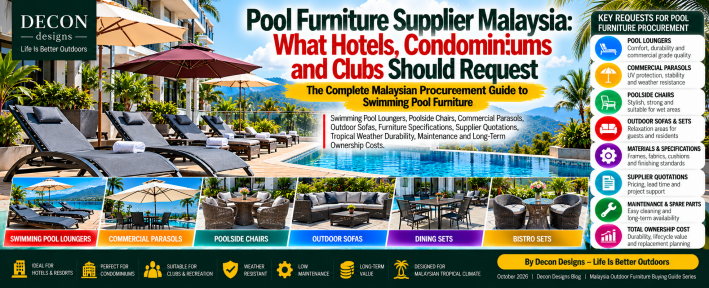
The Complete Malaysian Procurement Guide to Swimming Pool Loungers, Poolside Chairs, Commercial Parasols, Outdoor Sofas, Furniture Specifications, Supplier Quotations, Tropical Weather Durability, Maintenance and Long-Term Ownership Costs
By Decon Designs – Life Is Better Outdoors | Pool Furniture Supplier Malaysia | Swimming Pool Furniture | Pool Loungers | Hotel Furniture | Resort Furniture | Condominium Furniture | Club Furniture | Commercial Parasols | Outdoor Furniture Procurement
October 2026 | Decon Designs Blog | Malaysia Outdoor Furniture Buying Guide Series
Introduction: A Swimming Pool Is an Amenity. The Furniture Makes It Usable.
A swimming pool is often one of the most attractive facilities in a hotel, resort, condominium or recreational club.
It can become a place where guests relax, residents spend time with their families, club members socialize and visitors enjoy the surrounding environment.
However, the swimming pool itself is only one part of the experience.
The furniture surrounding it plays an important role in comfort, convenience, appearance and daily operations.
A hotel may have a beautiful swimming pool but insufficient loungers.
A condominium may provide seating that is uncomfortable or difficult to maintain.
A recreational club may have umbrellas that are unsuitable for the available space.
A resort may purchase attractive poolside furniture without considering replacement cushions, spare parts or long-term maintenance.
These problems often begin during procurement.
Furniture is selected based on appearance, price or immediate availability without fully considering the intended environment.
For hotels, condominiums and clubs in Malaysia, the important question should be:
What should we request from a pool furniture supplier before approving a purchase?
At Decon Designs – Life Is Better Outdoors, with more than two decades serving Malaysia’s outdoor and hospitality furniture market, we believe pool furniture procurement should begin with clear specifications, practical space planning and realistic maintenance expectations.
This guide explains how commercial buyers can evaluate poolside furniture, prepare supplier enquiries, compare quotations and make purchasing decisions that support both users and facility operators.
1. Understanding the Pool Furniture Market in Malaysia
Swimming pool furniture is used across several property categories.
These include:
- Hotels.
- Beach resorts.
- Urban resorts.
- Condominiums.
- Serviced apartments.
- Private clubs.
- Golf and country clubs.
- Recreation centres.
- Wellness facilities.
- Holiday villas.
- Homestays with private pools.
- Water recreation properties.
Each property has different requirements.
A boutique hotel may require a limited number of premium loungers.
A large resort may need coordinated furniture across several pool zones.
A condominium management team may prioritize maintenance and replacement costs.
A club may require practical furniture suitable for frequent member use.
A private villa may focus on comfort and design.
These differences should influence supplier selection.
2. Identify the Type of Swimming Pool Facility
Before requesting quotations, define the pool environment.
Hotel Swimming Pool
Potential priorities include guest comfort, coordinated design and operational maintenance.
Resort Pool
A resort may require larger quantities of loungers, shade products and lounge furniture.
Condominium Pool
Management teams may prioritize shared-use suitability, cleaning, safety and replacement planning.
Club Swimming Pool
Frequent use may make product durability and maintenance particularly important.
Private Villa Pool
Buyers may prioritize design, comfort and space efficiency.
Rooftop Swimming Pool
Site-specific wind exposure, access and placement require additional attention.
A supplier should understand the intended application before recommending products.
3. What Products Should a Pool Furniture Supplier Offer?
A poolside furniture project may involve several product categories.
Common products include:
- Sun loungers.
- Poolside chairs.
- Outdoor side tables.
- Commercial parasols.
- Outdoor sofas.
- Lounge chairs.
- Selected daybeds.
- Outdoor dining furniture.
Not every property needs every category.
A compact condominium pool may require only loungers and side tables.
A large resort may include multiple lounge and dining zones.
The purchasing list should be based on the facility’s actual requirements.
4. Pool Loungers: The Most Important Product to Specify
Pool loungers are among the most common swimming pool furniture products.
They allow users to relax beside the pool.
However, lounger quality and functionality vary.
What Buyers Should Request
- Product dimensions.
- Frame material.
- Seating material.
- Backrest design.
- Adjustment mechanism, if applicable.
- Stackability.
- Recommended use.
- Cleaning instructions.
- Warranty terms.
- Replacement-part information.
A supplier should provide the specifications for the exact model being quoted.
5. Aluminium Pool Loungers: What to Check
Aluminium is used in many outdoor lounger designs.
However, construction quality varies.
Buyers should evaluate:
- Frame design.
- Welds and joints.
- Protective finishes.
- Fasteners.
- Stability.
- Seating support.
- Product dimensions.
A product should not be selected solely because it is described as aluminium.
The actual construction matters.
For coastal locations, additional attention may be required for fittings and finishes.
6. Textilene and Mesh Pool Loungers
Some pool loungers use woven synthetic mesh seating.
Textilene is a trade name associated with certain woven vinyl-coated polyester fabrics, while other manufacturers use different mesh materials.
Buyers should confirm the exact seating material rather than treating all mesh products as identical.
Potential considerations include:
- Comfort.
- Support.
- Cleaning.
- Material specifications.
- Environmental exposure.
- Replacement availability.
A mesh lounger may suit some poolside applications, but suitability should be verified for the intended use.
7. Wicker Pool Loungers: Attractive but Construction-Dependent
Wicker-style loungers can complement tropical resort environments.
However, buyers should inspect both the weave and the supporting frame.
Important considerations include:
- Synthetic wicker material.
- Frame construction.
- Weave quality.
- Cushion specifications.
- Environmental suitability.
- Maintenance.
A woven exterior does not independently establish structural quality.
Hotels and resorts should request relevant product information.
8. Adjustable Pool Loungers: Check the Mechanism
Adjustable loungers may allow users to change the backrest position.
However, the adjustment mechanism requires attention.
Buyers should inspect:
- Ease of operation.
- Stability.
- Locking positions.
- Moving parts.
- Maintenance requirements.
- Manufacturer instructions.
A damaged or malfunctioning mechanism can create operational problems.
Facility teams should include adjustable components in their inspection routines.
9. Stackable Pool Loungers: When Storage Matters
Stackable loungers can be useful for properties that rearrange furniture.
Potential advantages include:
- Storage efficiency.
- Easier space management.
- Operational flexibility.
However, buyers should confirm that the exact model is designed for stacking.
Improper stacking may damage products or create hazards.
Questions to Ask
- How many loungers can be stacked according to manufacturer guidance?
- Are protective components provided?
- What storage conditions are recommended?
- Does stacking affect the warranty?
These details matter for hotels, condominiums and clubs.
10. Poolside Chairs: An Alternative to Loungers
Not every pool user wants to lie down.
Some prefer upright seating.
Poolside chairs may be useful for:
- Short visits.
- Social conversations.
- Parents supervising children.
- Poolside refreshments.
- Limited-space facilities.
Buyers should consider a balanced seating arrangement rather than installing only loungers.
However, the mix should reflect the facility’s actual usage patterns.
11. Poolside Side Tables: Small Products With Practical Value
Side tables are often overlooked during procurement.
Yet they can improve user convenience.
Guests may need a surface for:
- Books.
- Personal belongings.
- Drinks.
- Towels.
The table should be suitable for the environment.
Important factors include:
- Stability.
- Dimensions.
- Surface material.
- Cleaning.
- Placement.
Avoid selecting tables that obstruct circulation.
12. Commercial Parasols: Shade Requires Careful Planning
Parasols are common poolside products.
They can provide shade where appropriate.
However, their selection requires more than choosing a canopy colour.
Buyers should consider:
- Canopy dimensions.
- Frame construction.
- Base requirements.
- Placement.
- Operating limitations.
- Maintenance.
- Wind exposure.
Important Safety Principle
A freestanding parasol should not be assumed suitable for every poolside location.
Rooftop pools and exposed coastal properties may require additional assessment.
Follow manufacturer guidance and applicable site requirements.
13. Centre-Pole Versus Cantilever Parasols
Different parasol designs may suit different layouts.
Centre-Pole Parasols
These may be appropriate for certain seating and dining arrangements.
Cantilever Parasols
These can position shade away from the central support pole in some layouts.
However, they may require substantial base arrangements and careful placement.
Neither type is universally better.
The correct choice depends on the site, product and operating conditions.
14. Parasol Bases: A Critical Part of the Specification
A parasol base is not merely an accessory.
It is part of the shade system.
Potential base options include:
- Manufacturer-approved weighted bases.
- Suitable fixed installations.
- Other compatible support systems.
Buyers should confirm:
- Compatibility.
- Required weight or anchoring.
- Surface suitability.
- Operating limitations.
- Installation requirements.
Do not substitute an arbitrary base for the manufacturer’s specified arrangement.
15. Outdoor Sofas for Poolside Lounges
Outdoor sofas may be suitable for selected poolside lounge areas.
They can provide a different seating experience from loungers.
However, cushions and upholstery require attention.
Questions to Ask
- Is the sofa suitable for the intended exposure?
- What frame material is used?
- Are cushions removable?
- How should cushions be cleaned?
- What drying arrangements are required?
- Are replacement cushions available?
Poolside sofas should not be purchased solely because they match the property’s interior design.
16. Daybeds and Premium Resort Furniture
Some resorts and premium hospitality properties may use outdoor daybeds.
These can create dedicated relaxation spaces.
However, daybeds may require more floor area than standard loungers.
They may also involve additional cushion maintenance.
Before purchasing, consider:
- Space.
- Guest demand.
- Cleaning.
- Product dimensions.
- Exposure.
- Maintenance.
- Replacement components.
Daybeds should be included only when they suit the property’s operational model.
17. Pool Furniture Layout: Do Not Overcrowd the Deck
Furniture should improve the pool experience without obstructing movement.
A crowded deck can create inconvenience and operational concerns.
Before purchasing, prepare a layout showing:
- Pool edges.
- Access routes.
- Emergency equipment.
- Steps.
- Drainage.
- Furniture positions.
- Shade areas.
- Service routes.
The layout should be reviewed against applicable pool safety, accessibility and building requirements.
Furniture should not obstruct required access.
18. How Many Pool Loungers Does a Property Need?
There is no universal lounger-to-room or lounger-to-resident ratio suitable for every property.
The correct quantity depends on:
- Pool size.
- Available deck area.
- Guest or resident usage.
- Operating hours.
- Occupancy patterns.
- Existing furniture.
- Circulation requirements.
Practical Approach
Observe actual usage.
Identify peak periods.
Measure available space.
Prepare a layout.
Then determine the appropriate quantity.
Avoid purchasing furniture based only on a generic industry ratio.
19. Illustrative Pool Furniture Layout
Consider a hypothetical hotel pool deck.
The property may wish to accommodate:
- 20 loungers.
- 10 side tables.
- 6 parasols.
- 2 outdoor sofa sets.
However, the actual layout must be verified against available space and site requirements.
A furniture list alone is not sufficient.
Dimensions and placement matter.
20. Malaysia’s Tropical Weather: A Major Purchasing Factor
Pool furniture may be exposed to:
- Strong sunlight.
- Rainfall.
- High humidity.
- Moisture.
- Wind.
- Pool-related chemicals.
These conditions can influence maintenance and product performance.
Buyers should request product-specific guidance.
A product described as outdoor furniture is not necessarily appropriate for every pool environment.
21. Pool Chemicals and Furniture Maintenance
Swimming pool environments may expose nearby furniture to splashes and cleaning products.
Different materials react differently.
Buyers should ask about:
- Cleaning instructions.
- Chemical exposure limitations.
- Frame maintenance.
- Fabric care.
- Recommended cleaning products.
Avoid using aggressive chemicals without manufacturer approval.
Facility staff should follow appropriate cleaning procedures.
22. Coastal Resorts: Additional Environmental Considerations
Beachfront resorts may experience salt-laden air and moisture.
These conditions can affect certain metals, finishes and fittings.
Buyers should evaluate:
- Frame materials.
- Fasteners.
- Protective finishes.
- Maintenance.
- Product suitability.
A supplier should provide accurate information about the intended environment.
Avoid assuming that every product is equally suitable for coastal exposure.
23. Pool Furniture for Rooftop Condominiums
Rooftop swimming pools may create additional furniture-selection challenges.
Wind exposure and building access require attention.
Buyers should consider:
- Product stability.
- Furniture placement.
- Access routes.
- Maintenance.
- Building rules.
- Parasol suitability.
Large shade products should not be installed without appropriate assessment.
24. What Hotels Should Request From Pool Furniture Suppliers
Hotel procurement teams should request:
- Product catalogue.
- Detailed specifications.
- Dimensions.
- Material information.
- Quantity quotation.
- Delivery schedule.
- Installation arrangements.
- Warranty terms.
- Maintenance instructions.
- Replacement-part information.
For large projects, relevant supplier experience and product documentation may also be important.
25. What Condominium Management Teams Should Request
Condominium procurement may involve JMBs, MCs, property managers and facility teams.
They should consider:
- Shared-use suitability.
- Maintenance requirements.
- Budget.
- Supplier reliability.
- Written quotations.
- Warranty.
- Replacement availability.
- Appropriate approvals.
Purchasing should follow applicable strata-management governance requirements.
26. What Clubs and Recreation Facilities Should Request
Clubs may experience frequent furniture use.
Their procurement priorities may include:
- Suitable construction.
- Practical cleaning.
- Comfortable seating.
- Replacement availability.
- Maintenance.
- Delivery reliability.
A club should select furniture according to actual operating conditions.
27. Supplier Verification: Beyond the Product Catalogue
A pool furniture supplier should be evaluated as a business partner.
Before approving an order, verify:
- Business identity.
- Contact details.
- Product specifications.
- Supply capability.
- Quotation terms.
- Delivery arrangements.
- Warranty conditions.
- After-sales support.
For larger orders, additional commercial due diligence may be appropriate.
28. Compare Quotations Using the Same Specifications
Comparing different products only by price can be misleading.
A proper quotation comparison should include:
| Specification | Supplier A | Supplier B |
|---|---|---|
| Lounger model | Confirm | Confirm |
| Frame material | Confirm | Confirm |
| Seating material | Confirm | Confirm |
| Dimensions | Confirm | Confirm |
| Quantity | Confirm | Confirm |
| Warranty | Confirm | Confirm |
| Delivery | Confirm | Confirm |
| Installation | Confirm | Confirm |
| Lead time | Confirm | Confirm |
| Total cost | Confirm | Confirm |
This helps buyers identify differences in scope.
29. Ready Stock Versus Project Orders
Pool furniture procurement may involve ready-stock products or project-based supply.
Ready Stock
May be useful when replacement is urgent.
Project Orders
May be appropriate for larger quantities or specific requirements.
Customized Orders
May require additional production and approval time.
Buyers should confirm availability before making payment commitments.
30. Delivery and Installation: Often Overlooked Costs
Pool furniture may be bulky.
Delivery can involve:
- Transportation.
- Loading.
- Unloading.
- Lift access.
- Assembly.
- Placement.
- Packaging removal.
For hotels and condominiums, delivery should be coordinated with property operations.
For island resorts and East Malaysia destinations, logistics may require additional planning.
31. Pool Furniture Maintenance: Establish Responsibilities
Furniture maintenance should be planned before installation.
Potential responsibilities include:
| Task | Typical responsible function |
|---|---|
| Routine cleaning | Housekeeping |
| Visual inspection | Facility operations |
| Minor maintenance | Authorized maintenance personnel |
| Technical repair | Qualified personnel |
| Warranty coordination | Procurement or management |
| Replacement approval | Authorized management |
Actual responsibilities depend on the property.
Clear assignments help reduce neglected maintenance.
32. Inspection Checklist for Poolside Furniture
Facility teams should periodically inspect:
- Lounger frames.
- Adjustable mechanisms.
- Seating surfaces.
- Fasteners.
- Side tables.
- Sofa frames.
- Cushions.
- Parasol structures.
- Bases and supports.
Damaged or unsafe furniture should be removed from use pending appropriate assessment.
Inspection frequency should reflect usage and environmental conditions.
33. Replacement Cushions and Refurbishment
Some poolside furniture may be suitable for refurbishment.
Potential activities include:
- Cushion replacement.
- Upholstery renewal.
- Selected fitting replacement.
- Appropriate repairs.
However, refurbishment should not compromise safety.
Furniture with serious structural defects may require replacement.
34. Total Cost of Ownership: A Better Procurement Measure
The initial purchase price is only one part of pool furniture cost.
Additional expenses may include:
- Delivery.
- Installation.
- Cleaning.
- Maintenance.
- Repairs.
- Replacement cushions.
- Replacement furniture.
- Disposal.
Commercial buyers should evaluate the expected ownership costs.
35. Illustrative Five-Year Pool Lounger Cost Comparison
Consider two hypothetical loungers.
| Cost component | Lounger A | Lounger B |
|---|---|---|
| Initial purchase | RM500 | RM800 |
| Delivery allocation | RM40 | RM40 |
| Five-year maintenance | RM150 | RM120 |
| Additional replacement purchase | RM500 | RM0 |
| Illustrative total | RM1,190 | RM960 |
These figures are hypothetical.
They are not actual product quotations or verified lifespan estimates.
The example demonstrates why buyers should evaluate more than initial price.
36. Illustrative Hotel Pool Furniture Procurement Budget
Consider a hypothetical hotel planning a poolside upgrade.
| Product | Quantity | Illustrative unit price | Total |
|---|---|---|---|
| Pool loungers | 30 | RM750 | RM22,500 |
| Side tables | 15 | RM200 | RM3,000 |
| Commercial parasols | 8 | RM1,400 | RM11,200 |
| Outdoor sofa sets | 4 | RM3,200 | RM12,800 |
| Outdoor dining sets | 5 | RM1,800 | RM9,000 |
| Illustrative subtotal | RM58,500 |
This is a hypothetical budget, not a Decon Designs quotation or market-price benchmark.
Delivery, installation, applicable taxes and other project costs are excluded.
Actual pricing depends on specifications and supplier terms.
37. Pool Furniture Supplier Evaluation Scorecard
Commercial buyers may use a structured scoring system.
| Evaluation area | Illustrative weighting |
|---|---|
| Product suitability | 25% |
| Material and construction information | 20% |
| Supplier reliability | 15% |
| Price and overall value | 15% |
| Warranty and support | 10% |
| Delivery and installation | 10% |
| Availability | 5% |
| Total | 100% |
Weights should be adjusted to project requirements.
Mandatory safety and technical conditions should be assessed separately.
38. Common Pool Furniture Procurement Mistakes
Mistake 1: Buying Based Only on Appearance
Attractive furniture may not suit the intended environment.
Mistake 2: Ignoring Material Specifications
Different products may have different construction quality.
Mistake 3: Overcrowding the Pool Deck
Furniture may obstruct movement.
Mistake 4: Buying Parasols Without Proper Base Planning
Shade products may be incorrectly specified.
Mistake 5: Ignoring Cleaning Requirements
Maintenance may become difficult.
Mistake 6: Comparing Incomplete Quotations
Delivery and installation costs may be overlooked.
Mistake 7: Not Checking Replacement Availability
Future repairs may become more complicated.
Mistake 8: Purchasing Residential Furniture Without Verifying Commercial Suitability
Shared-use conditions may be more demanding.
Mistake 9: Ignoring Site Access
Large products may be difficult to deliver.
Mistake 10: Focusing Only on the Lowest Price
Long-term ownership costs may be missed.
39. Pool Furniture Procurement Checklist
Before approving an order, confirm:
-
The poolside area has been measured.
-
The furniture layout has been reviewed.
-
Required circulation is preserved.
-
Product quantities are confirmed.
-
Materials and dimensions are documented.
-
Intended-use suitability has been verified.
-
Parasol base and operating requirements are understood.
-
Supplier details are verified.
-
Written quotations are available.
-
Delivery and installation are clarified.
-
Warranty terms are understood.
-
Maintenance instructions are provided.
-
Replacement components have been discussed.
-
Budget approval is documented.
-
Asset records will be maintained.
40. What Pool Furniture Buyers Should Prepare for in 2027
As hotels, condominiums and clubs plan future upgrades, buyers should prioritize more informed procurement.
Better Product Documentation
Request accurate specifications.
More Careful Layout Planning
Avoid overcrowding and unsuitable placement.
Climate-Appropriate Furniture
Evaluate exposure and maintenance.
Stronger Supplier Evaluation
Compare reliability and support.
Better Replacement Planning
Maintain inventory and condition records.
Long-Term Cost Awareness
Consider total ownership costs.
Improved Maintenance Procedures
Assign cleaning and inspection responsibilities.
These priorities can help properties make more effective purchasing decisions in 2027.
41. Decon Designs: Our Perspective on Pool Furniture Supply in Malaysia
At Decon Designs – Life Is Better Outdoors, we believe swimming pool furniture should be selected according to the needs of the property and its users.
With more than two decades serving Malaysia’s outdoor and hospitality furniture market, our experience has reinforced the importance of practical furniture selection.
A hotel may need comfortable loungers and coordinated parasols.
A condominium may require furniture that is practical for shared use.
A resort may need a combination of loungers, sofas and side tables.
A club may prioritize cleaning, storage and replacement.
Each application requires careful evaluation.
We encourage buyers to understand product specifications, maintenance requirements, delivery arrangements and warranty terms before purchasing.
A good pool furniture supplier should help buyers understand what they are purchasing, how it will be used and what will be required to maintain it.
Conclusion: Request the Right Information Before Requesting the Lowest Price
Pool furniture plays an important role in the experience of hotels, condominiums, resorts and recreational clubs.
Sun loungers provide relaxation.
Side tables improve convenience.
Parasols offer shade under suitable conditions.
Outdoor sofas create social spaces.
However, these products must be selected carefully.
For Malaysian buyers, tropical weather, frequent use, maintenance and long-term ownership costs should influence procurement.
Before approving a supplier, request clear product specifications, written quotations, delivery arrangements, warranty terms and maintenance information.
Measure the space.
Review the layout.
Verify product suitability.
And evaluate supplier reliability.
The best pool furniture purchasing decision is not simply the one that looks attractive on installation day. It is the one that continues to support the property’s practical needs over time.
At Decon Designs, we believe better outdoor furniture decisions create better poolside experiences.
Decon Designs – Life Is Better Outdoors.
Frequently Asked Questions
1. What does a pool furniture supplier provide?
A pool furniture supplier may provide sun loungers, outdoor chairs, side tables, parasols, sofas, daybeds and related products for swimming pool areas.
2. What furniture is suitable for hotel swimming pools?
Suitable products depend on the pool environment, available space and operational requirements. Common options include loungers, side tables, parasols and lounge seating.
3. What should condominium management check before buying pool loungers?
Management teams should evaluate materials, stability, dimensions, intended use, maintenance, warranty and replacement availability.
4. Are aluminium pool loungers suitable for Malaysia?
Some aluminium loungers are designed for outdoor environments. Buyers should verify construction, finishes, fittings and intended exposure.
5. What is Textilene pool furniture?
Textilene is a trade name associated with certain woven vinyl-coated polyester fabrics used in applications including outdoor seating. Exact product specifications should be confirmed.
6. Should hotels buy stackable pool loungers?
Stackable loungers may be useful where storage and rearrangement are important, provided the products are designed for stacking.
7. Are cantilever parasols suitable for poolside use?
They may be suitable in some locations, subject to base requirements, wind exposure, manufacturer instructions and site conditions.
8. How many loungers should a condominium pool have?
There is no universal quantity. Management should assess available space, circulation, resident usage and operating needs.
9. Can pool furniture cushions be replaced?
Some products allow cushion replacement. Buyers should confirm dimensions, materials and availability.
10. How should pool furniture be maintained?
Follow manufacturer instructions and establish appropriate cleaning and inspection routines.
11. What should a commercial pool furniture quotation include?
It should identify products, quantities, specifications, prices, delivery, installation, warranty and lead times.
12. How can hotels and clubs choose a reliable pool furniture supplier in Malaysia?
They should verify supplier information, compare suitable products, review quotations and assess delivery, maintenance and after-sales support.
Research and Industry References
1. Malaysian Meteorological Department (METMalaysia)
Malaysia’s weather and climate information.
https://www.met.gov.my/
2. Malaysian Investment Development Authority (MIDA)
Furniture manufacturing and industry background.
https://www.mida.gov.my/industries/manufacturing/wood-based-and-furniture/
3. Forest Research Institute Malaysia (FRIM)
Furniture materials and product-related research.
https://www.frim.gov.my/
4. BIFMA
Furniture industry technical resources and standards information.
https://www.bifma.org/
5. Department of Standards Malaysia
National standards and conformity assessment information.
https://www.jsm.gov.my/
Editorial note: Product suitability, warranty conditions and maintenance requirements vary by model. Commercial buyers should verify relevant technical claims and applicable pool safety requirements. The cost examples in this article are hypothetical, not actual market quotations or verified product lifespan estimates.