
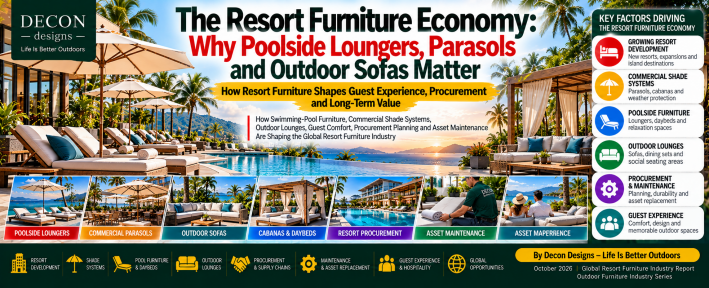
How Swimming-Pool Furniture, Commercial Shade Systems, Outdoor Lounges, Guest Comfort, Procurement Planning and Asset Maintenance Are Shaping the Global Resort Furniture Industry
By Decon Designs – Life Is Better Outdoors | Resort Furniture Industry | Outdoor Furniture Industry | Hospitality Furniture | Poolside Loungers | Commercial Parasols | Outdoor Sofas | Resort Procurement | Guest Experience | Furniture Maintenance | Asset Replacement | Global Industry Intelligence
October 2026 | Global Resort Furniture Industry Report | Outdoor Furniture Industry Series
Introduction: Resort Furniture Is More Than a Collection of Outdoor Products
When guests arrive at a resort, their experience is shaped by more than the accommodation they have booked.
The swimming pool, outdoor lounge, garden terrace, beachfront relaxation area and open-air restaurant can all influence how they experience the property.
A comfortable pool lounger allows a guest to relax.
A properly selected parasol provides shade.
An outdoor sofa creates space for families and friends to gather.
A well-designed dining set supports an enjoyable meal.
These products may appear to be relatively small elements within a large hospitality development, but together they help determine whether outdoor facilities are comfortable, functional and inviting.
For resort operators, furniture is not simply decoration.
It is part of the property’s operating environment.
For manufacturers, suppliers and retailers, resort furniture represents a specialized commercial market involving product design, material selection, procurement, logistics, installation, maintenance and replacement.
A resort may purchase furniture during its initial development.
Years later, the same property may require replacement cushions, additional loungers, new parasol canopies or complete furniture refurbishment.
This creates economic activity throughout the useful life of the furniture.
The resort furniture economy extends far beyond the first purchase. It includes the products, services and investments required to create and maintain functional outdoor hospitality environments.
At Decon Designs – Life Is Better Outdoors, with more than two decades serving Malaysia’s outdoor and hospitality furniture market, we believe resort furniture should be evaluated as a long-term operational asset rather than a one-time decorative expense.
This report explores the economic importance of poolside loungers, parasols and outdoor sofas, how resorts should approach procurement, and why maintenance and replacement planning are becoming increasingly important.
1. Understanding the Global Resort Furniture Economy
The resort furniture economy includes all commercial activities associated with furnishing and maintaining resort environments.
It connects several industries.
Manufacturing
Factories produce loungers, sofas, tables, chairs, parasols, cushions and related products.
Raw Materials and Components
Suppliers provide aluminium, timber, fabrics, foam, synthetic wicker, rope, coatings and hardware.
International Trade
Importers and exporters connect manufacturers with hospitality markets.
Distribution
Wholesalers and retailers make products available to resorts and contractors.
Design and Procurement
Architects, designers and purchasing teams specify furniture for hospitality environments.
Installation
Delivery and installation teams prepare furniture for guest use.
Maintenance
Cleaning, repair and replacement services help maintain furniture condition.
Refurbishment and Replacement
Existing resorts purchase replacement products or refurbish suitable furniture.
The industry therefore supports more than finished furniture sales.
It creates opportunities for manufacturers, designers, logistics providers, installers, upholsterers and service businesses.
2. Why Resort Furniture Demand Matters to the Global Outdoor Furniture Industry
Resorts are important customers because outdoor environments are central to many resort experiences.
Unlike some urban accommodation properties, resorts may devote substantial space to:
- Swimming pools.
- Beachfront areas.
- Garden lounges.
- Private villas.
- Outdoor dining.
- Wellness facilities.
- Recreational areas.
- Viewing terraces.
These environments require furniture suited to different uses.
The global tourism economy provides the broader commercial context.
UN Tourism reported approximately 1.52 billion international tourist arrivals in 2025.
However, tourism arrivals do not directly measure resort furniture sales.
Furniture demand depends on resort development, renovations, operating budgets and replacement requirements.
A busy resort may postpone furniture investment.
A newly opened property may make a substantial initial purchase.
An established resort may replace selected products rather than its entire collection.
Suppliers must therefore evaluate actual purchasing requirements rather than assuming tourism growth automatically creates orders.
3. Poolside Loungers: One of the Most Recognizable Resort Furniture Categories
Swimming-pool loungers are a defining feature of many resorts.
They provide places for guests to rest, read, sunbathe or relax near swimming pools.
However, not all loungers are designed for the same application.
Differences may include:
- Frame construction.
- Seat materials.
- Adjustable backrests.
- Cushion options.
- Product weight.
- Dimensions.
- Stackability.
- Mobility.
- Maintenance requirements.
Why Lounger Selection Matters
A resort purchasing loungers should consider guest comfort alongside operational requirements.
For example, a lounger may look attractive but be difficult for staff to move.
Another may be easy to clean but unsuitable for the property’s intended aesthetic.
A heavily cushioned product may offer comfort but require additional maintenance.
The correct selection depends on the resort’s environment, guests and operating model.
4. Commercial Parasols: Shade as a Hospitality Requirement
Parasols and shade systems play an important role in outdoor hospitality environments.
They may be used around:
- Swimming pools.
- Outdoor restaurants.
- Garden terraces.
- Private villas.
- Lounge areas.
- Recreational facilities.
Their purpose extends beyond visual design.
Shade can improve the usability of outdoor spaces during suitable weather conditions.
However, commercial parasols must be selected carefully.
Important Procurement Considerations
- Canopy size.
- Frame materials.
- Base requirements.
- Operating mechanism.
- Placement.
- Wind limitations.
- Maintenance.
- Storage procedures.
- Manufacturer instructions.
A large canopy does not automatically mean a parasol is suitable for every location.
Commercial buyers must consider site conditions and relevant safety requirements.
Parasols should be closed or secured according to manufacturer guidance and operating conditions.
A commercial parasol is a functional outdoor product that requires appropriate specification, installation and operational care.
5. Outdoor Sofas: Creating Resort Lounge Environments
Outdoor sofas are used in resort environments where guests gather, socialize and relax.
Potential applications include:
- Poolside lounges.
- Garden seating areas.
- Private villa terraces.
- Rooftop lounges.
- Outdoor reception spaces.
- Wellness relaxation areas.
Outdoor sofas may use:
- Aluminium frames.
- Suitable timber.
- Synthetic wicker.
- Outdoor rope.
- Specialized upholstery.
- Modular construction.
Design Considerations
Resorts should evaluate:
- Seating comfort.
- Product dimensions.
- Cushion construction.
- Cleaning requirements.
- Environmental exposure.
- Furniture arrangement.
- Replacement availability.
Modular sofa systems may offer layout flexibility.
However, modularity is only useful when the furniture suits the property’s operational requirements.
6. Guest Experience: How Furniture Influences Resort Environments
Outdoor furniture contributes to the physical experience of a resort.
A well-furnished poolside area may be more inviting.
Comfortable outdoor sofas can support social interaction.
Suitable shade may improve the practicality of relaxation spaces.
Appropriate dining furniture can support guest comfort.
However, furniture should not be treated as the sole determinant of guest satisfaction.
Hospitality experiences also depend on:
- Service quality.
- Cleanliness.
- Staff responsiveness.
- Food and beverage quality.
- Property maintenance.
- Safety.
- Accessibility.
- Overall value.
Furniture is one component of the wider experience.
What Resort Operators Should Ask
Does the furniture support how guests actually use the space?
Are seating arrangements comfortable and practical?
Is sufficient circulation space available?
Can staff clean and maintain the furniture efficiently?
Do products suit the climate and exposure?
These questions can help connect design decisions with operational performance.
7. The Economics of Poolside Seating Capacity
Resorts often need to determine how many loungers and seating areas to provide.
Purchasing too few products may limit guest access to facilities.
Purchasing too many may create congestion and unnecessary expenditure.
The correct quantity depends on:
- Guest capacity.
- Poolside area.
- Property operating model.
- Guest usage patterns.
- Circulation requirements.
- Accessibility.
- Safety.
- Furniture dimensions.
There is no universal number of loungers that suits every resort.
A small boutique resort may require a different arrangement from a large family-oriented property.
Illustrative Capacity Planning
Consider a hypothetical resort with 100 guest rooms.
Management may evaluate different poolside seating configurations based on expected guest use.
The resort should not simply assume that every room requires two loungers.
Instead, it should review actual occupancy patterns, available space and facility usage.
Professional space planning can help avoid overfurnishing.
8. Resort Furniture Procurement: Why the Purchasing Process Matters
Resort furniture procurement can involve several departments and external parties.
These may include:
- Owners.
- General managers.
- Procurement managers.
- Architects.
- Interior designers.
- Operations teams.
- Maintenance teams.
- Contractors.
- Furniture suppliers.
Each participant may have different priorities.
Designers may focus on appearance.
Operations teams may prioritize cleaning and practicality.
Procurement teams may focus on cost and delivery.
Maintenance teams may be concerned about repairs and replacement components.
The Procurement Challenge
A successful purchase must balance these requirements.
Furniture selected without operational input may create problems after installation.
For example, a product may be visually attractive but difficult to maintain.
A parasol may suit the design concept but be inappropriate for the intended exposure.
A sofa may fit the budget but not the available space.
Early coordination can reduce these risks.
9. A Practical Resort Furniture Procurement Process
Resorts can organize purchasing through a structured process.
Step 1: Define the application.
Identify where each product will be used.
Step 2: Assess environmental conditions.
Consider sunlight, rain, humidity, coastal exposure and other relevant factors.
Step 3: Establish functional requirements.
Determine seating capacity, comfort and operational needs.
Step 4: Develop product specifications.
Confirm materials, dimensions, finishes and relevant performance requirements.
Step 5: Evaluate suppliers.
Review product information, capability and commercial terms.
Step 6: Assess samples where appropriate.
Inspect comfort, construction and suitability.
Step 7: Confirm quantities and delivery.
Align purchasing with project schedules.
Step 8: Clarify installation responsibilities.
Establish who will assemble and position the furniture.
Step 9: Document maintenance requirements.
Prepare operational guidance.
Step 10: Plan future replacement.
Maintain records that support ongoing asset management.
This approach can improve procurement consistency.
10. Residential Furniture Versus Commercial Resort Furniture
A product marketed for outdoor use is not automatically suitable for intensive commercial applications.
Residential furniture may be designed for relatively limited use.
Resort furniture may experience frequent use by different guests.
Commercial environments can involve:
- Higher usage frequency.
- Repeated cleaning.
- Furniture movement.
- Greater exposure.
- Larger procurement quantities.
- More demanding maintenance requirements.
However, commercial suitability cannot be established through appearance or marketing labels alone.
Buyers should evaluate relevant specifications, testing information and manufacturer guidance.
Important Questions
Is the product appropriate for the expected usage?
Are the materials suitable for the environment?
Are relevant instructions available?
Can the supplier support the required quantity?
Are warranty conditions clearly defined?
11. Materials: Selecting Furniture for Resort Environments
Different materials offer different characteristics.
| Material | Common resort applications | Key considerations |
|---|---|---|
| Aluminium | Loungers, sofas, dining furniture | Frame construction, finish, exposure |
| Suitable timber | Garden lounges, dining sets | Maintenance, weathering, sourcing |
| Synthetic wicker | Outdoor sofas, lounge chairs | Weave quality, frame, environmental suitability |
| Outdoor rope | Contemporary seating | Material specification, construction |
| Steel | Selected furniture frames and bases | Corrosion protection |
| Outdoor fabrics | Cushions, upholstery, shade | Cleaning, drying, colour retention |
| Foam | Lounge cushions | Comfort, moisture management |
| Polymers | Selected seating and components | Material formulation, UV exposure |
No single material is ideal for every resort.
Product selection should reflect the intended location and maintenance capability.
12. Tropical Resorts: The Challenge of Heat, Rain and Humidity
Tropical resort environments create particular furniture requirements.
Malaysia, Thailand, Indonesia and other tropical destinations may experience:
- High humidity.
- Frequent rainfall.
- Strong sunlight.
- Moisture.
- Coastal exposure.
- Intensive outdoor use.
These conditions can influence material performance and maintenance needs.
Important Considerations
Furniture should be selected according to its exposure.
Cushions may require appropriate drying and storage arrangements.
Frames and fittings should be evaluated for environmental suitability.
Protective finishes should be maintained according to manufacturer guidance.
Operators should inspect products regularly.
A product suitable for a sheltered terrace may not be appropriate for an exposed beachfront location.
13. Coastal Resorts: Salt-Laden Air and Product Suitability
Coastal environments can be demanding.
Salt-laden air and moisture may affect some metals and finishes.
Wind can also influence shade-product operation.
Furniture suppliers should avoid generic claims that every outdoor product is suitable for beachfront use.
Coastal Procurement Checklist
- Verify frame and fitting specifications.
- Assess protective finishes.
- Review fabric suitability.
- Understand maintenance requirements.
- Evaluate parasol operating limits.
- Plan suitable storage where required.
- Confirm after-sales arrangements.
For island resorts, logistics and replacement-part availability may also influence purchasing decisions.
14. Luxury Resorts: Premium Design With Operational Discipline
Luxury resorts may seek distinctive furniture collections.
Potential products include:
- Designer loungers.
- Outdoor daybeds.
- Modular sofas.
- Premium dining furniture.
- Customized cushions.
- Coordinated shade systems.
Premium design can contribute to a property’s visual identity.
However, high purchase prices do not automatically guarantee suitable performance.
Luxury hospitality buyers should evaluate materials, construction, maintenance and replacement requirements.
Manufacturers supplying this segment may need to offer greater customization and specification control.
15. Family Resorts: Durability, Comfort and Practicality
Family-oriented resorts may require furniture suited to frequent use by guests of different ages.
Operational considerations may include:
- Appropriate product stability.
- Easy cleaning.
- Suitable dimensions.
- Practical layouts.
- Comfortable seating.
- Safe circulation.
- Maintenance.
Resorts should also consider accessibility and the needs of guests with different mobility requirements.
Furniture selection should form part of wider facility planning.
16. Boutique Resorts and Villas: Smaller Orders, Specialized Requirements
Boutique resorts and private villas may purchase smaller quantities of furniture.
However, they may require distinctive designs or custom configurations.
Potential applications include:
- Private pool loungers.
- Garden sofas.
- Outdoor dining sets.
- Terrace seating.
- Parasols.
- Relaxation furniture.
Smaller projects can offer opportunities for retailers and specialized suppliers.
However, customization, delivery and installation costs should be calculated accurately.
A small order can become commercially unprofitable if it requires extensive special handling without appropriate pricing.
17. Resort Furniture as an Asset: Why Inventory Records Matter
Resorts often manage furniture as part of their property assets.
Furniture records can support maintenance, budgeting and replacement decisions.
Useful information may include:
- Product description.
- Supplier.
- Purchase date.
- Quantity.
- Location.
- Material specifications.
- Warranty terms.
- Maintenance instructions.
- Replacement-part information.
- Inspection history.
Benefits of Asset Records
Better records can help resorts identify ageing furniture, monitor maintenance and plan future purchases.
They can also support discussions with suppliers when replacement components are needed.
Asset-management practices should match the size and complexity of the property.
18. Maintenance: Protecting the Value of Resort Furniture
Maintenance is a central part of the resort furniture economy.
Outdoor furniture may require:
- Routine cleaning.
- Inspection of fittings.
- Surface care.
- Cushion maintenance.
- Fabric cleaning.
- Appropriate storage.
- Replacement of suitable components.
Maintenance requirements differ by product.
Resorts should follow manufacturer guidance.
Why Maintenance Matters
Poor maintenance can affect appearance, comfort and product condition.
It may also contribute to avoidable replacement costs.
Regular inspection can help identify problems before they become more serious.
However, maintenance does not make every product indefinitely usable.
Unsafe or structurally compromised furniture may need to be removed from service.
19. Who Should Be Responsible for Resort Furniture Maintenance?
Maintenance responsibilities should be clearly assigned.
Depending on the property, responsibilities may involve:
- Housekeeping.
- Engineering and maintenance teams.
- Pool operations.
- Food and beverage staff.
- External contractors.
- Furniture suppliers.
Example Responsibility Structure
| Activity | Potential responsible team |
|---|---|
| Routine cleaning | Housekeeping or operations |
| Visual condition checks | Operations |
| Technical inspection | Maintenance team |
| Cushion care | Housekeeping or specialist provider |
| Repairs | Qualified maintenance personnel |
| Replacement purchasing | Procurement |
| Asset records | Finance, procurement or operations |
The exact arrangement depends on the resort’s organization.
Clear responsibilities can reduce neglected maintenance.
20. Replacement Cycles: Why There Is No Universal Furniture Lifespan
Resort operators often ask how long outdoor furniture should last.
The answer depends on several factors.
These include:
- Materials.
- Construction.
- Environmental exposure.
- Usage frequency.
- Cleaning practices.
- Maintenance.
- Storage.
- Product quality.
A lounger used intensively beside an exposed swimming pool may experience different wear from a sofa located under a covered terrace.
A resort should not assume that every furniture product has the same replacement cycle.
Better Replacement Planning
Properties can establish condition-based inspection programmes.
Furniture can be categorized as:
Serviceable: Suitable for continued use.
Maintenance Required: Requires cleaning, adjustment or appropriate repair.
Refurbishment Candidate: May be suitable for component replacement or restoration.
Replacement Required: No longer appropriate for continued use.
This approach can support more informed budgeting.
21. The Economics of Repair Versus Replacement
Resorts may need to decide whether to repair furniture or purchase replacements.
Relevant considerations include:
- Repair cost.
- Product condition.
- Safety.
- Availability of components.
- Remaining useful life.
- Appearance.
- Operational disruption.
- Replacement cost.
For example, replacing cushions may be economical when the furniture frame remains suitable.
However, a structurally compromised lounger may not be an appropriate repair candidate.
Decision Principle
Repair should be considered when it is safe, technically feasible and commercially sensible.
Replacement may be preferable when the product can no longer meet its intended requirements.
22. The Total Cost of Ownership of Resort Furniture
The purchase price is only one component of resort furniture expenditure.
Total ownership costs may include:
- Initial purchase.
- Freight.
- Delivery.
- Installation.
- Cleaning.
- Maintenance.
- Repairs.
- Replacement cushions.
- Storage.
- Replacement.
- Disposal.
A product with a lower purchase price may create higher maintenance or replacement expenses.
A premium product may also prove uneconomical if its maintenance requirements are unsuitable for the property.
The correct decision requires realistic assumptions.
23. Illustrative Five-Year Pool Lounger Cost Comparison
Consider two hypothetical pool lounger options.
| Cost component | Lounger A | Lounger B |
|---|---|---|
| Initial purchase | RM450 | RM750 |
| Initial delivery and installation | RM50 | RM50 |
| Annual maintenance assumption | RM50 | RM35 |
| Additional units purchased within five years | 2 | 1 |
| Cost of additional units | RM900 | RM750 |
| Five-year maintenance | RM250 | RM175 |
| Illustrative five-year total | RM1,650 | RM1,725 |
This hypothetical example assumes the additional units are replacements and excludes future delivery, disposal, financing and taxes. It is not an industry benchmark or prediction of product lifespan.
The comparison illustrates why purchasing decisions should not rely on initial price alone.
Actual results could differ substantially.
A resort should use product-specific information and its own operating assumptions.
24. Illustrative Resort Poolside Procurement Budget
Consider a hypothetical resort planning a poolside upgrade.
| Product | Quantity | Illustrative unit price | Total |
|---|---|---|---|
| Pool loungers | 50 | RM650 | RM32,500 |
| Commercial parasols | 15 | RM1,200 | RM18,000 |
| Outdoor sofa sets | 6 | RM3,500 | RM21,000 |
| Side tables | 25 | RM180 | RM4,500 |
| Outdoor dining sets | 10 | RM1,800 | RM18,000 |
| Furniture subtotal | RM94,000 |
This illustrative budget excludes taxes, delivery, installation, site works and maintenance.
It does not represent Decon Designs’ actual prices or a current market quotation.
Why This Matters
One resort refurbishment can create demand across several furniture categories.
It may also involve multiple suppliers and service providers.
The commercial opportunity extends beyond the products themselves.
25. The Role of Furniture Suppliers in Resort Procurement
A responsible supplier should do more than provide a catalogue.
Suppliers can help buyers evaluate:
- Product dimensions.
- Materials.
- Intended applications.
- Environmental suitability.
- Quantity availability.
- Delivery arrangements.
- Maintenance.
- Warranty terms.
- Replacement components.
However, suppliers should avoid promising performance characteristics that cannot be supported.
Accurate communication is essential.
A resort purchasing furniture for exposed coastal use should receive appropriate information about product limitations.
26. Logistics and Installation: Often-Overlooked Resort Costs
Resort furniture may be large or difficult to transport.
Projects can involve:
- Container shipments.
- Local transportation.
- Island delivery.
- Warehouse storage.
- Site access.
- Assembly.
- Furniture positioning.
- Packaging removal.
For Malaysian island resorts, logistics can be particularly important.
Suppliers should clarify whether quotations include delivery and installation.
Unexpected logistics costs can create disputes or reduce project profitability.
27. Sustainability and Circular Resort Furniture
Resorts may consider environmental factors when purchasing and maintaining furniture.
Relevant priorities include:
- Durable construction.
- Appropriate materials.
- Repairability.
- Replaceable components.
- Refurbishment.
- Responsible sourcing.
- Packaging reduction.
- Recycling where feasible.
A resort may extend the useful life of suitable furniture through maintenance and component replacement.
However, sustainability claims should be supported by evidence.
No product should be described as environmentally superior solely because it uses a particular material.
28. Digital Procurement and Supplier Reputation
Resort buyers increasingly use digital channels to research furniture.
They may review:
- Supplier websites.
- Product catalogues.
- Technical specifications.
- Project photographs.
- Customer reviews.
- Business profiles.
- Warranty information.
Digital visibility can help suppliers reach hospitality buyers.
However, an attractive website does not replace supplier verification.
Commercial buyers should confirm product specifications, business capability and contractual terms.
29. Regional Resort Furniture Opportunities
Southeast Asia
Tropical resorts create applications for pool loungers, parasols, outdoor sofas and dining furniture.
Middle East
Luxury hospitality and resort development can create opportunities, although geopolitical and project risks must be assessed.
Europe
Coastal and seasonal resorts may require furniture suited to different climates and operating periods.
North America
Resorts and hospitality properties use outdoor furniture across pools, terraces and recreational facilities.
Africa
Coastal resorts, safari lodges and leisure properties offer specialized applications.
Island Destinations
Island hospitality markets may require particular attention to logistics, coastal exposure and maintenance.
Demand differs by country and property.
Suppliers should evaluate actual projects rather than relying only on regional growth narratives.
30. Malaysia’s Resort Furniture Opportunity
Malaysia offers relevant resort furniture applications across destinations such as:
- Langkawi.
- Penang.
- Melaka.
- Pahang.
- Sabah.
- Sarawak.
- Johor.
- Other coastal and inland leisure destinations.
Potential customers include:
- Luxury resorts.
- Boutique resorts.
- Beachfront hotels.
- Holiday villas.
- Wellness retreats.
- Family resorts.
- Recreational properties.
Opportunities for Malaysian Businesses
- Pool lounger supply.
- Commercial parasols.
- Outdoor sofas.
- Resort dining furniture.
- Replacement cushions.
- Furniture refurbishment.
- Procurement coordination.
- Delivery and installation.
Businesses should consider product suitability, logistics and financial capacity before accepting commercial projects.
31. What Resort Operators Should Prepare for in 2027
Resort operators should review outdoor furniture as part of their asset-management and procurement planning.
Recommended Priorities
1. Inspect existing furniture.
Identify maintenance and replacement requirements.
2. Review guest-use patterns.
Understand how outdoor facilities are actually used.
3. Evaluate product suitability.
Confirm that furniture matches the intended environment.
4. Plan procurement budgets.
Include delivery, installation and maintenance.
5. Coordinate departments.
Involve operations, procurement and maintenance teams.
6. Review supplier reliability.
Verify specifications and commercial arrangements.
7. Improve maintenance records.
Track product condition and service requirements.
8. Consider refurbishment.
Evaluate safe and commercially appropriate repairs.
9. Plan replacement purchasing.
Avoid unnecessary emergency orders.
10. Monitor operating conditions.
Adjust investment plans according to actual business needs.
These steps can support more disciplined asset management.
32. What Manufacturers and Suppliers Should Prepare for in 2027
Manufacturers and suppliers serving resort customers should focus on:
- Commercial product suitability.
- Consistent manufacturing quality.
- Accurate specifications.
- Material performance.
- Realistic lead times.
- Packaging and logistics.
- Maintenance guidance.
- Replacement components.
- Customer communication.
- Financial discipline.
A large resort order may create substantial revenue.
However, it can also require significant working capital.
Businesses should evaluate margins, payment terms and project risks before accepting commitments.
33. Decon Designs: Our Perspective on Resort Furniture
At Decon Designs – Life Is Better Outdoors, we believe resort furniture should be selected according to the needs of the property and its guests.
With more than two decades serving Malaysia’s outdoor and hospitality furniture market, we understand that different resort environments require different solutions.
A poolside area may require loungers and parasols.
A garden lounge may benefit from outdoor sofas.
A restaurant terrace may need practical dining furniture.
A private villa may require a coordinated outdoor collection.
The correct choice depends on the application.
We encourage hospitality buyers to evaluate:
- Product dimensions.
- Material specifications.
- Comfort.
- Environmental exposure.
- Maintenance.
- Delivery.
- Installation.
- Long-term ownership costs.
We also believe resort operators should consider furniture maintenance and replacement during the initial procurement process.
A product purchase should not be viewed in isolation from its future care.
Better resort furniture decisions begin with understanding how products will be used, maintained and eventually replaced.
Conclusion: Resort Furniture Is a Long-Term Hospitality Investment
The resort furniture economy is more complex than the purchase of loungers, parasols and outdoor sofas.
It includes design, manufacturing, sourcing, procurement, delivery, installation, maintenance, refurbishment and replacement.
Pool loungers contribute to relaxation areas.
Parasols provide appropriate shade.
Outdoor sofas create gathering spaces.
Dining furniture supports hospitality services.
Together, these products help shape the functionality and appearance of resort environments.
For manufacturers, the opportunity is to develop products suited to hospitality applications.
For suppliers, the opportunity is to provide accurate information and dependable service.
For resort operators, the priority is to make purchasing decisions based on product suitability and total ownership costs.
For maintenance providers, the opportunity is to support furniture throughout its useful life.
The future of resort furniture will not be determined only by what properties purchase today. It will also depend on how intelligently they select, maintain and replace their outdoor furniture assets over time.
At Decon Designs, we believe better resort experiences begin with thoughtful outdoor environments.
Decon Designs – Life Is Better Outdoors.
Frequently Asked Questions
1. What is the resort furniture economy?
It includes the manufacturing, sourcing, procurement, installation, maintenance, refurbishment and replacement of furniture used in resorts.
2. Why are pool loungers important to resorts?
Pool loungers provide seating and relaxation space for guests and contribute to the functionality of poolside facilities.
3. Why are commercial parasols important?
Parasols can provide shade in suitable outdoor environments, but their selection must account for stability, operating limitations and site conditions.
4. What should resorts consider when buying outdoor sofas?
Important factors include comfort, dimensions, materials, environmental suitability, cleaning and maintenance.
5. Is residential outdoor furniture suitable for resorts?
Not necessarily. Buyers should verify whether a product is appropriate for the intended commercial application.
6. How often should resorts replace outdoor furniture?
There is no universal replacement period. Decisions should depend on product condition, safety, usage and maintenance.
7. Is repairing resort furniture better than replacing it?
Repair may be appropriate when it is safe, technically feasible and economical. Some damaged products require replacement.
8. Why should resorts calculate total cost of ownership?
Because the initial purchase price does not include all maintenance, repair, delivery and replacement expenses.
9. What opportunities exist for Malaysian resort furniture suppliers?
Potential opportunities include loungers, parasols, sofas, dining furniture, replacement cushions, refurbishment and installation services.
10. What should resort operators prioritize in 2027?
They should focus on product suitability, procurement planning, maintenance records, supplier reliability and condition-based replacement.
Research Sources and Industry References
1. UN Tourism — Global Tourism Trends
https://www.untourism.int/
2. World Travel & Tourism Council — Economic Impact Research
https://wttc.org/Research/Economic-Impact
3. Tourism Malaysia — Tourism Industry Information
https://www.tourism.gov.my/
4. Malaysian Investment Development Authority — Furniture Industry
https://www.mida.gov.my/industries/manufacturing/wood-based-and-furniture/
5. Grand View Research — Outdoor Furniture Market
https://www.grandviewresearch.com/industry-analysis/outdoor-furniture-market
6. BIFMA — Furniture Industry Standards and Technical Resources
https://www.bifma.org/
Editorial note: The report describes resort furniture demand and procurement practices. Hypothetical budgets are illustrative, and product lifespans must be evaluated individually. Tourism statistics are not direct measurements of resort furniture sales.


