
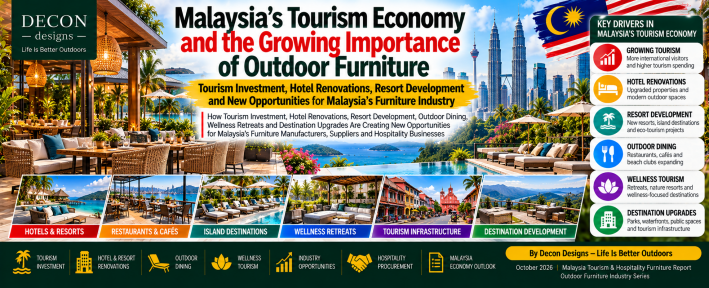
How Tourism Investment, Hotel Renovations, Resort Development, Outdoor Dining, Wellness Retreats and Destination Upgrades Are Creating New Opportunities for Malaysia’s Furniture Manufacturers, Suppliers and Hospitality Businesses
By Decon Designs – Life Is Better Outdoors | Malaysian Tourism Industry | Outdoor Furniture Industry | Hospitality Furniture | Hotel & Resort Development | Tourism Investment | Commercial Furniture | Outdoor Living | Hospitality Procurement | Malaysia Industry Intelligence
October 2026 | Malaysia Tourism & Hospitality Furniture Report | Outdoor Furniture Industry Series
Introduction: Malaysia’s Tourism Economy Is Creating Opportunities Beyond Hotels and Travel
Malaysia’s tourism industry is an important part of the national economy.
Its influence extends across accommodation, transportation, restaurants, retail, leisure facilities, construction, property development and many supporting industries.
One sector that deserves greater attention is outdoor furniture.
From the swimming pools of Langkawi resorts to the rooftop terraces of Kuala Lumpur hotels, from garden cafés in Selangor to waterfront hospitality properties in Sabah, outdoor furniture contributes to the environments in which visitors relax, dine and spend their time.
Tourism development creates opportunities for more than hotel operators.
It can generate demand for furniture manufacturers, importers, distributors, retailers, contractors, designers, transport companies, installers and maintenance providers.
A newly developed resort may require hundreds of furniture items.
An established hotel may need to replace ageing pool loungers.
A restaurant may invest in outdoor dining furniture.
A boutique villa may furnish a private garden or terrace.
A destination operator may create new seating and relaxation areas.
These activities form part of the wider hospitality supply economy.
However, tourism growth does not automatically translate into furniture orders.
Purchasing depends on actual development projects, renovation budgets, operational priorities and the financial circumstances of individual hospitality businesses.
The opportunity for Malaysia’s outdoor furniture industry is to understand where tourism investment creates genuine furnishing requirements—and to serve those requirements with suitable products, reliable procurement and long-term support.
At Decon Designs – Life Is Better Outdoors, with more than two decades serving Malaysia’s outdoor and hospitality furniture market, we believe the relationship between tourism and outdoor furniture deserves greater industry attention.
This report examines Malaysia’s tourism economy, its implications for outdoor furniture demand, regional opportunities, commercial procurement and the strategic priorities for 2027 and beyond.
1. Malaysia’s Tourism Economy: Understanding the Scale
Malaysia’s tourism industry generated approximately RM323 billion in gross value added in 2025, representing 15.9% of national GDP, according to the Department of Statistics Malaysia.
The sector recorded 8.6% growth in tourism-industry value added compared with 2024.
Inbound tourism expenditure reached RM124.8 billion.
Domestic tourism also remained significant.
According to DOSM’s Domestic Tourism Survey 2025, Malaysia recorded 290.1 million domestic visitors and RM121.3 billion in domestic visitor expenditure.
These indicators demonstrate the economic importance of tourism.
However, they should be interpreted correctly.
Tourism-industry value added is not equivalent to hotel investment.
Tourism expenditure is not equivalent to construction spending.
And neither figure directly measures outdoor furniture purchases.
Nevertheless, the scale of tourism-related activity provides an important reason for furniture businesses to monitor the hospitality sector.
2. Why Tourism Matters to the Outdoor Furniture Industry
The connection between tourism and outdoor furniture operates through several commercial channels.
New Hospitality Development
New hotels, resorts, villas and leisure facilities may require outdoor furnishings before opening.
Renovation and Refurbishment
Existing properties may replace furniture or redesign outdoor environments.
Food and Beverage Expansion
Restaurants, cafés and hotel dining outlets may invest in outdoor seating.
Destination Development
Tourism destinations may develop relaxation areas, terraces, recreational spaces and visitor facilities.
Replacement and Maintenance
Existing furniture may require repair, replacement cushions or eventual replacement.
These channels create different types of business opportunities.
A manufacturer may supply a complete collection.
An importer may provide specialized products.
A retailer may serve smaller accommodation operators.
A contractor may coordinate installation.
An upholstery company may replace cushions.
The economic opportunity extends across the entire furniture value chain.
3. Visit Malaysia 2026: A Strategic Context for Hospitality Investment
Visit Malaysia 2026 places national attention on tourism promotion and destination competitiveness.
For outdoor furniture businesses, the campaign is relevant because it encourages examination of the infrastructure and facilities supporting visitor experiences.
Hotels, restaurants, attractions and leisure operators may evaluate whether their properties are prepared to serve customers effectively.
Potential improvement areas include:
- Guest seating.
- Swimming-pool facilities.
- Outdoor dining.
- Garden environments.
- Rooftop lounges.
- Recreational spaces.
- Shade and relaxation areas.
However, suppliers should distinguish between tourism promotion and confirmed capital expenditure.
A national tourism campaign does not guarantee that an individual hotel will renovate or purchase furniture.
Practical Implications for Suppliers
Furniture companies should identify actual projects, understand procurement requirements and engage with potential buyers before committing substantial inventory or production capacity.
A targeted approach is more useful than relying on broad tourism optimism.
4. New Hotel and Resort Development: The First Major Opportunity
New hospitality properties can generate furniture requirements across multiple areas.
A resort may need:
- Outdoor dining tables and chairs.
- Pool loungers.
- Parasols.
- Outdoor sofas.
- Garden seating.
- Terrace furniture.
- Daybeds.
- Side tables.
- Cushions and accessories.
A city hotel may require different products.
Its outdoor requirements could include rooftop seating, poolside furniture or compact restaurant terraces.
The purchasing process often involves developers, architects, designers, contractors and procurement teams.
What Suppliers Need to Prepare
- Product specifications.
- Accurate dimensions.
- Material information.
- Quantity availability.
- Realistic delivery schedules.
- Installation requirements.
- Warranty terms.
- Appropriate maintenance guidance.
Commercial buyers may also request samples or technical documentation.
Suppliers should ensure they can meet the project’s requirements before accepting an order.
5. Hotel Renovations: An Opportunity Beyond New Construction
Not all hospitality furniture demand comes from newly built properties.
Existing hotels and resorts may undertake renovation projects to maintain facilities, improve functionality or update their appearance.
Outdoor furniture may be included in:
- Swimming-pool renovations.
- Restaurant refurbishments.
- Garden redesigns.
- Rooftop upgrades.
- Guest-room balcony improvements.
- Outdoor event-area renovations.
For furniture suppliers, renovation projects can be commercially attractive because they may involve replacing existing products with updated collections.
However, renovations can also be operationally complex.
Hotels may remain open during refurbishment.
Delivery and installation may need to occur within limited time windows.
Furniture suppliers must coordinate with property management and contractors.
The Renovation Opportunity
Businesses can develop specialized services for hospitality refurbishment, including product selection, replacement furniture, cushion renewal and phased delivery.
6. The Replacement Economy: Why Existing Hotels Matter
Outdoor furniture is exposed to use and environmental conditions.
Over time, products may require maintenance, repair or replacement.
This creates a recurring market.
A hotel may replace cushions while retaining suitable frames.
A resort may refurbish selected lounge furniture.
A restaurant may replace damaged chairs.
A property may decide to purchase a new collection as part of a broader renovation.
The timing of these decisions depends on product condition, operating requirements and budget.
There is no universal replacement cycle for every outdoor furniture category.
Opportunities for Malaysian Businesses
- Replacement cushions.
- Furniture refurbishment.
- Commercial upholstery.
- Suitable frame repairs.
- Replacement fittings.
- New furniture supply.
- Maintenance contracts.
The replacement economy may offer opportunities even when new hotel construction slows.
7. Langkawi: Resort Furniture, Poolside Loungers and Coastal Hospitality
Langkawi is an established Malaysian tourism destination with resort, hotel and leisure accommodation.
Outdoor furniture applications can include:
- Pool loungers.
- Parasols.
- Beachfront seating.
- Outdoor sofas.
- Garden dining furniture.
- Private villa furniture.
- Terrace seating.
Coastal conditions require careful product selection.
Salt-laden air, moisture, sunlight and frequent outdoor exposure can affect materials and finishes.
Suppliers should evaluate whether products are suitable for the intended location.
Business Opportunities
Langkawi hospitality operators may require new furniture, refurbishment, replacement cushions and maintenance support.
However, logistics and delivery arrangements should be considered carefully when supplying island properties.
8. Penang: Heritage Tourism, Urban Hospitality and Outdoor Dining
Penang combines urban hospitality, tourism, food culture and coastal environments.
Potential furniture applications include:
- Hotel terraces.
- Garden restaurants.
- Rooftop lounges.
- Boutique accommodation.
- Outdoor cafés.
- Poolside facilities.
Different hospitality properties have different requirements.
A heritage-style boutique hotel may seek furniture that complements its architectural character.
A modern hotel may prioritize contemporary designs.
A restaurant may require practical seating suited to frequent use.
Opportunity for Suppliers
Furniture companies can offer specialized products based on the property’s style, available space and operating requirements.
Accurate dimensions and material suitability remain essential.
9. Kuala Lumpur and Selangor: Urban Tourism and Commercial Outdoor Furniture
Kuala Lumpur and Selangor represent important urban hospitality markets.
Their potential outdoor furniture applications include:
- Hotel swimming pools.
- Rooftop bars.
- Outdoor restaurants.
- Business hotel terraces.
- Garden cafés.
- Event spaces.
- Serviced accommodation.
- Recreational facilities.
Urban hospitality often creates space-planning challenges.
Furniture must fit the available area while allowing practical circulation.
Relevant Product Categories
- Compact dining sets.
- Commercial chairs.
- Outdoor lounge furniture.
- Parasols.
- Pool loungers.
- Modular seating.
For suppliers operating in the Klang Valley, the ability to coordinate product consultation, delivery and installation may be commercially valuable.
10. Melaka: Heritage Hospitality and Outdoor Visitor Environments
Melaka’s tourism and hospitality economy includes hotels, guesthouses, restaurants and visitor-oriented businesses.
Outdoor furniture may be used in:
- Courtyards.
- Garden dining areas.
- Boutique hotels.
- Café terraces.
- Accommodation properties.
- Visitor relaxation areas.
Design compatibility can be important in heritage-oriented environments.
However, buyers must also consider comfort, cleaning and environmental exposure.
Furniture suppliers should avoid treating every hospitality property as requiring the same product range.
11. Johor: Tourism, Hospitality and Cross-Border Opportunities
Johor offers potential opportunities through hospitality, residential development, commercial facilities and tourism-related activity.
Outdoor furniture applications may include:
- Hotels.
- Resorts.
- Restaurants.
- Outdoor leisure facilities.
- Serviced accommodation.
- Residential hospitality developments.
Johor’s position within regional trading networks may also be relevant for furniture sourcing and distribution.
However, suppliers should evaluate actual project requirements, logistics and customer budgets.
12. Pahang: Nature Tourism, Resorts and Recreational Furniture
Pahang has a diverse tourism environment that includes highland destinations, nature-oriented accommodation and leisure properties.
Outdoor furniture may be required for:
- Resort gardens.
- Outdoor dining.
- Recreational areas.
- Terraces.
- Swimming pools.
- Guest relaxation spaces.
Environmental conditions differ between locations.
A highland property may face different requirements from a coastal resort.
Suppliers should therefore assess site-specific exposure and usage.
13. Sabah and Sarawak: Tourism Opportunities With Distinct Logistics Requirements
Sabah and Sarawak offer hospitality opportunities across urban centres, nature-based tourism and leisure accommodation.
Potential furniture applications include:
- Resort lounges.
- Poolside areas.
- Outdoor restaurants.
- Garden seating.
- Private accommodation.
- Recreational facilities.
However, suppliers serving East Malaysia must consider transportation, shipping costs, delivery times and after-sales support.
Large furniture products can be expensive to move over long distances.
Strategic Opportunity
Suppliers that provide accurate landed-cost quotations and dependable delivery planning may improve their competitiveness.
After-sales arrangements should also be clarified before purchase.
14. Island Tourism and the Importance of Outdoor Furniture Durability
Malaysia’s island destinations create particular furniture requirements.
Coastal environments may expose furniture to moisture, salt-laden air and strong sunlight.
Commercial furniture may also experience intensive guest use.
Buyers should examine:
- Frame construction.
- Material specifications.
- Protective finishes.
- Fasteners.
- Fabric suitability.
- Cushion drying characteristics.
- Maintenance requirements.
- Storage conditions.
A product that performs adequately on a covered residential balcony may not be suitable for a fully exposed resort poolside.
Supplier Responsibility
Furniture companies should explain environmental limitations accurately.
Unsupported claims such as “completely weatherproof” or “maintenance-free” can create unrealistic customer expectations.
15. Outdoor Restaurants and Cafés: Tourism Spending Beyond Accommodation
Tourism spending supports food and beverage activity.
Restaurants and cafés may invest in outdoor furniture to create different dining environments.
Potential products include:
- Dining tables.
- Commercial chairs.
- Benches.
- Parasols.
- Outdoor sofas.
- Compact café sets.
For restaurant operators, furniture decisions affect seating layout, cleaning, movement and customer comfort.
A restaurant should not select furniture solely on appearance.
What Commercial Buyers Should Consider
- Table dimensions.
- Seating capacity.
- Cleaning requirements.
- Product weight.
- Stackability where relevant.
- Environmental suitability.
- Storage.
- Maintenance.
Outdoor dining furniture represents a distinct opportunity for suppliers that understand food and beverage operations.
16. Beach Clubs and Waterfront Restaurants
Waterfront hospitality businesses may require furniture for dining, lounging and relaxation.
Relevant products include:
- Pool loungers.
- Daybeds.
- Outdoor sofas.
- Parasols.
- Dining furniture.
- Side tables.
Coastal exposure and operational conditions can create demanding requirements.
For shade products, stability and operating limitations are especially important.
Suppliers should assess site conditions rather than relying on generic product descriptions.
17. Wellness Tourism and Outdoor Relaxation Spaces
Wellness-related hospitality can create applications for outdoor furniture.
Potential environments include:
- Spa gardens.
- Wellness retreat terraces.
- Quiet relaxation areas.
- Nature-based accommodation.
- Meditation-adjacent seating.
- Outdoor lounges.
Furniture in these spaces may prioritize comfort, suitable materials and calm visual design.
However, products should be selected according to actual use and maintenance requirements.
Wellness tourism does not automatically translate into a large furniture order.
The opportunity depends on the scale and design of each property.
18. Homestays, Villas and Short-Term Rental Accommodation
Malaysia’s accommodation market includes homestays, holiday villas and short-term rental properties.
Some of these properties feature:
- Private gardens.
- Balconies.
- Swimming pools.
- Terraces.
- Outdoor dining areas.
- Rooftop spaces.
Outdoor furniture can improve the functionality of these environments.
However, owners should consider guest turnover, cleaning, maintenance and product replacement.
Opportunities for Retailers
Smaller accommodation operators may prefer ready-to-deliver furniture rather than large custom manufacturing orders.
Retailers can support these customers through product guidance, suitable collections and clear delivery arrangements.
19. Destination Development: Beyond Hotels and Resorts
Tourism destinations may invest in public and commercial facilities.
Potential projects include:
- Visitor centres.
- Recreational areas.
- Landscaped public spaces.
- Outdoor food courts.
- Waterfront developments.
- Tourism-related commercial facilities.
Some of these projects may require outdoor seating, benches, tables or shade products.
However, not every public-space project uses conventional residential outdoor furniture.
Products may need to meet specific technical, safety, accessibility or procurement requirements.
Suppliers should review project specifications carefully.
20. How Tourism Investment Reaches Furniture Manufacturers
Tourism investment can influence furniture manufacturing through several stages.
A developer approves a hospitality project.
Architects and designers define the outdoor spaces.
Procurement teams establish product requirements.
Suppliers prepare quotations.
Manufacturers produce or source furniture.
Logistics companies arrange delivery.
Installation teams prepare the site.
Maintenance providers support the furniture after handover.
This sequence demonstrates how hospitality investment can support multiple businesses.
However, the value of each contract depends on the specific project.
Manufacturers should not assume that every tourism development will purchase locally manufactured outdoor furniture.
Sourcing decisions may involve imported products, domestic suppliers or a combination of both.
21. The Opportunity for Malaysian Furniture Manufacturers
Malaysia has established furniture manufacturing capabilities.
Hospitality demand creates opportunities for businesses that can produce suitable commercial furniture.
Potential product categories include:
- Aluminium outdoor furniture.
- Synthetic wicker furniture.
- Timber outdoor furniture.
- Outdoor dining collections.
- Commercial loungers.
- Cushions.
- Customized furniture.
- Specialized components.
Manufacturers may benefit from developing collections for clearly defined hospitality applications.
However, commercial production requires attention to quantity consistency, quality control and delivery schedules.
Customization should be supported by accurate specifications and costing.
22. The Opportunity for Importers and Distributors
Not every outdoor furniture product purchased in Malaysia is manufactured domestically.
Importers and distributors may provide access to international product ranges.
Their services can include:
- Overseas sourcing.
- Supplier verification.
- Freight coordination.
- Customs clearance.
- Inventory holding.
- Domestic delivery.
- Warranty administration.
The opportunity is to make suitable products available to Malaysian customers.
However, importers must account for landed costs, currency exposure, shipping delays and quality risks.
A low factory quotation does not necessarily result in a competitive final selling price.
23. Why Furniture Showrooms Remain Important
Hospitality procurement increasingly involves digital research.
However, physical showrooms can remain useful.
Buyers may wish to inspect:
- Materials.
- Comfort.
- Dimensions.
- Finishes.
- Cushion construction.
- Product appearance.
A hotel procurement manager may need to verify whether a chair is suitable for the intended application.
A restaurant operator may want to evaluate seating comfort.
A villa owner may compare furniture sizes.
Showrooms provide opportunities for practical consultation.
The strongest customer experience may combine accurate online information with physical product evaluation where feasible.
24. The Importance of Contractors and Installation Teams
Large hospitality projects often involve contractors and installation providers.
Furniture may need to be delivered according to construction or renovation schedules.
Installation teams may coordinate:
- Site access.
- Unpacking.
- Assembly.
- Positioning.
- Inspection.
- Packaging removal.
- Handover.
Poor coordination can delay project completion.
For suppliers, project-management capability can be an important commercial differentiator.
However, installation and delivery responsibilities should be clearly defined in contracts.
25. Outdoor Furniture Procurement: A Practical Hospitality Checklist
Hospitality buyers should establish clear requirements before requesting quotations.
| Procurement area | Key question |
|---|---|
| Application | Where will the furniture be used? |
| Usage | How frequently will guests use it? |
| Climate | What environmental exposure is expected? |
| Materials | Are specifications appropriate? |
| Dimensions | Does the furniture fit the available space? |
| Quantity | How many units are required? |
| Delivery | What is the project deadline? |
| Installation | Who is responsible? |
| Maintenance | What care will be required? |
| Warranty | What is covered and excluded? |
| Replacement | Are suitable parts available? |
| Budget | What is the total ownership cost? |
This approach can reduce purchasing mistakes and improve supplier communication.
26. The Hidden Cost of Poor Hospitality Furniture Decisions
A hotel may purchase furniture based on initial price alone.
However, other costs can arise after delivery.
These may include:
- Repairs.
- Cushion replacement.
- Additional cleaning.
- Transport damage.
- Installation problems.
- Premature replacement.
- Operational disruption.
A more expensive product is not automatically better.
Likewise, a cheaper product is not necessarily more economical.
Buyers should evaluate products using realistic assumptions about usage, maintenance and service life.
27. An Illustrative Resort Furniture Procurement Budget
Consider a hypothetical resort upgrading its poolside and outdoor dining areas.
| Furniture category | Illustrative quantity | Illustrative unit budget | Total |
|---|---|---|---|
| Pool loungers | 40 | RM650 | RM26,000 |
| Commercial parasols | 12 | RM1,200 | RM14,400 |
| Outdoor dining sets | 15 | RM1,800 | RM27,000 |
| Outdoor lounge sets | 8 | RM3,500 | RM28,000 |
| Side tables | 20 | RM180 | RM3,600 |
| Illustrative furniture subtotal | RM99,000 |
This hypothetical budget excludes delivery, installation, applicable taxes, site preparation, maintenance and contingency.
It does not represent an actual quotation or industry-average pricing.
The example illustrates how one hospitality refurbishment can involve several product categories and multiple suppliers.
Actual budgets depend on product specifications, quality, quantities and commercial arrangements.
28. Furniture Maintenance and Refurbishment: The Recurring Opportunity
Tourism-related furniture demand continues after initial installation.
Hotels and resorts may require:
- Cushion replacement.
- Upholstery renewal.
- Cleaning.
- Suitable frame repairs.
- Replacement fittings.
- Product refurbishment.
- New furniture.
These activities create opportunities for specialized service businesses.
For hospitality operators, planned maintenance can support the appearance and functionality of guest facilities.
For suppliers, after-sales support can strengthen customer relationships.
However, repairs should be undertaken only when technically appropriate and safe.
29. The Role of Sustainability in Hospitality Furniture Procurement
Hospitality operators may increasingly consider environmental factors when purchasing furniture.
Relevant considerations include:
- Product durability.
- Responsible material sourcing.
- Repairability.
- Replacement components.
- Packaging.
- Maintenance.
- End-of-life management.
Suppliers should provide credible information rather than unsupported sustainability claims.
A product should not be described as environmentally superior solely because it uses a natural or recycled material.
Commercial buyers should evaluate the relevant lifecycle characteristics.
30. Challenges Facing Malaysia’s Tourism-Linked Furniture Market
Opportunities exist, but the market also faces risks.
Project Delays
Hotel and resort developments may be postponed.
Budget Constraints
Hospitality operators may prioritize essential expenses over refurbishment.
Price Competition
Suppliers may compete aggressively for commercial orders.
Import Costs
Exchange rates, freight and other charges can affect pricing.
Quality Issues
Unsuitable products may create complaints and replacement costs.
Inventory Pressure
Bulky furniture can require substantial storage and working capital.
Payment Terms
Large projects may involve payment schedules that create cash-flow pressure.
Logistics
Island and East Malaysia deliveries can involve additional complexity.
Businesses should manage these risks before committing to large orders.
31. Malaysia’s Tourism and Outdoor Furniture Outlook for 2027
The outlook for 2027 should be assessed through several possible scenarios.
Growth Scenario
Tourism activity and hospitality investment remain supportive.
More properties undertake renovations or develop outdoor facilities.
Furniture suppliers benefit where confirmed projects translate into orders.
Base Scenario
Hospitality demand continues but remains selective.
Buyers prioritize necessary replacements and carefully evaluated improvements.
Suppliers compete through price, product suitability and service.
Downside Scenario
Economic uncertainty or higher operating costs lead properties to postpone investment.
Furniture suppliers experience slower project activity and greater price pressure.
These are illustrative scenarios, not quantified forecasts.
The most appropriate strategy is to prepare for more than one possible outcome.
32. Ten Actions Malaysian Outdoor Furniture Businesses Should Take
1. Identify hospitality customer segments.
Separate hotels, resorts, restaurants, villas and property developers.
2. Develop commercial product information.
Provide accurate dimensions, materials and usage guidance.
3. Build relationships with procurement teams.
Understand purchasing processes and project schedules.
4. Monitor renovation opportunities.
Existing properties may require replacement furniture.
5. Improve delivery planning.
Consider logistics costs and site access.
6. Strengthen supplier verification.
Ensure products match agreed specifications.
7. Manage inventory carefully.
Avoid excessive investment in slow-moving stock.
8. Offer appropriate after-sales support.
Clarify maintenance and replacement arrangements.
9. Improve digital visibility.
Make it easier for hospitality buyers to find and evaluate products.
10. Protect profitability and cash flow.
Assess margins, payment terms and working-capital requirements before accepting major projects.
These priorities can help businesses pursue opportunities without depending entirely on optimistic tourism forecasts.
33. Decon Designs: Supporting Malaysia’s Outdoor Hospitality Environments
At Decon Designs – Life Is Better Outdoors, we believe Malaysia’s tourism economy creates an important reason to invest in better outdoor environments.
With more than two decades serving Malaysia’s outdoor and hospitality furniture market, our perspective is shaped by the practical needs of customers furnishing different types of properties.
A resort may require pool loungers and parasols.
A hotel may need outdoor sofas for a terrace.
A restaurant may require dining tables and chairs.
A holiday villa may need a comfortable outdoor lounge.
A property developer may require furniture for shared recreational facilities.
Each customer has different requirements.
Product dimensions matter.
Material selection matters.
Environmental exposure matters.
Maintenance matters.
Delivery and installation matter.
And the total cost of ownership matters.
We believe outdoor furniture suppliers should help customers understand these considerations before making purchasing decisions.
Malaysia’s hospitality sector can create opportunities for furniture manufacturers, distributors, retailers and service providers.
However, the industry’s long-term development requires reliable products, realistic commercial commitments and informed procurement.
Tourism may bring visitors to a destination, but the quality of the environment they experience depends on many details—including the furniture they use.
Conclusion: Tourism Growth Creates a Wider Furniture Economy
Malaysia’s tourism industry is more than an economic activity involving travel and accommodation.
It supports a wider network of businesses.
Hotels.
Resorts.
Restaurants.
Leisure properties.
Property developers.
Designers.
Contractors.
Manufacturers.
Retailers.
Logistics providers.
Maintenance companies.
Outdoor furniture connects with many of these activities.
New hospitality developments may create initial furniture demand.
Renovations may generate replacement orders.
Restaurants may invest in outdoor dining environments.
Wellness properties may develop relaxation areas.
Homestays and villas may furnish private outdoor spaces.
Existing properties may require maintenance and refurbishment.
These activities create commercial opportunities, but they also require careful planning.
Tourism growth alone does not guarantee profitable furniture sales.
Suppliers must identify real demand.
Manufacturers must maintain suitable quality.
Retailers must manage inventory.
Commercial buyers must evaluate long-term costs.
And service providers must support furniture throughout its useful life.
Malaysia’s tourism economy can help create the conditions for outdoor furniture demand—but the businesses that benefit will be those capable of converting hospitality requirements into suitable products and dependable service.
At Decon Designs, we believe better tourism experiences and better outdoor living begin with informed furniture decisions.
Decon Designs – Life Is Better Outdoors.
Frequently Asked Questions
1. How does tourism affect outdoor furniture demand in Malaysia?
Tourism can support investment in hotels, resorts, restaurants and leisure facilities, some of which require outdoor furniture for new developments, renovations and replacements.
2. What outdoor furniture do Malaysian resorts commonly need?
Products may include pool loungers, parasols, outdoor sofas, dining sets, daybeds, side tables and garden seating.
3. Why are hotel renovations important for furniture suppliers?
Existing hotels may replace worn furniture, upgrade poolside facilities or redesign outdoor areas without constructing new buildings.
4. Which Malaysian destinations offer hospitality furniture opportunities?
Potential markets include Kuala Lumpur, Selangor, Langkawi, Penang, Melaka, Johor, Pahang, Sabah and Sarawak. Actual opportunities depend on specific projects and purchasing requirements.
5. What materials should hotels consider for outdoor furniture?
Common options include aluminium, suitable timber, synthetic wicker, outdoor rope and specialized outdoor fabrics. Suitability depends on product specifications and exposure.
6. Why is commercial furniture procurement different from residential purchasing?
Hospitality projects may involve larger quantities, technical specifications, installation schedules and more demanding operating conditions.
7. Are imported outdoor furniture products suitable for Malaysian resorts?
They may be, provided the materials, construction and specifications are appropriate for the intended environment.
8. Can small Malaysian furniture businesses benefit from tourism?
Yes. Opportunities may exist in specialized retailing, commercial shade products, replacement cushions, installation and refurbishment, subject to actual demand.
9. What is the biggest procurement mistake hospitality operators should avoid?
Selecting furniture based only on initial price without considering suitability, maintenance, delivery and total ownership costs.
10. What should suppliers prepare for in 2027?
Suppliers should focus on verified hospitality demand, accurate product specifications, delivery reliability, after-sales support and financial discipline.
Research Sources and Industry References
1. Department of Statistics Malaysia (DOSM)
Tourism Satellite Account 2025 — released September 2026.
https://www.dosm.gov.my/portal-main/release-content/tourism-satellite-account-2025
2. Department of Statistics Malaysia (DOSM)
Domestic Tourism Survey 2025.
https://www.dosm.gov.my/site/downloadrelease?id=domestic-tourism-survey-2025&lang=English
3. Department of Statistics Malaysia (DOSM)
Domestic Tourism Survey: States 2025.
https://www.dosm.gov.my/portal-main/release-content/domestic-tourism-survey-states-2025
4. Tourism Malaysia
Official tourism information and industry resources.
https://www.tourism.gov.my/
5. Malaysian Investment Development Authority (MIDA)
Manufacturing and investment information.
https://www.mida.gov.my/
Editorial note: Tourism statistics measure tourism-related economic activity, not outdoor furniture procurement. Furniture demand must be assessed through actual projects, buyer requirements and supplier transactions.


