
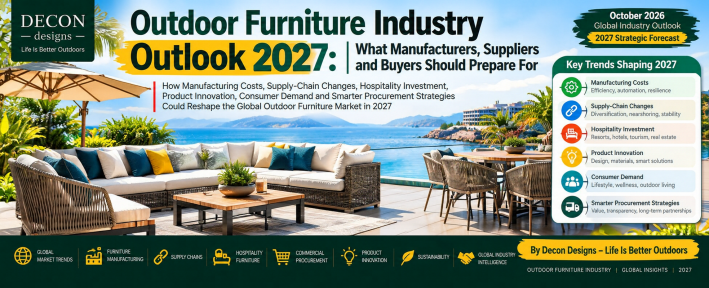
How Manufacturing Costs, Supply-Chain Changes, Hospitality Investment, Product Innovation, Consumer Demand and Smarter Procurement Strategies Could Reshape the Global Outdoor Furniture Market in 2027
By Decon Designs – Life Is Better Outdoors | Outdoor Furniture Industry | Global Market Outlook 2027 | Furniture Manufacturing | Supply Chains | Hospitality Furniture | Commercial Procurement | Product Innovation | Sustainability | Global Industry Intelligence
October 2026 | Global Industry Outlook | 2027 Strategic Forecast
The global outdoor furniture industry is approaching 2027 at a time when growth opportunities and business uncertainties are developing simultaneously.
Demand for outdoor living environments continues to create opportunities across residential, hospitality, commercial and property-development markets.
Manufacturers are exploring new materials, production technologies and product configurations.
Hotels and resorts are evaluating furniture investments that support guest comfort, design and long-term operating efficiency.
Retailers are adapting to digitally informed consumers who increasingly compare prices, specifications, photographs and customer experiences before purchasing.
Meanwhile, suppliers must navigate raw-material costs, freight uncertainty, currency fluctuations, inventory pressures and changing buyer expectations.
These developments raise a critical question:
What should outdoor furniture manufacturers, suppliers, retailers, hospitality operators and buyers prepare for in 2027?
The answer is not simply to manufacture more furniture or introduce new designs.
Businesses must understand how costs, customer expectations, distribution channels and product requirements are evolving.
At Decon Designs – Life Is Better Outdoors, with more than two decades serving Malaysia’s outdoor and hospitality furniture market, we believe the companies best positioned for 2027 will be those that combine product suitability, operational efficiency, transparent information and dependable customer service.
This industry outlook examines the forces likely to influence the global outdoor furniture sector in 2027 and identifies practical strategies for businesses preparing for the next stage of competition.
Editorial note: This report is a forward-looking analysis prepared in October 2026. It discusses plausible developments, risks and opportunities rather than guaranteed outcomes. Market conditions, regulations and business costs may change during 2027.
1. The Outdoor Furniture Industry Entering 2027
Outdoor furniture is no longer limited to garden chairs and patio tables.
The modern industry serves an extensive range of residential and commercial applications.
These include:
- Home gardens and patios.
- Condominium balconies.
- Rooftop terraces.
- Hotel and resort swimming pools.
- Outdoor restaurants and cafés.
- Beach clubs.
- Commercial courtyards.
- Holiday homes.
- Property-development amenities.
- Corporate and institutional outdoor environments.
This diversity creates several sources of demand.
A homeowner may purchase a compact balcony dining set.
A restaurant may replace chairs used for frequent customer seating.
A resort may procure loungers and parasols for a poolside renovation.
A property developer may require furniture for a new communal terrace.
Each customer has different expectations.
Manufacturers and suppliers that treat every outdoor furniture purchase as the same type of transaction risk overlooking important opportunities.
The industry entering 2027 is increasingly a market of specialized applications rather than one uniform product category.
2. Global Market Outlook: Growth Potential With Uneven Demand
Published research forecasts continued long-term expansion in the outdoor furniture market, although estimates vary by provider and market definition.
These projections reflect expectations surrounding outdoor living, hospitality, residential development and product innovation.
However, long-term market growth does not guarantee that every manufacturer, retailer or country will experience higher sales in 2027.
Demand may be affected by:
- Household purchasing power.
- Interest rates and financing conditions.
- Housing activity.
- Tourism and hospitality investment.
- Commercial renovation budgets.
- Exchange rates.
- Import duties and trade measures.
- Freight costs.
- Consumer confidence.
A market can grow overall while individual businesses experience weaker demand.
Similarly, a company may increase sales through improved market positioning even when its local market is relatively slow.
For this reason, manufacturers and suppliers should focus on actual customer demand rather than relying exclusively on broad industry forecasts.
Three Possible Market Conditions in 2027
| Scenario | Possible conditions | Business implications |
|---|---|---|
| Growth scenario | Stronger consumer spending, hospitality investment and property development | Higher demand, possible capacity expansion and new product opportunities |
| Base scenario | Selective demand growth with continued cost pressure | Greater importance of inventory control, differentiation and procurement discipline |
| Downside scenario | Weaker spending, delayed projects or supply-chain disruption | Increased price competition, slower orders and pressure on cash flow |
These are planning scenarios, not probability-weighted forecasts.
Businesses should prepare strategies that remain workable under more than one outcome.
3. Manufacturing Costs: One of the Most Important Issues for 2027
Outdoor furniture manufacturing depends on multiple cost components.
These include raw materials, labour, machinery, electricity, packaging, transportation, quality control and overhead expenses.
For international suppliers, exchange rates and shipping costs can significantly influence final selling prices.
Manufacturers should pay particular attention to five areas.
Raw Materials
Aluminium, steel, timber, polymers, foam and outdoor fabrics are important inputs.
Price changes can affect production margins.
Labour
Production efficiency, workforce availability and training influence manufacturing costs and consistency.
Energy
Electricity and fuel costs may affect fabrication, finishing and transportation.
Packaging
Protective packaging is necessary to reduce damage during storage and delivery.
Logistics
Freight charges, warehousing and distribution can materially influence landed costs.
The central challenge is balancing cost competitiveness with product quality.
Cutting material specifications without appropriate evaluation may reduce initial costs but increase defects, returns and reputational damage.
Manufacturers should focus on reducing unnecessary costs—not compromising essential product performance.
4. The Risk of Competing Only on Price
Price competition is unavoidable in the outdoor furniture industry.
However, competing exclusively on the lowest price can create long-term business risks.
A manufacturer may reduce costs by changing materials, simplifying construction or limiting inspection.
A retailer may lower prices without accounting adequately for delivery and after-sales expenses.
A supplier may accept a large commercial order with insufficient margin to manage unforeseen costs.
These decisions can create problems later.
For 2027, businesses should evaluate profitability at the product and customer-segment level.
A useful commercial approach is to calculate:
Selling Price – Total Relevant Costs = Contribution Before Remaining Overheads
Total relevant costs may include production or acquisition, freight, duties, delivery, installation, expected warranty servicing and transaction costs.
This analysis can help suppliers understand whether a product or project is commercially sustainable.
The objective should be competitive value, not merely the lowest advertised price.
5. Supply-Chain Resilience Will Remain a Strategic Priority
Outdoor furniture supply chains are international.
A product may contain components sourced from several countries.
Frames, fabrics, cushions, fittings and packaging may come from different suppliers.
Finished furniture may then be exported to regional distributors or international retailers.
This structure creates opportunities for specialization and cost efficiency.
It also creates exposure to disruption.
Potential risks include:
- Delayed raw-material deliveries.
- Shipping interruptions.
- Supplier production problems.
- Currency fluctuations.
- Port congestion.
- Customs delays.
- Inconsistent component quality.
- Changes in trade requirements.
For 2027, manufacturers should evaluate the resilience of critical supply relationships.
Practical Preparation
Businesses can:
- Identify components with limited supplier alternatives.
- Assess lead times and reorder points.
- Maintain appropriate inventory buffers for critical materials.
- Develop alternative suppliers where commercially viable.
- Improve production and shipment visibility.
- Document specifications to support consistent sourcing.
- Clarify responsibilities for delays and quality issues.
Supply-chain resilience does not mean holding excessive stock.
It means understanding where disruptions could occur and preparing proportionate responses.
6. Product Innovation: What Buyers May Expect in 2027
Outdoor furniture innovation is likely to focus on practical improvements as well as appearance.
Buyers increasingly need products that fit specific environments, spaces and usage patterns.
Potential areas of innovation include:
Modular Furniture
Sofas and seating systems that can be rearranged for different layouts.
Compact Designs
Space-efficient furniture for urban balconies and smaller terraces.
Multifunctional Products
Furniture that combines seating, storage or adaptable configurations.
Replaceable Components
Products designed to allow replacement of cushions, fittings or other serviceable parts.
Improved Materials
Developments in coatings, fabrics, structural components and weather-suitable materials.
Commercial Product Systems
Coordinated collections for hotels, restaurants and resorts.
Digital Product Visualization
Tools that help buyers compare colours, dimensions and configurations.
Innovation should solve real customer problems.
A visually unusual product is not necessarily commercially successful.
Manufacturers should test whether new designs improve comfort, suitability, maintenance, logistics or customer value.
7. Outdoor Furniture Materials: The 2027 Competitive Landscape
Material selection will continue to influence product positioning.
| Material | Commercial strengths | Considerations for 2027 |
|---|---|---|
| Aluminium | Lightweight applications and design flexibility | Coating quality, frame construction and cost |
| Synthetic wicker | Established outdoor furniture aesthetic | Material quality, UV exposure and weaving consistency |
| Suitable hardwoods | Natural appearance and premium positioning | Sourcing, maintenance and environmental suitability |
| Outdoor rope | Contemporary design possibilities | Tension, material specification and wear |
| Steel | Structural versatility | Corrosion protection, weight and maintenance |
| Recycled polymers | Potential circular-material applications | Verified composition, durability and environmental claims |
| Outdoor upholstery | Comfort and design differentiation | Cleaning, drying, UV exposure and replacement availability |
No material should be presented as universally superior.
The correct choice depends on the product’s intended environment and performance requirements.
For Malaysia, suppliers should pay particular attention to humidity, rainfall, sunlight and maintenance expectations.
For coastal hospitality projects, environmental exposure may require additional consideration.
Manufacturers should provide clear specifications rather than relying on broad descriptions such as “premium quality” or “weatherproof.”
8. Climate-Ready Furniture: A Growing Product Development Opportunity
Environmental suitability is likely to remain an important purchasing consideration.
Outdoor furniture may face:
- Direct sunlight.
- Rain.
- High humidity.
- Temperature changes.
- Coastal exposure.
- Frequent cleaning.
- Intensive commercial use.
A product designed for a covered residential patio may not be suitable for a fully exposed hotel poolside.
For 2027, suppliers should consider offering clearer guidance about recommended applications.
This may include:
- Covered outdoor use.
- Partially exposed outdoor use.
- Fully exposed locations where appropriate.
- Commercial-use requirements.
- Maintenance instructions.
- Storage recommendations.
- Product limitations.
Clear communication can reduce misunderstandings and improve customer satisfaction.
9. Hospitality Furniture Demand: Opportunities for Hotels and Resorts
Hospitality will remain an important segment to monitor in 2027.
Hotels and resorts may invest in outdoor furniture when opening new properties, renovating facilities or replacing existing products.
Common product categories include:
- Pool loungers.
- Parasols and umbrellas.
- Outdoor sofas.
- Dining sets.
- Lounge chairs.
- Daybeds.
- Garden seating.
- Outdoor accessories.
Hospitality buyers often have requirements beyond product appearance.
These may include:
- Quantity consistency.
- Delivery scheduling.
- Installation coordination.
- Maintenance.
- Replacement components.
- Warranty support.
- Product suitability.
- Total ownership cost.
Manufacturers and suppliers with relevant project capabilities may find opportunities in this segment.
However, tourism activity alone does not guarantee furniture orders.
Businesses should monitor actual hotel projects, renovation plans and procurement budgets.
10. Restaurants and Cafés: Outdoor Dining as a Commercial Opportunity
Restaurants and cafés use outdoor furniture to create dining and social environments.
For some operators, outdoor seating can support additional customer capacity.
For others, it contributes to atmosphere and brand positioning.
In 2027, commercial buyers may prioritize furniture that balances:
- Comfort.
- Ease of cleaning.
- Space efficiency.
- Durability.
- Storage.
- Design consistency.
- Maintenance requirements.
Stackable chairs and compact tables may suit some businesses.
Premium outdoor sofas and lounge arrangements may suit others.
Suppliers should understand the operational requirements of each customer.
A product that looks attractive in a catalogue may not be suitable for a high-frequency-use restaurant.
11. Residential Demand: What Homeowners May Prioritize
Residential outdoor furniture buyers are likely to remain diverse.
Some may focus on affordability.
Others may prioritize design, comfort or material quality.
Urban buyers may need compact furniture.
Homeowners with larger gardens may explore complete outdoor dining and lounge arrangements.
Potential purchasing priorities include:
- Comfortable seating.
- Practical dimensions.
- Easy maintenance.
- Suitable materials.
- Attractive finishes.
- Clear warranty information.
- Delivery convenience.
- Long-term value.
For retailers, understanding these needs can improve product selection and customer service.
Businesses should avoid assuming that every customer wants the same furniture style or price range.
12. Small-Space Outdoor Furniture: An Opportunity in Urban Markets
Urbanization and apartment living create opportunities for compact outdoor furniture.
Condominium balconies and smaller terraces may require careful space planning.
Suitable product categories can include:
- Two-seater dining sets.
- Compact lounge chairs.
- Folding tables.
- Stackable seating.
- Modular arrangements.
- Lightweight furniture.
- Space-efficient accessories.
However, suppliers should verify dimensions and intended use.
A balcony may have access restrictions, management rules or structural loading considerations.
Customers should not select furniture solely based on photographs.
Accurate measurements and appropriate installation guidance remain essential.
13. The Outdoor Shade Market: Parasols and Umbrellas
Shade products form an important part of outdoor living and hospitality environments.
Commercial parasols, centre-pole umbrellas and cantilever designs serve different applications.
For 2027, buyers may increasingly consider shade products as part of overall outdoor-space planning.
Important factors include:
- Canopy dimensions.
- Frame construction.
- Base requirements.
- Stability.
- Operating limitations.
- Maintenance.
- Placement.
- Compatibility with the intended environment.
A parasol should not be selected based only on its appearance.
Suppliers should provide clear information about installation and safe use.
Commercial buyers should also consider site-specific conditions and applicable safety requirements.
14. Sustainability: From Marketing Claims to Product Evidence
Sustainability will continue to influence industry discussions.
However, buyers are increasingly likely to benefit from specific information rather than broad environmental claims.
Manufacturers may need to explain:
- Material sourcing.
- Recycled content.
- Product durability.
- Repairability.
- Replacement availability.
- Packaging.
- End-of-life considerations.
A product described as environmentally friendly should have an appropriate basis for that claim.
Similarly, recycled materials should not automatically be assumed to deliver superior environmental performance in every application.
For 2027, manufacturers can strengthen credibility by improving product documentation and supporting claims with relevant evidence.
15. The Circular Outdoor Furniture Economy
Circularity focuses on extending product usefulness and reducing avoidable waste.
For outdoor furniture, this may include:
- Cushion replacement.
- Upholstery renewal.
- Frame repairs.
- Surface refinishing.
- Replacement fittings.
- Product refurbishment.
- Material recovery where practical.
Commercial hospitality buyers may benefit from products that can be maintained rather than replaced entirely.
Manufacturers can consider designing products with serviceable components.
Retailers and suppliers may also explore after-sales services that support longer product use.
Circular business opportunities should be evaluated according to actual technical feasibility and economics.
Not every product can be repaired safely or cost-effectively.
16. Digital Transformation: How Outdoor Furniture Buying Is Changing
Digital discovery is an important part of modern furniture purchasing.
Customers may research products through:
- Search engines.
- Furniture websites.
- Online marketplaces.
- Social media.
- Review platforms.
- Digital catalogues.
- AI-assisted search tools.
This creates opportunities for manufacturers and suppliers to reach new buyers.
However, digital visibility requires accurate information.
A furniture company should make it easy for customers to understand:
What products are available?
What materials are used?
What dimensions apply?
What colours or configurations are offered?
What is the intended application?
How can customers request a quotation?
What after-sales support is available?
Businesses that provide clear information may improve the quality of enquiries they receive.
17. AI and Product Visualization: Opportunities and Limitations
AI-assisted tools may influence furniture design, marketing and customer service.
Potential applications include:
Product Discovery
Helping buyers identify furniture categories that match their requirements.
Visual Planning
Illustrating possible furniture arrangements.
Customer Enquiries
Supporting responses to common product questions.
Product Information Management
Organizing specifications and catalogues.
Demand Analysis
Helping businesses examine sales patterns and customer interests.
However, AI-generated images should not be confused with verified product photographs.
A realistic visualization does not establish actual product quality, dimensions or performance.
Manufacturers and retailers should maintain clear distinctions between conceptual imagery and real products.
Technology should support informed purchasing—not create misleading expectations.
18. Why Online Reputation Will Matter in 2027
Customers increasingly use reviews to evaluate unfamiliar furniture businesses.
A supplier may have attractive products but struggle to build confidence if reliable information is difficult to find.
Online reputation may be influenced by:
- Customer reviews.
- Product information.
- Business identity.
- Delivery experiences.
- After-sales support.
- Public responses to complaints.
- Project references.
Platforms such as Google Reviews and furniture-focused review environments, including FurniReviewology, can provide additional information for buyers.
However, ratings should not replace supplier verification.
A five-star average does not guarantee that a manufacturer can handle a large hospitality order.
Commercial buyers should still examine relevant capabilities, specifications and references.
19. The Importance of Supplier Verification
For 2027, procurement professionals should strengthen supplier evaluation.
This is particularly important for larger commercial orders.
A supplier assessment may include:
Business identity: Confirm the supplier’s legal and operating information.
Product capability: Verify the relevant product range and specifications.
Manufacturing or sourcing: Understand how products are supplied.
Quality control: Ask about inspection procedures.
Delivery: Confirm lead times and logistics arrangements.
Warranty: Review coverage and exclusions.
After-sales support: Understand the process for defects, repairs and replacement components.
Commercial experience: Request relevant references where appropriate.
A supplier’s website and online reviews can support initial research.
They should not be the only basis for a major procurement decision.
20. Procurement Strategies for Hotels, Resorts and Property Developers
Commercial outdoor furniture procurement requires coordination.
A poorly planned purchase can create delivery delays, inconsistent specifications and unexpected costs.
For 2027, buyers should consider the following approach.
Stage One: Define Requirements
Identify quantities, dimensions, materials, colours, applications and budget.
Stage Two: Evaluate the Environment
Consider sunlight, rain, humidity, coastal exposure and frequency of use.
Stage Three: Shortlist Suppliers
Review relevant capabilities and commercial experience.
Stage Four: Request Specifications and Samples
Confirm product details before committing to large quantities.
Stage Five: Evaluate Total Cost
Include delivery, installation, maintenance and expected replacement requirements.
Stage Six: Agree on Commercial Terms
Clarify payment, delivery, inspection, warranty and responsibilities.
Stage Seven: Monitor Fulfilment
Coordinate production, delivery and installation.
Stage Eight: Plan Maintenance
Provide appropriate care instructions and establish maintenance responsibilities.
This structured approach can help reduce procurement risk.
21. Total Cost of Ownership: A Critical Buying Principle
The lowest purchase price does not necessarily produce the lowest long-term cost.
Commercial buyers should consider the full ownership period.
A practical cost framework is:
Total Cost of Ownership = Purchase Cost + Delivery + Installation + Maintenance + Repairs + Replacement Costs
Other relevant costs may include storage, operational disruption and disposal.
For example, a hotel purchasing loungers should evaluate more than the unit price.
It should consider whether replacement cushions are available, how the products should be maintained and whether the furniture suits the intended poolside environment.
Higher-priced furniture is not automatically more durable.
The correct decision requires relevant specifications and realistic cost assumptions.
22. Inventory Management: Avoiding the Risks of Too Much or Too Little Stock
Inventory can create substantial financial pressure.
Too much stock ties up working capital and storage space.
Too little stock may lead to missed sales or delivery delays.
Outdoor furniture retailers should evaluate:
- Historical sales patterns.
- Product seasonality.
- Lead times.
- Supplier reliability.
- Storage requirements.
- Product popularity.
- Slow-moving inventory.
- Customer demand by category.
Commercial project orders may require different inventory planning from residential retail sales.
For 2027, businesses should seek a balance between availability and financial efficiency.
23. Export Opportunities and International Competition
Outdoor furniture manufacturers may explore export markets to diversify revenue.
However, international expansion requires careful evaluation.
Potential considerations include:
- Market demand.
- Product standards.
- Import duties.
- Shipping costs.
- Exchange rates.
- Distribution partners.
- Product positioning.
- After-sales responsibilities.
- Documentation requirements.
A manufacturer should not assume that a product successful in one market will automatically perform well in another.
Climate, consumer preferences, purchasing power and regulations may differ.
Export development should be based on market research and operational readiness.
24. Malaysia’s Outdoor Furniture Industry: Preparing for 2027
Malaysia has relevant capabilities in furniture manufacturing, sourcing, retailing and hospitality supply.
The domestic market includes residential buyers, restaurants, resorts, property developers and commercial operators.
The country’s tropical climate creates particular product considerations.
Furniture may be exposed to high humidity, heavy rainfall and strong sunlight.
For Malaysian suppliers, 2027 preparation should focus on several priorities.
Product Suitability
Provide furniture appropriate for the intended environment.
Customer Education
Explain materials, maintenance and product limitations.
Commercial Procurement
Develop capabilities for hospitality and project-based requirements.
Digital Visibility
Maintain accurate product information and accessible contact channels.
After-Sales Support
Clarify warranty terms and replacement options.
Operational Efficiency
Improve stock planning, delivery coordination and supplier management.
Malaysia’s opportunities should be assessed through actual market demand and project activity rather than broad assumptions about regional growth.
25. What Outdoor Furniture Manufacturers Should Do Before 2027
Manufacturers should evaluate their readiness across several areas.
Review Product Costs
Identify major cost drivers and potential efficiency improvements.
Strengthen Quality Control
Improve consistency in materials, construction and finishing.
Evaluate Product Portfolios
Identify profitable products and categories with relevant demand.
Improve Documentation
Provide accurate specifications and maintenance information.
Review Supply-Chain Risks
Identify critical components and supplier dependencies.
Explore Product Innovation
Test new designs against real customer needs.
Strengthen Commercial Relationships
Develop relationships with distributors, hospitality buyers and project suppliers.
Improve Digital Presentation
Make products easier to discover and evaluate.
The goal should be sustainable competitiveness rather than expansion without sufficient planning.
26. What Outdoor Furniture Suppliers and Retailers Should Do Before 2027
Suppliers and retailers face a different set of priorities.
They should consider:
- Reviewing product-market fit.
- Improving inventory visibility.
- Clarifying product specifications.
- Strengthening customer consultation.
- Reviewing delivery costs.
- Improving after-sales processes.
- Building credible customer feedback.
- Developing commercial project capabilities.
- Updating digital catalogues.
- Monitoring changing buyer preferences.
Businesses should also evaluate whether their product range reflects the customers they actually serve.
A retailer specializing in compact urban furniture may require a different strategy from a supplier serving luxury resorts.
27. What Furniture Buyers Should Prepare For in 2027
Buyers should approach furniture purchases with clear expectations.
Before ordering, they should understand:
- Product dimensions.
- Materials.
- Intended use.
- Environmental suitability.
- Maintenance.
- Delivery arrangements.
- Warranty conditions.
- Total expected cost.
Residential customers may benefit from visiting showrooms or inspecting samples.
Commercial buyers should request appropriate technical and contractual information.
Online reviews can help identify potential suppliers, but important product claims should be independently verified.
The best purchasing decision is not necessarily the cheapest or most visually attractive option. It is the product that best matches the intended application and budget.
28. The Outdoor Furniture Industry 2027 Readiness Scorecard
Manufacturers, suppliers and commercial buyers can use this scorecard to identify preparation priorities.
| Readiness area | Key question | Priority |
|---|---|---|
| Cost management | Do we understand our total relevant costs? | High |
| Supply chain | Have we identified critical sourcing risks? | High |
| Product quality | Are specifications and inspections consistent? | High |
| Market demand | Do we understand our target customers? | High |
| Inventory | Is stock aligned with realistic demand? | High |
| Digital visibility | Can customers find accurate product information? | Medium–High |
| Sustainability | Are environmental claims properly supported? | Medium–High |
| Innovation | Are new products solving actual customer needs? | Medium–High |
| Customer service | Are enquiries and complaints handled effectively? | High |
| After-sales support | Are warranty and replacement arrangements clear? | High |
The priorities may differ according to business size and operating model.
A manufacturer, retailer and hotel procurement team should adapt the scorecard to their responsibilities.
29. Decon Designs: Our Perspective on the Outdoor Furniture Industry in 2027
At Decon Designs – Life Is Better Outdoors, we believe 2027 will require businesses to think beyond individual furniture transactions.
With more than two decades serving Malaysia’s outdoor and hospitality furniture market, we understand that different buyers require different solutions.
A homeowner may prioritize comfort and design.
A restaurant operator may require practical, easy-to-maintain seating.
A hotel may need coordinated furniture procurement.
A property developer may require products for shared amenities.
A commercial buyer may be particularly concerned about delivery, replacement components and lifecycle costs.
These requirements reinforce the importance of product knowledge and responsible customer guidance.
We believe manufacturers and suppliers should focus on:
- Understanding customer applications.
- Communicating product specifications clearly.
- Providing realistic delivery information.
- Maintaining appropriate quality standards.
- Supporting informed purchasing decisions.
- Building long-term customer relationships.
Industry growth can create opportunities.
But long-term business success depends on the ability to meet customer expectations consistently.
30. Final Outlook: 2027 Will Reward Preparation, Not Assumptions
The global outdoor furniture industry offers opportunities across residential living, hospitality, property development, manufacturing, international trade and digital commerce.
However, opportunities do not eliminate business risks.
Manufacturers must manage costs.
Suppliers must maintain reliable operations.
Retailers must understand customer demand.
Commercial buyers must evaluate product suitability and total ownership costs.
Consumers must verify important information before purchasing.
Technology may improve efficiency.
New materials may expand design possibilities.
Digital platforms may help customers discover suppliers.
But the fundamentals of the industry remain important.
Product quality.
Customer trust.
Operational reliability.
Accurate information.
Appropriate pricing.
Responsible service.
The businesses best prepared for 2027 will not necessarily be those offering the most products or the lowest prices. They will be those that understand their customers, manage risks and consistently deliver appropriate value.
At Decon Designs – Life Is Better Outdoors, we believe the future of outdoor furniture belongs to businesses that combine design, practical performance and customer confidence.
The outdoor furniture industry in 2027 is not simply a growth opportunity. It is a test of how effectively businesses prepare for changing market conditions.
Decon Designs – Life Is Better Outdoors.
Frequently Asked Questions: Outdoor Furniture Industry Outlook 2027
Will the outdoor furniture industry grow in 2027?
Long-term industry forecasts indicate growth potential, but actual 2027 performance will depend on economic conditions, consumer spending, hospitality investment and regional demand.
What will be the biggest challenges for manufacturers?
Important challenges include raw-material costs, labour efficiency, supply-chain reliability, quality consistency and price competition.
Which outdoor furniture products may offer opportunities?
Potential opportunities include modular seating, compact balcony furniture, hospitality loungers, commercial dining furniture and outdoor shade products. Demand should be validated in each target market.
Why is hospitality important to outdoor furniture suppliers?
Hotels, resorts, restaurants and leisure properties require outdoor furniture for guest areas, dining environments and recreational facilities.
What should commercial buyers prioritize?
Commercial buyers should evaluate product suitability, specifications, supplier capability, delivery arrangements, warranty terms and total cost of ownership.
What opportunities exist for Malaysian suppliers?
Potential opportunities include residential furniture, hospitality procurement, commercial project supply, product development and international distribution.
How will technology influence outdoor furniture?
Digital catalogues, product visualization, inventory systems and AI-assisted tools may improve product discovery, customer communication and operational efficiency.
What is the most important preparation for 2027?
Businesses should strengthen cost management, quality control, supplier relationships, customer understanding and operational readiness.