
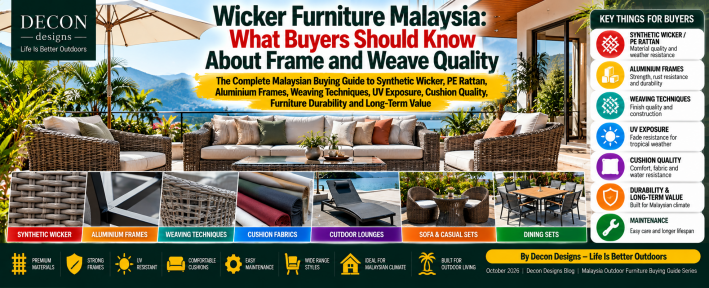
The Complete Malaysian Buying Guide to Synthetic Wicker, PE Rattan, Aluminium Frames, Weaving Techniques, UV Exposure, Cushion Quality, Furniture Durability and Long-Term Value
By Decon Designs – Life Is Better Outdoors | Wicker Furniture Malaysia | Rattan Furniture Malaysia | Outdoor Furniture Malaysia | Synthetic Wicker | PE Rattan | Garden Furniture | Patio Furniture | Outdoor Sofas | Furniture Quality | Tropical Outdoor Living
October 2026 | Decon Designs Blog | Malaysia Outdoor Furniture Buying Guide Series
Introduction: Beautiful Wicker Furniture Is Not Always Well-Made Wicker Furniture
Wicker furniture is a familiar choice for Malaysian gardens, patios, balconies, resorts, cafés and outdoor lounges.
Its woven appearance can create a warm, welcoming environment. It works with contemporary homes, tropical landscaping, poolside spaces and hospitality interiors.
Buyers can find wicker dining chairs, outdoor sofas, lounge sets, daybeds, sun loungers and decorative furniture in a wide range of colours and designs.
However, two wicker furniture sets that look almost identical in photographs may have very different construction quality.
One may use a carefully constructed frame with consistent weaving and suitable materials.
Another may have poorly finished joints, uneven weave tension, weak connections or materials unsuitable for prolonged outdoor exposure.
These differences are not always visible in a product catalogue.
They become important when furniture is used regularly, exposed to Malaysian weather or maintained over several years.
For buyers, the essential question is not simply:
Does this wicker furniture look attractive?
It is:
What is underneath the weaving, how is the furniture constructed, and is it suitable for the way I intend to use it?
At Decon Designs – Life Is Better Outdoors, with more than two decades serving Malaysia’s outdoor and hospitality furniture market, we believe buyers should understand frame quality, weave construction, material specifications and maintenance requirements before purchasing wicker furniture.
This guide explains what to inspect, what questions to ask suppliers and how to compare wicker furniture more confidently.
1. What Is Wicker Furniture?
Wicker refers to a weaving technique or woven furniture construction.
It does not identify one specific raw material.
Wicker furniture can be produced using natural materials or manufactured synthetic materials.
In Malaysia, the terms wicker furniture, rattan furniture and synthetic rattan furniture are sometimes used interchangeably in retail descriptions.
However, they are not technically identical.
Natural Rattan
Natural rattan is a plant-based material used in furniture making.
Its suitability depends on construction, finishing and environmental exposure.
Natural rattan furniture is generally better protected from prolonged rain and excessive moisture.
Synthetic Wicker
Synthetic wicker commonly uses manufactured strands woven around a supporting frame.
The strands may be made from different polymers, including polyethylene-based materials.
Some synthetic wicker products are designed for outdoor use.
However, their performance depends on the exact material formulation, manufacturing quality and intended exposure.
Why This Difference Matters
A buyer searching for “rattan furniture Malaysia” may encounter both natural and synthetic products.
The correct material should be confirmed before purchase.
2. Why Wicker Furniture Is Popular in Malaysia
Wicker-style furniture can complement a variety of Malaysian environments.
These include:
- Tropical gardens.
- Covered patios.
- Condominium balconies.
- Residential terraces.
- Hotel swimming pools.
- Resort lounges.
- Outdoor cafés.
- Restaurants.
- Private villas.
- Homestays.
Its woven appearance can provide texture and visual warmth.
Wicker furniture may also be available in different configurations, including compact balcony sets and larger outdoor sofas.
However, appearance alone should not determine the purchase.
Buyers must also evaluate the furniture’s intended use and construction.
3. The Hidden Structure: Why Frame Quality Matters
The frame is one of the most important components of wicker furniture.
It provides the supporting structure beneath the woven material.
A wicker sofa may appear substantial because of its thick woven exterior, but the quality of the underlying frame is not necessarily obvious.
Common Frame Materials
Depending on the product, frames may use:
- Aluminium.
- Steel.
- Timber.
- Other structural materials.
Each material requires appropriate design and construction.
Questions to Ask
- What material is the frame made from?
- How are the joints connected?
- What finish or protective treatment is used?
- Is the frame suitable for the intended environment?
- What maintenance is required?
- Are there recommended loading or usage limitations?
A supplier should be able to provide accurate information about the frame.
4. Aluminium Frames: What Buyers Should Inspect
Aluminium is used in many outdoor wicker furniture collections.
However, not every aluminium frame is constructed to the same standard.
Buyers should examine:
Joint Quality
Connections should be properly constructed and free from obvious defects.
Welds
Where welding is used, workmanship should be consistent and appropriate to the design.
Frame Stability
Furniture should not wobble excessively or feel unstable under normal intended use.
Surface Finish
Check for visible scratches, inconsistent coatings or exposed areas.
Fasteners
Confirm that fittings are appropriate for the intended environment.
Overall Construction
The furniture should feel structurally sound.
Buyers should avoid assuming that all aluminium-framed furniture offers identical performance.
5. Steel Frames: Understand the Corrosion Risk
Some wicker furniture uses steel frames.
Steel can be suitable for certain furniture applications when appropriately designed and protected.
However, corrosion protection is important, especially in humid or coastal environments.
Buyers should ask:
- What protective finish is applied?
- Are joints and fittings adequately protected?
- Is the furniture suitable for outdoor exposure?
- What maintenance is required?
A steel-framed product should not automatically be considered unsuitable.
Its suitability depends on the specific construction and environmental conditions.
6. Frame Design: Why Internal Support Matters
The strength of a furniture frame depends on more than the material name.
Design and construction also matter.
A frame may include:
- Supporting members.
- Reinforcement.
- Cross-bracing.
- Seat supports.
- Backrest structures.
- Armrest connections.
Poorly designed support structures can affect furniture stability and performance.
However, buyers should not attempt to judge structural safety solely by counting support bars or examining photographs.
Commercial buyers may need relevant technical information or testing evidence.
7. Understanding Synthetic Wicker Materials
Synthetic wicker strands may differ in:
- Polymer composition.
- Thickness.
- Profile.
- Colour.
- Surface texture.
- Flexibility.
- Additives.
- Manufacturing process.
Some products use polyethylene-based strands.
Others may use different polymer formulations.
The term “synthetic wicker” does not guarantee a specific quality level.
Ask the Supplier
- What is the actual material?
- Is it intended for outdoor use?
- What environmental limitations apply?
- Are maintenance instructions available?
- Does the supplier provide any relevant performance information?
Avoid relying solely on marketing descriptions such as “premium PE rattan.”
8. PE Rattan: What the Term Means
PE generally refers to polyethylene.
PE rattan is a common retail term for synthetic wicker strands made from polyethylene-based materials.
However, not all polyethylene-based wicker strands are identical.
Differences in formulation and manufacturing can affect performance.
Important Buyer Considerations
- Material specification.
- Intended exposure.
- Colour retention.
- Flexibility.
- Construction.
- Warranty terms.
A supplier should not claim that every PE rattan product has the same useful life.
Actual performance depends on the product and its operating conditions.
9. Weave Quality: What Buyers Can See
The weave is one of the most visible features of wicker furniture.
A consistent weave can contribute to appearance and construction quality.
Buyers should inspect:
Weave Consistency
Are the strands arranged evenly?
Tension
Are there loose or excessively uneven sections?
Edges
Are exposed ends properly finished?
Corners
Does the weaving follow the furniture shape neatly?
Seat and Back Areas
Are there visible defects or gaps inconsistent with the intended design?
Surface Condition
Are strands cracked, damaged or poorly joined?
These observations can help identify obvious workmanship problems.
However, a visually neat weave does not independently prove long-term durability.
10. Tight Weaving Is Not Always the Same as Better Weaving
Some buyers assume the tightest possible weave is always the best.
In practice, suitable weave construction depends on the furniture design, material characteristics and intended function.
Excessive tension may not be appropriate for every synthetic material.
Loose weaving can also create problems.
The objective is consistent, suitable construction rather than simply maximum tightness.
Buyers should assess the finished product and request relevant specifications.
11. Flat, Round and Half-Round Wicker Profiles
Synthetic wicker furniture may use different strand profiles.
Flat Wicker
Often used to create broad woven surfaces and contemporary designs.
Round Wicker
Can produce a more traditional woven appearance.
Half-Round Wicker
May provide a different texture and visual depth.
The profile affects appearance and construction methods.
However, no profile should automatically be described as superior in every application.
Quality depends on the material, design and manufacturing.
12. Why Corners and Edges Deserve Special Attention
Corners and edges are useful areas to inspect.
They may reveal how carefully the weaving has been finished.
Check for:
- Loose ends.
- Inconsistent wrapping.
- Exposed sharp components.
- Damaged strands.
- Poor finishing.
For chairs and sofas, examine armrests and seating edges.
These areas may experience frequent contact during use.
A well-finished appearance is desirable, but buyers should also consider structural construction.
13. Wicker Sofa Quality: What to Check Before Buying
Outdoor wicker sofas are available in many configurations.
These include:
- Single-seater chairs.
- Two-seater sofas.
- Three-seater sofas.
- L-shaped sofas.
- Modular collections.
- Lounge sets.
Before buying, inspect:
- Frame construction.
- Seat support.
- Weave condition.
- Cushion comfort.
- Overall dimensions.
- Stability.
- Intended exposure.
- Maintenance requirements.
- Warranty terms.
- Replacement availability.
A large sofa should not be selected solely because it offers more seating.
It must fit the intended space.
14. Wicker Dining Chairs: Commercial and Residential Differences
Wicker dining chairs may be used in homes, restaurants and resorts.
However, usage conditions differ.
A residential dining chair may be used occasionally.
A restaurant chair may experience frequent movement, cleaning and customer turnover.
Commercial buyers should ask whether the product is suitable for the intended level of use.
Important Considerations
- Frame stability.
- Seat support.
- Cleaning.
- Weight.
- Stackability where applicable.
- Maintenance.
- Replacement availability.
A chair described as outdoor furniture is not automatically suitable for intensive commercial use.
15. Wicker Sun Loungers: Construction and Comfort
Wicker-style sun loungers may be used beside swimming pools or in garden relaxation areas.
Buyers should evaluate:
- Frame stability.
- Lounger dimensions.
- Backrest mechanisms, if fitted.
- Weave condition.
- Cushion requirements.
- Cleaning.
- Environmental suitability.
For adjustable loungers, the mechanism should be inspected and used according to manufacturer instructions.
Commercial resorts should also consider maintenance and replacement components.
16. Cushion Quality: An Important Part of Wicker Furniture Value
Cushions contribute significantly to the comfort and appearance of wicker furniture.
However, cushion specifications vary.
Important factors include:
- Fabric composition.
- Foam type.
- Cushion thickness.
- Seam construction.
- Removable covers.
- Cleaning instructions.
- Drying requirements.
A sofa with attractive cushions may still be difficult to maintain if the materials are unsuitable for the environment.
Ask whether replacement cushions can be supplied.
17. Waterproof, Water-Resistant and Outdoor Fabrics
These terms are not interchangeable.
A water-resistant fabric may resist some moisture under specified conditions.
However, the complete cushion may still absorb water.
Water can enter through seams, zippers and other openings.
Practical Advice
Follow the manufacturer’s cleaning and storage instructions.
Allow cushions to dry properly when wet.
Do not assume that a cushion can remain exposed to heavy rain indefinitely.
In Malaysia’s humid environment, appropriate drying and storage can be important.
18. UV Exposure: Why Sunlight Matters
Sunlight can affect outdoor furniture materials over time.
Potential changes may include:
- Colour fading.
- Surface changes.
- Material degradation.
- Loss of flexibility.
The rate and extent of these changes depend on material formulation, exposure and product design.
Buyers should avoid assuming that every synthetic wicker product has identical UV resistance.
Questions to Ask
- Is the material intended for outdoor sunlight exposure?
- Are there relevant test results?
- What limitations apply?
- Does the warranty address colour or material changes?
Any performance claim should be supported by product-specific information.
19. Why Synthetic Wicker Sometimes Cracks or Becomes Brittle
Cracking or brittleness may result from several factors.
Potential contributors include:
- Material formulation.
- Environmental exposure.
- Ageing.
- Mechanical stress.
- Manufacturing defects.
- Improper maintenance.
It is not possible to identify the cause of every failure from appearance alone.
A supplier or qualified specialist may need to inspect the product.
Buyer Lesson
Material specifications and intended-use guidance matter.
A low initial price does not necessarily reveal how a product will perform over time.
20. Wicker Furniture and Malaysia’s Rainy Weather
Rain and humidity are important considerations.
Synthetic wicker furniture may be designed for outdoor use, but its frame, cushions and other components also matter.
Buyers should consider:
- Drainage.
- Cushion drying.
- Frame protection.
- Cleaning.
- Storage.
- Environmental exposure.
Avoid leaving moisture trapped beneath covers or inside cushions.
Follow manufacturer instructions.
21. Coastal Wicker Furniture: Additional Considerations
Coastal environments can expose furniture to salt-laden air and moisture.
These conditions may affect certain frames, fittings and finishes.
Buyers furnishing beachfront villas or resorts should ask about:
- Frame material.
- Fastener specifications.
- Protective finishes.
- Maintenance.
- Intended exposure.
- Warranty limitations.
The woven exterior does not eliminate the need to evaluate the underlying structure.
22. Natural Rattan vs Synthetic Wicker: A Practical Comparison
| Feature | Natural rattan | Synthetic wicker |
|---|---|---|
| Material origin | Plant-based | Manufactured polymer |
| Typical applications | Interior and appropriately sheltered spaces | Selected indoor and outdoor products |
| Appearance | Natural texture | Multiple colours and profiles |
| Moisture considerations | Requires careful environmental management | Depends on product and frame |
| Maintenance | Product-specific | Product-specific |
| Outdoor suitability | Must be assessed carefully | Must be verified by specification |
Neither category is universally better.
The appropriate choice depends on the intended application.
23. How to Inspect Wicker Furniture in a Showroom
A showroom visit can help buyers evaluate products.
Step 1: Sit on the Furniture
Assess comfort and stability under normal intended use.
Step 2: Examine the Frame
Ask about the frame material and construction.
Step 3: Inspect the Weave
Look for loose ends, uneven finishing and visible damage.
Step 4: Check Cushions
Review fabric, seams, filling and cleaning instructions.
Step 5: Measure the Product
Confirm dimensions.
Step 6: Ask About Maintenance
Understand the required care.
Step 7: Review Warranty Terms
Clarify coverage and exclusions.
Step 8: Confirm Delivery
Ask about stock, assembly and transport.
24. Buying Wicker Furniture Online in Malaysia
Online shopping offers convenience, but photographs may not show all construction details.
Before ordering, request:
- Accurate dimensions.
- Frame material.
- Wicker material.
- Cushion specifications.
- Product photographs.
- Warranty terms.
- Delivery information.
- Assembly requirements.
For expensive or commercial purchases, consider requesting samples or inspecting products where practical.
25. Why Two Similar Wicker Sets Can Have Different Prices
Two wicker furniture sets may look similar but differ in:
- Frame construction.
- Material specifications.
- Weave workmanship.
- Cushion quality.
- Dimensions.
- Finishes.
- Manufacturing costs.
- Brand positioning.
- Warranty.
- Delivery.
A lower price does not automatically mean poor quality.
A higher price does not automatically guarantee superior performance.
The correct comparison requires product-specific information.
26. Illustrative Wicker Furniture Price Comparison
Consider two hypothetical outdoor wicker sofa sets.
| Feature | Set A | Set B |
|---|---|---|
| Illustrative purchase price | RM1,500 | RM2,400 |
| Frame | Specification to verify | Specification to verify |
| Wicker | Specification to verify | Specification to verify |
| Cushions | Specification to verify | Specification to verify |
| Warranty | Confirm terms | Confirm terms |
| Intended exposure | Confirm | Confirm |
| Replacement cushions | Confirm | Confirm |
The figures are hypothetical and are not actual Decon Designs quotations or market benchmarks.
The purpose is to show that price comparisons should include construction details.
27. Total Cost of Ownership: Why Durability Matters
The initial purchase price is only one part of furniture ownership.
Additional costs may include:
- Delivery.
- Cleaning.
- Cushion replacement.
- Repairs.
- Storage.
- Replacement furniture.
A lower-cost product may be economical if it performs adequately for its intended use.
A higher-cost product may be worthwhile if its specifications and support meet the buyer’s needs.
However, neither outcome should be assumed without evidence.
28. Wicker Furniture for Condominiums in Malaysia
Condominium balconies and common areas have different requirements.
Private Balconies
Buyers may prioritize compact dimensions and comfort.
Shared Pool Areas
Management teams may prioritize maintenance, quantity consistency and commercial suitability.
Rooftop Areas
Exposure, wind and building rules require additional consideration.
Furniture should not obstruct access or circulation.
29. Wicker Furniture for Hotels and Resorts
Hotels and resorts may use wicker furniture in:
- Poolside lounges.
- Garden seating areas.
- Outdoor restaurants.
- Private villas.
- Terraces.
- Guest relaxation spaces.
Commercial procurement should consider:
- Usage frequency.
- Product suitability.
- Cleaning.
- Replacement components.
- Delivery schedules.
- Warranty.
- Maintenance.
Resorts should not rely solely on appearance when selecting furniture.
30. Wicker Furniture for Restaurants and Cafés
Restaurants and cafés may choose wicker-style dining chairs and lounge furniture.
However, commercial requirements can differ from residential use.
Potential considerations include:
- Cleaning frequency.
- Chair movement.
- Seating comfort.
- Product weight.
- Durability.
- Storage.
- Replacement availability.
Suppliers should provide accurate guidance about intended use.
31. How to Maintain Wicker Furniture in Malaysia
Maintenance depends on the exact product.
General practices may include:
- Removing dust and debris.
- Cleaning according to manufacturer instructions.
- Avoiding unsuitable chemicals.
- Inspecting the weave.
- Checking frames and fittings.
- Drying cushions properly.
- Using suitable storage arrangements.
Avoid aggressive cleaning methods unless approved by the manufacturer.
A maintenance routine can help identify developing problems.
32. Can Damaged Wicker Furniture Be Repaired?
Some wicker furniture may be repairable.
Potential repairs include:
- Selected strand replacement.
- Cushion renewal.
- Appropriate fitting replacement.
- Certain frame repairs.
However, repair feasibility depends on product construction, available materials and safety.
A structurally compromised chair or sofa should not remain in use without appropriate assessment.
Repairs should be undertaken by suitable personnel.
33. Replacement Cushions: An Opportunity to Extend Furniture Use
If a wicker furniture frame remains suitable, replacing worn cushions may be practical.
Buyers should confirm:
- Cushion dimensions.
- Foam requirements.
- Fabric suitability.
- Cover construction.
- Cleaning.
- Colour matching.
Replacement cushions may allow homeowners and hospitality operators to refresh furniture without purchasing an entirely new set.
However, replacement is appropriate only when the underlying furniture remains serviceable.
34. Sustainability: Look Beyond the Word “Eco-Friendly”
Wicker furniture may be marketed using environmental claims.
Buyers should ask for evidence.
Relevant considerations include:
- Material sourcing.
- Product durability.
- Repairability.
- Replaceable components.
- Packaging.
- End-of-life handling.
Synthetic wicker should not automatically be described as sustainable simply because it is long-lasting.
Natural rattan should not automatically be described as environmentally superior without considering sourcing and production.
Responsible purchasing requires credible information.
35. Wicker Furniture Quality Checklist
Before purchasing, confirm the following:
-
The actual wicker material is identified.
-
The frame material is confirmed.
-
The product is suitable for the intended environment.
-
The furniture feels stable under normal use.
-
The weave is consistent and properly finished.
-
There are no obvious sharp or damaged areas.
-
Cushion specifications are available.
-
Product dimensions are confirmed.
-
Cleaning instructions are provided.
-
Warranty terms are clear.
-
Delivery and assembly arrangements are confirmed.
-
Replacement cushions or parts have been discussed.
For commercial orders, request additional documentation where appropriate.
36. Ten Questions to Ask a Wicker Furniture Supplier
- Is the furniture made from natural rattan or synthetic wicker?
- What is the frame material?
- Is the product suitable for fully exposed outdoor use?
- What maintenance does it require?
- What are the exact dimensions?
- What cushion materials are included?
- Is the product suitable for commercial use?
- What does the warranty cover?
- Are replacement cushions available?
- What are the delivery and installation terms?
A supplier should be able to answer these questions accurately.
37. What Wicker Furniture Buyers Should Prioritize in 2027
For 2027, Malaysian buyers should focus on better purchasing information rather than relying only on design trends.
Material Transparency
Suppliers should identify the actual materials used.
Frame Quality
Buyers should understand the structure beneath the weave.
Commercial Suitability
Hospitality customers should verify intended-use requirements.
Maintenance Planning
Cushion care and furniture cleaning should be considered before purchase.
Replacement Availability
Buyers should ask about spare components and cushions.
Long-Term Value
Purchasing decisions should consider total ownership costs.
These priorities can improve buying decisions regardless of future design trends.
38. Decon Designs: Our Perspective on Wicker Furniture Quality
At Decon Designs – Life Is Better Outdoors, we believe wicker furniture should be evaluated beyond its appearance.
With more than two decades serving Malaysia’s outdoor and hospitality furniture market, we understand the importance of selecting furniture according to its intended application.
A homeowner may require a compact wicker sofa for a covered patio.
A resort may need lounge furniture for a poolside environment.
A condominium management team may require furniture for shared amenities.
A restaurant may need practical dining chairs.
These applications involve different expectations.
We encourage buyers to examine:
- Frame construction.
- Wicker materials.
- Weave quality.
- Cushion specifications.
- Environmental suitability.
- Maintenance.
- Warranty.
- Long-term value.
A furniture purchase should begin with understanding what the product is made from and how it will be used.
The real quality of wicker furniture is found not only in the beauty of its weave, but also in the structure, materials and workmanship that support it.
Conclusion: Look Beneath the Weave Before You Buy
Wicker furniture can create beautiful outdoor environments.
Its woven texture complements gardens, patios, balconies, resorts and hospitality spaces.
However, appearance is only one part of furniture quality.
The frame supports the structure.
The weave contributes to construction and appearance.
The cushions influence comfort.
The materials affect environmental suitability.
And maintenance influences long-term condition.
For Malaysian buyers, tropical weather exposure makes material selection especially important.
Before purchasing wicker furniture, inspect the frame, examine the weave, confirm the materials and understand the product’s intended use.
Do not assume that all wicker furniture offers identical durability.
Do not judge quality solely by photographs.
And do not compare prices without comparing specifications.
A beautiful weave may attract your attention. A well-constructed frame, suitable materials and proper maintenance are what make the purchasing decision more meaningful.
At Decon Designs, we believe informed furniture choices create better outdoor living experiences.
Decon Designs – Life Is Better Outdoors.
Frequently Asked Questions
1. What is wicker furniture?
Wicker refers to a weaving technique used to create furniture. It can involve natural or synthetic materials.
2. Is wicker furniture the same as rattan furniture?
Not exactly. Rattan is a material, while wicker describes a weaving construction. Retail descriptions sometimes use the terms interchangeably.
3. Is synthetic wicker suitable for Malaysia’s weather?
Some synthetic wicker products are designed for outdoor use. Suitability depends on the material formulation, frame and intended exposure.
4. What is PE rattan?
PE rattan generally refers to synthetic wicker made using polyethylene-based materials.
5. Is aluminium-framed wicker furniture better than steel-framed furniture?
Not automatically. Performance depends on design, construction, protective finishes and intended use.
6. How can I check wicker weave quality?
Look for consistent weaving, properly finished edges, suitable tension and the absence of obvious damage.
7. Why does synthetic wicker sometimes crack?
Possible causes include material ageing, environmental exposure, mechanical stress or manufacturing problems.
8. Can wicker furniture be left in the rain?
Follow the product’s intended-use and maintenance instructions. Cushions and other components may require additional protection.
9. Can damaged wicker furniture be repaired?
Some damage may be repairable, depending on the product and safety considerations.
10. Is wicker furniture suitable for hotels and resorts?
Certain products may be suitable for commercial hospitality use, but buyers should verify specifications and intended-use requirements.
11. What should I check before buying a wicker sofa?
Inspect frame construction, weave quality, cushion specifications, dimensions, stability and warranty terms.
12. Where can I buy wicker furniture in Malaysia?
Wicker furniture is available through outdoor furniture specialists, showrooms, retailers and suppliers. Compare product specifications and after-sales arrangements before purchasing.
Research and Industry References
1. Forest Research Institute Malaysia (FRIM)
Research and information relating to forest products and furniture materials.
https://www.frim.gov.my/
2. Malaysian Investment Development Authority (MIDA)
Wood-based and furniture industry information.
https://www.mida.gov.my/industries/manufacturing/wood-based-and-furniture/
3. BIFMA
Furniture industry standards and technical resources.
https://www.bifma.org/
4. Department of Standards Malaysia
Standards and conformity assessment information.
https://www.jsm.gov.my/
Editorial note: Wicker and frame performance varies by product, material formulation and use. Buyers should verify product-specific specifications, maintenance instructions and any testing claims. This article does not establish a universal furniture lifespan or quality rating.

