
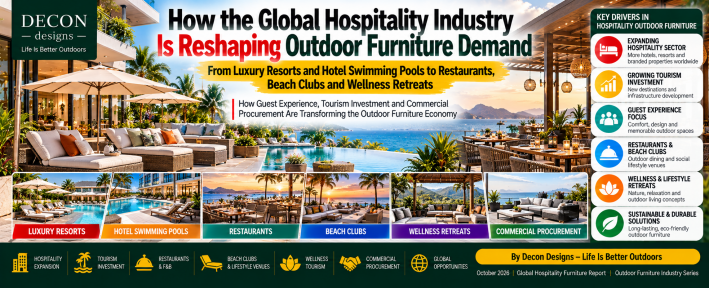
From Luxury Resorts and Hotel Swimming Pools to Restaurants, Beach Clubs and Wellness Retreats: How Guest Experience, Tourism Investment and Commercial Procurement Are Transforming the Outdoor Furniture Economy
By Decon Designs – Life Is Better Outdoors | Global Hospitality Industry | Outdoor Furniture Industry | Hotel Furniture | Resort Furniture | Hospitality Procurement | Tourism Investment | Restaurant Furniture | Wellness Tourism | Commercial Outdoor Living | Global Industry Intelligence
October 2026 | Global Hospitality Furniture Report | Outdoor Furniture Industry Series
Introduction: Outdoor Spaces Are Becoming Part of the Hospitality Experience
The global hospitality industry is changing the way outdoor furniture is designed, purchased, used and maintained.
For decades, outdoor furniture was often treated as a supporting requirement for hotels, resorts and restaurants.
A hotel swimming pool needed loungers.
A restaurant terrace needed dining tables and chairs.
A resort garden needed benches.
An outdoor café needed shade.
Today, the role of outdoor furniture can extend beyond these basic functions.
Hotels are developing outdoor lounges that encourage guests to spend more time within the property.
Resorts are creating coordinated poolside environments, private terraces and relaxation spaces.
Restaurants are using outdoor seating to develop distinctive dining experiences.
Wellness retreats are incorporating garden lounges, meditation areas and spaces for quiet relaxation.
Luxury villas and boutique accommodation operators are treating outdoor furnishings as part of their property’s identity.
These developments create opportunities for furniture manufacturers, importers, distributors, retailers, designers, contractors and maintenance providers.
However, the opportunity is more complex than simply supplying additional chairs and tables.
Hospitality operators must consider guest comfort, product durability, climate, cleaning, maintenance, safety, operational efficiency and long-term ownership costs.
Outdoor furniture is becoming an important component of hospitality design and operations—not merely a decorative addition to a property.
At Decon Designs – Life Is Better Outdoors, with more than two decades serving Malaysia’s outdoor and hospitality furniture market, we believe hospitality procurement represents an important opportunity for suppliers that understand the relationship between furniture, guest experience and operational performance.
This report examines the global hospitality sector’s influence on outdoor furniture demand, the most important customer segments, regional opportunities, procurement challenges and the strategic priorities for 2027 and beyond.
1. The Global Hospitality Economy: Why Outdoor Furniture Suppliers Should Pay Attention
Tourism and hospitality represent substantial economic activities.
According to UN Tourism, approximately 1.52 billion international tourist arrivals were recorded worldwide in 2025, an increase of 4% compared with 2024.
The World Travel & Tourism Council reported that travel and tourism contributed approximately US$11.6 trillion to global GDP in 2025, representing 9.8% of the world economy.
These figures demonstrate the scale of the broader travel and tourism ecosystem.
However, they do not measure outdoor furniture spending.
The commercial relationship is indirect.
Tourism activity supports accommodation, food and beverage services, leisure facilities, transportation and destination development.
When hospitality businesses invest in new properties, renovations or facility upgrades, some projects require outdoor furniture.
Where Furniture Demand Can Arise
- New hotel developments.
- Resort construction.
- Existing hotel renovations.
- Restaurant expansions.
- Poolside refurbishment.
- Outdoor dining upgrades.
- Wellness retreat development.
- Luxury villa furnishing.
- Beach club projects.
- Hospitality furniture replacement.
Suppliers should evaluate actual procurement activity rather than assuming tourism growth automatically produces furniture orders.
2. A Changing Outlook: Growth Opportunities Alongside Tourism Risks
The hospitality industry is not experiencing uniform growth across all regions.
UN Tourism’s September 2026 reporting indicates that international arrivals grew only 0.4% during the first half of 2026.
Economic uncertainty, geopolitical disruption, transportation costs and inflation have influenced travel conditions.
This matters for furniture suppliers.
A hotel may delay refurbishment when operating conditions weaken.
A resort developer may postpone construction.
A restaurant may reduce capital expenditure.
Conversely, some hospitality businesses may invest in improvements to differentiate themselves from competitors.
What This Means for Suppliers
Manufacturers and retailers should avoid relying exclusively on optimistic tourism forecasts.
They should monitor:
- Confirmed hotel and resort projects.
- Renovation activity.
- Hospitality investment.
- Property operating conditions.
- Customer budgets.
- Procurement schedules.
- Payment terms.
The strongest commercial strategy is to identify real purchasing requirements and manage project risks carefully.
3. From Functional Furniture to Guest-Experience Investment
Hospitality businesses increasingly compete through the experiences they offer.
Outdoor environments can influence how guests perceive a property.
Consider two hypothetical resorts.
The first provides basic seating around its swimming pool.
The second offers coordinated loungers, appropriate shade, comfortable outdoor sofas, landscaped relaxation areas and well-planned dining spaces.
The second resort may create a more inviting environment.
However, attractive furniture alone does not guarantee higher occupancy, room rates or profitability.
Guest satisfaction depends on many factors, including service, cleanliness, location, facilities and overall value.
Outdoor furniture should therefore be evaluated as one component of a broader hospitality experience.
The Commercial Opportunity
Furniture suppliers can support hospitality operators by providing:
- Appropriate product recommendations.
- Coordinated furniture collections.
- Space-planning information.
- Material specifications.
- Commercial procurement support.
- Delivery coordination.
- Maintenance guidance.
The opportunity is to help properties create functional outdoor environments that suit their guests and operations.
4. Hotels: The Expanding Role of Outdoor Furniture
Hotels use outdoor furniture in a variety of locations.
These may include:
- Swimming pools.
- Rooftop terraces.
- Outdoor restaurants.
- Garden lounges.
- Entrance courtyards.
- Private balconies.
- Event spaces.
- Recreational facilities.
Different hotel categories have different requirements.
A business hotel may need compact rooftop seating.
An urban luxury hotel may prioritize coordinated design and premium materials.
A family-oriented hotel may require practical furniture suited to frequent use.
A boutique hotel may seek distinctive furniture that complements its identity.
Important Procurement Considerations
Hotels should evaluate:
- Intended usage.
- Guest comfort.
- Material suitability.
- Product dimensions.
- Cleaning requirements.
- Maintenance.
- Delivery schedules.
- Warranty terms.
- Replacement availability.
- Total cost of ownership.
Suppliers that understand these requirements may be better positioned to serve hotel customers.
5. Resorts: A Major Application for Commercial Outdoor Furniture
Resorts frequently incorporate outdoor environments into their guest facilities.
Common locations include:
- Swimming pools.
- Beachfront areas.
- Garden terraces.
- Outdoor restaurants.
- Private villas.
- Relaxation zones.
- Recreational areas.
Relevant furniture categories include:
- Pool loungers.
- Outdoor sofas.
- Daybeds.
- Dining sets.
- Parasols.
- Garden chairs.
- Lounge tables.
- Outdoor cushions.
Resort furniture must be selected according to actual conditions.
A sheltered garden lounge may have different requirements from an exposed beachfront pool area.
Why Resort Procurement Can Be Complex
Resort projects may involve:
- Multiple furniture categories.
- Coordinated finishes.
- Large quantities.
- Delivery scheduling.
- Site restrictions.
- Installation.
- Replacement components.
- Maintenance planning.
For suppliers, resort procurement can create valuable commercial opportunities.
However, project complexity and working-capital requirements must be managed carefully.
6. Swimming Pools: A Specialized Outdoor Furniture Market
Swimming-pool furniture is an important hospitality category.
Products commonly include loungers, side tables, parasols and relaxation seating.
Poolside environments create particular requirements.
Furniture may be exposed to:
- Sunlight.
- Rain.
- Moisture.
- Frequent cleaning.
- Pool-related chemicals.
- Heavy guest use.
Commercial buyers should evaluate materials and finishes carefully.
They should also consider furniture placement, circulation, accessibility and maintenance.
The Importance of Poolside Planning
A pool deck should not be furnished solely according to the maximum number of loungers that can physically fit.
Operators must consider movement, safety, access and the practical use of the area.
Appropriate shade is also important.
Furniture should be positioned according to site conditions and operational requirements.
7. Restaurants and Cafés: Outdoor Dining as a Commercial Opportunity
Outdoor dining is another important segment of hospitality furniture demand.
Restaurants and cafés may create outdoor seating areas to provide different dining environments.
Potential applications include:
- Street-facing terraces.
- Courtyards.
- Garden restaurants.
- Rooftop dining.
- Waterfront dining.
- Café patios.
Relevant products include:
- Dining tables.
- Commercial chairs.
- Benches.
- Parasols.
- Compact lounge seating.
Operational Requirements
Restaurant furniture should be evaluated for:
- Seating comfort.
- Ease of cleaning.
- Appropriate dimensions.
- Durability.
- Movement and storage.
- Layout efficiency.
- Material suitability.
A restaurant may prioritize easy-to-clean furniture that can be rearranged.
A fine-dining terrace may place greater emphasis on coordinated design and guest comfort.
Suppliers should understand the establishment’s business model before recommending products.
8. Beach Clubs and Waterfront Hospitality
Beach clubs and waterfront properties represent a specialized furniture market.
Their environments may involve strong sunlight, moisture, wind and salt-laden air.
Products may include:
- Loungers.
- Daybeds.
- Outdoor sofas.
- Dining furniture.
- Parasols.
- Side tables.
- Outdoor cushions.
The Coastal Challenge
Not every product marketed as outdoor furniture is suitable for prolonged coastal exposure.
Buyers should evaluate:
- Frame materials.
- Protective finishes.
- Fasteners.
- Fabric specifications.
- Maintenance requirements.
- Storage arrangements.
- Environmental limitations.
Commercial operators should also consider wind-related safety when selecting shade products.
Furniture suitability should be established through relevant specifications rather than appearance alone.
9. Wellness Retreats: An Emerging Outdoor Furniture Opportunity
Wellness tourism connects travel with activities intended to support physical and mental well-being.
The Global Wellness Institute estimates wellness tourism spending reached approximately US$894 billion in 2024.
This figure measures wellness-related tourism spending, not outdoor furniture purchases.
Nevertheless, wellness destinations can create applications for outdoor furniture.
Potential environments include:
- Meditation gardens.
- Yoga retreat areas.
- Spa terraces.
- Quiet relaxation spaces.
- Nature-based accommodation.
- Outdoor treatment-adjacent lounges.
- Wellness resort pools.
Furniture Requirements
Wellness properties may prioritize:
- Comfort.
- Calm visual design.
- Appropriate materials.
- Easy maintenance.
- Functional layouts.
- Privacy.
- Suitability for the surrounding environment.
Furniture should support the intended experience without creating unnecessary maintenance or operational complexity.
10. Luxury Hospitality: Design, Comfort and Product Differentiation
Luxury hotels and resorts may invest in distinctive outdoor environments.
Outdoor furniture can contribute to the property’s design identity.
Potential product requirements include:
- Coordinated lounge collections.
- Premium finishes.
- Customized upholstery.
- Outdoor dining collections.
- Private villa furniture.
- Poolside daybeds.
- Designer parasols.
However, luxury positioning does not eliminate the need for practical product evaluation.
A visually distinctive outdoor sofa must still suit its intended environment.
Commercial buyers should verify materials, construction, maintenance and delivery arrangements.
For manufacturers, premium hospitality may create opportunities for specialized design and customization.
But customization must be supported by accurate costing and production capability.
11. Boutique Hotels and Independent Resorts
Smaller hospitality properties may have different procurement requirements from large hotel groups.
A boutique hotel may purchase smaller quantities but seek distinctive products.
An independent resort may require furniture that fits its architectural character.
A guesthouse may prioritize cost-effective, practical furnishings.
Suppliers serving these businesses should understand budget limitations and project scale.
Potential Opportunities
- Smaller coordinated furniture collections.
- Compact lounge areas.
- Custom cushion colours.
- Garden dining sets.
- Replacement furniture.
- Refurbishment.
Smaller orders can still be commercially worthwhile when managed efficiently.
However, suppliers should calculate delivery, customization and service costs accurately.
12. Short-Term Rentals, Villas and Homestays
Hospitality demand also includes furnished villas, holiday homes and short-term rental properties.
These properties may feature:
- Balconies.
- Gardens.
- Private swimming pools.
- Terraces.
- Outdoor dining areas.
- Rooftop spaces.
Owners may use outdoor furniture to improve the functionality and presentation of their accommodation.
However, purchasing decisions should account for frequent guest turnover and maintenance.
Important Considerations
- Appropriate furniture dimensions.
- Cleaning.
- Weather exposure.
- Product stability.
- Replacement availability.
- Practicality.
- Budget.
Furniture should be selected according to the property’s intended use rather than only its appearance in photographs.
13. The Regional Hospitality Opportunity: Asia-Pacific
Asia-Pacific is particularly relevant to hospitality furniture suppliers.
The region includes established tourism destinations, major cities, resorts and growing hospitality markets.
Countries such as Malaysia, Thailand, Indonesia, Vietnam, India, Japan and Australia offer different hospitality furniture applications.
Southeast Asia
Tropical resorts, urban hotels, restaurants and holiday accommodation create potential demand for outdoor furnishings.
India
Hospitality, residential development and leisure properties offer opportunities for commercial furniture suppliers.
Japan and South Korea
Urban hotels, terraces and specialized hospitality environments may require compact or design-focused furniture.
Australia
Hotels, restaurants, resorts and outdoor dining environments represent relevant customer segments.
Regional suppliers should account for climate differences and country-specific procurement requirements.
14. Malaysia: A Hospitality Furniture Market Worth Monitoring
Malaysia’s hospitality sector is relevant to outdoor furniture demand.
Potential customers include:
- Hotels.
- Beach resorts.
- Urban hospitality properties.
- Restaurants.
- Cafés.
- Holiday villas.
- Homestays.
- Recreational facilities.
Outdoor furniture applications differ across destinations.
A hotel in Kuala Lumpur may require rooftop seating.
A resort in Langkawi may need pool loungers and parasols.
A hospitality property in Sabah may require furniture suited to tropical conditions.
A restaurant in Selangor may need practical outdoor dining furniture.
Opportunities for Malaysian Suppliers
Businesses can explore:
- Hospitality furniture procurement.
- Commercial parasol supply.
- Outdoor dining collections.
- Poolside furniture.
- Furniture replacement.
- Maintenance services.
- Project coordination.
At Decon Designs, we believe customer education and appropriate product selection are essential to serving these markets responsibly.
15. The Middle East: Hospitality Development and Regional Risk
The Middle East includes significant hospitality and tourism destinations.
Hotels, resorts, luxury developments and leisure properties can create demand for outdoor furniture.
Potential applications include:
- Resort lounges.
- Poolside seating.
- Outdoor dining.
- Luxury villa furniture.
- Shade products.
- Commercial terraces.
However, the regional outlook must be assessed carefully.
Conflict and travel disruption affected Middle Eastern tourism in 2026.
Hospitality furniture suppliers should therefore avoid assuming that all announced developments will proceed according to their original schedules.
Commercial opportunities should be evaluated through confirmed projects, budgets and procurement plans.
16. Europe: Outdoor Dining, Resorts and Seasonal Hospitality
Europe includes a wide variety of hospitality environments.
Examples include:
- Mediterranean resorts.
- Coastal hotels.
- City terraces.
- Garden restaurants.
- Wellness properties.
- Seasonal hospitality venues.
Outdoor furniture demand may be influenced by climate, tourism activity and seasonal operations.
For some properties, furniture storage is important during colder months.
Others may require products suited to frequent outdoor use.
Manufacturers and suppliers should consider regional climate and commercial requirements.
European buyers may also request specific documentation or compliance information depending on the product and market.
17. North America: Hotels, Resorts and Commercial Outdoor Spaces
North America offers hospitality furniture applications across hotels, resorts, restaurants and recreational properties.
Potential environments include:
- Swimming pools.
- Outdoor dining terraces.
- Rooftop bars.
- Resort gardens.
- Commercial lounges.
- Holiday accommodation.
The United States, Canada and Mexico have different climate conditions and customer requirements.
Suppliers should evaluate product suitability by location and application.
International manufacturers should also account for trade requirements, logistics and buyer specifications.
18. Africa and Island Tourism Markets
African hospitality markets include urban hotels, safari lodges, coastal resorts and leisure properties.
Island destinations may also offer opportunities for outdoor furniture suppliers.
Potential applications include:
- Garden lounges.
- Resort dining.
- Poolside furniture.
- Shade products.
- Private accommodation.
- Outdoor relaxation areas.
However, demand varies considerably between countries and destinations.
Suppliers should evaluate local infrastructure, project financing, logistics and maintenance capabilities.
A market’s tourism potential does not automatically translate into immediate furniture purchasing demand.
19. How Hospitality Is Changing Outdoor Furniture Design
Hospitality requirements can influence furniture product development.
Manufacturers may be asked to provide:
- Coordinated collections.
- Modular configurations.
- Custom finishes.
- Replacement cushions.
- Compact furniture.
- Larger lounge arrangements.
- Commercial-use specifications.
- Easier-to-maintain products.
The objective is to align furniture with the property’s design and operational needs.
Modular Furniture
Modular products may allow operators to rearrange seating layouts.
Coordinated Collections
Matching furniture can create visual consistency.
Replaceable Components
Appropriate replacement parts may simplify maintenance.
Commercial Specifications
Products should be evaluated according to intended usage and applicable requirements.
These considerations can create opportunities for manufacturers that specialize in hospitality furniture.
20. Outdoor Furniture Materials for Hospitality Applications
Material selection is particularly important in commercial environments.
| Material or component | Potential applications | Important considerations |
|---|---|---|
| Aluminium | Dining, lounges, loungers | Construction, finish, exposure |
| Suitable timber | Dining, garden furniture | Maintenance, weathering |
| Synthetic wicker | Lounge and dining collections | Material quality, frame construction |
| Outdoor rope | Contemporary seating | Specification, tension, exposure |
| Outdoor fabrics | Cushions, upholstery | Cleaning, drying, colour retention |
| Foam | Cushions and upholstered seating | Comfort, moisture management |
| Steel | Selected frames and bases | Corrosion protection |
| Parasol components | Shade products | Stability, mechanisms, site conditions |
No material should be described as universally maintenance-free.
Suppliers should provide accurate usage and care guidance.
21. Commercial Parasols: More Than Decorative Accessories
Parasols and shade products can be important components of outdoor hospitality environments.
They may be used in:
- Poolside areas.
- Restaurants.
- Garden terraces.
- Resort lounges.
- Beachfront facilities.
Commercial buyers should consider:
- Canopy dimensions.
- Frame construction.
- Base requirements.
- Wind limitations.
- Operating procedures.
- Maintenance.
- Storage.
A parasol should not be selected solely because its colour matches the furniture.
Site conditions and safety considerations are essential.
Suppliers should avoid unsupported claims about wind resistance or product performance.
22. Hospitality Furniture Procurement: A Different Purchasing Process
Commercial procurement differs from ordinary residential purchasing.
A hotel may require multiple products delivered according to a project schedule.
A resort may need consistent finishes across several locations.
A restaurant group may require matching furniture for different outlets.
The procurement process may involve:
- Requirement definition.
- Space planning.
- Product selection.
- Supplier evaluation.
- Sample review.
- Technical approval.
- Quotation.
- Contract and payment terms.
- Production or sourcing.
- Delivery.
- Installation.
- Final inspection.
Each stage creates opportunities for coordination.
It also introduces potential risks.
23. Why the Lowest Purchase Price Can Be Misleading
Hospitality operators must consider the full cost of owning and maintaining furniture.
A low-priced product may require frequent replacement.
A more expensive product may also prove unsuitable if it is poorly specified.
The correct purchasing decision depends on actual performance and ownership costs.
Total Cost of Ownership
Relevant expenses may include:
- Purchase price.
- Delivery.
- Installation.
- Cleaning.
- Maintenance.
- Repairs.
- Replacement components.
- Furniture replacement.
- Disposal.
Commercial buyers should compare products using realistic assumptions.
The best-value hospitality furniture is not necessarily the cheapest or the most expensive. It is the product that appropriately meets the property’s needs at a sustainable total cost.
24. Illustrative Hospitality Furniture Lifecycle Comparison
Consider two hypothetical outdoor lounge chairs for a hotel.
| Cost item | Chair A | Chair B |
|---|---|---|
| Initial purchase | RM450 | RM750 |
| Delivery and installation | RM50 | RM50 |
| Annual maintenance assumption | RM60 | RM40 |
| Assumed replacement during five years | Twice | Once |
| Five-year purchase and replacement cost | RM1,350 | RM1,500 |
| Five-year maintenance cost | RM300 | RM200 |
| Initial delivery and installation | RM50 | RM50 |
| Illustrative five-year total | RM1,700 | RM1,750 |
This is a hypothetical example, not a forecast of product lifespan or actual market pricing. Replacement events and costs vary. The example excludes financing, downtime, taxes and disposal.
The comparison shows that a lower purchase price may produce similar long-term expenditure.
Changing the assumptions could reverse the outcome.
Hotels should therefore evaluate actual product specifications, expected usage and maintenance conditions.
25. Furniture Maintenance: An Important Part of Hospitality Operations
Outdoor furniture requires appropriate maintenance.
Commercial environments may involve frequent use, cleaning and exposure.
Maintenance activities can include:
- Routine cleaning.
- Inspection of fittings.
- Cushion care.
- Fabric cleaning.
- Surface maintenance.
- Safe storage where appropriate.
- Replacement of suitable components.
Hotels should establish maintenance procedures based on manufacturer guidance.
Why Maintenance Matters
Poor maintenance can affect appearance, comfort and product performance.
It may also lead to avoidable replacement expenditure.
For suppliers, maintenance guidance can support customer satisfaction and reduce misunderstandings.
For service providers, furniture care and refurbishment may create specialized business opportunities.
26. The Replacement and Refurbishment Economy
Hospitality furniture demand is not limited to new construction.
Existing hotels, resorts and restaurants may need to replace or refurbish furniture.
Potential services include:
- Cushion replacement.
- Upholstery renewal.
- Suitable frame repairs.
- Surface refinishing.
- Replacement fittings.
- Furniture cleaning.
- Product upgrades.
This creates opportunities for manufacturers, upholsterers, maintenance businesses and retailers.
However, repair should only be undertaken when technically appropriate.
Unsafe or structurally compromised furniture may require replacement.
Suppliers should provide realistic advice about repairability and product condition.
27. Sustainability: A Growing Consideration in Hospitality Furniture
Hospitality businesses may evaluate environmental considerations when purchasing furniture.
Potential priorities include:
- Product durability.
- Responsible material sourcing.
- Repairability.
- Replacement components.
- Packaging.
- Waste reduction.
- Refurbishment.
However, sustainability claims should be supported by credible evidence.
Recycled content alone does not establish the complete environmental impact of a product.
Likewise, natural materials are not automatically environmentally superior.
Commercial buyers should ask for relevant information and avoid relying solely on marketing terminology.
28. Digital Discovery and Supplier Reputation
Hospitality procurement increasingly involves digital research.
Buyers may discover suppliers through:
- Search engines.
- Business websites.
- Online catalogues.
- Industry directories.
- Professional networks.
- Customer reviews.
- Project references.
A supplier’s digital presence can help buyers evaluate products and capabilities.
Useful information includes:
- Product dimensions.
- Material specifications.
- Commercial applications.
- Delivery arrangements.
- Warranty terms.
- Contact information.
- Relevant project experience.
However, a strong online presence does not automatically establish supplier reliability.
Commercial buyers should verify capacity, specifications and contractual terms.
29. The 2027 Hospitality Furniture Opportunity Matrix
| Hospitality segment | Typical outdoor furniture needs | Supplier opportunity |
|---|---|---|
| Urban hotels | Rooftop seating, poolside furniture | Compact, coordinated collections |
| Beach resorts | Loungers, parasols, daybeds | Climate-appropriate products |
| Luxury resorts | Premium sofas, private terraces | Design and customization |
| Restaurants | Dining tables, chairs, shade | Commercial seating solutions |
| Cafés | Compact tables, chairs | Space-efficient furniture |
| Wellness retreats | Garden lounges, relaxation seating | Comfort-focused collections |
| Boutique hotels | Distinctive outdoor furniture | Smaller customized orders |
| Villas and homestays | Patio and poolside furniture | Practical residential-hospitality products |
| Property-linked hospitality | Shared lounges and amenities | Project procurement and installation |
| Existing hospitality properties | Replacement and refurbishment | Maintenance and after-sales services |
These categories represent potential applications, not guaranteed purchasing demand.
Suppliers should validate opportunities through actual customer requirements.
30. What Manufacturers and Suppliers Should Prepare for in 2027
The hospitality furniture opportunity requires more than attractive catalogues.
Manufacturers and suppliers should prepare in several areas.
Product Development
Develop furniture suited to clearly defined hospitality applications.
Material Specifications
Provide accurate information about construction, finishes and intended environmental exposure.
Commercial Procurement
Understand project schedules, quantities and approval procedures.
Quality Control
Maintain consistent product specifications.
Inventory and Production
Avoid accepting commitments that exceed operational or financial capacity.
Logistics
Plan packaging, transportation and installation requirements.
After-Sales Support
Clarify maintenance, warranty and replacement arrangements.
Digital Visibility
Make product information accessible to professional buyers.
Financial Discipline
Evaluate margins, payment terms and working-capital requirements before accepting major projects.
A large hospitality order is not automatically a profitable order.
Commercial success depends on execution and cost control.
31. Decon Designs: Our Perspective on Hospitality Furniture Demand
At Decon Designs – Life Is Better Outdoors, we view hospitality furniture as an important part of the wider outdoor living economy.
With more than two decades serving Malaysia’s outdoor and hospitality furniture market, we understand that different customers have different requirements.
A hotel may be planning a poolside refurbishment.
A restaurant may need practical outdoor dining furniture.
A resort may be evaluating loungers and parasols.
A boutique accommodation operator may want to create a comfortable garden environment.
A property developer may require outdoor furniture for shared facilities.
In each case, successful furniture selection begins with understanding the intended use.
The right material for one environment may not be suitable for another.
The right furniture dimensions for a residential terrace may not suit a commercial restaurant.
A product that looks attractive in a photograph may require closer inspection before being selected for intensive hospitality use.
We believe the role of a responsible furniture supplier is to help customers evaluate these differences.
That includes discussing materials, dimensions, environmental conditions, maintenance and realistic purchasing requirements.
Hospitality furniture should be selected to support both the guest experience and the practical needs of the property operator.
32. Conclusion: Hospitality Is Changing the Business of Outdoor Furniture
The global hospitality industry is creating a broader range of applications for outdoor furniture.
Hotels are developing more functional outdoor environments.
Resorts require coordinated poolside and relaxation furniture.
Restaurants and cafés use outdoor seating as part of their dining experience.
Wellness retreats incorporate furniture into relaxation and nature-based environments.
Boutique accommodation and holiday villas require practical outdoor furnishings.
These developments create opportunities for manufacturers, suppliers, retailers, designers, contractors, installers and maintenance businesses.
However, the industry must remain realistic.
Tourism growth does not automatically guarantee furniture sales.
Hospitality projects can be delayed.
Procurement budgets may change.
International supply chains can be disrupted.
Poor product selection can increase long-term operating costs.
For manufacturers and suppliers, the strongest opportunities will come from understanding customer needs, maintaining suitable product specifications and managing commercial commitments responsibly.
For hospitality operators, better procurement begins with evaluating furniture as a long-term operational asset rather than only a decorative purchase.
The future of hospitality outdoor furniture will be shaped by businesses that understand the connection between guest comfort, product suitability, operational efficiency and long-term value.
At Decon Designs, our guiding principle remains:
Life Is Better Outdoors.
And in hospitality, better outdoor environments begin with informed furniture choices.
Frequently Asked Questions
1. Why is the hospitality industry important to outdoor furniture demand?
Hotels, resorts, restaurants and other hospitality properties use outdoor furniture in guest areas, dining spaces, pools and relaxation environments. New developments and renovations can create purchasing opportunities.
2. What outdoor furniture do hotels commonly purchase?
Common products include pool loungers, outdoor sofas, dining sets, parasols, side tables and garden seating.
3. How is resort furniture different from residential furniture?
Resort furniture may experience more frequent use and demanding environmental conditions. Buyers should verify suitability for the intended commercial application.
4. Why are parasols important in hospitality?
Parasols provide shade in appropriate outdoor environments, but product selection must consider stability, operating limits and site conditions.
5. What furniture is suitable for outdoor restaurants?
Suitable products depend on the restaurant’s layout, customer needs and environment. Commercial buyers often prioritize comfort, cleaning, dimensions and durability.
6. How does wellness tourism influence furniture demand?
Wellness properties may use outdoor seating and lounge furniture in gardens, spa terraces and relaxation areas.
7. Why should hotels consider total cost of ownership?
The purchase price does not include all expenses. Maintenance, delivery, repairs and replacement can influence long-term costs.
8. What opportunities exist for Malaysian suppliers?
Potential opportunities include hotel furniture, resort loungers, commercial parasols, outdoor dining, procurement coordination and furniture replacement services.
9. What are the main risks for hospitality furniture suppliers?
Risks include project delays, specification changes, payment terms, inventory costs, shipping and product-quality issues.
10. What should manufacturers prepare for in 2027?
Manufacturers should strengthen product specifications, quality control, production planning, sourcing, commercial procurement and financial discipline.
Research Sources and Industry References
1. UN Tourism — World Tourism Barometer, January 2026
International tourist arrivals and global travel trends.
https://www.untourism.int/news/international-tourist-arrivals-up-4-in-2025-reflecting-strong-travel-demand-around-the-world
2. UN Tourism — World Tourism Barometer, September 2026
International tourism performance during the first half of 2026.
https://www.untourism.int/un-tourism-world-tourism-barometer-data
3. World Travel & Tourism Council — Economic Impact Research 2026
Global travel and tourism economic contribution, employment and outlook.
https://wttc.org/Research/Economic-Impact
4. Global Wellness Institute — Wellness Tourism Research
Wellness tourism spending and sector development.
https://globalwellnessinstitute.org/what-is-wellness/what-is-wellness-tourism/
5. Tourism Malaysia
Malaysia’s tourism sector and destination information.
https://www.tourism.gov.my/
6. Malaysian Investment Development Authority (MIDA)
Furniture manufacturing and investment context.
https://www.mida.gov.my/industries/manufacturing/wood-based-and-furniture/
Editorial note: Tourism and wellness statistics provide economic context. They should not be represented as direct measurements of hospitality outdoor furniture sales.


