
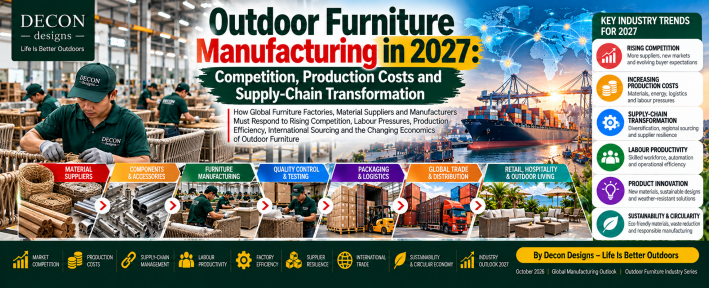
How Global Furniture Factories, Material Suppliers and Manufacturers Must Respond to Rising Competition, Labour Pressures, Production Efficiency, International Sourcing and the Changing Economics of Outdoor Furniture
By Decon Designs – Life Is Better Outdoors | Outdoor Furniture Manufacturing | Global Furniture Industry | Manufacturing Costs | Supply-Chain Management | Furniture Materials | Labour Productivity | Factory Efficiency | Supplier Resilience | International Trade | Industry Outlook 2027
October 2026 | Global Manufacturing Outlook | Outdoor Furniture Industry Series
Introduction: The Outdoor Furniture Factory Is Entering a New Competitive Era
The global outdoor furniture industry is approaching 2027 with a fundamental challenge.
Manufacturers must remain competitive in a market where customers expect attractive designs, suitable materials, dependable quality, reasonable prices and reliable delivery.
At the same time, factories must manage material costs, labour requirements, energy consumption, equipment investment, inventory, international trade and changing customer expectations.
For many manufacturers, producing furniture is no longer the most difficult part of the business.
The greater challenge is producing the right furniture, at the right cost, with consistent quality, while maintaining sufficient profitability to continue operating.
An outdoor sofa may appear simple when displayed in a showroom.
Behind it are numerous production decisions involving frame construction, material specifications, cushion manufacturing, finishing, packaging and transportation.
A small change in one component can affect the entire production process.
A delayed material shipment can interrupt manufacturing.
An inaccurate bill of materials can create purchasing problems.
A defective finish can lead to rework.
Poor packaging can damage products during transportation.
A large order accepted at an inadequate margin can place financial pressure on the factory.
These challenges are particularly relevant as manufacturers prepare for 2027.
The future of outdoor furniture manufacturing will not be determined solely by factory capacity or low selling prices. It will depend on manufacturing efficiency, supplier resilience, product quality, cost discipline and the ability to respond to changing customer requirements.
At Decon Designs – Life Is Better Outdoors, with more than two decades serving Malaysia’s outdoor and hospitality furniture market, we believe understanding the manufacturing economy is essential for suppliers, distributors, retailers and commercial buyers.
This report examines the competitive forces reshaping outdoor furniture manufacturing and the practical strategies businesses should consider for 2027 and beyond.
1. Understanding the Global Outdoor Furniture Manufacturing Industry
Outdoor furniture manufacturing involves converting raw materials and components into finished products intended for exterior or semi-exterior environments.
The industry includes production of:
- Outdoor dining tables and chairs.
- Garden benches.
- Patio sofas and lounge sets.
- Pool loungers.
- Outdoor daybeds.
- Synthetic wicker furniture.
- Aluminium furniture.
- Timber outdoor furniture.
- Outdoor rope furniture.
- Commercial parasols.
- Balcony furniture.
- Hospitality furniture.
- Outdoor cushions and accessories.
Manufacturing methods vary considerably by product category.
A welded aluminium dining chair requires different machinery and technical skills from a timber garden bench.
Synthetic wicker furniture may involve extensive manual weaving.
An upholstered outdoor sofa requires cushion design, fabric cutting, sewing and assembly.
Commercial parasols involve structural components, canopy production and operating mechanisms.
Because production requirements differ, manufacturers cannot evaluate competitiveness using a single industry-wide cost formula.
The appropriate manufacturing strategy depends on product design, order volume, material requirements, labour intensity and target customers.
2. The Global Manufacturing Landscape: Who Is Competing?
Outdoor furniture manufacturing operates across multiple countries.
China remains an important international furniture manufacturing and sourcing centre.
Vietnam and Indonesia participate in export-oriented furniture production.
Malaysia has established furniture manufacturing capabilities and regional trading relationships.
India combines domestic demand with manufacturing and export opportunities.
European manufacturers participate in design-led, premium and specialist furniture categories.
Other countries contribute through component manufacturing, contract production and regional distribution.
These markets do not compete on identical terms.
Some factories emphasize production volume.
Others focus on design, craftsmanship, customization, material specialization or commercial project requirements.
The Main Areas of Competition
Manufacturers compete through:
- Product price.
- Design.
- Material specifications.
- Production capacity.
- Quality consistency.
- Delivery reliability.
- Customization.
- Product documentation.
- After-sales support.
- Customer relationships.
The challenge for 2027 is determining where a manufacturer can compete profitably.
A small factory may struggle to match the production volume of a large international producer.
However, it may be able to offer specialized products, shorter local coordination cycles or customer-specific services.
Manufacturing competitiveness should be based on genuine capabilities—not an attempt to be the cheapest supplier in every category.
3. Production Costs: What Really Determines the Factory Price?
Outdoor furniture production costs involve more than raw materials and labour.
A manufacturer must account for direct and indirect expenses.
Major Cost Categories
| Cost category | Typical examples | Management priority |
|---|---|---|
| Materials | Aluminium, timber, polymers, fabrics, foam | Sourcing, specifications, waste |
| Direct labour | Fabrication, weaving, sewing, assembly | Productivity, skills, consistency |
| Factory overhead | Rent, utilities, supervision | Capacity utilization |
| Machinery | Equipment, maintenance, depreciation | Reliability, investment returns |
| Finishing | Coatings, surface treatment, consumables | Quality, process efficiency |
| Quality control | Inspection, testing, rework | Defect prevention |
| Packaging | Cartons, wrapping, protective materials | Protection, shipping efficiency |
| Logistics | Inbound materials, outbound transport | Planning, supplier coordination |
| Inventory | Storage, financing, obsolescence | Working-capital discipline |
| Administration | Planning, procurement, compliance | Operational efficiency |
Different products have different cost structures.
Labour-intensive woven furniture may be particularly sensitive to workforce productivity.
Metal furniture may be influenced by material prices, fabrication efficiency and finishing processes.
Upholstered products may be affected by fabric consumption, foam specifications and sewing efficiency.
Manufacturers should understand costs at the product level rather than relying only on total monthly factory expenses.
4. The Manufacturing Cost Equation
A useful way to understand factory economics is to distinguish the cost of production from the selling price.
Manufacturing Cost = Direct Materials + Direct Labour + Manufacturing Overhead
Manufacturers must then account for relevant selling, distribution, financing and administrative expenses when assessing overall profitability.
Consider a hypothetical outdoor dining chair.
| Illustrative cost component | Cost per chair |
|---|---|
| Frame materials | RM65 |
| Other components | RM25 |
| Direct labour | RM35 |
| Manufacturing overhead | RM25 |
| Quality control and packaging | RM15 |
| Illustrative manufacturing cost | RM165 |
If the manufacturer sells the chair for RM200, the difference of RM35 is not necessarily net profit.
Other expenses may still need to be covered.
These can include sales commissions, transportation, financing, administration, warranty servicing and taxes.
The example is illustrative and does not represent actual Decon Designs pricing or an industry benchmark.
For 2027, manufacturers should strengthen product-level costing.
A factory that does not understand its true costs may increase sales while weakening its financial position.
5. Raw-Material Sourcing: The Foundation of Manufacturing Competitiveness
Raw materials are central to outdoor furniture production.
Common inputs include:
- Aluminium.
- Steel.
- Timber.
- Synthetic wicker.
- Outdoor rope.
- Foam.
- Upholstery fabrics.
- Coatings.
- Fasteners.
- Packaging materials.
Manufacturers must consider price, quality, lead time and supplier reliability.
The lowest-priced material may not be the most economical choice.
A cheaper component that creates frequent defects can increase total manufacturing costs.
Similarly, a material that arrives late can disrupt production schedules.
Better Sourcing Practices
Manufacturers should:
- Maintain accurate material specifications.
- Compare suppliers using total relevant cost.
- Verify quality before large purchases.
- Monitor lead times.
- Identify critical components.
- Review supplier performance.
- Maintain appropriate documentation.
Supplier selection should support consistent production rather than only short-term purchasing savings.
6. Aluminium Furniture Manufacturing: Cost and Efficiency Challenges
Aluminium is used in many outdoor furniture categories.
Products include dining chairs, tables, sofas, loungers and other frame-based furniture.
Manufacturing may involve:
- Extrusion sourcing.
- Cutting.
- Bending.
- Welding.
- Surface preparation.
- Powder coating or other finishing.
- Assembly.
- Inspection.
Production efficiency depends on equipment, worker skills, material utilization and process consistency.
Common Cost Pressures
- Aluminium input prices.
- Cutting waste.
- Welding labour.
- Finishing defects.
- Rework.
- Equipment maintenance.
- Packaging and transport.
Manufacturers can improve performance by examining material utilization and production flow.
However, cost reduction should not compromise structural design or required product performance.
7. Synthetic Wicker and Rope Furniture: Labour, Skills and Quality
Synthetic wicker and outdoor rope products often require specialized assembly and weaving processes.
These activities can be labour-intensive.
Manufacturers must manage:
- Material consistency.
- Weaving patterns.
- Worker training.
- Production time.
- Frame quality.
- Tension consistency.
- Finishing.
- Inspection.
Labour productivity matters, but speed alone is not an appropriate quality measure.
A worker producing more units may not improve profitability if defects also increase.
Opportunities for Improvement
Factories can explore:
- Standardized production methods.
- Better workstation design.
- Improved material preparation.
- Worker training.
- Clear quality checkpoints.
- More accurate production planning.
The objective is consistent output with less avoidable waste and rework.
8. Timber Outdoor Furniture: Material Yield and Processing Efficiency
Timber furniture manufacturing involves additional considerations.
Production may include:
- Material selection.
- Drying.
- Cutting.
- Machining.
- Joinery.
- Sanding.
- Finishing.
- Assembly.
Manufacturers must manage material yield and quality.
Poor cutting plans can increase waste.
Inconsistent moisture conditions can create production problems.
Finishing defects may require additional labour.
Responsible sourcing and appropriate documentation can also be important.
For 2027, timber furniture manufacturers should focus on material efficiency, suitable construction and realistic product-care information.
9. Outdoor Cushions and Upholstery: A Manufacturing Category of Its Own
Outdoor cushions are often treated as accessories.
In reality, cushion production involves its own supply chain and manufacturing processes.
These may include:
- Fabric sourcing.
- Foam sourcing.
- Pattern development.
- Cutting.
- Sewing.
- Filling.
- Inspection.
- Packaging.
Cushion quality influences comfort, appearance and maintenance.
For hospitality customers, replacement availability can also be important.
Manufacturing Opportunities
Businesses may specialize in:
- Replacement cushions.
- Custom upholstery.
- Commercial cushion production.
- Fabric replacement.
- Cushion refurbishment.
This creates opportunities beyond manufacturing complete furniture sets.
10. Labour Costs and Workforce Productivity in 2027
Labour remains a major consideration in furniture manufacturing.
Factories require workers with different skills.
These may include:
- Welders.
- Machine operators.
- Weavers.
- Carpenters.
- Upholsterers.
- Sewing operators.
- Finishers.
- Assemblers.
- Quality inspectors.
- Production supervisors.
Labour costs can be influenced by wages, recruitment, training, overtime, turnover and applicable employment requirements.
However, reducing labour expenditure is not always the best way to improve competitiveness.
A poorly trained workforce can increase defects and production delays.
Productivity Versus Wage Cost
A manufacturer should evaluate the cost of producing an acceptable finished unit.
A higher hourly wage may be economically justified when supported by better productivity, quality and lower rework.
Likewise, lower wages do not guarantee lower production costs.
The most useful productivity measure is not simply how many units workers produce, but how many acceptable units are produced efficiently.
11. Skills Development: A Long-Term Manufacturing Advantage
Furniture manufacturing requires technical knowledge.
Workers must understand materials, machinery, construction methods and quality requirements.
Training can improve:
- Production consistency.
- Equipment operation.
- Safety practices.
- Material handling.
- Assembly accuracy.
- Quality awareness.
- Problem-solving.
For manufacturers, skills development should be viewed as an investment in operational capability.
A factory dependent on a small number of highly experienced workers may face disruption when those workers leave.
Documented processes and structured training can reduce this dependency.
12. Automation: Where Technology Can Improve Furniture Manufacturing
Automation offers opportunities, but its benefits depend on the process.
Potential applications include:
- CNC cutting.
- Automated machining.
- Digital cutting systems.
- Production tracking.
- Inventory management.
- Computer-aided design.
- Quality documentation.
- Packaging optimization.
Some activities are easier to automate than others.
Complex weaving, customized upholstery and certain assembly operations may continue to require substantial manual work.
Before Investing in Automation
Manufacturers should evaluate:
- Current production volume.
- Labour requirements.
- Equipment cost.
- Maintenance capability.
- Training needs.
- Product consistency.
- Expected productivity improvement.
- Payback period.
- Financial capacity.
Automation should solve a specific operational problem.
Purchasing expensive machinery without sufficient demand or utilization can increase financial pressure.
13. Factory Efficiency: Reducing Waste Without Reducing Quality
Manufacturing efficiency involves producing suitable products with fewer avoidable losses.
Common sources of inefficiency include:
- Material waste.
- Excess movement.
- Poor production scheduling.
- Equipment downtime.
- Rework.
- Unnecessary inventory.
- Waiting for components.
- Incorrect specifications.
- Poor communication between departments.
Lean manufacturing principles can help identify these problems.
However, factories should avoid implementing efficiency programmes as superficial cost-cutting exercises.
The objective is to improve production flow and reliability.
Practical Efficiency Measures
Manufacturers can track:
- Material yield.
- Production cycle time.
- Defect rates.
- Rework hours.
- On-time completion.
- Equipment downtime.
- Inventory turnover.
- Cost per acceptable unit.
These indicators can help management identify where improvements are needed.
14. Quality Control: The Cost of Getting Furniture Wrong
Quality failures can create substantial expenses.
A defective outdoor chair may require repair or replacement.
A faulty finish may require rework.
Incorrect dimensions can make a product unsuitable for a project.
Poor packaging can lead to transportation damage.
These problems create costs beyond the factory floor.
They may affect:
- Customer satisfaction.
- Delivery schedules.
- Retailer relationships.
- Warranty expenses.
- Brand reputation.
- Future orders.
For 2027, manufacturers should strengthen preventive quality systems.
This includes accurate specifications, inspection procedures and traceability.
A well-managed quality process can help reduce the cost of defects.
15. The Importance of Accurate Bills of Materials
A bill of materials, commonly called a BOM, identifies the components required to manufacture a product.
For an outdoor sofa, the BOM may include:
- Frame materials.
- Fasteners.
- Synthetic wicker or rope.
- Cushion foam.
- Upholstery fabric.
- Protective feet.
- Packaging.
- Other required components.
An inaccurate BOM can create production and purchasing problems.
For example, a factory may order insufficient fabric or use an incorrect fitting.
This can delay manufacturing.
Benefits of BOM Control
- Better purchasing accuracy.
- More reliable costing.
- Improved inventory planning.
- Consistent product specifications.
- Easier component replacement.
- Stronger production traceability.
For manufacturers producing multiple models and variants, BOM accuracy becomes particularly important.
16. Supplier Resilience: Preparing for Disruption
Furniture factories depend on suppliers.
A single delayed component can interrupt production.
Manufacturers should identify critical materials and evaluate the risks associated with their supply.
Key Questions
- Which components have only one supplier?
- How long does replenishment take?
- Are alternative materials technically acceptable?
- What happens if a shipment is delayed?
- How much inventory is necessary?
- Can suppliers maintain consistent specifications?
Supplier resilience does not necessarily require buying from many companies.
It requires understanding dependencies and preparing appropriate alternatives.
Supplier Evaluation Scorecard
| Evaluation area | Key question |
|---|---|
| Quality | Does the supplier meet specifications consistently? |
| Delivery | Are lead times reliable? |
| Capacity | Can the supplier fulfil required quantities? |
| Documentation | Are specifications and records accurate? |
| Communication | Are problems reported promptly? |
| Commercial terms | Are pricing and payment terms workable? |
| Continuity | Is there a plan for supply disruption? |
Manufacturers can use these criteria to improve supplier selection.
17. International Sourcing: Opportunities and Risks
International sourcing allows manufacturers to access materials and components from different countries.
Potential benefits include:
- Broader supplier selection.
- Specialized materials.
- Alternative manufacturing capabilities.
- Competitive purchasing arrangements.
However, international sourcing also introduces risks.
These may include:
- Currency fluctuations.
- Shipping costs.
- Customs requirements.
- Long lead times.
- Quality inconsistencies.
- Communication difficulties.
- Geopolitical disruptions.
Manufacturers should calculate total landed costs rather than comparing supplier quotations alone.
The lowest quoted price may not be the lowest delivered cost.
18. Nearshoring and Regional Sourcing
Some manufacturers may consider sourcing materials or components closer to their production facilities.
Regional sourcing can potentially reduce certain transport and coordination risks.
However, nearby suppliers are not automatically cheaper or more reliable.
A manufacturer should evaluate:
- Product quality.
- Cost.
- Lead time.
- Production capacity.
- Technical capability.
- Supply continuity.
For Malaysian manufacturers, regional supply relationships within Southeast Asia may offer opportunities.
The correct sourcing strategy depends on the component and commercial requirements.
19. Logistics and Packaging: Manufacturing Decisions With Distribution Consequences
Furniture design affects logistics costs.
Large products may occupy substantial shipping volume.
Poor packaging can lead to damage.
Complex assembly can increase installation time.
Manufacturers should consider logistics during product development.
Design-for-Logistics Opportunities
- Appropriate modular construction.
- Efficient packaging dimensions.
- Clear assembly instructions.
- Protective packaging.
- Standardized components.
- Reduced unnecessary handling.
However, logistics optimization must not compromise product strength, stability or intended performance.
A product that ships cheaply but fails during use is not an efficient product.
20. Inventory and Working Capital: The Hidden Manufacturing Challenge
Inventory represents money invested in materials, components and finished products.
Excess inventory can create financial pressure.
Insufficient inventory can interrupt production.
Manufacturers must balance availability with cash-flow requirements.
Common Inventory Categories
Raw Materials: Inputs waiting to be used.
Work in Progress: Partially manufactured products.
Finished Goods: Completed furniture awaiting shipment.
Spare Parts: Components for maintenance and production support.
Working-Capital Risks
A manufacturer may need to purchase materials before receiving payment from customers.
If production or customer payment is delayed, cash can become constrained.
This makes payment terms, production scheduling and inventory planning important.
For 2027, manufacturers should avoid expanding production without understanding the cash required to support it.
21. Why High Sales Do Not Always Mean a Healthy Factory
A factory can report increasing sales while experiencing financial difficulties.
This can happen when:
- Profit margins are inadequate.
- Customers pay slowly.
- Inventory is excessive.
- Production costs are underestimated.
- Defects create rework.
- Financing expenses increase.
- Overheads exceed contribution margins.
Manufacturers should monitor both profitability and cash flow.
A large order may appear attractive but create problems if it requires substantial upfront spending and offers unfavourable payment terms.
Important Financial Indicators
- Gross margin.
- Operating profit.
- Cash conversion cycle.
- Inventory turnover.
- Receivables collection.
- Production cost per unit.
- Working-capital requirements.
Financial discipline is as important as manufacturing capability.
22. Commercial Furniture Manufacturing: Hotels and Resorts Require Different Capabilities
Hospitality furniture manufacturing can differ from ordinary residential production.
Hotels and resorts may require:
- Large quantities.
- Consistent finishes.
- Coordinated designs.
- Specific dimensions.
- Commercial-use suitability.
- Reliable delivery schedules.
- Replacement components.
- Project documentation.
Manufacturers serving this segment must understand procurement requirements.
A hotel order may involve coordination with designers, contractors and project managers.
Delays or specification changes can affect the entire project.
Opportunities
Factories can develop specialized commercial furniture collections.
However, accepting commercial orders without adequate production and financial capacity can create significant risks.
23. Customization: Opportunity or Manufacturing Risk?
Customization can help manufacturers differentiate their products.
Customers may request:
- Different dimensions.
- Alternative colours.
- Specific fabrics.
- Modified frame designs.
- Custom configurations.
- Project-specific products.
However, customization increases operational complexity.
It may require new materials, additional engineering, separate production planning and specialized inspection.
Managing Custom Orders
Manufacturers should establish:
- Clear specifications.
- Approved drawings.
- Material confirmation.
- Accurate quotations.
- Production lead times.
- Change-control procedures.
- Customer approval.
- Appropriate payment terms.
Customization should be priced according to its actual costs and risks.
24. Sustainability and Manufacturing Efficiency
Sustainability and manufacturing efficiency can overlap.
Reducing avoidable material waste may lower costs.
Improving product durability may reduce premature replacement.
Better packaging design may reduce unnecessary material use.
However, environmental claims should be supported by evidence.
Manufacturers should consider:
- Material sourcing.
- Production waste.
- Energy use.
- Product lifespan.
- Repairability.
- Packaging.
- End-of-life management.
A product containing recycled materials is not automatically environmentally superior in every circumstance.
Likewise, a product made from natural materials is not automatically sustainable.
Responsible manufacturing requires evaluating relevant environmental impacts.
25. Repairability and Replacement Components: A Manufacturing Opportunity
Outdoor furniture can create demand for replacement parts and maintenance.
Manufacturers may explore designs that allow appropriate components to be replaced.
Examples include:
- Cushions.
- Upholstery covers.
- Selected fittings.
- Furniture feet.
- Appropriate structural components.
- Parasol canopies and serviceable parts.
Repairability can support customer satisfaction and create after-sales opportunities.
However, not every component can be safely repaired or replaced.
Manufacturers should provide clear guidance about suitable maintenance and repair procedures.
26. Digital Manufacturing and AI: What Is Practical for 2027?
Digital systems can support manufacturing management.
Potential applications include:
- Production scheduling.
- Inventory visibility.
- Material planning.
- Product costing.
- Quality records.
- Demand analysis.
- Digital product design.
- Supplier communication.
AI-assisted tools may help businesses organize information and identify patterns.
However, AI should not be treated as a substitute for verified technical specifications or responsible management decisions.
A digital forecast can be inaccurate.
A product visualization may not represent actual manufacturing capability.
Technology should support better decisions, not create false confidence.
27. Malaysia’s Outdoor Furniture Manufacturing Outlook
Malaysia has established furniture manufacturing capabilities and regional supply relationships.
Its manufacturers face opportunities and challenges similar to those affecting the wider international industry.
Potential opportunities include:
- Commercial outdoor furniture.
- Hospitality furniture.
- Specialized components.
- Product design.
- Custom manufacturing.
- Regional distribution.
- Export development.
- Furniture refurbishment.
Important challenges include:
- Production costs.
- Labour productivity.
- International competition.
- Material sourcing.
- Quality consistency.
- Cash-flow management.
- Market visibility.
Strategic Priorities for Malaysian Manufacturers
Manufacturers should evaluate whether their business model is best suited to:
- High-volume production.
- Specialized manufacturing.
- Custom commercial projects.
- Component production.
- Own-brand development.
- Contract manufacturing.
Different strategies require different investments and capabilities.
The objective should be a commercially sustainable position within the industry.
28. The 2027 Outdoor Furniture Manufacturing Readiness Scorecard
Manufacturers can use the following checklist to evaluate preparation for 2027.
| Readiness area | Key management question | Priority |
|---|---|---|
| Product costing | Do we know the true cost of each product? | High |
| Material sourcing | Are critical materials available reliably? | High |
| Labour productivity | Are we measuring acceptable output efficiently? | High |
| Quality control | Are defects identified and prevented systematically? | High |
| Supplier resilience | Do we have plans for critical disruptions? | High |
| Inventory | Is stock aligned with production requirements? | High |
| Cash flow | Can we finance orders and operating expenses? | High |
| Equipment | Is machinery reliable and appropriately utilized? | High |
| Product development | Are new products based on actual demand? | Medium–High |
| Digital systems | Do we have accurate production and inventory information? | Medium–High |
| Export readiness | Do we understand overseas requirements? | As applicable |
| After-sales support | Are warranty and replacement arrangements clear? | High |
A manufacturer does not need to address every issue through expensive investment.
Some improvements may begin with better documentation, planning and management discipline.
29. Ten Practical Actions Manufacturers Should Take Before 2027
1. Review product-level profitability.
Identify products that generate sustainable contribution margins.
2. Update material specifications.
Ensure purchasing and production teams use accurate information.
3. Evaluate supplier dependencies.
Identify materials that could interrupt production if unavailable.
4. Measure factory waste.
Track scrap, rework and avoidable material losses.
5. Improve production planning.
Coordinate materials, labour and delivery commitments.
6. Strengthen quality control.
Focus on preventing defects rather than only inspecting finished products.
7. Review inventory and cash flow.
Avoid tying up excessive working capital in slow-moving stock.
8. Invest selectively in skills and technology.
Choose improvements with clear operational benefits.
9. Understand customer applications.
Develop products suitable for residential, hospitality or commercial use as appropriate.
10. Build long-term supplier and customer relationships.
Reliability can be an important competitive advantage.
These actions can help manufacturers improve resilience without assuming that market growth alone will solve operational problems.
30. Decon Designs: Our Perspective on Manufacturing and Supply-Chain Transformation
At Decon Designs – Life Is Better Outdoors, we believe outdoor furniture manufacturing must be understood from the customer’s perspective as well as the factory’s perspective.
With more than two decades serving Malaysia’s outdoor and hospitality furniture market, we recognize that customers evaluate more than product appearance.
A homeowner may be concerned about comfort, maintenance and value.
A restaurant may require practical seating that suits frequent use.
A hotel may need coordinated products, reliable delivery and appropriate specifications.
A property developer may require furniture that fits the design and operational needs of shared amenities.
These expectations influence manufacturing decisions.
Material selection affects product suitability.
Construction quality affects reliability.
Packaging affects delivery.
Production planning affects lead times.
Accurate specifications affect customer confidence.
After-sales arrangements affect the long-term ownership experience.
For manufacturers, the opportunity is to connect factory efficiency with customer value.
For suppliers and retailers, the responsibility is to understand product capabilities and communicate them accurately.
For buyers, the objective should be to evaluate products according to intended use, relevant specifications and total ownership costs.
The strongest outdoor furniture supply relationships are built when manufacturers, suppliers and customers understand one another’s requirements.
Conclusion: The Future of Outdoor Furniture Manufacturing Is About Resilience, Efficiency and Value
Outdoor furniture manufacturing in 2027 will continue to operate in a competitive international environment.
Factories must manage materials, labour, production costs, machinery, quality, logistics and working capital.
They must also respond to changing customer expectations.
Manufacturers that compete only on price may struggle when costs increase or demand weakens.
Businesses that invest without understanding their markets may face financial pressure.
Factories that neglect quality may incur expensive rework and damage customer relationships.
However, opportunities remain.
Manufacturers can improve material efficiency.
They can strengthen supplier relationships.
They can develop specialized products.
They can improve production planning.
They can invest selectively in skills and technology.
They can design furniture that is easier to maintain.
And they can develop stronger relationships with hospitality buyers, distributors and retailers.
The future of outdoor furniture manufacturing will not belong automatically to the largest factory or the lowest-priced supplier. It will favour businesses that understand their costs, maintain reliable operations and deliver products suited to customer needs.
For Malaysia and the wider Asia-Pacific region, these priorities are especially relevant as manufacturers compete in both domestic and international markets.
At Decon Designs, we believe a better outdoor furniture industry begins with stronger manufacturing decisions and more informed purchasing.
Decon Designs – Life Is Better Outdoors.
Frequently Asked Questions About Outdoor Furniture Manufacturing in 2027
What are the main challenges facing outdoor furniture manufacturers?
Major challenges include raw-material costs, labour productivity, international competition, quality consistency, logistics, inventory and cash-flow management.
Which countries are important in outdoor furniture manufacturing?
China, Vietnam, Indonesia, Malaysia and India have relevant furniture manufacturing capabilities, while other regions participate through specialized production, design and distribution.
What determines outdoor furniture production costs?
Important factors include materials, labour, manufacturing overhead, machinery, finishing, quality control, packaging and logistics.
How can manufacturers reduce production costs?
They can improve material utilization, production planning, quality control, equipment reliability and inventory management without compromising essential specifications.
Why is supplier resilience important?
Reliable suppliers help manufacturers maintain production schedules and reduce disruption caused by material shortages or delivery delays.
Is automation necessary for furniture manufacturing?
Automation may improve some processes, but investment should be based on production needs, financial capacity and expected returns.
What role does labour productivity play?
Labour productivity influences the cost and consistency of acceptable finished products. Training and efficient processes can improve performance.
Why is quality control important?
Quality control helps reduce defects, rework, customer complaints and warranty costs.
What opportunities exist for Malaysian manufacturers?
Potential opportunities include hospitality furniture, specialized products, commercial manufacturing, components, customization and export development.
What should manufacturers prioritize for 2027?
Manufacturers should focus on accurate costing, supplier reliability, quality, inventory, cash flow, product suitability and operational efficiency.
Research and Industry References
The following organizations provide useful background information for further research. Specific forecasts and policy requirements should be checked against their latest publications before commercial decisions are made.
1. Malaysian Investment Development Authority (MIDA)
Wood-Based and Furniture Industry
https://www.mida.gov.my/industries/manufacturing/wood-based-and-furniture/
2. Malaysia External Trade Development Corporation (MATRADE)
Furniture Export Development and International Trade
https://www.matrade.gov.my/
3. Malaysian Timber Industry Board (MTIB)
Timber and Wood-Based Industry Development
https://www.mtib.gov.my/
4. International Labour Organization (ILO)
Labour Productivity, Skills and Manufacturing Employment
https://www.ilo.org/
5. United Nations Industrial Development Organization (UNIDO)
Industrial Development and Manufacturing Competitiveness
https://www.unido.org/
6. World Furniture Online
International Furniture Manufacturing and Trade Research
https://www.worldfurnitureonline.com/
7. Grand View Research
Global Outdoor Furniture Market
https://www.grandviewresearch.com/industry-analysis/outdoor-furniture-market
Publishing Pack
Caption
Outdoor Furniture Manufacturing in 2027: Competition, Production Costs and Supply-Chain Transformation
The global outdoor furniture manufacturing industry is entering 2027 with growing pressure to balance competitive prices, material costs, labour productivity, quality and delivery reliability.
From aluminium frames and synthetic wicker to outdoor fabrics, factory operations, international sourcing and commercial furniture production, manufacturers face important decisions.
How can factories reduce waste without compromising quality?
How can suppliers strengthen supply-chain resilience?
Why do higher sales not always translate into stronger profitability?
Explore Decon Designs’ comprehensive manufacturing outlook for 2027.
The future of furniture manufacturing belongs to businesses that understand costs, protect quality and build resilient operations.
By Decon Designs – Life Is Better Outdoors.


