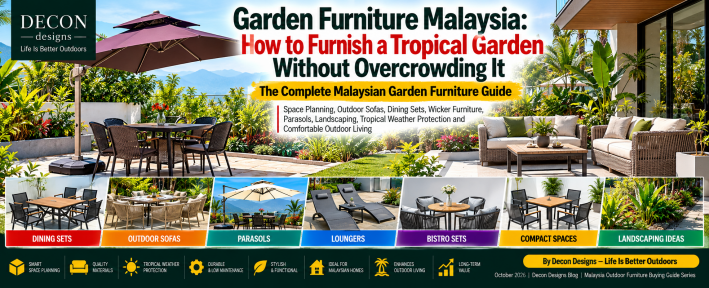
The Complete Malaysian Garden Furniture Guide to Space Planning, Outdoor Sofas, Dining Sets, Wicker Furniture, Parasols, Landscaping, Tropical Weather Protection and Comfortable Outdoor Living
By Decon Designs – Life Is Better Outdoors | Garden Furniture Malaysia | Outdoor Furniture Malaysia | Patio Furniture | Tropical Garden Design | Wicker & Rattan Furniture | Outdoor Sofas | Garden Parasols | Outdoor Living | Home & Garden Improvement
October 2026 | Decon Designs Blog | Malaysia Outdoor Furniture Buying Guide Series
Introduction: A Beautiful Garden Does Not Need More Furniture. It Needs Better Planning.
A tropical garden can be one of the most enjoyable spaces in a Malaysian home.
It offers fresh air, greenery, a connection with nature and an opportunity to create a comfortable outdoor living environment.
Whether you live in a terrace house in Selangor, a semi-detached property in Petaling Jaya, a bungalow in Shah Alam or a landed home in Penang, Johor or Kuala Lumpur, a well-furnished garden can become an extension of your living space.
It can serve as a place for morning coffee, family conversations, outdoor dining, relaxation or entertaining guests.
However, one common mistake can reduce the enjoyment of an otherwise beautiful garden.
Too much furniture.
A large outdoor sofa may dominate a small garden.
An oversized dining set may obstruct walking paths.
A parasol may be positioned where it interferes with trees or surrounding structures.
Too many chairs, side tables and decorative accessories can make a garden feel crowded rather than welcoming.
The objective of garden furnishing should not be to fill every available space.
It should be to create a balanced environment where furniture, landscaping, movement and relaxation work together.
At Decon Designs – Life Is Better Outdoors, with more than two decades serving Malaysia’s outdoor and hospitality furniture market, we believe successful garden furnishing begins with understanding the available space and selecting furniture that genuinely supports how people want to use it.
This guide explores how Malaysian homeowners can choose garden furniture, plan layouts, work with tropical landscaping and create attractive outdoor spaces without overcrowding them.
1. Why Garden Furniture Planning Matters in Malaysia
Malaysian gardens come in many shapes and sizes.
Some landed homes have narrow side gardens.
Others feature compact rear yards.
Semi-detached houses may have landscaped garden strips.
Bungalows may offer larger lawns, patios and covered terraces.
Each property requires a different furnishing approach.
A furniture arrangement that works in a large bungalow garden may not suit a compact terrace house.
Likewise, furniture selected for a sheltered patio may not be appropriate for an exposed lawn.
Before buying garden furniture, consider three important factors:
- Space: How much usable outdoor area is available?
- Function: What activities should the garden support?
- Environment: How much sun, rain and moisture will the furniture experience?
These considerations should guide product selection.
2. Begin With the Purpose of Your Garden
Before choosing furniture, ask yourself how you intend to use the garden.
A garden can serve several functions, but trying to accommodate every activity in a limited area may create unnecessary crowding.
Garden for Relaxation
Suitable products may include:
- Two comfortable lounge chairs.
- A compact outdoor sofa.
- A coffee table.
- A suitable parasol.
Garden for Outdoor Dining
Consider:
- A dining table.
- Appropriate dining chairs.
- Shade where suitable.
- Sufficient circulation space.
Garden for Family Activities
Prioritize:
- Open movement areas.
- Practical seating.
- Easy-to-clean furniture.
- Appropriate storage.
Garden for Entertaining Guests
Consider:
- Modular seating.
- A coordinated lounge arrangement.
- Flexible side tables.
- Adequate circulation.
Garden for Quiet Enjoyment
A simple garden bench or two chairs may be sufficient.
The best garden furniture arrangement is the one that supports your lifestyle without unnecessarily reducing usable outdoor space.
3. Measure Your Garden Before Buying Furniture
One of the most important steps is measuring the available area.
Do not estimate furniture dimensions based only on photographs.
Measure:
- Total usable length.
- Total usable width.
- Door openings.
- Walkways.
- Steps.
- Trees and planting areas.
- Drainage points.
- Existing structures.
- Covered and uncovered sections.
Then compare these measurements with the furniture dimensions.
An Illustrative Example
Imagine a garden seating area measuring 3 metres by 4 metres.
Its total area is 12 square metres.
However, not all 12 square metres should be occupied by furniture.
You may need room for walking, opening doors, accessing plants and moving around chairs.
A compact seating arrangement may work better than a large sectional sofa.
The actual layout should be determined by furniture dimensions and site conditions.
4. Understand the Difference Between Total Garden Area and Usable Furniture Area
A garden may appear spacious but contain areas that cannot accommodate furniture.
Examples include:
- Flower beds.
- Trees.
- Drainage channels.
- Sloped ground.
- Access paths.
- Utility equipment.
- Water features.
- Uneven surfaces.
These features reduce the space available for furniture.
A garden measuring 30 square metres may have considerably less usable seating space.
Before buying furniture, identify the areas that can safely and practically accommodate it.
Furniture should be positioned on suitable, stable surfaces.
Avoid placing heavy products on unstable ground or where they obstruct access.
5. Create Outdoor Zones Instead of Filling the Entire Garden
Zoning is a useful way to organize outdoor spaces.
A larger garden may include separate areas for:
- Dining.
- Relaxation.
- Gardening.
- Children’s activities.
- Walking.
- Decorative landscaping.
However, smaller gardens may need only one primary activity zone.
Example: Small Malaysian Terrace-House Garden
A compact garden might include:
- One two-seater outdoor sofa.
- Two lounge chairs.
- One coffee table.
- A few plants.
- Clear access to the house.
Example: Medium-Sized Garden
A larger space might accommodate:
- One dining area.
- One small relaxation corner.
- A landscaped section.
- Clear circulation paths.
Example: Large Bungalow Garden
A spacious property may accommodate:
- Outdoor dining.
- A lounge area.
- A garden swing.
- Landscaped walkways.
- A separate relaxation zone.
The objective is balance, not maximum furniture quantity.
6. How Much Space Should You Leave Around Garden Furniture?
Comfortable movement is important.
People should be able to walk around furniture without constantly moving chairs or stepping over obstacles.
As a preliminary planning guide, a clear route of approximately 900 mm may be useful in some residential layouts.
However, this is not a universal accessibility or building-code requirement.
Actual circulation needs depend on the property, intended users, furniture configuration and applicable requirements.
Dining chairs also need additional clearance when occupied or pulled away from a table.
Practical Planning Advice
Before buying, mark furniture dimensions on the ground using removable tape, cardboard or another temporary method.
Walk around the proposed arrangement.
Check whether doors can open fully.
Consider how the space will function when all seats are occupied.
This simple exercise can reveal overcrowding before any furniture is purchased.
7. Choose Furniture Proportionate to Your Garden
Furniture scale is one of the most important design considerations.
Large furniture can make a small garden feel cramped.
Very small furniture may appear disconnected in a large outdoor environment.
Small Gardens
Consider:
- Two-seater sofas.
- Bistro dining sets.
- Compact lounge chairs.
- Narrow benches.
- Small coffee tables.
Medium Gardens
Consider:
- Four-seater dining sets.
- Compact sectional sofas.
- Lounge seating.
- Garden benches.
Large Gardens
Consider:
- Larger outdoor sofas.
- Six- or eight-seater dining sets.
- Separate seating zones.
- Garden swings.
- Coordinated lounge collections.
Furniture should be selected according to actual dimensions rather than generic categories such as small, medium or large.
8. Outdoor Sofas: When They Work and When They Overcrowd a Garden
Outdoor sofas can create comfortable relaxation areas.
However, they require careful space planning.
A large L-shaped sofa may be appropriate for a spacious patio.
The same sofa may dominate a narrow garden.
What to Consider
- Overall sofa length.
- Sofa depth.
- Seat height.
- Coffee table dimensions.
- Walking clearance.
- Cushion maintenance.
- Environmental exposure.
Better Options for Compact Gardens
A two-seater sofa paired with one or two chairs may offer more flexibility than a large sectional.
Individual seating can sometimes be rearranged more easily.
For larger gardens, modular sofa arrangements may allow different configurations.
9. Garden Dining Furniture: Select the Right Number of Seats
Outdoor dining furniture is popular among Malaysian homeowners who enjoy meals and gatherings outside.
However, dining sets require more space than the table dimensions alone suggest.
A four-seater dining table needs room for chairs and movement.
A six-seater set requires additional space.
An eight-seater set may be unsuitable for a small garden even if the table technically fits.
Before Buying
Ask:
- How many people use the dining area regularly?
- How often do you entertain larger groups?
- Can chairs be pulled out comfortably?
- Is the dining area sheltered?
- Is the floor surface suitable?
A smaller everyday dining set may be more practical than purchasing a large table for occasional gatherings.
10. Bistro Furniture: A Smart Choice for Small Gardens
Bistro furniture typically includes a compact table and two chairs.
It can be useful for:
- Small patios.
- Garden corners.
- Courtyards.
- Compact terraces.
- Balcony gardens.
A bistro arrangement may create a functional seating area without occupying excessive space.
However, buyers should still verify dimensions, comfort and material suitability.
A compact set should not be selected solely because it is small.
It must also be practical for its intended use.
11. Wicker Furniture Malaysia: Creating a Comfortable Tropical Garden
Wicker-style furniture can complement landscaped outdoor environments.
Its woven appearance may work well with greenery, timber finishes and natural-looking garden materials.
However, buyers should distinguish between natural rattan and synthetic wicker.
Synthetic wicker products may be designed for outdoor applications.
Natural rattan generally requires more careful consideration of moisture and environmental exposure.
What to Check
- Frame material.
- Weave construction.
- Material specification.
- Cushion quality.
- Intended outdoor exposure.
- Maintenance instructions.
Not every wicker product is equally suitable for Malaysia’s tropical environment.
12. Aluminium Garden Furniture: Practical and Contemporary
Aluminium furniture is used in many modern outdoor collections.
It may suit gardens with contemporary architecture and minimalist landscaping.
Common products include:
- Dining sets.
- Lounge chairs.
- Outdoor sofas.
- Side tables.
- Sun loungers.
Buyers should inspect frame construction, joints, finishes and stability.
Although aluminium is widely used for outdoor furniture, it still requires appropriate maintenance.
Surface damage and unsuitable components can affect long-term performance.
13. Wooden Garden Furniture: Warmth, Character and Maintenance
Wooden furniture can create a warm appearance in tropical gardens.
Suitable timber furniture may complement:
- Natural stone.
- Tropical plants.
- Garden pathways.
- Timber decking.
- Landscaped courtyards.
However, different wood species have different characteristics.
Buyers should ask about:
- Timber type.
- Treatment.
- Joinery.
- Finishes.
- Maintenance.
- Intended exposure.
Wooden outdoor furniture may require periodic care to maintain its appearance and condition.
The required maintenance depends on the product and environment.
14. Garden Benches: A Simple Alternative to Large Furniture Sets
A garden bench can provide seating without requiring a complete lounge collection.
Benches may work well:
- Along garden pathways.
- Under suitable shade.
- Near landscaped areas.
- Against appropriate walls.
- In quiet garden corners.
A bench can also serve as a visual feature.
However, it should not obstruct circulation or access to plants and maintenance areas.
For smaller gardens, one well-positioned bench may be more useful than several individual chairs.
15. Garden Swings: Attractive but Space-Dependent
Garden swings can add a distinctive feature to an outdoor environment.
However, they require more planning than ordinary stationary seating.
Buyers should consider:
- Overall dimensions.
- Movement clearance.
- Structural design.
- Ground conditions.
- Assembly.
- Manufacturer instructions.
- Safe operating limits.
Do not position a swing where its movement could interfere with walls, plants, furniture or walkways.
A garden swing should be selected only when the available space and installation conditions are appropriate.
16. Parasols and Garden Umbrellas: Plan Shade Before Buying
Shade is an important consideration in Malaysian outdoor living.
Garden parasols can help create more comfortable seating areas under appropriate conditions.
Common options include:
- Centre-pole parasols.
- Cantilever parasols.
- Side-pole umbrellas.
- Round canopies.
- Square canopies.
However, shade products require sufficient space and suitable placement.
Important Questions
- How large is the canopy?
- Where will the base be positioned?
- Does the canopy interfere with trees or structures?
- What operating limits apply?
- Can the parasol be closed safely?
- Is the product suitable for the intended location?
A parasol should not be treated as a permanent all-weather structure.
Follow manufacturer guidance, especially during adverse weather.
17. Use Landscaping to Make Furniture Feel Integrated
Furniture should complement the garden rather than compete with it.
Consider how furniture relates to:
- Trees.
- Shrubs.
- Flower beds.
- Grass.
- Paving.
- Decking.
- Stone.
- Lighting.
A compact outdoor sofa surrounded by greenery may create a welcoming relaxation area.
A dining set positioned on a suitable patio surface may provide a clear functional zone.
However, furniture should not block plant access, drainage or maintenance.
Design Principle
Use landscaping to frame furniture.
Do not remove every open area simply to accommodate additional seating.
18. Colours That Work Well in Malaysian Tropical Gardens
Furniture colour influences the visual character of an outdoor space.
Potential choices include:
Neutral Colours
White, grey, beige and taupe may complement contemporary gardens.
Earth Tones
Brown, coffee and timber finishes can work with natural landscaping.
Dark Finishes
Black and charcoal may suit modern architectural environments.
Accent Colours
Selected cushion colours can introduce contrast.
There is no universally correct garden furniture colour.
The best choice depends on the surrounding materials, landscaping and homeowner preferences.
Buyers should also consider cleaning and visible wear.
19. Avoid Too Many Furniture Styles in One Garden
A garden may feel visually crowded even when the furniture does not occupy excessive physical space.
This can happen when too many styles, materials and colours are combined.
For example, a small garden containing several unrelated sofa styles, chairs, tables and decorative objects may lack visual consistency.
A Better Approach
Choose a primary furniture style.
Use a limited number of complementary materials.
Repeat selected colours or finishes.
Avoid purchasing accessories simply to fill empty corners.
Visual consistency can make an outdoor space feel more organized.
20. Malaysia’s Rainfall: Plan Furniture Placement and Cushion Care
Rainfall is an important consideration for garden furniture.
Products placed in fully exposed areas may require more maintenance than furniture under suitable shelter.
Cushions may need to be stored or dried according to manufacturer instructions.
Standing water should not be allowed to remain unnecessarily on furniture surfaces.
Practical Maintenance Measures
- Follow product-specific cleaning instructions.
- Allow suitable cushions to dry properly.
- Inspect frames and fittings.
- Keep drainage areas clear.
- Use appropriate storage arrangements.
- Avoid covering damp furniture in ways that trap moisture.
A low-maintenance garden is not necessarily a maintenance-free garden.
21. Covered Patio or Open Garden: The Difference Matters
A covered patio offers some protection from direct rainfall and sunlight.
An open garden may expose furniture to more demanding conditions.
However, covered spaces can still experience moisture, humidity and wind-driven rain.
Buyers should not assume that all products are suitable for every covered area.
Covered Patio
Potentially suitable products may include certain outdoor sofas, dining sets and lounge furniture, subject to specifications.
Fully Exposed Garden
Buyers should place greater emphasis on material suitability, finishes, drainage and maintenance.
Product selection should always follow the manufacturer’s intended-use guidance.
22. Garden Flooring: An Overlooked Furniture Planning Factor
Furniture stability depends partly on the surface beneath it.
Common garden surfaces include:
- Concrete.
- Outdoor tiles.
- Paving stones.
- Timber decking.
- Composite decking.
- Gravel.
- Grass.
Different surfaces create different challenges.
A dining table may be unstable on uneven ground.
Heavy furniture may damage certain surfaces.
Some furniture legs may require suitable protection.
Parasols may need specific base arrangements.
Before purchasing, evaluate whether the intended surface is appropriate.
23. Outdoor Furniture for Malaysian Terrace Houses
Terrace-house gardens are often compact.
The available outdoor area may be concentrated at the front, back or side of the property.
A practical approach is to prioritize one main function.
Suggested Arrangement
For a small rear garden:
- One compact outdoor sofa or bench.
- One small coffee table.
- A few carefully selected plants.
- Clear access to the house.
For a compact front patio:
- Two lounge chairs.
- One side table.
- Appropriate shade if feasible.
Avoid purchasing a large dining set unless there is sufficient usable space.
24. Garden Furniture for Semi-Detached Homes
Semi-detached properties may offer more flexibility.
However, the shape of the garden can still influence furniture selection.
A long, narrow side garden may benefit from linear seating.
A wider rear garden may accommodate a small dining area.
A corner garden may suit an L-shaped lounge arrangement.
Recommended Planning Approach
Identify the most usable section.
Choose furniture based on dimensions.
Maintain circulation.
Preserve landscaping.
Avoid filling every available corner.
25. Garden Furniture for Bungalows and Larger Properties
Larger gardens offer more opportunities for separate furniture zones.
Potential arrangements include:
- Outdoor dining.
- Garden lounge.
- Reading corner.
- Swing seating.
- Poolside furniture.
- Entertaining area.
However, larger spaces can also become overcrowded when too many furniture collections are added.
Better Strategy
Create clear zones.
Maintain visual connections between them.
Use coordinated materials.
Leave meaningful open areas.
A spacious garden should still feel like a garden, not an outdoor furniture showroom.
26. Garden Furniture for Homes With Swimming Pools
Residential swimming pools create additional furniture requirements.
Common products include:
- Sun loungers.
- Side tables.
- Parasols.
- Outdoor sofas.
- Dining furniture.
Poolside furniture should be selected according to the environment and available space.
Buyers should consider:
- Product stability.
- Moisture exposure.
- Cleaning.
- Pool-related chemicals.
- Circulation.
- Appropriate placement.
Avoid overcrowding pool decks.
Maintain safe access and follow relevant pool-area requirements.
27. Families With Children: Keep Outdoor Spaces Practical
Families may need gardens that support both relaxation and activity.
Too much furniture can reduce open space.
Potential priorities include:
- Clear movement areas.
- Stable furniture.
- Appropriate materials.
- Practical cleaning.
- Suitable storage.
- Safe furniture placement.
Avoid sharp or unsuitable furniture features in areas where children frequently play.
Furniture should not obstruct access or create unnecessary hazards.
28. Garden Furniture for Older Adults and Guests With Mobility Needs
Comfortable outdoor spaces should consider different users.
Potential considerations include:
- Suitable seat height.
- Supportive seating.
- Stable furniture.
- Appropriate armrests.
- Clear walking paths.
- Even surfaces.
- Accessible routes.
Low lounge furniture may not be comfortable for everyone.
Buyers should consider the needs of the people who will use the garden most frequently.
29. How to Make a Small Garden Look More Spacious
A small garden can feel more open through careful furniture selection.
Use Fewer, Better-Selected Pieces
Avoid unnecessary chairs and tables.
Choose Appropriate Furniture Proportions
Oversized products can dominate compact spaces.
Preserve Clear Walkways
Unobstructed circulation improves usability.
Coordinate Colours
Visual consistency can reduce clutter.
Keep Landscaping Balanced
Avoid excessive decorative accessories.
Consider Flexible Furniture
Movable chairs and small tables may allow different arrangements.
The goal is not to make the garden appear empty.
It is to create a comfortable balance between furniture and open space.
30. Illustrative Garden Furniture Layouts
| Garden type | Suggested arrangement | Main objective |
|---|---|---|
| Small courtyard | Two chairs and one table | Compact relaxation |
| Narrow side garden | Bench and limited accessories | Preserve movement |
| Small rear patio | Two-seater sofa and coffee table | Casual lounge |
| Medium garden | Four-seater dining set | Family dining |
| Larger garden | Dining plus separate lounge | Multiple activities |
| Poolside garden | Loungers and suitable shade | Relaxation |
| Landscaped bungalow | Several defined zones | Balanced outdoor living |
These are conceptual examples.
Actual furniture selection should be based on site measurements and product dimensions.
31. Garden Furniture Budgeting: Avoid Buying Everything at Once
Garden furnishing can be approached in stages.
A homeowner may not need to purchase every item immediately.
Phase One: Essential Furniture
Select the main seating or dining arrangement.
Phase Two: Shade and Comfort
Add appropriate parasols or cushions where required.
Phase Three: Supporting Furniture
Consider side tables, benches or additional chairs.
Phase Four: Decorative Improvements
Add selected accessories if they genuinely improve the space.
This approach can help avoid unnecessary purchases.
It also allows homeowners to understand how they use the garden before investing further.
32. Illustrative Garden Furniture Budget
Consider a hypothetical homeowner furnishing a compact garden.
| Product | Illustrative budget |
|---|---|
| Two-seater outdoor sofa | RM1,500 |
| Two lounge chairs | RM900 |
| Coffee table | RM350 |
| Suitable garden parasol | RM700 |
| Outdoor accessories | RM250 |
| Illustrative subtotal | RM3,700 |
This is a hypothetical planning example, not an actual Decon Designs quotation or a market-price benchmark.
Delivery, installation and other costs are excluded.
Actual prices depend on product specifications, materials and supplier terms.
33. Maintenance: Keep Your Garden Comfortable Without Creating Excessive Work
Garden furniture should be selected according to the maintenance effort the homeowner can realistically provide.
A product requiring frequent specialized care may not suit every household.
Before purchasing, ask:
- How should the product be cleaned?
- Can the cushions be removed?
- What storage is recommended?
- What maintenance is required for the frame?
- Are replacement components available?
A garden should be a place to enjoy.
Furniture that creates unnecessary maintenance burdens may reduce that enjoyment.
34. When to Repair Garden Furniture Instead of Replacing It
Some outdoor furniture can be repaired or refurbished.
Examples may include:
- Cushion replacement.
- Upholstery renewal.
- Selected hardware replacement.
- Suitable surface refinishing.
- Cleaning and restoration.
However, repair is not appropriate for every product.
Furniture with serious structural damage may require replacement.
Homeowners should evaluate safety, repair cost and remaining useful life.
35. Common Garden Furnishing Mistakes in Malaysia
Buying an Oversized Sofa
The furniture dominates the garden.
Choosing Too Many Seating Types
The space becomes visually and physically crowded.
Ignoring Walking Paths
Furniture obstructs movement.
Purchasing Before Measuring
Products may not fit properly.
Forgetting Rain and Humidity
Maintenance becomes more difficult.
Choosing Unsuitable Materials
Products may not match the intended exposure.
Ignoring Parasol Base Requirements
Shade products may be incorrectly specified.
Overdecorating
The garden loses its sense of openness.
Not Planning Storage
Cushions and accessories may be difficult to manage.
Buying Only for Occasional Guests
Everyday usability may be sacrificed for infrequent gatherings.
36. A Practical Garden Furniture Buying Checklist
Before buying garden furniture in Malaysia, confirm the following:
-
I have measured the usable outdoor area.
-
I know the primary purpose of the garden.
-
I have identified the covered and exposed areas.
-
I have checked furniture dimensions.
-
I have allowed appropriate circulation space.
-
I understand the furniture materials.
-
I have reviewed cushion care requirements.
-
I have considered shade and parasol placement.
-
I have checked the ground surface.
-
I have confirmed delivery and installation arrangements.
-
I understand the warranty terms.
-
I have considered maintenance and future replacement.
This checklist can help buyers make more informed decisions.
37. Decon Designs: Our Perspective on Garden Furniture in Malaysia
At Decon Designs – Life Is Better Outdoors, we believe a garden should be designed around the people who use it.
With more than two decades serving Malaysia’s outdoor and hospitality furniture market, our perspective is that successful outdoor furnishing depends on balance.
A small garden does not necessarily need a large sofa.
A family patio may not require an eight-seater dining table.
A beautifully landscaped space may be more enjoyable with a simple bench than a complete lounge collection.
The right furniture should complement the environment.
It should provide comfort without obstructing movement.
It should suit Malaysia’s climate and the intended exposure.
And it should be practical to maintain.
We encourage homeowners to begin with measurements, understand their needs and evaluate product specifications before purchasing.
A well-furnished garden is not defined by how much furniture it contains. It is defined by how comfortably and naturally the furniture fits the space.
Conclusion: Leave Room for the Garden to Be a Garden
Garden furniture can transform outdoor spaces into comfortable living environments.
A small patio can become a morning coffee corner.
A landscaped garden can provide a relaxing seating area.
A larger backyard can accommodate dining and entertaining.
However, successful furnishing requires restraint.
Oversized sofas, excessive chairs, poorly positioned tables and unnecessary accessories can reduce the usefulness of a garden.
The best approach is to understand the space, define its purpose and select furniture that complements the surrounding landscape.
For Malaysian homeowners, tropical weather suitability and maintenance should remain important considerations.
Whether choosing wicker furniture, aluminium dining sets, outdoor sofas, garden benches or parasols, buyers should prioritize appropriate dimensions, materials and long-term practicality.
The secret to a beautiful tropical garden is not filling every corner. It is creating enough comfort to enjoy the space while leaving enough openness to appreciate nature.
At Decon Designs, we believe that thoughtful outdoor furnishing creates better everyday living.
Decon Designs – Life Is Better Outdoors.
Frequently Asked Questions
1. What is the best garden furniture for a small Malaysian garden?
Compact outdoor sofas, bistro sets, benches and small lounge chairs may be suitable, depending on the available space and intended use.
2. How do I stop my garden from looking overcrowded?
Measure the space, prioritize one main activity, select appropriately sized furniture and preserve clear walking paths.
3. Is wicker furniture suitable for tropical gardens?
Some synthetic wicker furniture is designed for outdoor use. Buyers should verify the materials, construction and environmental suitability.
4. Should I choose aluminium or wooden garden furniture?
Both may be appropriate. The best choice depends on design preferences, exposure, product specifications and maintenance requirements.
5. Can I leave outdoor cushions in the rain?
Follow the manufacturer’s instructions. Water-resistant fabrics do not necessarily make entire cushions waterproof.
6. What size dining set should I buy for my garden?
Choose according to the number of regular users, table dimensions and the clearance needed for chairs and circulation.
7. Are cantilever parasols suitable for small gardens?
They may be suitable in some layouts, but base requirements, canopy dimensions, operating limitations and site conditions must be evaluated.
8. How can I furnish a terrace-house garden in Malaysia?
Start with compact seating, a small table and clear circulation. Avoid purchasing oversized furniture before measuring.
9. Do garden furniture sets require maintenance?
Yes. Maintenance requirements depend on the materials, construction and environmental exposure.
10. Is a garden bench better than an outdoor sofa?
A bench may be more space-efficient in some gardens. A sofa may provide greater lounge comfort where sufficient space is available.
11. Should I buy all my garden furniture at once?
Not necessarily. Purchasing in stages can help you evaluate how the space is used before adding more furniture.
12. Where can I find garden furniture in Malaysia?
Specialist outdoor furniture suppliers, showrooms, retailers and manufacturers offer different product ranges. Compare dimensions, materials, warranty terms and delivery arrangements before purchasing.
Research and Practical References
1. Malaysian Meteorological Department (METMalaysia)
Malaysia’s climate, rainfall and weather information.
https://www.met.gov.my/
2. Forest Research Institute Malaysia (FRIM)
Wood products, timber research and product-related information.
https://www.frim.gov.my/
3. Malaysian Investment Development Authority (MIDA)
Furniture manufacturing and industry background.
https://www.mida.gov.my/industries/manufacturing/wood-based-and-furniture/
4. Department of Standards Malaysia
National standards and conformity-assessment information.
https://www.jsm.gov.my/
Editorial note: Furniture dimensions, environmental suitability and maintenance requirements vary by product. The illustrative layout suggestions and budget are general guidance, not site-specific architectural advice or current product quotations.