
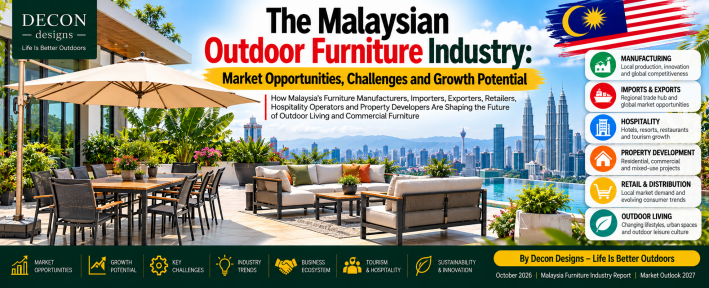
How Malaysia’s Furniture Manufacturers, Importers, Exporters, Retailers, Hospitality Operators and Property Developers Are Shaping the Future of Outdoor Living and Commercial Furniture
By Decon Designs – Life Is Better Outdoors | Malaysian Outdoor Furniture Industry | Furniture Manufacturing | Hospitality Furniture | Furniture Imports & Exports | Outdoor Living | Commercial Furniture | Tourism | Property Development | Global Industry Intelligence
October 2026 | Malaysia Furniture Industry Report | Market Outlook 2027
Malaysia’s outdoor furniture industry occupies an important position at the intersection of manufacturing, international trade, residential development, tourism, hospitality and modern outdoor living.
Across the country, outdoor furniture serves an increasingly diverse range of environments.
Condominium residents are furnishing balconies and terraces.
Homeowners are creating outdoor dining and relaxation spaces.
Restaurants and cafés are developing open-air seating environments.
Hotels and resorts are investing in swimming-pool facilities, outdoor lounges and guest amenities.
Property developers are incorporating landscaped communal areas, rooftop terraces and recreational facilities into residential and mixed-use developments.
At the same time, furniture manufacturers, importers, wholesalers, distributors and retailers are competing to supply products that meet different customer requirements.
These activities create opportunities throughout Malaysia’s furniture ecosystem.
However, the industry also faces significant challenges.
Manufacturing costs, imported components, international competition, climate suitability, inventory management, product quality and changing customer expectations all influence business performance.
The important question is no longer simply whether Malaysia has demand for outdoor furniture.
It is whether Malaysian manufacturers, suppliers and retailers are sufficiently prepared to capture opportunities in residential outdoor living, hospitality, commercial development and international trade.
At Decon Designs – Life Is Better Outdoors, with more than two decades serving Malaysia’s outdoor and hospitality furniture market, we believe the country’s future opportunities depend on combining manufacturing capability, suitable product specifications, customer education and reliable service.
This report examines the Malaysian outdoor furniture ecosystem, its demand drivers, manufacturing and distribution structure, import and export opportunities, major challenges and strategic priorities for 2027 and beyond.
1. Understanding Malaysia’s Outdoor Furniture Industry
The Malaysian outdoor furniture industry is part of the country’s wider furniture, home furnishings, building amenities and hospitality supply ecosystem.
It includes products designed for outdoor and semi-outdoor environments.
Major product categories include:
- Outdoor dining tables and chairs.
- Garden furniture.
- Patio sofas and lounge sets.
- Synthetic wicker furniture.
- Timber outdoor furniture.
- Aluminium furniture.
- Outdoor rope furniture.
- Pool loungers and daybeds.
- Parasols and umbrellas.
- Swings and garden seating.
- Balcony furniture.
- Commercial outdoor dining furniture.
- Resort and hotel furniture.
- Outdoor cushions and accessories.
The industry involves more than furniture manufacturing.
Its value chain includes material suppliers, component producers, importers, exporters, wholesalers, retailers, designers, logistics companies, project contractors, installation providers and maintenance businesses.
A furniture retailer in Selangor may source products from local manufacturers, overseas factories or a combination of both.
A resort in Langkawi may purchase furniture through a hospitality supplier that coordinates sourcing, delivery and installation.
A manufacturer in Johor may produce furniture for export while also supplying domestic distributors.
These business models form an interconnected industry.
An Important Market Measurement Challenge
Malaysia publishes official information about furniture manufacturing, investment and international trade.
However, publicly available headline statistics do not always isolate outdoor furniture from indoor furniture and other furnishings.
As a result, broad furniture-industry figures should not automatically be treated as outdoor-furniture-specific market figures.
This distinction is important for accurate reporting and investment decisions.
2. Malaysia’s Furniture Manufacturing Base: A Foundation for Outdoor Furniture Growth
Malaysia has an established furniture manufacturing sector.
The industry includes producers of wooden furniture, upholstered furniture, metal furniture, furniture components and other product categories.
According to the Malaysian Investment Development Authority (MIDA), the furniture and fixtures segment recorded:
- 39 approved projects in 2024.
- RM692.7 million in approved investment.
- 2,005 potential job opportunities associated with those approved projects.
MIDA also identifies modernization, automation, design development and higher-value manufacturing as important priorities for Malaysia’s furniture sector.
These figures demonstrate investment activity in the broader furniture and fixtures industry.
They do not establish how much investment was directed specifically toward outdoor furniture.
Nevertheless, Malaysia’s existing manufacturing capabilities provide a foundation for businesses seeking to develop outdoor furniture products.
Opportunities for Manufacturers
Manufacturers can explore:
- Commercial outdoor furniture.
- Hospitality furniture collections.
- Aluminium and mixed-material furniture.
- Modular outdoor seating.
- Export-oriented product ranges.
- Customized furniture for property projects.
- Replacement cushions and components.
- Product design and development services.
The strategic opportunity is to move beyond competing solely on manufacturing price.
Businesses can develop expertise in product design, technical specifications, material selection and customer-specific applications.
3. From Furniture Manufacturing to Higher-Value Product Development
Malaysia’s furniture industry has traditionally benefited from manufacturing and export capabilities.
However, international competition requires businesses to continually improve their positioning.
Manufacturers can operate through different models.
Original Equipment Manufacturing (OEM)
Manufacturing products according to another company’s specifications or designs.
Original Design Manufacturing (ODM)
Developing products that may be supplied to other brands or distributors.
Own-Brand Manufacturing (OBM)
Developing and marketing products under the manufacturer’s own brand.
Each model offers different commercial opportunities.
For outdoor furniture, higher-value development may involve:
- Original product designs.
- Better material specifications.
- Coordinated hospitality collections.
- Improved manufacturing consistency.
- Replaceable components.
- Technical documentation.
- Product customization.
- Stronger brand recognition.
Manufacturers that develop design and engineering capabilities may reduce their dependence on competing exclusively through low prices.
4. Malaysia’s Tourism Economy: Why It Matters to Outdoor Furniture
Tourism is an important part of Malaysia’s economy.
According to the Department of Statistics Malaysia (DOSM), tourism contributed RM323.0 billion in value added in 2025, equivalent to 15.9% of the country’s GDP.
The tourism sector also supported approximately 3.7 million jobs in 2025.
These figures demonstrate the economic scale of tourism-related activities.
However, they should not be interpreted as direct furniture expenditure.
The relationship between tourism and outdoor furniture is indirect but commercially important.
Tourism activity can support demand for accommodation, food and beverage services, recreational facilities and hospitality investment.
When hotels, resorts and restaurants open, renovate or replace furnishings, outdoor furniture suppliers may benefit.
Common Hospitality Furniture Requirements
- Pool loungers.
- Outdoor sofas.
- Garden seating.
- Restaurant dining sets.
- Parasols.
- Beach and poolside furniture.
- Terrace furniture.
- Outdoor cushions.
- Recreational-area furniture.
The opportunity extends beyond new hotel construction.
Existing properties may require furniture replacement, refurbishment and upgrades.
5. Visit Malaysia 2026 and the Hospitality Furniture Opportunity
Malaysia’s Visit Malaysia 2026 campaign provides a relevant context for businesses serving tourism and hospitality.
The campaign aims to strengthen the country’s tourism positioning.
For outdoor furniture suppliers, potential opportunities may arise when hospitality operators invest in:
- Guest-area improvements.
- Swimming-pool facilities.
- Restaurant terraces.
- Garden environments.
- Outdoor event spaces.
- Resort renovations.
- Recreational amenities.
However, a tourism campaign does not automatically create furniture orders.
Suppliers must identify actual projects, procurement requirements and purchasing budgets.
What Suppliers Should Do
Rather than relying on broad tourism optimism, businesses should:
- Develop relationships with hotel procurement teams.
- Understand resort furniture requirements.
- Prepare commercial product catalogues.
- Provide accurate material specifications.
- Clarify quantity availability.
- Offer realistic delivery schedules.
- Support appropriate maintenance planning.
Hospitality customers frequently evaluate suppliers according to operational reliability as well as product appearance.
6. Domestic Tourism: A Market Driver Worth Monitoring
Malaysia’s domestic tourism sector also represents an important part of the wider hospitality economy.
DOSM reported 290.1 million domestic visitors in 2025, an increase of 11.5% compared with 2024.
Domestic tourism expenditure reached RM121.3 billion in 2025.
These figures include many types of visitor activities and spending.
They do not indicate how much was spent on outdoor furniture.
Nevertheless, domestic tourism contributes to activity in hotels, resorts, restaurants and leisure destinations.
For outdoor furniture businesses, this creates a reason to monitor hospitality development and renovation activity across the country.
Potential opportunities may arise in:
- Langkawi.
- Penang.
- Kuala Lumpur.
- Selangor.
- Melaka.
- Johor.
- Pahang.
- Perak.
- Sabah.
- Sarawak.
Each market has different hospitality characteristics and procurement requirements.
7. Regional Opportunities Across Malaysia
Malaysia’s outdoor furniture market should not be treated as one uniform customer base.
Different states and urban centres have different demand characteristics.
Klang Valley: Kuala Lumpur and Selangor
The Klang Valley offers opportunities linked to residential properties, condominiums, restaurants, cafés, hotels and commercial developments.
Relevant product categories include balcony furniture, outdoor dining sets, rooftop seating and hospitality furnishings.
Retailers and distributors may also benefit from access to a large metropolitan customer base.
Johor
Johor offers opportunities associated with residential development, hospitality, commercial facilities and cross-border business activity.
Manufacturing and distribution capabilities are also relevant to the state’s furniture ecosystem.
Penang
Penang combines urban residential demand with tourism, hotels, restaurants and hospitality properties.
Outdoor furniture applications include balconies, terraces, gardens and commercial dining areas.
Melaka
Tourism-related businesses, accommodation operators and restaurants may require outdoor furniture for guest and dining environments.
Langkawi and Kedah
Island hospitality creates potential demand for resort loungers, parasols, outdoor sofas and poolside furniture.
Coastal exposure requires careful product selection and maintenance planning.
Pahang
Resorts, holiday accommodation and recreational properties create potential applications for outdoor furniture.
Sabah and Sarawak
Hospitality, tourism, residential development and commercial facilities provide opportunities for appropriate outdoor furnishing solutions.
Logistics and delivery arrangements can be particularly important when supplying projects across East Malaysia.
Regional demand should be evaluated through actual customer requirements, project activity and local purchasing conditions.
8. Residential Outdoor Living: A Changing Malaysian Consumer Market
Outdoor furniture is not purchased only by hotels and resorts.
Residential customers represent an important market.
Malaysian homeowners may use outdoor furniture in:
- Gardens.
- Covered patios.
- Terraces.
- Balconies.
- Courtyards.
- Rooftop areas.
- Swimming-pool surroundings.
Customers may seek comfortable furniture that complements their homes and lifestyles.
However, purchasing requirements differ considerably.
A condominium resident may need a compact two-person dining set.
A landed-property owner may prefer a larger outdoor sofa arrangement.
A homeowner with a swimming pool may require loungers and shade products.
Retailers should understand these differences rather than offering the same solution to every customer.
9. The Condominium and Balcony Furniture Opportunity
Urban residential development creates opportunities for compact outdoor furniture.
Condominium balconies often require careful planning.
Furniture must fit the available space while allowing practical movement.
Suitable products may include:
- Compact dining sets.
- Small lounge chairs.
- Lightweight tables.
- Folding furniture.
- Space-efficient seating.
- Appropriate shade accessories.
Customers should verify dimensions before purchasing.
They should also consider building-management requirements, access restrictions and applicable safety considerations.
Large furniture may be difficult to transport through lifts or narrow entrances.
Retailers that provide accurate measurements and practical advice can help reduce purchasing mistakes.
10. The Malaysian Hospitality Furniture Market
Hotels and resorts often have more demanding furniture requirements than residential customers.
Furniture may be used frequently by different guests.
Cleaning and maintenance may occur regularly.
Products may be exposed to moisture, sunlight and poolside conditions.
Commercial buyers should therefore consider:
- Intended usage.
- Product dimensions.
- Frame materials.
- Cushion specifications.
- Surface finishes.
- Maintenance requirements.
- Quantity consistency.
- Replacement availability.
- Delivery and installation.
- Warranty conditions.
A product suitable for occasional residential use may not be appropriate for intensive commercial applications.
Suppliers should avoid treating residential and hospitality furniture as interchangeable without verifying specifications.
11. Restaurants, Cafés and Outdoor Dining Furniture
Malaysia has a diverse food and beverage sector.
Restaurants and cafés may use outdoor furniture to create dining areas and improve customer environments.
Relevant products include:
- Outdoor dining tables.
- Commercial chairs.
- Benches.
- Parasols.
- Lounge seating.
- Compact café furniture.
Commercial operators often prioritize ease of cleaning, seating comfort, layout flexibility and durability.
Furniture selection may also affect staff movement and customer circulation.
Suppliers should understand the operational requirements of each establishment.
A café with limited terrace space may need different furniture from a large restaurant with an open garden.
12. Property Developers: An Important Customer Segment
Residential and mixed-use property developments may include outdoor amenities.
Examples include:
- Swimming pools.
- Rooftop lounges.
- Landscaped courtyards.
- Garden seating areas.
- Clubhouses.
- Recreational spaces.
- Shared terraces.
Outdoor furniture can contribute to the usability and appearance of these facilities.
However, furniture should be considered during project planning rather than only at the final purchasing stage.
Developers and designers should evaluate:
- Space dimensions.
- Circulation.
- Intended occupancy.
- Environmental exposure.
- Maintenance responsibilities.
- Storage.
- Installation.
- Product replacement requirements.
Early coordination can help avoid unsuitable product selections.
13. Malaysia’s Outdoor Furniture Imports: Why Overseas Sourcing Matters
Imported furniture plays a role in Malaysia’s domestic market.
Retailers and project suppliers may source finished furniture, components or materials from international manufacturers.
Potential sourcing countries include China, Vietnam, Indonesia and other established furniture-producing markets.
Imports can offer access to:
- Additional product designs.
- Different materials.
- Specialized manufacturing capabilities.
- Alternative price points.
- Product categories not readily available locally.
However, importing furniture involves more than comparing factory prices.
Businesses must account for:
- Freight.
- Customs classification.
- Applicable duties and taxes.
- Exchange rates.
- Shipping insurance.
- Packaging.
- Delivery lead times.
- Quality inspection.
- Product specifications.
- Warranty responsibilities.
The final landed cost may differ substantially from the original factory quotation.
Import Strategy for 2027
Importers should strengthen supplier verification and product inspection.
They should also avoid assuming that a product suitable for another country will automatically perform well in Malaysia’s tropical climate.
14. Malaysia’s Furniture Exports: Opportunities Beyond the Domestic Market
Malaysia participates in international furniture trade.
Its established manufacturing sector provides a platform for export-oriented businesses.
However, furniture export statistics typically include multiple product categories.
Outdoor furniture should not be assumed to represent the entire reported export value.
Manufacturers considering international markets should evaluate:
- Customer demand.
- Product standards.
- Material specifications.
- Shipping costs.
- Import requirements.
- Packaging.
- Distribution partnerships.
- Currency exposure.
- After-sales responsibilities.
Potential Export Strategies
OEM Manufacturing: Supplying international brands according to agreed specifications.
ODM Manufacturing: Developing products for overseas distributors.
Own-Brand Exporting: Building Malaysian outdoor furniture brands internationally.
Commercial Project Supply: Serving overseas hospitality and development projects.
Specialized Components: Exporting furniture components, cushions or other suitable products.
International expansion should be based on verified market opportunities and operational readiness.
15. The Import-versus-Local-Manufacturing Decision
Malaysian furniture businesses may face a strategic choice between local manufacturing and imported products.
Neither model is automatically superior.
| Factor | Local manufacturing | Imported furniture |
|---|---|---|
| Customization | May offer easier coordination with nearby factories | Depends on overseas manufacturer |
| Lead times | May be shorter for locally available production | Can include international shipping |
| Product variety | Depends on domestic capabilities | May offer broader international sourcing |
| Currency exposure | May still affect imported inputs | Often affected by foreign-currency purchases |
| Quality control | Potential for local inspection | May require overseas inspection |
| Minimum orders | Depends on manufacturer | Depends on supplier and shipping economics |
| After-sales support | May simplify some repairs or replacements | Depends on importer and spare-part arrangements |
Many businesses may benefit from combining local and international sourcing.
The correct approach depends on product requirements, price, volume and supplier reliability.
16. Outdoor Furniture Materials Suitable for Malaysia’s Climate
Malaysia’s tropical conditions create particular furniture requirements.
High humidity, rainfall and sunlight can affect product performance.
Material selection should therefore be based on intended application.
Aluminium
Aluminium is used in many outdoor furniture designs.
Buyers should examine frame construction, coating quality and intended environmental suitability.
Synthetic Wicker
Synthetic wicker is widely associated with outdoor lounge and dining furniture.
Material quality, weaving consistency and frame construction matter.
Timber
Suitable timber furniture can offer natural appearance and design appeal.
However, maintenance and weathering expectations should be understood.
Outdoor Rope
Rope-based furniture can provide contemporary styling.
Performance depends on material specification, construction and exposure.
Steel
Steel can be used in furniture structures, but appropriate corrosion protection is important.
Outdoor Fabrics
Cushion and upholstery performance depends on fabric construction, drying characteristics, UV exposure and maintenance.
No outdoor furniture material should be described as universally maintenance-free or suitable for every environment.
17. Why Malaysia’s Climate Creates Both Challenges and Opportunities
Tropical weather can influence the lifespan and maintenance of outdoor furniture.
Potential concerns include:
- Surface deterioration.
- Corrosion.
- Colour changes.
- Moisture retention.
- Cushion drying.
- Material ageing.
- Maintenance frequency.
These conditions create opportunities for manufacturers to develop products appropriate for local environments.
They also create opportunities for suppliers to educate customers.
For example, a product used on a covered condominium balcony may experience different conditions from furniture installed beside an exposed swimming pool.
Suppliers should explain recommended usage conditions and maintenance practices.
This can help reduce customer dissatisfaction and improve product selection.
18. Commercial Parasols and Outdoor Shade Products
Parasols and umbrellas are important products in Malaysia’s outdoor furniture market.
They serve residential, hospitality and commercial applications.
Product categories include:
- Centre-pole parasols.
- Cantilever parasols.
- Commercial umbrellas.
- Garden umbrellas.
- Shade accessories.
- Appropriate bases and support systems.
Buyers should consider:
- Canopy dimensions.
- Frame construction.
- Base requirements.
- Stability.
- Operating limitations.
- Installation.
- Maintenance.
- Intended location.
Commercial parasols should be selected with particular attention to safety and site conditions.
A product’s appearance alone does not establish its suitability.
19. The Outdoor Furniture Retail Market in Malaysia
Furniture retailing is changing as customers increasingly combine online research with showroom visits.
A customer may discover an outdoor dining set through a search engine.
They may then compare prices and photographs across several websites.
After reading reviews, they may visit a showroom or contact a supplier for clarification.
This creates opportunities for retailers that provide accurate product information.
Useful retail capabilities include:
- Clear product catalogues.
- Accurate dimensions.
- Material descriptions.
- Realistic photographs.
- Transparent product inclusions.
- Delivery information.
- Warranty explanations.
- Customer consultation.
- After-sales support.
A showroom remains valuable because customers can inspect actual materials, finishes and seating comfort.
Digital information and physical retail experiences can complement one another.
20. Digital Competition: Why Malaysian Outdoor Furniture Companies Need Better Visibility
Many furniture businesses compete for online attention.
Customers may search for:
“Outdoor furniture Malaysia”
“Outdoor furniture supplier Selangor”
“Patio furniture Kuala Lumpur”
“Hotel outdoor furniture supplier”
“Commercial parasol Malaysia”
“Resort furniture Malaysia”
Businesses that provide relevant, accurate and searchable information may improve their opportunities to reach prospective buyers.
However, digital visibility should not be confused with guaranteed sales.
A business must still offer suitable products and reliable service.
Digital Priorities
Furniture companies should maintain:
- Accurate business information.
- Product descriptions.
- Technical specifications.
- Clear contact channels.
- Relevant photographs.
- Customer reviews.
- Educational articles.
- Project information where available.
The objective is to make supplier evaluation easier for customers.
21. The Role of Reviews and Reputation in Malaysia’s Furniture Market
Customer reviews can influence furniture purchasing decisions.
They may provide information about:
- Product quality.
- Delivery.
- Supplier communication.
- Installation.
- After-sales service.
- Long-term satisfaction.
Platforms such as Google Reviews and furniture-focused review services can contribute to buyer research.
However, buyers should evaluate review quality rather than relying exclusively on star ratings.
For commercial projects, supplier references and technical verification are also important.
A supplier with positive residential reviews may not necessarily have the capacity to fulfil a large hotel project.
Reputation should be supported by relevant evidence.
22. The Challenges Facing Malaysian Outdoor Furniture Manufacturers
Manufacturers face several competitive pressures.
Production Costs
Materials, labour, energy and equipment influence manufacturing economics.
International Competition
Overseas manufacturers may offer competing products and prices.
Quality Consistency
Poor production controls can increase defects and customer complaints.
Product Development
Manufacturers must adapt to changing design preferences and buyer requirements.
Skilled Labour
Technical skills and manufacturing expertise influence production quality.
Export Complexity
International markets may require different documentation, standards and logistics arrangements.
Sustainability Expectations
Customers may request more information about materials, sourcing and product lifespan.
Businesses that address these issues systematically may improve their competitiveness.
23. Challenges Facing Importers, Retailers and Distributors
Importers and retailers face a different set of risks.
These include:
- Shipping delays.
- Exchange-rate changes.
- Excess inventory.
- Slow-moving products.
- Delivery damage.
- Product mismatch.
- Warranty disputes.
- Price competition.
- Customer acquisition costs.
- Storage expenses.
Outdoor furniture can be bulky and may require substantial warehouse space.
Retailers should therefore manage stock carefully.
A product with attractive margins may become less profitable if it remains unsold for an extended period.
Accurate demand planning and inventory management are important.
24. The Hidden Cost of Poor Furniture Procurement
Commercial buyers may focus heavily on purchase price.
However, furniture procurement involves several additional costs.
These may include:
- Delivery.
- Installation.
- Maintenance.
- Repairs.
- Replacement components.
- Product replacement.
- Operational disruption.
A hotel purchasing outdoor loungers should consider whether replacement cushions are available.
A restaurant purchasing dining chairs should evaluate cleaning and frequency of use.
A property developer should understand maintenance responsibilities after project completion.
The lowest initial price may not produce the lowest long-term cost.
Commercial buyers should evaluate total cost of ownership using realistic assumptions.
25. Sustainability and the Future of Malaysian Outdoor Furniture
Sustainability is becoming an important consideration across the furniture sector.
Potential areas of improvement include:
- Responsible material sourcing.
- Product durability.
- Repairability.
- Replacement components.
- Packaging efficiency.
- Waste reduction.
- Recycling.
- Product lifecycle management.
Manufacturers should avoid unsupported environmental claims.
For example, recycled content does not automatically guarantee lower overall environmental impact.
Likewise, natural materials are not automatically sustainable.
Credible sustainability practices require appropriate evidence and consideration of the complete product lifecycle.
26. The Circular Furniture Economy: Repair, Refurbishment and Replacement
Outdoor furniture creates opportunities beyond the initial sale.
Products may require:
- Cushion replacement.
- Upholstery renewal.
- Frame repairs.
- Surface refinishing.
- Replacement fittings.
- Cleaning.
- Refurbishment.
These services can support longer product use where technically and economically practical.
For hospitality operators, planned maintenance may help manage furniture assets.
For suppliers, after-sales services can create ongoing customer relationships.
For manufacturers, designing products with serviceable components may provide commercial differentiation.
27. Opportunities for Malaysian SMEs and Furniture Entrepreneurs
Malaysia’s outdoor furniture ecosystem offers opportunities for businesses of different sizes.
Small and medium-sized enterprises may explore specialized activities such as:
- Balcony furniture retailing.
- Commercial parasol supply.
- Resort furniture procurement.
- Replacement cushions.
- Outdoor upholstery services.
- Furniture maintenance.
- Project installation.
- Digital furniture catalogues.
- Specialized furniture components.
- Export-market development.
Businesses should select opportunities based on available capabilities and verified demand.
A focused business model may be more sustainable than attempting to serve every furniture category.
28. The Malaysian Outdoor Furniture Industry: Opportunities for 2027
Looking toward 2027, several strategic opportunities deserve attention.
| Opportunity | Potential customers | Important preparation |
|---|---|---|
| Hospitality furniture | Hotels and resorts | Product suitability, project coordination |
| Outdoor dining | Restaurants and cafés | Durability, cleaning, layout planning |
| Balcony furniture | Condominium residents | Compact dimensions, delivery access |
| Property amenities | Developers and management companies | Specifications, quantity planning |
| Parasols and shade | Hospitality and residential buyers | Stability, site suitability, safety |
| Furniture refurbishment | Hotels, businesses and homeowners | Repair capability, parts availability |
| Export development | International buyers | Market research, compliance, logistics |
| Digital furniture retail | Residential and commercial customers | Accurate catalogues, customer service |
These opportunities are not guaranteed growth categories.
Their commercial attractiveness will depend on customer demand, competition and operating costs.
Businesses should validate opportunities before committing substantial investment.
29. What Malaysia’s Outdoor Furniture Businesses Should Do Next
Manufacturers, suppliers and retailers can strengthen their readiness through a practical industry-development agenda.
For Manufacturers
Improve product design, quality consistency and manufacturing efficiency.
For Importers
Strengthen supplier verification, landed-cost analysis and product inspection.
For Retailers
Provide clearer product information and improve customer consultation.
For Hospitality Suppliers
Develop commercial procurement capabilities and reliable project coordination.
For Property Developers
Integrate outdoor furniture requirements into early design and budgeting.
For Industry Associations
Support relevant skills development, trade intelligence, manufacturing modernization and industry collaboration.
For Buyers
Verify product specifications, environmental suitability, warranty terms and total ownership costs.
The common objective should be to improve the quality of commercial decisions across the industry.
30. Decon Designs: Supporting Malaysia’s Outdoor Living and Hospitality Furniture Needs
At Decon Designs – Life Is Better Outdoors, we see Malaysia’s outdoor furniture industry as an important part of the country’s residential, commercial and hospitality ecosystem.
With more than two decades serving Malaysia’s outdoor and hospitality furniture market, our perspective is shaped by the practical requirements of customers purchasing furniture for different environments.
A homeowner may be looking for a suitable outdoor dining set.
A restaurant may need seating for a terrace.
A resort may be evaluating pool loungers and parasols.
A property developer may require furniture for communal amenities.
Each application requires careful consideration of materials, dimensions, environmental exposure, maintenance and budget.
We believe customers benefit from understanding these factors before making purchasing decisions.
We also believe furniture businesses benefit from understanding wider industry developments.
Malaysia’s furniture manufacturing base, tourism economy, property-development activity and international trade relationships create opportunities across the outdoor furniture value chain.
However, long-term business success requires more than identifying demand.
It requires product suitability, operational reliability, accurate information and customer confidence.
Our guiding principle remains simple: Life Is Better Outdoors—but better outdoor living begins with informed furniture choices.
Conclusion: Malaysia’s Outdoor Furniture Industry Has Opportunities Beyond Furniture Sales
Malaysia’s outdoor furniture industry is supported by several interconnected economic activities.
Manufacturing.
Imports and exports.
Residential outdoor living.
Hospitality.
Tourism.
Restaurants and cafés.
Property development.
Retailing.
Logistics.
Maintenance and refurbishment.
These activities create opportunities for manufacturers, suppliers, distributors, retailers, designers and service providers.
However, the industry must address important challenges.
International competition, production costs, climate suitability, inventory management and customer expectations all influence commercial performance.
The businesses best positioned for future opportunities will be those that understand their customers, maintain suitable product standards and manage their operations responsibly.
For Malaysia, the next stage of outdoor furniture industry development should focus on stronger manufacturing capabilities, better product information, commercial specialization and greater coordination between suppliers and buyers.
The future of Malaysia’s outdoor furniture industry is not simply about selling more chairs, tables, sofas or parasols. It is about creating better outdoor environments, stronger businesses and more reliable furniture supply relationships.
Decon Designs – Life Is Better Outdoors.
Frequently Asked Questions About Malaysia’s Outdoor Furniture Industry
1. What is the outdoor furniture industry in Malaysia?
It includes businesses involved in manufacturing, importing, exporting, distributing, retailing and maintaining furniture used in gardens, balconies, patios, hotels, resorts, restaurants and other outdoor environments.
2. Does Malaysia manufacture outdoor furniture?
Malaysia has an established furniture manufacturing sector with capabilities relevant to outdoor furniture. However, not all Malaysian furniture manufacturers specialize in outdoor products.
3. What drives outdoor furniture demand in Malaysia?
Potential demand drivers include residential outdoor living, hospitality investment, restaurants, property development and replacement of existing furniture.
4. Why is tourism important to outdoor furniture suppliers?
Hotels, resorts and restaurants use outdoor furniture in guest areas, dining environments and recreational facilities. New projects and renovations may create purchasing opportunities.
5. Does Malaysia import outdoor furniture?
Yes. Imported furniture and components are part of the domestic supply ecosystem. Importers should evaluate landed costs, specifications and supplier reliability.
6. Can Malaysian manufacturers export outdoor furniture?
Manufacturers can explore export markets, subject to customer demand, product suitability, relevant standards and commercial requirements.
7. Which materials are suitable for outdoor furniture in Malaysia?
Common options include aluminium, suitable timber, synthetic wicker, outdoor rope and specialized fabrics. Suitability depends on product specifications and environmental exposure.
8. What are the biggest challenges?
Challenges include production costs, international competition, shipping, product quality, climate exposure, inventory management and customer expectations.
9. What opportunities exist for Malaysian furniture SMEs?
Potential opportunities include specialized retailing, hospitality procurement, commercial shade products, furniture maintenance, replacement components and digital distribution.
10. What should commercial buyers evaluate before purchasing?
Buyers should assess product specifications, intended use, supplier capability, delivery arrangements, maintenance, warranty and total cost of ownership.
Research Sources and Industry References
The following sources provide official industry and tourism context. Their statistics relate to broader economic sectors and should not be interpreted as outdoor-furniture-only figures.
1. Malaysian Investment Development Authority (MIDA)
Wood-Based and Furniture Industry
https://www.mida.gov.my/industries/manufacturing/wood-based-and-furniture/
2. Department of Statistics Malaysia (DOSM)
Tourism Satellite Account, 2025
https://www.dosm.gov.my/portal-main/release-content/tourism-satellite-account-2025
3. Department of Statistics Malaysia (DOSM)
Domestic Tourism Survey, 2025
https://www.dosm.gov.my/portal-main/release-content/domestic-tourism-survey-2025
4. Department of Statistics Malaysia (DOSM)
Performance of Domestic Tourism Malaysia, Second Quarter 2026
https://www.dosm.gov.my/uploads/release-content/file_20260923103501.pdf
5. Tourism Malaysia
Official tourism information and industry resources
https://www.tourism.gov.my/
6. Malaysia External Trade Development Corporation (MATRADE)
Export development and trade information
https://www.matrade.gov.my/
7. Malaysian Timber Industry Board (MTIB)
Timber industry development and information
https://www.mtib.gov.my/
Publishing Pack
Caption
The Malaysian Outdoor Furniture Industry: Market Opportunities, Challenges and Growth Potential
Malaysia’s outdoor furniture industry is more than a market for garden chairs, patio sofas and dining sets.
It connects furniture manufacturing, international trade, tourism, hospitality, property development, retailing and modern outdoor living.
With Malaysia’s tourism economy contributing RM323 billion in value added in 2025, the wider hospitality sector represents an important market to watch for furniture suppliers.
But growth opportunities also bring challenges—from manufacturing costs and imports to tropical-climate durability, competition and changing buyer expectations.
Explore Decon Designs’ comprehensive report on the Malaysian Outdoor Furniture Industry and the opportunities ahead.
Malaysia’s outdoor furniture future depends on stronger products, smarter procurement and businesses that understand their customers.
By Decon Designs – Life Is Better Outdoors.


