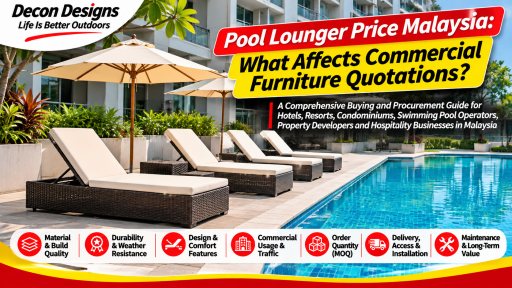
A Comprehensive Buying and Procurement Guide for Hotels, Resorts, Condominiums, Swimming Pool Operators, Property Developers and Hospitality Businesses in Malaysia
By Decon Designs – Life Is Better Outdoors
Pool Lounger Price Malaysia | Commercial Pool Furniture | Hotel Sun Loungers | Resort Furniture Malaysia | Swimming Pool Furniture | Outdoor Furniture Procurement | Poolside Furniture Supplier Malaysia | Hospitality Furniture Quotations | Commercial Sun Loungers | Outdoor Furniture Malaysia
Introduction: Why Can Two Pool Loungers Have Very Different Prices?
When a hotel, resort, condominium or property developer requests a quotation for swimming pool loungers in Malaysia, the first question is often straightforward:
“How much does one pool lounger cost?”
But the answer is rarely as simple as quoting a single price.
One supplier may offer a sun lounger for several hundred ringgit.
Another may quote several thousand ringgit for a product that appears similar in photographs.
Why such a significant difference?
Is it the brand?
The frame material?
The quality of the outdoor fabric?
The reclining mechanism?
The quantity being ordered?
Or the delivery and installation requirements?
In commercial outdoor furniture procurement, the selling price is influenced by numerous factors, including construction quality, materials, manufacturing specifications, order quantity, intended application, logistics and after-sales terms.
A pool lounger intended for occasional residential use may not have the same specifications as a lounger selected for a busy resort.
Similarly, a product used beside a sheltered condominium swimming pool may face different conditions from furniture installed near a coastal resort.
The most important purchasing decision is not finding the cheapest pool lounger. It is identifying the right furniture specification at a commercially justifiable total cost.
For hospitality operators, furniture is not merely decoration.
It affects guest comfort, poolside functionality, maintenance workload, visual presentation and replacement planning.
This guide by Decon Designs – Life Is Better Outdoors explains what influences pool lounger prices in Malaysia, how commercial quotations are prepared, what procurement teams should ask suppliers and how to compare competing offers fairly.
1. What Is a Pool Lounger?
A pool lounger, also called a sun lounger, poolside lounger or outdoor reclining chair, is a seating product designed for reclining or relaxing in an appropriate outdoor environment.
Pool loungers are commonly found in:
- Hotels and resorts.
- Condominium swimming pool areas.
- Serviced apartments.
- Private residences.
- Beach clubs.
- Wellness retreats.
- Hospitality and recreational facilities.
- Selected commercial leisure environments.
They may feature adjustable backrests, fixed reclining positions, wheels, armrests, cushions or other functional components.
However, not every product marketed as a pool lounger is designed for intensive commercial use.
Buyers should confirm the manufacturer’s intended application before purchasing.
2. Pool Lounger Prices in Malaysia: Why There Is No Universal Price
There is no single standard price for pool loungers in Malaysia.
Prices depend on the product and the procurement arrangement.
A quotation for five loungers may differ from a quotation for fifty.
A basic folding lounger may cost less than a larger product with premium materials and an adjustable reclining mechanism.
A supplier may quote furniture only, while another includes delivery, assembly or other services.
Therefore, a fair price comparison must consider the complete specification and quotation scope.
Illustrative price categories
Rather than assuming fixed market prices, commercial buyers can divide pool loungers into broad categories:
| Product category | Typical specification considerations |
|---|---|
| Basic residential lounger | Simpler construction, occasional-use suitability |
| Adjustable outdoor lounger | Reclining mechanism, frame design, support |
| Wheeled pool lounger | Wheels, mobility, additional fittings |
| Cushioned pool lounger | Frame plus cushion materials and upholstery |
| Commercial hospitality lounger | Intended-use suitability, durability and maintenance |
| Premium resort lounger | Design, materials, finishes and project specifications |
These are product categories, not verified market price bands.
The actual selling price should be obtained through current supplier quotations.
3. Factor One: Frame Material
The frame is one of the most important factors affecting pool lounger cost.
It supports the user and determines much of the furniture’s structural performance.
Common materials include aluminium, steel, timber and selected polymer-based constructions.
Aluminium Pool Loungers
Aluminium is widely used in outdoor furniture because it is relatively lightweight and does not rust in the same way as iron or steel.
It may be suitable for many poolside applications.
However, aluminium furniture varies in quality.
Important factors include:
- Alloy selection.
- Frame dimensions.
- Wall thickness.
- Welding.
- Joint construction.
- Surface finishing.
- Fasteners.
- Product design.
An aluminium frame should not automatically be considered suitable for every commercial environment.
Powder-Coated Steel Pool Loungers
Steel can provide structural strength.
However, it requires appropriate corrosion protection.
Poolside environments may expose furniture to water, cleaning products and other corrosive conditions.
If a protective coating is damaged, exposed steel may corrode.
For commercial procurement, the quality of finishing and maintenance requirements should be evaluated carefully.
Wooden Pool Loungers
Timber loungers may be selected for their natural appearance.
However, wood species, processing, joinery and finishing affect performance and price.
Wooden furniture may also require periodic maintenance.
For hospitality operators, maintenance costs should be included in the purchasing decision.
4. Factor Two: Poolside Corrosion and Chemical Exposure
Swimming pool environments can be demanding.
Furniture may be exposed to splashing water, cleaning chemicals, humidity and, in coastal locations, airborne salts.
These conditions can affect frames, fasteners, coatings and moving parts.
It is important to distinguish between ordinary outdoor suitability and suitability for a specific poolside environment.
A product used beside a freshwater residential pool may face different conditions from one installed at a coastal resort.
Questions for suppliers
What materials are used in the frame?
What materials are used for fasteners?
What protective finish is applied?
Is the product intended for poolside exposure?
Are there specific cleaning restrictions?
What maintenance is recommended?
Are there documented corrosion-resistance claims?
The correct material specification should reflect the actual installation environment.
5. Factor Three: Lounger Dimensions and Material Consumption
Larger loungers generally require more materials.
However, dimensions alone do not determine price.
A compact lounger with a complex mechanism may cost more than a larger product with a simpler construction.
Buyers should compare:
- Overall length.
- Width.
- Seat height.
- Reclining dimensions.
- Folded dimensions, where applicable.
- Product weight.
- Recommended user load.
- Required clearance around the product.
The dimensions also influence the number of loungers that can fit safely within the pool deck.
6. Factor Four: Adjustable Backrest Mechanisms
Some pool loungers feature adjustable backrests.
This allows users to choose different reclining positions.
The mechanism may involve hinges, support brackets, locking positions and other components.
Manufacturing complexity can affect cost.
However, an adjustable feature should not be valued solely because it is present.
Commercial buyers should evaluate whether the mechanism is easy to operate, stable and appropriate for frequent use.
What to inspect
Does the backrest lock securely?
Are the adjustment positions practical?
Are there pinch points?
Are moving parts protected against the intended environment?
Can the mechanism be maintained or repaired?
A poorly designed reclining mechanism can create operational problems even if the furniture looks attractive.
7. Factor Five: Wheels and Mobility
Wheels can make pool loungers easier to reposition.
This may be useful for hotels and resorts where staff regularly rearrange furniture.
However, wheels introduce additional components.
Their material, attachment method and suitability for the pool-deck surface matter.
Buyers should ask whether wheels are intended for frequent movement and whether replacement components are available.
Wheeled loungers should also be assessed for stability during use.
8. Factor Six: Seating Surface and Fabric
Pool loungers may use different seating surfaces.
Some have stretched mesh or textile seating.
Others use rigid support surfaces with removable cushions.
Some combine multiple materials.
The seating surface influences comfort, maintenance and cost.
Mesh and textile seating
These products may be designed to allow ventilation and practical cleaning.
However, fabric specifications and attachment methods vary.
Cushioned loungers
Cushions may provide additional comfort.
They also introduce foam, fabric, stitching and maintenance requirements.
Rigid seating surfaces
These may be simpler to clean, depending on material and design.
However, user comfort and surface temperature should be considered.
Commercial buyers should assess the seating system as a complete product.
9. Factor Seven: Cushion Specifications
Cushions can significantly influence the total cost of a poolside furniture arrangement.
Differences may include:
- Foam type.
- Cushion thickness.
- Fabric composition.
- Water resistance.
- UV performance.
- Stitching quality.
- Removable covers.
- Cleaning requirements.
- Replacement availability.
Water-resistant cushions are not necessarily waterproof.
A cushion may resist light moisture but still absorb water during heavy rain or prolonged exposure.
Hotel and resort operators should understand the care requirements before purchasing.
10. Factor Eight: UV Resistance and Colour Stability
Pool loungers may receive prolonged direct sunlight.
UV exposure can affect certain polymers, fabrics, coatings and other materials.
Manufacturers may use stabilisers and pigments to improve weathering performance.
However, claims such as UV-resistant or weatherproof should be supported by appropriate product information.
Buyers should ask what the claim covers and whether testing has been performed.
A material may resist one form of deterioration while still experiencing colour changes or other ageing effects.
11. Factor Nine: Manufacturing Quality and Workmanship
The quality of fabrication can influence both price and serviceability.
Commercial procurement teams should examine:
- Frame alignment.
- Joint quality.
- Surface finishing.
- Stability.
- Moving mechanisms.
- Fastener security.
- Seating support.
- Sharp edges.
- Assembly quality.
Photographs alone may not reveal these details.
Where practical, evaluate a physical sample before approving a large order.
12. Factor Ten: Residential Versus Commercial Specifications
A major procurement mistake is assuming that all outdoor loungers are suitable for commercial use.
Residential furniture may be designed for occasional use.
Commercial hospitality furniture may need to withstand more frequent occupancy, cleaning and movement.
However, the label commercial grade is not a substitute for evidence.
Ask suppliers for relevant load ratings, durability information, intended-use guidance and applicable test documentation where available.
Do not assume that a higher price automatically proves commercial suitability.
13. Factor Eleven: Quantity Ordered
Order quantity can affect commercial quotations.
A supplier may offer different unit prices for different quantities.
This can reflect purchasing efficiencies, logistics, production scale or inventory considerations.
However, bulk discounts are not guaranteed.
For example, a quotation for 40 loungers may have a lower unit price than an order for four, but the difference depends on the supplier’s circumstances.
Buyers should request written quotations for the required quantities rather than assuming a particular discount percentage.
14. Factor Twelve: Standard Products Versus Custom-Made Furniture
Standard inventory products may have established specifications and available stock.
Custom-made products may require additional design, materials, production planning and approval processes.
Customisation may include:
- Frame colours.
- Fabric colours.
- Dimensions.
- Branding.
- Special finishes.
- Product configuration.
Each custom requirement can affect pricing, minimum order quantities and lead times.
For commercial projects, final specifications should be documented before production.
15. Factor Thirteen: Imported Versus Locally Manufactured Loungers
The country of manufacture can influence the cost structure.
Imported furniture may involve international freight, exchange-rate exposure, customs-related charges and local distribution.
Locally manufactured products may have different raw-material, labour and overhead costs.
Neither origin automatically guarantees better quality.
Commercial buyers should evaluate specifications, quality control, lead times and support.
16. Factor Fourteen: Delivery, Handling and Installation
A commercial quotation may or may not include delivery.
For hotel and condominium projects, logistics can be substantial.
Costs may depend on:
- Delivery location.
- Order quantity.
- Product dimensions.
- Packaging.
- Loading access.
- Lift availability.
- Delivery scheduling.
- Assembly requirements.
- Site restrictions.
A supplier offering a lower furniture price may have higher delivery or installation charges.
Always compare the total delivered cost.
17. Factor Fifteen: Warranty and After-Sales Support
Commercial furniture procurement should include a review of after-sales terms.
Questions include:
What warranty applies?
Does it cover commercial use?
Which components are covered?
Are moving parts included?
What exclusions apply?
Are replacement parts available?
How are claims handled?
What maintenance is required to preserve coverage?
Do not assume that a residential warranty applies to hotel or resort use.
18. Why Hotel Pool Lounger Quotations May Differ From Condominium Quotations
Hotels and condominiums may have different operational requirements.
A hotel may need a coordinated quantity of loungers with consistent appearance and maintenance procedures.
A condominium management body may prioritise long-term replacement planning and resident safety.
A resort may face coastal exposure and frequent rearrangement.
Therefore, the quotation should reflect the project rather than only the number of products.
19. Pool Loungers for Coastal Resorts
Coastal environments may expose furniture to airborne salts and other demanding conditions.
Material selection should account for corrosion risks.
Frames, fasteners and moving components may require particular attention.
A product suitable for an inland residential patio may not be appropriate for a coastal commercial project.
Suppliers should be informed of the installation location before quoting.
20. Pool Loungers for Condominium Swimming Pools
Condominium pool decks often serve many residents.
Furniture selection should consider durability, stability, maintenance and the applicable management requirements.
The number of loungers should be based on the usable deck area and safe circulation.
Furniture must not obstruct emergency equipment, access routes or pool operations.
Management should confirm applicable safety and operational requirements before installation.
21. Pool Loungers for Hotels and Serviced Apartments
Hotels and serviced apartments may prioritise guest comfort and visual consistency.
However, appearance should not overshadow operational needs.
A lounger should be practical for staff to clean, inspect and maintain.
Replacement availability can also matter when a property needs to maintain a consistent furniture arrangement.
22. Pool Loungers for Private Residential Swimming Pools
Residential buyers may have different priorities from commercial operators.
They may place greater emphasis on personal comfort, appearance and occasional use.
However, material suitability and safety remain important.
A lower-cost residential lounger may be appropriate for some private applications, provided the product meets the intended requirements.
23. How Many Pool Loungers Should a Commercial Property Buy?
The correct quantity depends on the pool-deck layout, expected occupancy, circulation requirements and operational needs.
There is no universal number suitable for every project.
Buyers should prepare a scaled layout.
Allow adequate space around furniture.
Maintain clear access to pool equipment, emergency facilities and circulation routes.
Avoid placing loungers where they interfere with safe pool use.
For larger projects, coordinate furniture planning with the relevant design and facilities teams.
24. Comparing Pool Lounger Quotations Fairly
Commercial buyers should avoid comparing only the unit price.
Instead, request quotations using the same specifications.
| Comparison item | Supplier A | Supplier B | Supplier C |
|---|---|---|---|
| Product model | Confirm | Confirm | Confirm |
| Frame material | Confirm | Confirm | Confirm |
| Overall dimensions | Confirm | Confirm | Confirm |
| Seating material | Confirm | Confirm | Confirm |
| Adjustable backrest | Confirm | Confirm | Confirm |
| Wheels | Confirm | Confirm | Confirm |
| Cushion inclusion | Confirm | Confirm | Confirm |
| Intended commercial use | Confirm | Confirm | Confirm |
| Unit price | Quote | Quote | Quote |
| Quantity | Quote | Quote | Quote |
| Delivery | Quote | Quote | Quote |
| Assembly | Quote | Quote | Quote |
| Warranty | Confirm | Confirm | Confirm |
| Lead time | Confirm | Confirm | Confirm |
| Replacement parts | Confirm | Confirm | Confirm |
This makes the purchasing decision more transparent.
25. Example: Understanding the Total Cost of a Commercial Pool Lounger Order
Consider a hypothetical hotel purchasing 30 pool loungers.
Supplier A offers a unit price of RM900.
Supplier B offers a unit price of RM1,050.
At first glance, Supplier A appears cheaper.
However, assume the following illustrative costs.
| Cost component | Supplier A | Supplier B |
|---|---|---|
| Unit price | RM900 | RM1,050 |
| Quantity | 30 | 30 |
| Furniture subtotal | RM27,000 | RM31,500 |
| Delivery | RM2,000 | Included |
| Assembly | RM1,500 | Included |
| Total quoted cost | RM30,500 | RM31,500 |
Supplier A remains RM1,000 cheaper in this example.
But the buyer still needs to compare product specifications, commercial suitability, warranty terms and expected maintenance.
These figures are hypothetical examples, not actual supplier quotations.
The lesson is that total cost matters more than unit price alone.
26. Cost Per Year: A Better Way to Evaluate Commercial Furniture
Commercial furniture should be evaluated over its expected period of use.
For example, consider two hypothetical loungers.
Lounger A
Purchase price: RM800.
Assumed service life: Three years.
Annualised purchase cost: Approximately RM267.
Lounger B
Purchase price: RM1,400.
Assumed service life: Six years.
Annualised purchase cost: Approximately RM233.
Under these assumptions, Lounger B has a lower annualised purchase cost.
However, the assumed service lives are illustrative and do not represent actual performance claims.
Maintenance, repairs, utilisation and environmental exposure can change the result.
Commercial buyers should use realistic project-specific assumptions.
27. Hidden Costs in Pool Lounger Procurement
Some costs may not be obvious in the initial quotation.
These can include:
- Replacement cushions.
- Cleaning labour.
- Repairs.
- Replacement wheels.
- Replacement fittings.
- Storage requirements.
- Disposal of damaged furniture.
- Transport for repairs.
- Product downtime.
- Replacement purchases.
A procurement decision should consider these potential costs where relevant.
28. Why Buying the Cheapest Lounger Can Become Expensive
A low purchase price can be attractive.
But a product that is unsuitable for the intended use may create additional costs.
Possible issues include premature deterioration, frequent repairs, difficult cleaning and replacement needs.
However, an expensive product can also be poor value if its specifications do not match the project.
The objective is not to buy the cheapest or most expensive lounger. It is to buy the most appropriate product at a justifiable total cost.
29. The Importance of Product Samples
For larger commercial projects, requesting a sample can help buyers evaluate the product.
A sample allows inspection of comfort, stability, finish quality, adjustment mechanisms and maintenance practicality.
It may also help the design team confirm appearance and dimensions.
Where appropriate, buyers can document sample approval before placing the full order.
A sample does not replace formal testing or technical documentation, but it can reduce avoidable purchasing mistakes.
30. Pool Lounger Procurement Checklist for Malaysian Businesses
Before approving a quotation, confirm the following.
- Exact product model.
- Intended commercial application.
- Frame material.
- Dimensions.
- Product weight.
- Recommended load capacity.
- Seating material.
- Cushion specifications.
- Adjustable mechanism details.
- Wheel specifications, if applicable.
- UV and weathering information.
- Corrosion-related specifications.
- Quantity.
- Unit price.
- Delivery charges.
- Assembly requirements.
- Lead time.
- Warranty coverage.
- Replacement component availability.
- Maintenance instructions.
- Applicable taxes and payment terms.
- Product condition.
- Quotation validity.
- Site access requirements.
- Any relevant test documentation.
This checklist can help procurement teams obtain clearer and more comparable quotations.
31. Common Mistakes in Commercial Pool Lounger Purchasing
Mistake One: Comparing photographs instead of specifications
Similar-looking loungers may have different construction and intended uses.
Mistake Two: Ignoring poolside corrosion exposure
Materials must be appropriate for the installation environment.
Mistake Three: Buying residential furniture for intensive commercial use
Always verify intended-use suitability.
Mistake Four: Overlooking cushion maintenance
Cushions may require cleaning, drying and replacement.
Mistake Five: Ignoring delivery costs
The total delivered cost may differ significantly from the advertised unit price.
Mistake Six: Failing to check replacement parts
Repairability can affect long-term costs.
Mistake Seven: Buying too many loungers
Overcrowding can reduce comfort and interfere with circulation.
Mistake Eight: Assuming expensive means durable
Price alone does not prove performance.
Mistake Nine: Accepting vague warranty terms
Commercial-use coverage should be confirmed in writing.
Mistake Ten: Ordering without sample evaluation
For significant orders, a sample review may help identify suitability issues.
32. Decon Designs: Outdoor Furniture Experience in Malaysia
Decon Designs has more than 20 years of experience in Malaysia’s outdoor and hospitality furniture market.
The brand has offered furniture for residential and commercial environments, including garden furniture, outdoor dining sets, sofas, parasols, loungers and related products.
For commercial projects, buyers should provide complete information about the installation location, intended use, required quantity and specifications.
This helps establish whether a particular product is suitable.
Not every product is designed for intensive hospitality use, and suitability should be confirmed at the model level.
Decon Designs – Life Is Better Outdoors.
33. Decon Designs Pool Lounger Clearance Example
As part of its Year-End Stock Clearance 2026, Decon Designs has previously advertised the following product.
Victron Lounger Cum Chair
Model: JHA-4099
Previous listed price: RM1,144
Clearance price: RM699
Previously supplied product details describe a foldable lounger that can also function as a chair and includes wheels.
This product may be of interest to buyers comparing different lounger designs.
However, the previously advertised price does not confirm current availability.
Its suitability for intensive commercial use, load capacity, construction, warranty and intended exposure should be verified before procurement.
A promotional price should not be treated as a commercial specification.
34. Can Clearance Furniture Be Used for Commercial Projects?
Clearance furniture may offer purchasing opportunities, but commercial buyers should evaluate the practical limitations.
Existing stock may be available only in limited quantities.
Matching colours or models may not be available for future expansion.
Replacement components may require separate confirmation.
For projects requiring many identical loungers, consistent supply can be as important as the initial price.
A clearance purchase may be appropriate for a smaller project or replacement requirement if the product meets the specifications.
However, it should not be assumed that every clearance item is suitable for commercial use.
35. Decon Designs Year-End Stock Clearance 2026
Decon Designs is conducting its Year-End Stock Clearance 2026 as part of a business downsizing and inventory-reduction exercise.
Selected existing furniture inventory is being offered at promotional prices.
Campaign: Decon Designs Year-End Stock Clearance 2026
Campaign message: Everything Must Go!
Sale period: 1 November – 31 December 2026
Availability: Limited stock, first come, first served.
Official promotion page:
https://decondesigns.com/product-category/promotion/
The campaign is an inventory-reduction exercise, not an announcement that the Decon Designs brand is closing.
Customers should confirm current prices, stock, specifications, product condition, delivery arrangements and sale terms.
36. Frequently Asked Questions About Pool Lounger Prices in Malaysia
How much does a pool lounger cost in Malaysia?
Prices vary according to materials, construction, features, supplier and order quantity. Obtain current quotations for the required specifications.
Why are commercial pool loungers sometimes more expensive?
They may have different construction, materials, durability requirements or procurement conditions. However, commercial suitability should be verified rather than inferred from price.
Is aluminium suitable for pool loungers?
Aluminium is commonly used in outdoor furniture, but alloy selection, construction, finishes and fittings still matter.
Are steel pool loungers suitable for poolside use?
Some may be suitable with appropriate corrosion protection. The specific product and environment should be evaluated.
Do pool loungers need waterproof cushions?
Cushion requirements depend on the application. Water-resistant and waterproof are not interchangeable descriptions.
Are adjustable loungers more expensive?
They may cost more because of additional mechanisms and manufacturing complexity, but actual pricing varies.
Do wheels increase pool lounger prices?
Wheels add components and may influence cost, depending on design and quality.
Can hotels buy residential pool loungers?
Only where the product is suitable for the intended level of use. Commercial suitability should be confirmed.
Do suppliers offer bulk discounts?
Some may, depending on quantity and commercial terms. Request a written quotation.
Should hotels request samples?
For significant orders, sample evaluation can help assess comfort, workmanship and suitability.
What should be included in a commercial quotation?
Product specifications, quantity, unit price, delivery, assembly, lead time, warranty, payment terms and applicable taxes should be clearly addressed.
Can clearance loungers be used at resorts?
Possibly, if the product meets the required specifications and intended-use conditions. Current stock and commercial suitability must be confirmed.
Where can I explore Decon Designs promotional loungers?
Visit https://decondesigns.com/product-category/promotion/ and confirm availability.
Conclusion: The Best Commercial Pool Lounger Quotation Is Not Necessarily the Lowest
Pool lounger prices in Malaysia are influenced by many factors.
Frame materials.
Corrosion resistance.
Product dimensions.
Reclining mechanisms.
Wheels.
Seating surfaces.
Cushions.
UV performance.
Manufacturing quality.
Order quantity.
Delivery arrangements.
Warranty terms.
And long-term maintenance requirements.
For hotels, resorts, condominiums and commercial swimming pool operators, the purchasing decision should begin with a clear specification.
A quotation is only meaningful when buyers understand what is included.
DON’T COMPARE POOL LOUNGER PRICES ALONE. COMPARE MATERIALS, CONSTRUCTION, SUITABILITY AND TOTAL COST.
A well-planned procurement process can help businesses select furniture that supports guest comfort, operational requirements and responsible spending.
Explore selected outdoor furniture during the Decon Designs Year-End Stock Clearance 2026.
EVERYTHING MUST GO!
1 NOVEMBER – 31 DECEMBER 2026
LIMITED STOCK | FIRST COME, FIRST SERVED
EXPLORE THE CLEARANCE COLLECTION:
https://decondesigns.com/product-category/promotion/
Decon Designs – Life Is Better Outdoors.