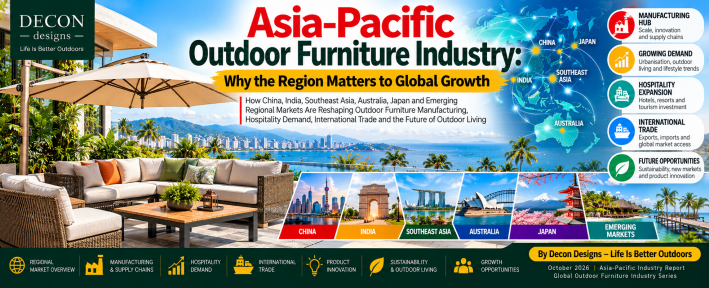
How China, India, Southeast Asia, Australia, Japan and Emerging Regional Markets Are Reshaping Outdoor Furniture Manufacturing, Hospitality Demand, International Trade and the Future of Outdoor Living
By Decon Designs – Life Is Better Outdoors | Asia-Pacific Outdoor Furniture Industry | Global Market Intelligence | China Furniture Manufacturing | India Furniture Market | Southeast Asian Furniture Industry | Australia Outdoor Living | Hospitality Furniture | International Trade | Market Outlook 2027
October 2026 | Asia-Pacific Industry Report | Global Outdoor Furniture Industry Series
The Asia-Pacific region is becoming one of the most strategically important parts of the global outdoor furniture industry.
From large-scale furniture manufacturing in China to expanding residential and hospitality markets in India, from Southeast Asia’s established furniture supply chains to Australia’s outdoor living culture, the region combines production capabilities with diverse consumer demand.
Asia-Pacific is not simply a manufacturing base supplying furniture to North America and Europe.
It is also an increasingly important destination for furniture sales, hospitality procurement, property-development projects, product innovation and regional trade.
Hotels and resorts across Southeast Asia require outdoor lounges, dining furniture, parasols and poolside furnishings.
Urban residents in China, India and Southeast Asian cities are exploring ways to make balconies, terraces and gardens more functional.
Australian consumers and commercial operators require furniture suited to different outdoor environments.
Japanese and South Korean markets offer opportunities for design-conscious, compact and specialized furniture.
Meanwhile, manufacturers across the region are navigating international competition, material costs, supply-chain changes and evolving buyer expectations.
These developments raise an important question:
Why does Asia-Pacific matter so much to the future of the global outdoor furniture industry, and which countries offer the most relevant opportunities for manufacturers, suppliers, retailers and commercial buyers?
At Decon Designs – Life Is Better Outdoors, with more than two decades serving Malaysia’s outdoor and hospitality furniture market, we believe Asia-Pacific deserves particular attention because of its combination of manufacturing expertise, tropical hospitality demand, urban development and international trading relationships.
This report examines the region’s market outlook, major countries, industry challenges and strategic opportunities through 2027 and beyond.
1. Understanding the Asia-Pacific Outdoor Furniture Ecosystem
Asia-Pacific is a diverse region encompassing economies with very different manufacturing capabilities, consumer preferences and commercial conditions.
The region includes major markets such as:
- China.
- India.
- Japan.
- South Korea.
- Australia.
- New Zealand.
- Malaysia.
- Vietnam.
- Indonesia.
- Thailand.
- Singapore.
- The Philippines.
- Cambodia.
- Other Southeast Asian and Pacific markets.
Each country plays a different role.
China is an important global manufacturing and sourcing centre.
Vietnam is a significant export-oriented furniture production market.
Malaysia participates in furniture manufacturing, international trade, retailing and hospitality supply.
Indonesia has established capabilities in timber, rattan and furniture craftsmanship.
India combines a large domestic market with developing manufacturing and export opportunities.
Australia is an important consumer and import market with established outdoor living applications.
Japan and South Korea offer specialized consumer segments influenced by design, available space and product functionality.
These differences create opportunities for cross-border trade and business specialization.
The regional industry includes raw-material suppliers, manufacturers, exporters, importers, distributors, retailers, hospitality contractors, designers, logistics providers and maintenance companies.
Understanding this wider ecosystem is essential.
Outdoor furniture growth is not determined only by how many chairs or tables are sold.
It also depends on manufacturing investment, construction activity, tourism, distribution networks and product replacement demand.
2. How Large Is the Asia-Pacific Outdoor Furniture Market?
Published research indicates that Asia-Pacific represents a substantial part of the global outdoor furniture market.
However, market estimates vary considerably between research providers.
For example, Fortune Business Insights estimates Asia-Pacific’s outdoor furniture market at approximately US$25.48 billion in 2025, representing 45.49% of its estimated global market.
Its outlook places the regional market at approximately US$26.73 billion in 2026.
Grand View Research uses a different market estimation framework. It estimates that Asia-Pacific accounted for approximately 22.5% of global outdoor furniture revenue in 2025 and projects the region to be the fastest-growing geographic market through 2033.
These estimates should not be combined into a single market calculation because their coverage and methodologies differ.
The important conclusion is not that one figure should be treated as an exact measurement.
It is that several research providers identify Asia-Pacific as a major outdoor furniture market with meaningful growth potential.
Market Intelligence Snapshot
| Indicator | Research estimate |
|---|---|
| Asia-Pacific outdoor furniture market, 2025 | US$25.48 billion — Fortune Business Insights |
| Regional share of global market, 2025 | 45.49% — Fortune Business Insights |
| Asia-Pacific outdoor furniture market, 2026 | US$26.73 billion — Fortune Business Insights |
| Regional share of global market, 2025 | 22.5% — Grand View Research |
| Asia-Pacific commercial outdoor furniture, 2025 | US$5.49 billion — Grand View Research |
| Asia-Pacific commercial outdoor furniture forecast, 2033 | US$10.40 billion — Grand View Research |
Important: The figures come from different proprietary research models. They are presented separately for context and should not be added together or treated as directly comparable.
For businesses, these forecasts provide reasons to investigate opportunities, not guarantees of future sales.
Actual performance will depend on economic conditions, property development, hospitality investment, consumer spending and international trade.
3. Why Asia-Pacific Matters to Global Outdoor Furniture Growth
Five structural factors help explain the region’s importance.
Manufacturing Capacity
Asia-Pacific contains established furniture manufacturing centres capable of producing a wide range of products.
Population and Urban Development
Large urban markets create potential demand for residential furniture, including compact outdoor products.
Tourism and Hospitality
Resorts, hotels, restaurants and leisure destinations require outdoor furnishing solutions.
International Trade
Regional manufacturers supply both domestic customers and overseas markets.
Product and Material Diversity
The region offers capabilities across timber, metal, synthetic wicker, upholstery, rope and mixed-material furniture.
Together, these factors make Asia-Pacific relevant to both the supply and demand sides of the global industry.
However, market conditions differ significantly by country.
Manufacturers and investors should avoid assuming that all regional markets offer the same opportunities.
4. China: A Major Manufacturing and Consumer Market
China remains one of the world’s most important furniture manufacturing and sourcing economies.
Its industrial capabilities span furniture frames, finished products, upholstery, fittings, accessories, packaging and manufacturing equipment.
China’s role in outdoor furniture is particularly relevant because many international brands and distributors source products or components from Chinese manufacturers.
Manufacturing Strengths
Chinese suppliers may offer:
- Large production capacity.
- Extensive product ranges.
- Specialized component sourcing.
- Established export operations.
- Product customization.
- Manufacturing technology.
- Integrated supply-chain capabilities.
These strengths support international furniture distribution.
However, buyers should evaluate individual factories rather than assuming that every supplier offers identical quality or reliability.
China’s Domestic Outdoor Furniture Opportunity
China also represents a substantial consumer market.
Potential demand includes residential balconies, gardens, terraces, hospitality developments and commercial outdoor spaces.
Fortune Business Insights forecasts China’s outdoor furniture market at approximately US$12.04 billion in 2026 under its market model.
This is a proprietary estimate rather than an official government measurement.
Challenges
Chinese manufacturers face competition, changing export conditions, labour and production costs, and pressure to differentiate their products.
For international buyers, supplier verification and specification control remain essential.
5. India: A Market With Manufacturing and Domestic Demand Potential
India is strategically important because of its population, urban development, hospitality activity and manufacturing capabilities.
Outdoor furniture applications include residential gardens, terraces, balconies, hotels, resorts, restaurants and commercial facilities.
Manufacturing Opportunities
Indian businesses can explore:
- Metal outdoor furniture.
- Timber furniture.
- Synthetic wicker products.
- Hospitality furniture.
- Commercial dining furniture.
- Export-oriented manufacturing.
- Specialized product design.
India’s manufacturing landscape is diverse, ranging from smaller workshops to larger industrial operations.
Domestic Demand
Potential demand drivers include urban residential development, hospitality investment, leisure properties and growing interest in furnished outdoor spaces.
Fortune Business Insights estimates India’s outdoor furniture market could reach approximately US$3.55 billion in 2026 under its research framework.
Challenges
Manufacturers and suppliers must navigate material costs, logistics, product quality, regional purchasing differences and competitive pricing.
India should not be treated as a single uniform consumer market.
Demand can differ substantially between cities, regions and income groups.
6. Southeast Asia: A Strategic Manufacturing and Hospitality Region
Southeast Asia is especially relevant to outdoor furniture because it combines production capabilities with tropical hospitality environments.
The region includes manufacturing economies, international tourism destinations and rapidly developing urban markets.
Its outdoor furniture demand comes from several sources.
Hospitality
Hotels, resorts, beach clubs, restaurants and tourism properties require outdoor furnishings.
Residential Development
Condominiums, landed homes and mixed-use properties create opportunities for balconies, terraces and shared amenities.
Manufacturing and Exports
Several countries participate in international furniture production and trade.
Commercial Development
Restaurants, offices, leisure facilities and property developments require outdoor seating and related products.
The region’s climate also creates distinct product requirements.
High humidity, heavy rainfall, sunlight and coastal exposure can influence furniture selection and maintenance.
Suppliers that understand these conditions can provide more appropriate product recommendations.
7. Vietnam: An Export-Oriented Furniture Manufacturing Centre
Vietnam has developed a substantial export-oriented furniture manufacturing industry.
Its role in the international furniture supply chain has expanded through manufacturing investment, overseas customer relationships and production capabilities.
World Furniture Online has identified Vietnam as one of Asia-Pacific’s significant furniture manufacturing and export centres.
However, this broader furniture position should not be interpreted as an outdoor-furniture-only ranking.
Opportunities
Vietnamese manufacturers may serve international customers seeking:
- Outdoor seating.
- Dining furniture.
- Timber furniture.
- Metal furniture.
- Mixed-material collections.
- Hospitality products.
Challenges
Export-oriented manufacturers are exposed to changes in overseas demand, trade requirements, production costs and shipping conditions.
Maintaining quality and delivery reliability remains essential.
For buyers, factory selection should be based on verified capabilities, not country reputation alone.
8. Indonesia: Timber, Rattan and Furniture Craftsmanship
Indonesia has established capabilities in furniture production, including timber and rattan-related products.
Its furniture sector serves domestic and international markets.
Indonesia’s material resources and manufacturing traditions create opportunities for outdoor furniture design and production.
Potential Product Categories
- Timber outdoor dining furniture.
- Garden seating.
- Rattan-inspired furniture.
- Lounge chairs.
- Resort furniture.
- Decorative outdoor collections.
Material suitability must still be assessed carefully.
Natural materials can require particular maintenance depending on exposure and construction.
Commercial Opportunities
Indonesia’s tourism and hospitality sector also creates potential domestic demand.
Resorts, villas, restaurants and leisure properties may require outdoor furniture suited to tropical environments.
Manufacturers can benefit from understanding both export requirements and domestic hospitality applications.
9. Malaysia: Connecting Manufacturing, Hospitality and Regional Distribution
Malaysia occupies a useful position within the Asia-Pacific furniture ecosystem.
The country has established furniture manufacturing and trading capabilities, alongside domestic demand from residential, hospitality and commercial customers.
Potential outdoor furniture applications include:
- Hotel poolside furniture.
- Resort loungers.
- Commercial parasols.
- Restaurant dining sets.
- Garden furniture.
- Condominium balcony furniture.
- Property-development amenities.
Malaysia’s Competitive Opportunities
Malaysian businesses can explore several strategies.
Manufacturing: Developing appropriate products for domestic and export markets.
Distribution: Sourcing furniture from regional factories and supplying Malaysian customers.
Hospitality Procurement: Coordinating products for hotels, resorts and commercial properties.
Retailing: Providing product knowledge and showroom experiences.
After-Sales Services: Supporting maintenance, replacement cushions and furniture refurbishment.
Malaysia’s tropical conditions also make environmental suitability an important product-selection issue.
Decon Designs’ Perspective
At Decon Designs, we see opportunities for Malaysian suppliers that understand the practical needs of hospitality and outdoor living customers.
The objective should be to supply furniture that matches the intended application, not merely the most visually attractive or lowest-priced product.
10. Thailand: Hospitality and Outdoor Lifestyle Opportunities
Thailand’s hospitality sector creates potential demand for outdoor furniture.
Hotels, resorts, restaurants, cafés and leisure destinations require products for outdoor environments.
Relevant categories include:
- Pool loungers.
- Parasols.
- Outdoor dining furniture.
- Lounge sofas.
- Garden seating.
- Commercial shade products.
Tourism activity may support renovation and property investment, but furniture suppliers should focus on actual procurement projects rather than assuming tourism growth automatically produces orders.
Thailand also offers manufacturing and distribution opportunities.
Suppliers should evaluate product specifications, commercial requirements and regional market conditions.
11. Singapore: A High-Value Urban and Commercial Market
Singapore’s urban environment creates distinctive outdoor furniture requirements.
Space efficiency is important in many residential and commercial applications.
Potential demand includes:
- Condominium balconies.
- Rooftop terraces.
- Hotels.
- Restaurants.
- Commercial courtyards.
- Landscaped communal areas.
Buyers may prioritize compact dimensions, design consistency, maintenance and dependable supplier service.
Singapore also functions as a regional commercial and logistics centre.
For Malaysian and other Southeast Asian suppliers, it can be a relevant nearby market.
However, businesses must evaluate delivery costs, customer expectations, product requirements and applicable import arrangements.
12. The Philippines: Residential and Hospitality Applications
The Philippines offers potential outdoor furniture opportunities across residential, hospitality and tourism markets.
Its islands, resorts and leisure destinations create applications for poolside furniture, dining sets, loungers and shade products.
Urban residential properties also create demand for balcony and terrace furniture.
However, coastal exposure, humidity and weather conditions require appropriate material selection.
Manufacturers and suppliers should distinguish between products intended for sheltered residential spaces and those used in exposed commercial environments.
13. Cambodia, Laos and Other Emerging Southeast Asian Markets
Smaller Southeast Asian markets may offer opportunities connected to hospitality development, residential projects and commercial facilities.
However, these opportunities should be evaluated individually.
Important considerations include:
- Purchasing power.
- Project activity.
- Distribution infrastructure.
- Import costs.
- Supplier availability.
- Product specifications.
- After-sales service.
A developing hospitality market may offer attractive projects without necessarily supporting a large mass-market furniture retail sector.
Businesses should avoid making investment decisions based only on broad regional growth narratives.
14. Australia: A Major Outdoor Living and Import Market
Australia is an important market for outdoor furniture because outdoor spaces play a practical role in many residential and hospitality settings.
Homes may include gardens, patios, decks and outdoor dining areas.
Hotels, restaurants and leisure properties also require outdoor furniture.
Residential Demand
Common product categories include:
- Outdoor dining sets.
- Lounge sofas.
- Garden chairs.
- Patio tables.
- Loungers.
- Shade products.
Commercial Demand
Restaurants, hotels, resorts and other commercial facilities require furniture suited to their operating environments.
Opportunities for Asian Manufacturers
Australia can be a relevant export destination for manufacturers in Malaysia, Vietnam, Indonesia, China and other regional economies.
However, export success requires attention to product specifications, freight costs, buyer requirements, warranty arrangements and applicable standards.
Environmental Suitability
Australia includes different climate zones.
A product suitable for one location may not be appropriate for another.
Suppliers should not assume that all Australian outdoor environments have identical requirements.
15. New Zealand: A Smaller but Relevant Outdoor Furniture Market
New Zealand offers opportunities across residential outdoor living, hospitality and commercial environments.
Buyers may value practical design, appropriate materials and long-term product performance.
For international suppliers, market size, shipping costs, distribution partnerships and customer requirements should be carefully evaluated.
A smaller market may still offer opportunities for specialized products.
However, manufacturers should consider whether expected sales volumes justify market-entry costs.
16. Japan: Compact Design, Functionality and Specialized Demand
Japan offers a distinctive furniture market influenced by urban living, design preferences and available space.
Outdoor furniture applications include balconies, terraces, gardens, hotels and commercial properties.
Potential product opportunities include:
- Compact seating.
- Space-efficient tables.
- Lightweight furniture.
- Modular products.
- Design-led collections.
- Hospitality furniture.
Buyers may place importance on dimensions, product details and suitability for the intended space.
Manufacturers should also consider Japan’s seasonal and regional climate differences.
The Japanese market should not be approached using a single generic product strategy.
17. South Korea: Urban Outdoor Living and Commercial Opportunities
South Korea offers potential demand for outdoor furniture in residential and commercial environments.
Applications include rooftop spaces, terraces, cafés, hospitality properties and selected residential outdoor areas.
Suppliers may explore:
- Contemporary outdoor seating.
- Compact dining furniture.
- Modular lounge systems.
- Commercial café furniture.
- Suitable shade products.
Design and product presentation may be important, but businesses must also verify actual demand, price positioning and distribution requirements.
18. Comparing Asia-Pacific’s Major Outdoor Furniture Markets
The region’s countries differ in their strengths and opportunities.
| Market | Important industry role | Potential opportunities | Major considerations |
|---|---|---|---|
| China | Large-scale manufacturing and domestic demand | Production, sourcing, design, domestic sales | Competition, quality consistency, trade conditions |
| India | Large domestic market and manufacturing potential | Residential, hospitality, exports | Diverse regional demand, logistics |
| Vietnam | Export-oriented furniture manufacturing | International supply, commercial products | Export dependence, quality and delivery |
| Indonesia | Timber and rattan-related capabilities | Design-led furniture, hospitality, exports | Material suitability, sourcing |
| Malaysia | Manufacturing, trading, retail and hospitality supply | Commercial projects, residential, distribution | Tropical climate, inventory, competition |
| Thailand | Hospitality and commercial demand | Resorts, restaurants, leisure furniture | Project cycles, supplier capability |
| Singapore | Urban and commercial market | Premium, compact and project furniture | Space, costs, customer expectations |
| Philippines | Residential and tourism applications | Resort, balcony and dining furniture | Logistics, coastal exposure |
| Australia | Residential and commercial consumer market | Imports, outdoor living, hospitality | Climate differences, freight, requirements |
| New Zealand | Residential and commercial demand | Specialized imports and outdoor products | Market scale, shipping |
| Japan | Design-conscious and specialized market | Compact and functional furniture | Product detail, dimensions, market fit |
| South Korea | Urban and commercial demand | Rooftop, café and contemporary furniture | Distribution, design preferences |
This comparison describes broad market characteristics, not a ranking of commercial attractiveness.
Businesses should conduct country-specific research before making investment or export decisions.
19. Asia-Pacific’s Hospitality Furniture Opportunity
Hospitality is one of the most commercially relevant segments for outdoor furniture suppliers.
The region contains international tourism destinations, urban hotels, resorts, restaurants and leisure properties.
Common furniture requirements include:
- Pool loungers.
- Outdoor sofas.
- Dining sets.
- Parasols.
- Daybeds.
- Garden seating.
- Terrace furniture.
- Outdoor cushions.
Commercial buyers often require more than product availability.
They may need coordinated specifications, reliable quantities, delivery planning and maintenance support.
For suppliers, hospitality procurement can create opportunities for larger orders and ongoing relationships.
However, project demand can be irregular.
Businesses should evaluate payment terms, project schedules and customer requirements carefully.
20. The Importance of Property Development and Urbanization
Residential and commercial development influences outdoor furniture demand.
New buildings may include balconies, rooftop terraces, swimming pools, landscaped courtyards and shared recreational spaces.
These environments require suitable furnishings.
However, outdoor furniture should be considered during design planning rather than only after construction.
Developers and designers should evaluate:
- Available space.
- Circulation.
- Seating capacity.
- Accessibility.
- Shade.
- Drainage.
- Cleaning.
- Maintenance.
- Storage.
- Product dimensions.
Better coordination between developers, designers and suppliers can reduce procurement mistakes.
21. The Outdoor Furniture Materials Opportunity Across Asia-Pacific
The region’s material diversity is an important industry advantage.
Manufacturers work with:
- Aluminium.
- Steel.
- Timber.
- Synthetic wicker.
- Natural rattan in appropriate applications.
- Outdoor rope.
- Polymers.
- Upholstery.
- Outdoor fabrics.
- Composite materials.
Different materials suit different customer requirements.
A resort in tropical Malaysia may prioritize different performance characteristics from a residential customer in a temperate Australian location.
Manufacturers can differentiate themselves by providing accurate specifications and clear application guidance.
Material innovation should focus on measurable product benefits rather than unsupported marketing claims.
22. Climate Diversity: Why One Outdoor Furniture Specification Cannot Serve Every Market
Asia-Pacific includes tropical, temperate, coastal, high-altitude and other environmental conditions.
Furniture may be exposed to:
- Strong sunlight.
- Heavy rainfall.
- High humidity.
- Salt-laden coastal air.
- Temperature fluctuations.
- Seasonal cold.
- Intensive commercial use.
This diversity creates opportunities for specialized products.
However, suppliers should avoid describing all outdoor furniture as suitable for every climate.
A product designed for a covered terrace may not perform the same way in a fully exposed coastal environment.
Manufacturers should provide relevant maintenance and usage guidance.
Commercial buyers should evaluate the complete product specification.
23. Regional Supply Chains and International Trade
Asia-Pacific’s furniture industry depends on interconnected supply chains.
Materials and components may move between countries before finished products reach buyers.
For example, a manufacturer may source metal components, fabrics or fittings from different suppliers.
Finished furniture may then be distributed to domestic or overseas markets.
This creates opportunities for specialization.
It also creates risks.
Potential challenges include:
- Freight costs.
- Shipping disruptions.
- Currency fluctuations.
- Customs requirements.
- Supplier delays.
- Product-quality inconsistencies.
- Inventory pressures.
Businesses should understand their critical supply dependencies.
Supplier diversification may improve resilience where commercially practical.
However, maintaining too many suppliers or excessive stock can also increase costs.
24. The Role of Regional Trade Agreements
Regional trade agreements can influence furniture trade by establishing rules for participating countries.
Relevant frameworks include:
- Regional Comprehensive Economic Partnership (RCEP).
- Comprehensive and Progressive Agreement for Trans-Pacific Partnership (CPTPP).
- ASEAN trade arrangements.
However, the commercial benefits available for a specific product depend on the importing country, tariff classification, origin rules and applicable procedures.
Businesses should not assume that every furniture shipment automatically qualifies for preferential treatment.
Exporters and importers should verify the relevant requirements before calculating landed costs.
25. The Competitive Challenge: Low Prices Versus Long-Term Value
Asia-Pacific includes manufacturers competing across different price segments.
Some focus on high-volume production.
Others specialize in premium design, materials or commercial projects.
Price competition can create pressure to reduce costs.
However, excessive cost-cutting may affect product quality and customer satisfaction.
For outdoor furniture, buyers should consider:
- Material specifications.
- Construction.
- Finishes.
- Comfort.
- Maintenance.
- Delivery.
- Warranty.
- Replacement components.
- Expected service conditions.
A lower initial price may not represent the lowest long-term cost.
Similarly, a premium price does not automatically guarantee superior performance.
Businesses should demonstrate value through relevant evidence.
26. Sustainability and Circular Furniture Opportunities
Environmental considerations are increasingly relevant to furniture manufacturing and purchasing.
Potential priorities include:
- Responsible material sourcing.
- Manufacturing efficiency.
- Product durability.
- Repairability.
- Replaceable components.
- Packaging reduction.
- Waste management.
- Recycling where feasible.
The circular economy also creates opportunities for refurbishment, replacement cushions and product maintenance.
However, sustainability claims should be supported by credible evidence.
A product should not be described as environmentally superior solely because it contains a particular material.
Environmental performance depends on several factors across the product lifecycle.
27. Digital Transformation Across Asia-Pacific Furniture Markets
Digital discovery is changing how buyers identify and evaluate furniture suppliers.
Customers may research products through search engines, online marketplaces, social media, business websites and review platforms.
For manufacturers, this creates opportunities to reach buyers beyond traditional distribution relationships.
For retailers, it creates pressure to provide better information.
Important digital assets include:
- Accurate company profiles.
- Detailed product catalogues.
- Technical specifications.
- Clear photographs.
- Relevant project information.
- Customer reviews.
- Contact channels.
- Delivery and warranty information.
Digital visibility should be supported by genuine operational capability.
A searchable supplier is useful only if the business can deliver appropriate products and service.
28. What Asia-Pacific Manufacturers Should Prepare for in 2027
Manufacturers should consider several strategic priorities.
Cost Control: Understand material, labour, energy and logistics costs.
Quality Consistency: Strengthen specifications and inspection procedures.
Market Specialization: Identify products and customer segments where the business can compete effectively.
Product Development: Improve designs based on actual buyer needs.
Supply-Chain Resilience: Review critical suppliers and lead times.
Export Readiness: Verify product requirements and distribution economics.
Digital Visibility: Maintain accurate product information.
After-Sales Support: Clarify warranty and replacement arrangements.
Manufacturers should avoid expanding capacity solely because market forecasts indicate growth.
Investment decisions should reflect realistic demand, financial capability and operating conditions.
29. Opportunities for Malaysian Outdoor Furniture Businesses Within Asia-Pacific
Malaysia’s location and furniture ecosystem create opportunities for businesses serving regional markets.
Potential strategies include:
Regional Sourcing
Working with suitable manufacturers in neighbouring countries.
Hospitality Supply
Serving hotels, resorts, restaurants and commercial properties.
Product Specialization
Developing expertise in parasols, pool loungers, outdoor dining or other categories.
Export Development
Exploring overseas customers where product and commercial requirements can be met.
Customer Education
Helping buyers understand materials, maintenance and product suitability.
After-Sales Services
Supporting replacement components, repairs and refurbishment.
Digital Distribution
Making products easier for domestic and international buyers to discover.
For Decon Designs, the region’s diversity reinforces the importance of understanding customer applications.
A product suitable for a sheltered Malaysian balcony may not meet the requirements of an exposed Australian hospitality project.
Likewise, a premium resort may require different specifications from a small residential terrace.
Successful suppliers must understand these distinctions.
30. Decon Designs: Our Perspective on Asia-Pacific’s Outdoor Furniture Future
At Decon Designs – Life Is Better Outdoors, we view Asia-Pacific as an important part of the global outdoor furniture ecosystem.
The region connects manufacturing, international trade, tourism, hospitality, property development and residential outdoor living.
With more than two decades serving Malaysia’s outdoor and hospitality furniture market, we understand that customer needs vary considerably.
A homeowner may be looking for a comfortable outdoor dining set.
A restaurant may require practical seating.
A resort may need pool loungers and parasols.
A property developer may require furniture for shared amenities.
Each application requires appropriate product selection.
We believe Asia-Pacific’s long-term opportunities will depend on more than manufacturing volume.
Businesses must understand materials, climate, customer expectations, logistics, quality and after-sales requirements.
The region’s manufacturers and suppliers have opportunities to develop specialized products and stronger commercial relationships.
However, sustainable growth requires operational discipline.
The future of Asia-Pacific outdoor furniture will be shaped by businesses that connect manufacturing capabilities with real customer needs.
Conclusion: Asia-Pacific Is Both a Supply Centre and a Growing Customer Market
The Asia-Pacific outdoor furniture industry represents an important part of the global furniture ecosystem.
China provides major manufacturing capabilities.
India offers domestic demand and production opportunities.
Vietnam and Indonesia contribute to international furniture supply chains.
Malaysia combines manufacturing, trading, hospitality and residential demand.
Thailand and the Philippines offer hospitality-related applications.
Singapore provides urban and commercial opportunities.
Australia and New Zealand represent established outdoor living markets.
Japan and South Korea offer specialized consumer segments.
Together, these markets create a diverse regional ecosystem.
However, growth will not be uniform.
Manufacturers must manage costs and quality.
Exporters must understand market requirements.
Retailers must improve customer information.
Commercial buyers must evaluate product suitability.
And consumers must make informed purchasing decisions.
Asia-Pacific matters to global outdoor furniture growth because it connects the factories that make furniture, the markets that purchase it and the hospitality and property environments where it is used.
For Decon Designs, the opportunity is to contribute to this evolving ecosystem through practical product knowledge, informed customer guidance and an understanding of Malaysia’s outdoor living and hospitality requirements.
Decon Designs – Life Is Better Outdoors.
Frequently Asked Questions
What is the Asia-Pacific outdoor furniture industry?
It includes manufacturing, importing, exporting, distributing, selling and maintaining outdoor furniture across Asia-Pacific markets.
Why is Asia-Pacific important to global outdoor furniture?
The region combines major manufacturing capabilities, large consumer markets, tourism destinations, property development and international trade.
Which countries are important outdoor furniture manufacturers?
China, Vietnam, Indonesia, Malaysia and India are among the countries with relevant furniture manufacturing capabilities. Their strengths differ by product and market.
Is Asia-Pacific the largest outdoor furniture market?
Some research providers estimate that Asia-Pacific holds the largest regional share, while others identify North America as the largest. Differences arise from market definitions and methodologies.
What opportunities exist in Southeast Asia?
Potential opportunities include hospitality furniture, residential outdoor living, commercial dining, regional distribution and specialized manufacturing.
Why is Australia important to Asian furniture exporters?
Australia offers residential and commercial outdoor furniture demand and is a relevant destination for international suppliers.
What materials are commonly used?
Common materials include aluminium, timber, synthetic wicker, outdoor rope, steel, polymers and specialized outdoor fabrics.
What challenges does the region face?
Major challenges include price competition, manufacturing costs, shipping, product quality, climate suitability and changing buyer expectations.
What should Malaysian suppliers focus on?
Relevant priorities include product suitability, hospitality procurement, sourcing, customer education, inventory management and after-sales support.
What is the outlook for 2027?
Long-term research indicates growth potential, but actual performance will depend on country-level economic conditions, hospitality investment, consumer demand and business execution.
Publishing Pack
Caption
Asia-Pacific Outdoor Furniture Industry: Why the Region Matters to Global Growth
From China’s manufacturing capabilities and India’s expanding market potential to Southeast Asia’s hospitality economy and Australia’s outdoor living culture, Asia-Pacific is a strategic region for the global outdoor furniture industry.
Discover how manufacturing, international trade, tourism, property development, product innovation and changing consumer expectations are shaping opportunities across the region.
Explore Decon Designs’ Asia-Pacific Outdoor Furniture Industry Report and what manufacturers, suppliers, retailers and buyers should prepare for in 2027.
One region. Diverse markets. A connected outdoor furniture ecosystem.
By Decon Designs – Life Is Better Outdoors.