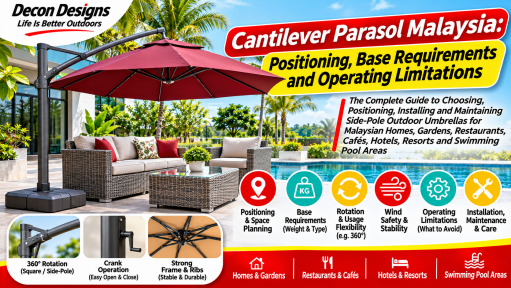
The Complete Guide to Choosing, Positioning, Installing and Maintaining Side-Pole Outdoor Umbrellas for Malaysian Homes, Gardens, Restaurants, Cafés, Hotels, Resorts and Swimming Pool Areas
By Decon Designs – Life Is Better Outdoors
Cantilever Parasol Malaysia | Side Pole Parasol Malaysia | Offset Garden Umbrella | Cantilever Umbrella Base | 360-Degree Rotating Parasol | Outdoor Umbrella Malaysia | Garden Parasol Safety | Commercial Parasol Malaysia | Patio Shade Solutions | Outdoor Furniture Malaysia
Introduction: A Cantilever Parasol Offers More Open Space — But Requires More Careful Planning
A cantilever parasol can transform an outdoor seating area.
Unlike a traditional centre-pole garden umbrella, a cantilever parasol supports its canopy from a pole positioned to one side.
This creates an open area beneath the canopy where homeowners and commercial operators can arrange tables, chairs, sofas or loungers without a central pole.
For Malaysian outdoor living, this can be especially attractive.
A cantilever parasol may be considered for a garden patio, swimming pool deck, café courtyard, restaurant terrace or resort lounge.
Its offset design can provide greater flexibility in certain furniture arrangements.
However, the same design also introduces important questions.
Where should the support pole be positioned?
How much space does the base require?
Can the canopy rotate?
Does every cantilever parasol offer 360-degree movement?
What happens when the wind becomes stronger?
Can a cantilever parasol be installed on a condominium balcony?
And what is the difference between a freestanding weighted base and a fixed anchoring system?
These questions should be answered before purchasing.
A cantilever parasol is not simply a centre-pole umbrella with the pole moved to one side. Its support arrangement, positioning and operating limitations must be considered as a complete system.
This guide by Decon Designs – Life Is Better Outdoors explains how cantilever parasols work, how to position them effectively, what to check about bases and anchoring, and how to operate them responsibly in Malaysia’s tropical outdoor conditions.
The objective is to help buyers make informed decisions based on product specifications, site conditions and practical requirements.
1. What Is a Cantilever Parasol?
A cantilever parasol is an outdoor umbrella in which the canopy is supported by an offset pole and arm arrangement.
The supporting pole is generally positioned away from the central shaded area.
This distinguishes it from a conventional centre-pole parasol.
Cantilever parasols are also commonly called:
- Side-pole parasols.
- Offset umbrellas.
- Side-post garden umbrellas.
- Cantilever garden umbrellas.
- Offset patio umbrellas.
The terms are often used interchangeably, although individual products may have different mechanisms and configurations.
Some models feature rotation or adjustable canopy positions.
Others have more limited operating functions.
The exact specifications must be confirmed for each model.
2. Why Choose a Cantilever Parasol?
The principal attraction of a cantilever parasol is the open space beneath its canopy.
With the pole positioned to one side, furniture can sometimes be arranged more freely.
This may be useful for:
- Outdoor sofa sets.
- Garden lounge arrangements.
- Patio dining furniture.
- Poolside loungers.
- Café seating.
- Resort relaxation areas.
However, the open area beneath the canopy does not mean the parasol requires less overall space.
The support pole, arm, base and canopy operating clearance still need to be accommodated.
A cantilever parasol may actually require more careful positioning than a conventional centre-pole design.
3. Cantilever vs Centre-Pole Parasols: The Main Differences
| Feature | Cantilever parasol | Centre-pole parasol |
|---|---|---|
| Pole position | Offset from canopy centre | Generally beneath canopy |
| Space beneath canopy | No central support pole | Pole occupies central area |
| Typical furniture arrangement | Selected lounge and dining layouts | Dining tables and garden seating |
| Base requirements | Often specialised | Model-specific centre-pole support |
| Rotation | Available on some models | Available on selected models |
| Tilt adjustment | Depends on model | Depends on model |
| Installation complexity | Can be greater | Depends on design |
| Wind suitability | Must be verified | Must be verified |
| Maintenance | Frame, arm, joints and mechanism | Frame, pole and mechanism |
Neither configuration is universally better.
The correct choice depends on the location, furniture layout, operating requirements and manufacturer’s instructions.
4. Understanding the Cantilever Support System
A cantilever parasol generally includes several main components.
These may include the canopy, ribs, support arm, vertical pole, opening mechanism, base connection and support system.
Each component contributes to the complete product.
The offset canopy creates forces that must be resisted by the support structure.
For this reason, the base or anchoring system is particularly important.
A visually strong frame does not establish that the parasol is suitable for every installation.
The manufacturer should provide the appropriate support and operating requirements.
5. Positioning: Where Should a Cantilever Parasol Be Placed?
The best position depends on the outdoor space and the intended shade area.
Begin by identifying where people will sit.
Then consider the direction of sunlight during the hours the space is used.
Next, identify a suitable location for the support pole and base.
The base must not obstruct circulation or create an unnecessary trip hazard.
The canopy must have sufficient clearance to open, close and move through any approved adjustment positions.
Do not place the parasol where it can strike walls, trees, roof structures or other obstacles.
Position the complete parasol system, not just the canopy.
6. How to Position a Cantilever Parasol Over a Sofa Set
A cantilever parasol may be useful above an outdoor sofa arrangement because the central area can remain free of a support pole.
However, the furniture should be measured before selecting the canopy size.
A compact sofa set has different shade requirements from a large L-shaped arrangement.
Consider the position of side tables, coffee tables and walkways.
The base should remain outside the main circulation route where possible, subject to the approved installation configuration.
Do not compromise base stability to achieve a particular furniture layout.
7. Positioning a Cantilever Parasol Over an Outdoor Dining Set
For outdoor dining, shade should be planned around the full seating arrangement.
This includes the table and the space occupied by chairs when in use.
A cantilever parasol may provide an unobstructed central area.
However, the support pole and arm must be positioned so that they do not interfere with customers or staff.
Restaurants should also consider how the arrangement affects service routes.
The parasol should not obstruct doors, walkways or emergency access.
8. Cantilever Parasols Beside Swimming Pools
Cantilever parasols may be considered for suitable poolside areas.
The offset pole can allow the canopy to extend over selected seating arrangements.
However, poolside installations require careful attention.
The base must not create a hazard near the pool edge.
The parasol should not obstruct circulation or emergency equipment.
Water exposure, cleaning chemicals and corrosion risks should be considered.
For commercial swimming pools, installation should be coordinated with the facilities or safety team.
9. Cantilever Parasols for Garden Patios
Garden patios can provide suitable settings for some cantilever parasols.
However, not every patio has the necessary clearance or supporting surface.
Measure the usable area.
Identify the canopy’s open dimensions and the base footprint.
Consider nearby walls, trees, lighting fixtures and roof eaves.
Check whether the surface is level and suitable for the approved support system.
A cantilever parasol should not be installed on an unsuitable surface simply because the canopy fits.
10. Sun Position: Why Shade Moves Throughout the Day
A cantilever parasol can provide shade, but the shadow changes as the sun moves.
The amount and location of useful shade depend on:
- Canopy size.
- Canopy shape.
- Canopy height.
- Sun direction.
- Sun elevation.
- Parasol orientation.
- Surrounding structures.
- Any adjustment features.
A canopy positioned effectively at noon may provide less shade over the same furniture in the late afternoon.
For Malaysian homes and restaurants, observe the site during the actual hours of use.
This can help determine whether a fixed orientation is sufficient or whether a model with approved adjustment features would be useful.
11. Do All Cantilever Parasols Rotate 360 Degrees?
No.
Some cantilever parasols offer 360-degree rotation.
Others may have limited rotation or no rotation feature.
The mechanism depends on the product design.
Buyers should confirm the exact model specifications.
Do not assume that a parasol rotates simply because it has a side pole.
Likewise, a product with a rotating canopy may not necessarily have an adjustable tilt angle.
Rotation and tilt are separate features.
12. How Does a 360-Degree Rotating Cantilever Parasol Work?
Some models include a rotation mechanism that allows the canopy assembly to turn around the support pole.
This can help users adjust the canopy’s orientation.
However, the mechanism may require a specific operating procedure.
Some designs use a foot pedal or locking arrangement.
Others use different systems.
The parasol should only be adjusted according to the manufacturer’s instructions.
Do not force the mechanism.
Do not assume that rotation is permitted in all weather conditions.
13. Rotation vs Tilt: Understanding the Difference
Rotation changes the canopy’s horizontal orientation around the support system.
Tilt changes the canopy’s angle.
Some cantilever parasols provide both functions.
Others provide only one.
Certain models have fixed canopy positions.
The availability of these features should be confirmed before purchasing.
An adjustable canopy can offer flexibility, but it also introduces additional components that may require maintenance.
14. Operating Clearance: How Much Space Is Required?
A cantilever parasol requires clearance for the canopy, arm, pole and operating mechanism.
If the canopy rotates, additional clearance may be necessary throughout its permitted movement.
A parasol that fits in one orientation may strike an obstacle when rotated.
Before ordering, check:
- Open canopy dimensions.
- Closed canopy dimensions.
- Support pole height.
- Arm movement.
- Rotation clearance.
- Tilt clearance.
- Base dimensions.
- Nearby structures.
Do not position the parasol where its movement could create a collision hazard.
15. Base Requirements: Why Cantilever Parasols Need Special Attention
The base is one of the most important components of a cantilever parasol.
Because the canopy is offset from the support pole, the support system must resist forces associated with that configuration.
Different cantilever parasols may require different ballast or anchoring arrangements.
Some use proprietary weighted bases.
Others use cross-base systems with specified ballast blocks.
Certain commercial models may require approved fixed anchoring.
These systems should not be substituted without manufacturer approval.
The correct base is determined by the exact parasol model and installation—not by a generic weight recommendation.
16. Cross Bases and Ballast Blocks
Some cantilever parasols are supplied with a cross-shaped support frame.
However, the cross alone may not provide the required ballast.
The manufacturer may specify compatible weight blocks or another support arrangement.
Buyers should confirm whether the complete support system is included in the quotation.
If ballast blocks are sold separately, their cost should be included in the purchasing decision.
Never assume that a bare cross base is sufficient.
17. HDPE Water-Filled and Sand-Filled Bases
Some cantilever parasol support systems use HDPE ballast containers.
These may be designed to hold water, sand or another manufacturer-approved filling.
HDPE stands for high-density polyethylene.
An empty HDPE shell may be relatively easy to transport.
Once filled correctly, it provides additional mass.
However, the permitted filling method depends on the product.
Do not assume that sand and water are interchangeable.
Do not add extra filling or improvised weights beyond the manufacturer’s instructions.
18. Concrete and Stone Bases
Some parasol systems use concrete or stone ballast.
These materials provide substantial mass.
However, weight alone does not establish stability.
The base geometry, connection method and installation conditions matter.
Heavy bases may also create handling difficulties or concentrated loads on the supporting surface.
For balconies, rooftops and elevated terraces, structural loading requires particular attention.
19. Fixed Anchoring Systems
Some cantilever parasols may be installed using approved fixed anchoring systems.
These may involve base plates, structural fixings or other engineered arrangements.
Such installations should be assessed carefully.
Drilling into a terrace or pool deck can affect waterproofing or structural elements.
Property-owner or building-management approval may be necessary.
Where structural anchoring is involved, use appropriately qualified professionals.
Do not improvise an anchoring system.
20. How Heavy Should a Cantilever Parasol Base Be?
There is no universal safe weight for all cantilever parasols.
The correct support depends on:
- Canopy dimensions.
- Canopy shape.
- Support-arm geometry.
- Pole height.
- Base design.
- Manufacturer specifications.
- Wind exposure.
- Installation surface.
- Intended use.
A generic recommendation based only on canopy size can be misleading.
For example, two cantilever parasols with similar canopy dimensions may require different support systems.
Always follow the manufacturer’s approved base or anchoring requirements.
21. Why Extra Weight Does Not Automatically Make a Parasol Safe
Some buyers attempt to improve stability by adding bricks, stones or other heavy objects.
However, improvised ballast may create additional hazards.
Loose objects can shift.
They may obstruct walkways.
They may damage the base or surrounding surface.
And they may not address the actual forces acting on the parasol.
If the manufacturer requires a specific support system, use that system.
Do not assume that adding weight makes a parasol safe in strong winds.
22. Wind Safety: The Biggest Operating Limitation
Cantilever parasols present a substantial canopy surface to wind.
Wind can generate forces on the canopy, arm, pole and base.
The risks depend on the product design and installation.
A parasol may be suitable for certain normal operating conditions but inappropriate during strong gusts or thunderstorms.
Buyers should request the manufacturer’s wind-use guidance.
Commercial operators should establish clear procedures for closing and securing parasols.
No cantilever parasol should be treated as safe in all wind conditions.
23. Can Cantilever Parasols Be Used During Heavy Rain?
Some canopy fabrics may provide rain protection under suitable conditions.
However, water resistance does not establish storm suitability.
Heavy rain may occur together with strong winds or thunderstorms.
A cantilever parasol should not be used as shelter during dangerous weather.
Follow the manufacturer’s instructions and close the parasol when conditions are unsuitable.
24. What About Malaysia’s Sudden Thunderstorms?
Malaysia’s tropical climate can produce sudden thunderstorms and strong gusts.
This creates operational challenges for outdoor parasols.
Restaurants, cafés and resorts should have procedures for responding to changing weather.
Staff should know when to stop using the parasols and how to close and secure them safely.
Do not wait until dangerous wind conditions have developed before attempting to operate a large canopy.
Follow weather information and site safety procedures.
25. Can a Cantilever Parasol Be Left Open Overnight?
Leaving a parasol open while unattended can increase exposure to unexpected weather.
The correct procedure depends on the manufacturer’s instructions.
For many outdoor parasol applications, closing and securing the canopy when not in use is an important precaution.
Commercial operators should establish end-of-day checks.
Do not assume that a heavy base makes unattended use safe.
26. Can You Use a Cantilever Parasol on a Condominium Balcony?
Not automatically.
High-rise balconies may experience demanding wind conditions.
They may also have structural loading restrictions and building-management rules.
A cantilever parasol can require a substantial base or anchoring system.
The combined installation must be assessed for suitability.
A canopy that physically fits on a balcony is not necessarily safe there.
Do not install a standard cantilever parasol on an exposed high-rise balcony without confirming the manufacturer’s suitability requirements and obtaining any necessary technical and management approvals.
27. Cantilever Parasols for Rooftop Restaurants
Rooftop restaurants may offer attractive outdoor dining experiences.
However, elevated locations can experience complex wind conditions.
Building geometry can influence local airflow.
A standard garden cantilever parasol should not be assumed suitable for rooftop use.
Site-specific technical advice may be necessary.
Any proposed installation should comply with applicable building rules and structural requirements.
28. Cantilever Parasols for Coastal Resorts
Coastal resorts may expose outdoor furniture to airborne salts and other demanding environmental conditions.
This can affect metal components, fasteners and mechanisms.
Commercial buyers should consider corrosion protection and maintenance requirements.
A parasol suitable for an inland garden may not be appropriate for a beachfront installation.
Ask suppliers for product-specific information about intended exposure.
29. Frame Materials: Aluminium, Steel and Other Components
Cantilever parasols may use aluminium, steel or other engineered materials.
Aluminium is relatively lightweight and does not rust in the same way as iron or steel.
Steel may provide structural strength but requires appropriate corrosion protection.
However, the material name alone does not establish performance.
Buyers should assess:
- Frame construction.
- Joint quality.
- Support-arm design.
- Fasteners.
- Surface finishing.
- Operating mechanism.
- Maintenance requirements.
The complete assembly matters more than a single material description.
30. Canopy Fabrics: What Malaysian Buyers Should Check
The canopy fabric affects shade, appearance and maintenance.
Common outdoor fabrics include polyester and acrylic-based materials.
However, performance varies by formulation and construction.
Ask about:
- Fabric composition.
- UV protection.
- Colourfastness.
- Water resistance.
- Cleaning requirements.
- Replacement availability.
- Warranty.
Do not assume that every fabric described as outdoor-grade has the same performance characteristics.
31. Is a Cantilever Parasol Waterproof?
Some canopy fabrics may be water-resistant or designed to resist water penetration under specified conditions.
However, the complete canopy’s performance depends on fabric, seams, stitching and construction.
Waterproof and water-resistant are not interchangeable descriptions.
Even where a canopy provides rain protection, this does not make the parasol suitable for use during thunderstorms or strong winds.
32. How Much Shade Does a Cantilever Parasol Provide?
Shade coverage depends on the canopy’s dimensions, shape, height and orientation.
A 3-metre round canopy has a nominal flat circular area of approximately 7.07 square metres.
A 3 × 3-metre square canopy has a nominal flat area of 9 square metres.
However, these are geometric canopy areas, not guaranteed usable shade throughout the day.
Actual shade changes with the sun’s position.
Rotation or tilt features may help adjust coverage where the manufacturer permits their use.
33. Cantilever Parasol Sizes: Which One Should You Choose?
Different sizes may suit different applications.
A compact garden patio may require a smaller canopy.
A large lounge arrangement may need more coverage.
However, larger canopies also require more space and potentially different support arrangements.
Before selecting a size, measure the complete furniture arrangement and available installation area.
Do not assume that the largest available parasol is the best option.
34. Cantilever Parasols for Restaurants and Cafés
Restaurants and cafés may use cantilever parasols to create shade over outdoor seating.
However, commercial operators should consider staff movement and customer circulation.
The support pole and base should not obstruct service routes.
The canopy should not interfere with neighbouring structures or other parasols.
Commercial suitability and operating limitations should be confirmed.
A parasol selected for appearance alone may create practical difficulties during daily operations.
35. Cantilever Parasols for Hotels and Resorts
Hotels and resorts may use cantilever parasols in garden lounges, selected poolside areas and outdoor dining spaces.
Visual consistency may be important.
However, the same parasol model may not be suitable for every location.
A sheltered courtyard and an exposed coastal terrace can have very different environmental conditions.
For larger projects, prepare a site-specific installation plan.
Document the exact models, support systems and operating procedures.
36. Operating Mechanisms: What to Check Before Buying
Cantilever parasols may use different opening and adjustment mechanisms.
These can include crank systems, sliding arrangements, rotation mechanisms and locking devices.
Commercial buyers should evaluate ease of use.
Ask whether staff can operate the parasol according to the manufacturer’s instructions.
Check whether replacement components are available.
Do not force a mechanism that is difficult to operate.
A damaged or malfunctioning parasol should be removed from service until properly assessed.
37. Staff Training for Commercial Cantilever Parasols
Commercial parasols may be operated by several employees.
Training helps reduce misuse.
Relevant staff should understand:
- Opening procedures.
- Closing procedures.
- Locking arrangements.
- Rotation and tilt limitations.
- Weather-related restrictions.
- Inspection requirements.
- Reporting of damage.
For large installations, written operating procedures may be useful.
38. Maintenance: How to Care for a Cantilever Parasol
Cantilever parasols should be inspected and maintained according to manufacturer guidance.
Maintenance may include checking:
- Canopy fabric.
- Stitching.
- Frame condition.
- Support arm.
- Joints.
- Fasteners.
- Rotation mechanism.
- Opening mechanism.
- Base condition.
- Signs of corrosion or instability.
Do not continue using a parasol with damaged structural components or an unstable base.
Cleaning should follow the product’s material-specific instructions.
39. Replacement Canopies and Spare Parts
Replacement availability can affect long-term ownership costs.
Commercial buyers should ask whether the supplier offers compatible replacement canopies and operating components.
A replacement canopy must match the correct frame and model.
Do not assume that any fabric canopy of similar dimensions will fit.
The same applies to mechanical components.
Use manufacturer-approved replacements.
40. Cantilever Parasol Price Malaysia: What Affects the Quotation?
Prices vary according to the product and supplier.
Important factors include:
- Canopy size.
- Canopy shape.
- Frame material.
- Fabric specifications.
- Rotation features.
- Tilt adjustment.
- Opening mechanism.
- Base inclusion.
- Ballast requirements.
- Manufacturing quality.
- Warranty.
- Delivery.
- Installation.
- Order quantity.
A lower-priced product may be suitable for some applications.
A more expensive model may offer additional features or specifications.
However, price alone does not establish safety or durability.
41. Comparing Cantilever Parasol Quotations
| Quotation item | What buyers should confirm |
|---|---|
| Exact model | Product identification |
| Canopy size | Actual dimensions |
| Canopy shape | Round, square or rectangular |
| Frame material | Construction and finish |
| Fabric | Composition and performance |
| Rotation | Whether available and operating range |
| Tilt | Whether available and operating range |
| Opening mechanism | Type and operating instructions |
| Base | Included or excluded |
| Ballast | Manufacturer-approved requirements |
| Wind-use guidance | Operating restrictions |
| Warranty | Coverage and exclusions |
| Replacement parts | Availability |
| Delivery | Charges and handling |
| Installation | Included or excluded |
| Lead time | Availability and schedule |
| Total price | Complete quotation |
This approach helps buyers compare the full product and installation rather than only the canopy price.
42. Ten Common Cantilever Parasol Buying Mistakes
Mistake 1: Buying based only on canopy size.
The complete installation space matters.
Mistake 2: Assuming every cantilever parasol rotates 360 degrees.
Features vary by model.
Mistake 3: Ignoring base requirements.
The correct support system is essential.
Mistake 4: Using improvised ballast.
Unapproved weights can create hazards.
Mistake 5: Positioning the base in a walkway.
This can interfere with circulation.
Mistake 6: Ignoring wind exposure.
A parasol suitable for a sheltered patio may be inappropriate elsewhere.
Mistake 7: Leaving the canopy open during unsuitable weather.
Parasols are not storm shelters.
Mistake 8: Forgetting operating clearance.
The canopy may strike surrounding structures.
Mistake 9: Assuming residential products are suitable for intensive commercial use.
Intended-use specifications should be confirmed.
Mistake 10: Buying without checking spare parts and warranty.
Long-term serviceability matters.
43. Cantilever Parasol Buying Checklist for Malaysia
Before purchasing, answer these questions.
- What is the exact parasol model?
- What are the canopy dimensions?
- Is the canopy round, square or rectangular?
- What furniture will sit beneath it?
- Where will the support pole be positioned?
- Is there sufficient operating clearance?
- Does the parasol rotate?
- Does it tilt?
- What are the permitted adjustment positions?
- What base or anchoring is required?
- Is the base included?
- What filling or ballast is specified?
- Is the installation surface suitable?
- What wind conditions affect the site?
- Does the manufacturer approve the intended application?
- What fabric is used?
- What maintenance is required?
- Are replacement canopies available?
- What warranty applies?
- What is the total delivered and installed cost?
A cantilever parasol should be purchased as a complete shade system—not as a canopy alone.
44. Decon Designs: Cantilever and Garden Parasols in Malaysia
Decon Designs has more than 20 years of experience in Malaysia’s outdoor and hospitality furniture market.
Its product categories have included centre-pole parasols, side-pole parasols, garden furniture, outdoor dining sets, lounge furniture and related accessories.
Different models may offer different operating features.
Certain side-pole designs may include 360-degree rotation, while other products have different adjustment arrangements.
Customers should confirm the exact model specifications before purchasing.
A product suitable for a residential garden should not automatically be assumed suitable for an exposed rooftop or demanding commercial environment.
Decon Designs – Life Is Better Outdoors.
45. Decon Designs Parasol and Base Clearance Examples
As part of the Decon Designs Year-End Stock Clearance 2026, selected parasol-related products have previously been advertised.
JHA-0112 Garden Parasol
Previously specified canopy size: Approximately 300 cm
Frame: Grey powder-coated metal
Fabric colour: Chocolate
Base: HDPE water-fillable base in the previously supplied configuration
Previous listed price: RM1,999
Clearance price: RM999
This product is included as a garden parasol example.
It should not be assumed to have 360-degree rotation, adjustable tilt or cantilever construction without confirmation of the exact specifications.
JHA-008 HDPE Parasol Base
Material: HDPE
Previously specified dimensions: 85 × 85 × 18 cm
Previously specified filling options: Water or sand
Previous listed price: RM1,218
Clearance price: RM449
The base is included as an example of a fillable parasol support product.
Its compatibility with any particular cantilever parasol must be confirmed.
Previously advertised prices are not confirmation of current inventory, compatibility or commercial suitability.
46. Decon Designs Year-End Stock Clearance 2026
Decon Designs is conducting its Year-End Stock Clearance 2026 as part of a business downsizing and inventory-reduction exercise.
Selected existing outdoor furniture and accessories are being offered at promotional prices.
Campaign: Decon Designs Year-End Stock Clearance 2026
Campaign message: Everything Must Go!
Sale period: 1 November – 31 December 2026
Availability: Limited stock, first come, first served.
Official promotion page:
https://decondesigns.com/product-category/promotion/
The campaign is an inventory-reduction exercise, not an announcement that the Decon Designs brand is closing.
Customers should confirm current prices, availability, specifications, product condition, delivery arrangements and sale terms.
47. Frequently Asked Questions About Cantilever Parasols in Malaysia
What is a cantilever parasol?
A cantilever parasol is an outdoor umbrella with an offset support pole, allowing the canopy to extend over an area without a central pole beneath it.
Is a cantilever parasol better than a centre-pole parasol?
Neither is universally better. The right choice depends on the layout, support requirements and intended use.
Do all cantilever parasols rotate 360 degrees?
No. Rotation features vary by model.
Can a cantilever parasol tilt?
Some models offer tilt adjustment, while others do not.
What base does a cantilever parasol need?
Use the manufacturer-approved base or anchoring system for the exact model and installation.
How heavy should the base be?
There is no universal safe weight. Follow the manufacturer’s requirements.
Can I use a water-filled HDPE base?
Only if it is approved for the exact parasol model and intended installation.
Can I add extra concrete blocks to the base?
Do not use improvised ballast as a substitute for the manufacturer’s approved support system.
Can I leave a cantilever parasol open overnight?
Follow manufacturer instructions. Unattended open canopies may be exposed to unexpected weather.
Can cantilever parasols withstand strong winds?
Suitability depends on the exact product and installation. They should not be used outside manufacturer-approved operating conditions.
Can I use a cantilever parasol on a high-rise balcony?
Do not assume so. Wind exposure, structural loading and building rules require careful assessment.
Are cantilever parasols suitable for restaurants?
Some models may be suitable for commercial applications. Confirm the intended-use specifications and site conditions.
Can I replace the canopy fabric?
Replacement availability depends on the model and supplier.
How much does a cantilever parasol cost in Malaysia?
Prices vary according to size, materials, mechanisms, base, warranty and installation requirements.
Where can I explore Decon Designs parasol promotions?
Visit https://decondesigns.com/product-category/promotion/ and confirm current availability.
Conclusion: A Cantilever Parasol Is About Positioning, Stability and Responsible Operation
Cantilever parasols can provide attractive and flexible shade for Malaysian outdoor spaces.
Their offset design allows furniture to be arranged beneath the canopy without a central support pole.
This can be useful for selected gardens, patios, dining areas, poolside lounges and hospitality environments.
However, the benefits depend on correct product selection and installation.
The support pole must be positioned appropriately.
The canopy must have sufficient operating clearance.
The base or anchoring system must match the manufacturer’s requirements.
And the parasol must be operated within its intended weather and usage limitations.
BEFORE BUYING A CANTILEVER PARASOL, ASK FIVE QUESTIONS:
1. WHERE WILL THE POLE AND BASE BE POSITIONED?
2. HOW MUCH SHADE WILL THE CANOPY PROVIDE?
3. DOES THE MODEL ROTATE OR TILT?
4. WHAT BASE OR ANCHORING SYSTEM IS REQUIRED?
5. WHAT ARE THE WIND AND OPERATING LIMITATIONS?
A good cantilever parasol purchase begins with accurate measurements, verified specifications and an understanding of the site.
THE RIGHT SHADE IS NOT JUST ABOUT THE CANOPY. IT IS ABOUT THE COMPLETE SYSTEM.
Explore selected outdoor furniture and parasol accessories during the Decon Designs Year-End Stock Clearance 2026.
EVERYTHING MUST GO!
1 NOVEMBER – 31 DECEMBER 2026
LIMITED STOCK | FIRST COME, FIRST SERVED
EXPLORE THE CLEARANCE COLLECTION:
https://decondesigns.com/product-category/promotion/
Decon Designs – Life Is Better Outdoors.