
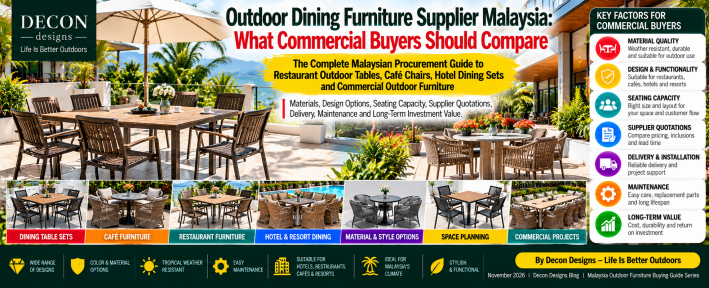
The Complete Malaysian Procurement Guide to Restaurant Outdoor Tables, Café Chairs, Hotel Dining Sets, Commercial Furniture Materials, Seating Capacity, Supplier Quotations, Delivery, Maintenance and Long-Term Investment Value
By Decon Designs – Life Is Better Outdoors | Outdoor Dining Furniture Supplier Malaysia | Commercial Outdoor Furniture | Restaurant Furniture Malaysia | Café Furniture | Hotel & Resort Dining Furniture | Outdoor Tables & Chairs | Hospitality Procurement | Outdoor Living Malaysia
November 2026 | Decon Designs Blog | Malaysia Outdoor Furniture Buying Guide Series
Introduction: Commercial Outdoor Dining Furniture Is a Business Investment, Not Just a Furniture Purchase
Outdoor dining has become an important part of many hospitality and food-service environments in Malaysia.
From cafés in Petaling Jaya and restaurants in Kuala Lumpur to beachfront resorts in Langkawi, hotels in Penang, recreational clubs in Johor and condominium dining facilities across Selangor, outdoor tables and chairs contribute directly to the customer experience.
A well-designed outdoor dining area can provide comfortable seating, support service operations and complement the character of a business.
However, purchasing commercial outdoor dining furniture requires more consideration than selecting a dining set for a private home.
Restaurant chairs may be moved repeatedly throughout the day.
Café tables may need frequent cleaning.
Hotel furniture may need to match the property’s design standards.
Resort dining sets may be exposed to sunlight, moisture and salt-laden air.
Commercial buyers may also need consistent quantities, delivery coordination, replacement parts and after-sales support.
Two outdoor dining sets may look similar in a catalogue but differ considerably in construction, materials, dimensions and maintenance requirements.
The essential procurement question is therefore:
What should commercial buyers compare before choosing an outdoor dining furniture supplier in Malaysia?
At Decon Designs – Life Is Better Outdoors, with more than two decades serving Malaysia’s outdoor and hospitality furniture market, we believe commercial furniture procurement should focus on product suitability, operational practicality, transparent specifications and long-term value.
This comprehensive guide explains how restaurant owners, café operators, hotel purchasing departments, resort managers, developers and commercial procurement teams can compare suppliers and make more informed decisions.
1. Understanding the Commercial Outdoor Dining Furniture Market in Malaysia
Commercial outdoor dining furniture is used across many types of properties.
These include:
- Restaurants.
- Cafés.
- Hotels.
- Resorts.
- Beach clubs.
- Rooftop dining venues.
- Food courts.
- Golf and country clubs.
- Condominium barbecue areas.
- Commercial terraces.
- Shopping centres.
- Event venues.
- Hospitality developments.
Each application involves different requirements.
A small café may need compact bistro tables.
A large restaurant may require dozens of dining chairs.
A resort may prefer coordinated furniture across multiple dining zones.
A condominium management team may prioritize maintenance and shared-use suitability.
A rooftop restaurant may need special attention to wind exposure and furniture stability.
The correct furniture should be selected according to the intended environment and business operations.
2. Commercial Furniture Versus Residential Furniture: Understand the Difference
One of the most important procurement considerations is intended use.
Residential outdoor furniture may be used by a small household.
Commercial furniture may experience more frequent use, movement and cleaning.
Commercial Buyers Should Consider
- Expected daily use.
- Customer turnover.
- Cleaning frequency.
- Furniture movement.
- Storage.
- Maintenance.
- Replacement availability.
- Intended environmental exposure.
However, the term commercial grade should not be accepted as proof of durability.
Buyers should request product-specific specifications and relevant evidence where appropriate.
3. Start With the Type of Business
Before requesting quotations, identify the operational needs of the venue.
Restaurants
May prioritize seating capacity, table stability, cleaning and customer comfort.
Cafés
May require compact furniture and flexible arrangements.
Hotels
May prioritize coordinated design, guest comfort and procurement consistency.
Resorts
May need furniture suitable for outdoor environments and hospitality operations.
Clubs
May require practical seating for members and events.
Rooftop Venues
May need additional consideration of wind exposure and site-specific requirements.
The furniture supplier should understand the application before recommending products.
4. Outdoor Dining Tables: What Commercial Buyers Should Compare
Outdoor dining tables are central to restaurant and café operations.
Important specifications include:
- Table dimensions.
- Height.
- Tabletop material.
- Frame material.
- Base design.
- Stability.
- Cleaning requirements.
- Environmental suitability.
A visually attractive table may still be unsuitable if it is unstable, difficult to clean or poorly sized for the dining area.
Buyers should request accurate product information.
5. Tabletop Materials: Understanding the Options
Outdoor dining tables may use different tabletop materials.
Common options include:
- Suitable timber.
- Aluminium.
- Glass.
- Compact laminate.
- Stone or stone-like materials.
- Other engineered surfaces.
Each material has different characteristics.
Important Questions
- Is the material suitable for the intended outdoor exposure?
- How should it be cleaned?
- What maintenance is required?
- Is it resistant to the expected operating conditions?
- Are there limitations involving heat or chemicals?
No tabletop material should automatically be described as maintenance-free.
6. Aluminium Outdoor Dining Tables
Aluminium tables are used in many contemporary outdoor furniture collections.
Buyers should inspect:
- Frame construction.
- Joints.
- Finishes.
- Stability.
- Fasteners.
- Tabletop connection.
A supplier should provide the specifications for the exact model.
Aluminium furniture can be suitable for certain outdoor applications, but performance depends on design and construction.
7. Wooden Outdoor Dining Tables
Wooden dining tables may complement tropical gardens, resort terraces and natural-style restaurants.
However, different timber species and finishes require different maintenance.
Buyers should ask:
- What timber is used?
- What finishing system is applied?
- Is the product intended for outdoor exposure?
- What maintenance is recommended?
- What warranty limitations apply?
Wooden furniture may change in appearance with environmental exposure.
Buyers should understand the expected maintenance requirements.
8. Glass-Top Outdoor Dining Tables
Glass-top tables may offer a clean, contemporary appearance.
However, buyers should consider:
- Glass specification.
- Edge finishing.
- Support design.
- Stability.
- Cleaning.
- Breakage risks.
- Intended use.
Commercial buyers should request relevant product safety information.
A glass tabletop should not be selected solely because it is easy to wipe clean.
9. Compact Laminate and Engineered Table Surfaces
Some commercial dining tables use engineered surfaces.
Potential benefits depend on the specific product.
Buyers should verify:
- Material composition.
- Outdoor suitability.
- Edge construction.
- Cleaning instructions.
- Heat-related limitations.
- Warranty.
Not all products described as laminate are suitable for exposed outdoor use.
10. Table Bases: Stability Is Essential
The base is a critical part of a commercial dining table.
A poorly balanced table can create inconvenience for guests and staff.
Buyers should inspect:
- Base dimensions.
- Stability.
- Floor compatibility.
- Connections.
- Adjustability, if provided.
- Maintenance.
The table should be appropriate for the intended floor surface.
Uneven outdoor flooring may require additional planning.
11. Outdoor Dining Chairs: Comfort and Practicality
Commercial dining chairs should be selected according to both customer comfort and operational requirements.
Important considerations include:
- Seat dimensions.
- Seat height.
- Backrest design.
- Armrests.
- Weight.
- Stability.
- Cleaning.
- Storage.
A chair that looks attractive may not be comfortable for extended dining.
Where practical, commercial buyers should test sample chairs.
12. Wicker Dining Chairs: What Buyers Should Check
Wicker-style dining chairs are common in tropical outdoor settings.
However, construction quality varies.
Buyers should evaluate:
- Frame material.
- Wicker material.
- Weave condition.
- Seat support.
- Stability.
- Cleaning requirements.
A woven exterior does not independently establish structural quality.
For commercial applications, intended-use suitability should be confirmed.
13. Aluminium Dining Chairs
Aluminium chairs may be suitable for certain outdoor dining environments.
Buyers should inspect:
- Frame construction.
- Welds and joints.
- Finishes.
- Seat support.
- Stability.
- Weight.
Commercial suitability depends on the exact product.
14. Stackable Outdoor Chairs: Benefits and Limitations
Stackable chairs may be useful for restaurants, cafés and event venues.
Potential advantages include:
- Easier storage.
- Flexible seating arrangements.
- Space management.
However, stacking should follow manufacturer instructions.
Buyers should confirm:
- Whether the product is designed for stacking.
- Recommended stacking limits.
- Storage requirements.
- Protective components.
- Warranty conditions.
Improper stacking can damage furniture.
15. Outdoor Rope Dining Chairs
Rope-style furniture may offer a contemporary appearance.
However, buyers should verify the exact material.
Important considerations include:
- Rope composition.
- Frame construction.
- Weaving.
- Cleaning.
- Environmental exposure.
- Maintenance.
Not every rope-style chair is suitable for fully exposed outdoor use.
16. Cushioned Versus Non-Cushioned Dining Chairs
Cushions may improve seating comfort.
However, they can increase cleaning and maintenance requirements.
Cushioned Chairs
Potential advantages include additional comfort.
Potential considerations include fabric care, drying and replacement.
Non-Cushioned Chairs
May be easier to manage in some high-turnover environments.
However, comfort depends on the chair design.
The correct choice depends on the venue’s operating model.
17. Seating Capacity: Avoid Overcrowding the Dining Area
Commercial operators naturally want to use available space efficiently.
However, excessive furniture can create problems.
These may include:
- Restricted circulation.
- Difficult service access.
- Reduced customer comfort.
- Cleaning challenges.
- Obstructed exits.
Before buying furniture, prepare a layout.
Consider:
- Table dimensions.
- Chair movement.
- Customer access.
- Staff circulation.
- Emergency routes.
- Applicable building requirements.
Seating capacity should not be maximized at the expense of safe and practical operation.
18. Four-Seater, Six-Seater and Eight-Seater Dining Sets
Different dining configurations suit different spaces.
Four-Seater Sets
May be suitable for compact restaurant terraces and cafés.
Six-Seater Sets
May work in medium-sized outdoor dining areas.
Eight-Seater Sets
May be appropriate for larger hospitality environments.
However, product dimensions vary.
A six-seater table from one supplier may occupy a different amount of space from another.
Always compare actual dimensions.
19. Bistro Furniture for Compact Cafés
Bistro furniture can be useful in smaller outdoor spaces.
A compact table with two chairs may suit:
- Café terraces.
- Sidewalk dining areas where permitted.
- Courtyards.
- Small hospitality spaces.
However, buyers should verify local operating permissions and circulation requirements.
Furniture should not obstruct public walkways or required access.
20. Restaurant Terrace Layout: Balance Capacity and Comfort
A well-planned terrace should support both customer experience and service operations.
Before purchasing, identify:
- Dining zones.
- Service routes.
- Entry points.
- Emergency access.
- Shade requirements.
- Cleaning access.
- Storage.
A layout should be tested before finalizing quantities.
Temporary floor markings may help visualize furniture positions.
21. Rooftop Restaurants: Additional Furniture Considerations
Rooftop dining environments require careful assessment.
Potential concerns include:
- Wind exposure.
- Furniture stability.
- Access.
- Building rules.
- Storage.
- Shade-product suitability.
Furniture appropriate for a ground-level terrace may not be suitable for an exposed rooftop.
Large parasols require particular caution.
Appropriate professional assessment may be necessary.
22. Outdoor Dining Furniture and Malaysia’s Tropical Weather
Malaysia’s outdoor dining environments may experience:
- Sunlight.
- Rain.
- Humidity.
- Moisture.
- Wind.
These conditions can influence furniture performance and maintenance.
Buyers should request product-specific guidance.
Do not assume that every outdoor furniture product is suitable for all weather conditions.
23. Coastal Restaurants and Resorts
Coastal properties may experience salt-laden air and moisture.
These conditions can affect certain frames, fittings and finishes.
Commercial buyers should ask about:
- Material specifications.
- Protective finishes.
- Fasteners.
- Maintenance.
- Intended exposure.
The correct product should be selected according to the actual environment.
24. Outdoor Dining Parasols: Shade Planning Matters
Restaurants and cafés may use parasols to provide shade.
Common designs include:
- Centre-pole parasols.
- Cantilever parasols.
- Side-pole umbrellas.
However, shade products require appropriate support and safe operation.
Buyers should confirm:
- Canopy dimensions.
- Base compatibility.
- Operating limits.
- Wind considerations.
- Maintenance.
A parasol should not obstruct circulation or create hazards.
25. Commercial Dining Furniture Supplier Malaysia: What to Verify
Before selecting a supplier, commercial buyers should evaluate:
Business Identity
Verify the supplier’s details.
Product Specifications
Request accurate materials and dimensions.
Commercial Suitability
Confirm intended use.
Supply Capability
Assess whether the supplier can fulfil the required quantity.
Delivery
Clarify logistics.
Installation
Confirm assembly responsibilities.
Warranty
Review coverage and exclusions.
After-Sales Support
Ask about repairs and replacement components.
26. Request a Written Commercial Furniture Quotation
A written quotation should clearly identify:
- Product models.
- Quantities.
- Dimensions.
- Materials.
- Finishes.
- Prices.
- Delivery.
- Installation.
- Lead times.
- Warranty.
- Payment terms.
Commercial buyers should avoid approving vague quotations.
27. Comparing Suppliers: Use Equivalent Specifications
Two suppliers may quote different prices because the products differ.
Comparison Table
| Item | Supplier A | Supplier B |
|---|---|---|
| Table model | Confirm | Confirm |
| Tabletop material | Confirm | Confirm |
| Chair model | Confirm | Confirm |
| Frame material | Confirm | Confirm |
| Quantity | Confirm | Confirm |
| Dimensions | Confirm | Confirm |
| Warranty | Confirm | Confirm |
| Delivery | Confirm | Confirm |
| Installation | Confirm | Confirm |
| Lead time | Confirm | Confirm |
| Total price | Confirm | Confirm |
This approach improves purchasing transparency.
28. Ready Stock Versus Project-Based Supply
Commercial buyers may require furniture immediately or according to a project schedule.
Ready Stock
May be suitable for urgent replacements.
Project Supply
May support larger coordinated orders.
Customized Orders
May require additional production time.
Availability and delivery expectations should be confirmed in writing.
29. Bulk Furniture Orders: Why Samples Matter
For larger orders, sample evaluation can be useful.
A sample allows buyers to inspect:
- Dimensions.
- Comfort.
- Construction.
- Finishes.
- Cleaning.
- Stability.
However, sample approval should be documented.
Commercial buyers should confirm that delivered products match the approved specifications.
30. Delivery and Installation for Commercial Projects
Furniture delivery may involve:
- Transportation.
- Loading.
- Unloading.
- Site access.
- Assembly.
- Placement.
- Packaging removal.
Restaurants and hotels should coordinate delivery to reduce operational disruption.
Buyers should clarify the full scope before approving an order.
31. Furniture Maintenance: Plan Before Installation
Commercial dining furniture requires appropriate maintenance.
Potential activities include:
- Routine cleaning.
- Frame inspection.
- Fastener checks.
- Surface care.
- Cushion maintenance.
- Repair coordination.
Maintenance should follow manufacturer instructions.
Staff responsibilities should be clear.
32. Replacement Parts and Furniture Continuity
Commercial buyers may want to replace individual chairs or tables over time.
However, products may be discontinued.
Before purchasing, ask about:
- Spare parts.
- Replacement cushions.
- Matching products.
- Product continuity.
- Warranty support.
No supplier can necessarily guarantee indefinite availability.
Nevertheless, discussing replacement options can improve long-term planning.
33. Total Cost of Ownership: A Better Purchasing Measure
The initial furniture price is only one part of the investment.
Additional costs may include:
- Delivery.
- Installation.
- Cleaning.
- Maintenance.
- Repairs.
- Replacement parts.
- Replacement furniture.
Commercial buyers should compare expected ownership costs.
34. Illustrative Five-Year Dining Chair Cost Comparison
Consider two hypothetical outdoor dining chairs.
| Cost component | Chair A | Chair B |
|---|---|---|
| Initial purchase | RM180 | RM300 |
| Delivery allocation | RM20 | RM20 |
| Five-year maintenance | RM80 | RM60 |
| Additional replacement purchase | RM180 | RM0 |
| Illustrative total | RM460 | RM380 |
These figures are hypothetical.
They are not actual Decon Designs quotations or verified lifespan estimates.
The example illustrates why long-term costs matter.
35. Illustrative Restaurant Outdoor Dining Furniture Budget
Consider a hypothetical restaurant furnishing an outdoor dining area.
| Product | Quantity | Illustrative unit price | Total |
|---|---|---|---|
| Four-seater dining tables | 10 | RM700 | RM7,000 |
| Outdoor dining chairs | 40 | RM220 | RM8,800 |
| Commercial parasols | 5 | RM1,200 | RM6,000 |
| Compatible parasol bases | 5 | RM300 | RM1,500 |
| Illustrative subtotal | RM23,300 |
This is a hypothetical budget.
It excludes delivery, installation, applicable taxes and other project costs.
Actual prices depend on specifications and supplier terms.
36. Supplier Evaluation Scorecard
Commercial buyers may use a structured evaluation framework.
| Evaluation category | Illustrative weighting |
|---|---|
| Product suitability | 25% |
| Materials and construction | 20% |
| Supplier reliability | 15% |
| Price and overall value | 15% |
| Warranty and support | 10% |
| Delivery and installation | 10% |
| Availability | 5% |
| Total | 100% |
These weights are illustrative.
Mandatory safety and technical requirements should be assessed separately.
37. Common Commercial Outdoor Dining Furniture Procurement Mistakes
Mistake 1: Buying Only by Appearance
The furniture may not suit commercial operations.
Mistake 2: Ignoring Intended Use
Residential products may not be suitable for frequent commercial use.
Mistake 3: Overcrowding the Terrace
Circulation and service may be affected.
Mistake 4: Comparing Incomplete Quotations
Delivery and installation may be excluded.
Mistake 5: Ignoring Cleaning Requirements
Daily maintenance may become difficult.
Mistake 6: Buying Parasols Without Proper Base Planning
Shade products may be incorrectly specified.
Mistake 7: Not Checking Replacement Availability
Future repairs may become more complicated.
Mistake 8: Ignoring Rooftop Conditions
Wind and access may be overlooked.
Mistake 9: Purchasing Without Sample Evaluation
Product comfort and construction may not be understood.
Mistake 10: Choosing Only the Lowest Price
Long-term ownership costs may be ignored.
38. Commercial Outdoor Dining Furniture Procurement Checklist
Before approving a purchase, confirm:
-
The intended application is defined.
-
The dining area has been measured.
-
Furniture quantities are confirmed.
-
Circulation and access are preserved.
-
Table and chair dimensions are documented.
-
Materials and finishes are identified.
-
Commercial suitability has been verified.
-
Supplier details are confirmed.
-
Written quotations are available.
-
Samples have been evaluated where appropriate.
-
Delivery and installation are clarified.
-
Warranty terms are understood.
-
Maintenance requirements are documented.
-
Replacement components have been discussed.
-
Budget approval is recorded.
39. What Commercial Outdoor Dining Furniture Buyers Should Prioritize in 2027
As hospitality operators plan future upgrades, several procurement priorities deserve attention.
Better Product Specifications
Buyers should request accurate technical information.
Flexible Seating Arrangements
Furniture layouts should support changing operational needs.
Practical Maintenance
Cleaning requirements should be understood before purchase.
Supplier Reliability
Commercial buyers should evaluate delivery and support capability.
Long-Term Cost Awareness
Purchasing decisions should consider ownership costs.
Replacement Planning
Operators should maintain product and supplier records.
Appropriate Climate Suitability
Furniture should match the intended environmental exposure.
These are practical purchasing priorities rather than predictions of guaranteed market trends.
40. Decon Designs: Our Perspective on Commercial Outdoor Dining Furniture
At Decon Designs – Life Is Better Outdoors, we believe outdoor dining furniture should be selected according to the needs of the business and its customers.
With more than two decades serving Malaysia’s outdoor and hospitality furniture market, our experience has reinforced the importance of balancing design with operational practicality.
A café may need compact tables and chairs.
A restaurant may require coordinated dining furniture for a larger terrace.
A hotel may prioritize consistent designs and guest comfort.
A resort may need furniture suitable for outdoor environments.
A club may require practical seating for frequent use.
Each application involves different considerations.
We encourage commercial buyers to evaluate materials, construction, dimensions, maintenance, supplier reliability and long-term value before purchasing.
A good outdoor dining furniture supplier should help businesses understand the products they are buying and how those products will support their operations.
Conclusion: Compare Specifications, Not Just Prices
Outdoor dining furniture can influence the customer experience in restaurants, cafés, hotels, resorts and clubs.
Tables should be practical.
Chairs should be comfortable.
Furniture layouts should support circulation.
Materials should suit the intended environment.
And suppliers should provide accurate information.
For commercial buyers in Malaysia, the best purchasing decisions involve careful comparison.
Request detailed quotations.
Inspect samples where appropriate.
Confirm intended-use suitability.
Understand maintenance requirements.
And consider long-term ownership costs.
The right commercial outdoor dining furniture is not simply furniture that looks attractive in a catalogue. It is furniture that fits the space, supports daily operations and meets the property’s practical requirements.
At Decon Designs, we believe better furniture decisions create better outdoor dining experiences.
Decon Designs – Life Is Better Outdoors.
Frequently Asked Questions
1. What is commercial outdoor dining furniture?
It refers to tables, chairs and related furniture intended for outdoor dining applications such as restaurants, cafés, hotels and resorts.
2. How is commercial outdoor furniture different from residential furniture?
Commercial furniture may need to accommodate more frequent use, cleaning and movement. Buyers should verify intended-use suitability.
3. What is the best material for outdoor restaurant tables in Malaysia?
There is no universal best material. Suitability depends on the environment, construction, maintenance and operational requirements.
4. Are wicker dining chairs suitable for restaurants?
Some wicker-style chairs may be suitable for commercial use, subject to product specifications and intended-use requirements.
5. Are stackable chairs better for cafés?
They may be useful where storage and flexible layouts are important, provided the products are designed for stacking.
6. What size outdoor dining table should I choose?
Choose according to the number of users, available space and required circulation.
7. Can outdoor dining furniture be used on rooftops?
Suitability depends on site conditions, wind exposure, building rules and product specifications.
8. What should a commercial furniture quotation include?
It should identify product models, quantities, specifications, prices, delivery, installation, warranty and lead times.
9. Should restaurants inspect furniture samples before bulk orders?
Sample inspection can help buyers evaluate comfort, construction and finishes before approving larger quantities.
10. How should outdoor dining furniture be maintained?
Follow manufacturer instructions and establish appropriate cleaning and inspection routines.
11. Can damaged outdoor dining furniture be repaired?
Some products may be repairable, depending on the damage, construction and safety considerations.
12. How do I choose a reliable outdoor dining furniture supplier in Malaysia?
Verify supplier details, compare suitable products, request written quotations and assess delivery, warranty and after-sales support.
Research and Industry References
1. Malaysian Meteorological Department (METMalaysia)
Weather and climate information relevant to outdoor environments.
https://www.met.gov.my/
2. Malaysian Investment Development Authority (MIDA)
Furniture manufacturing and industry background.
https://www.mida.gov.my/industries/manufacturing/wood-based-and-furniture/
3. Forest Research Institute Malaysia (FRIM)
Furniture materials and product-related research.
https://www.frim.gov.my/
4. BIFMA
Furniture industry technical resources and standards information.
https://www.bifma.org/
5. Department of Standards Malaysia
National standards and conformity-assessment information.
https://www.jsm.gov.my/
Editorial note: Product suitability, maintenance requirements and warranty conditions vary by model. Commercial buyers should verify technical claims and applicable building, safety and operating requirements. All cost examples are hypothetical and are not actual Decon Designs quotations or verified market benchmarks.


