
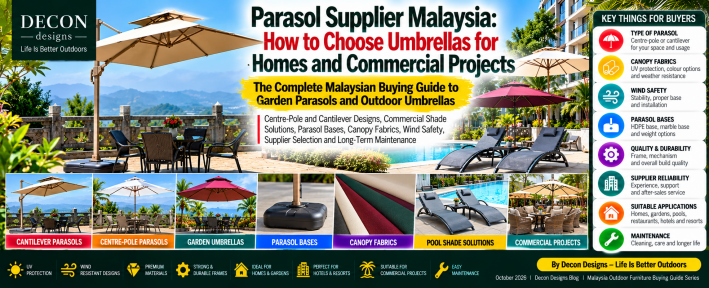
The Complete Malaysian Buying Guide to Garden Parasols, Outdoor Umbrellas, Centre-Pole and Cantilever Designs, Commercial Shade Solutions, Parasol Bases, Canopy Fabrics, Wind Safety, Supplier Selection and Long-Term Maintenance
By Decon Designs – Life Is Better Outdoors | Parasol Supplier Malaysia | Garden Umbrella Malaysia | Outdoor Umbrella Supplier | Commercial Parasols | Cantilever Umbrellas | Centre-Pole Parasols | Outdoor Furniture Malaysia | Hospitality & Outdoor Living
November 2026 | Decon Designs Blog | Malaysia Outdoor Furniture Buying Guide Series
Introduction: Choosing a Parasol Is About More Than Choosing an Umbrella
In Malaysia, outdoor shade is an important consideration for homes, restaurants, hotels, resorts, condominiums and commercial properties.
A beautifully furnished garden may become uncomfortable under strong afternoon sunlight.
A restaurant terrace may need shade for outdoor dining.
A hotel swimming pool may require umbrellas near loungers.
A condominium may want to improve comfort in a shared garden or recreational area.
For many of these environments, an outdoor parasol can be a practical shade option.
However, buying a parasol involves more than selecting an attractive canopy colour or choosing the largest available umbrella.
The frame, canopy, operating mechanism, base, installation conditions and environmental exposure all matter.
A parasol that is suitable for a sheltered residential patio may not be appropriate for a windy rooftop.
A large cantilever umbrella may require a substantial support arrangement.
A centre-pole parasol may suit certain dining tables but interfere with other furniture layouts.
A commercial property may require multiple coordinated umbrellas, replacement canopies and clear operating procedures.
These differences make supplier selection important.
The essential question is:
How can Malaysian buyers choose the right parasol supplier and the right outdoor umbrella for their intended space?
At Decon Designs – Life Is Better Outdoors, with more than two decades serving Malaysia’s outdoor and hospitality furniture market, we believe parasol selection should begin with the location, intended use and safety requirements—not simply the product photograph.
This guide explains the different parasol types, important specifications, base requirements, maintenance considerations and questions buyers should ask before placing an order.
1. What Is a Parasol?
A parasol is a shade product designed to provide protection from direct sunlight within its intended operating conditions.
Outdoor parasols are commonly used in:
- Residential gardens.
- Patios.
- Outdoor dining areas.
- Swimming pools.
- Hotel terraces.
- Resort lounges.
- Cafés.
- Restaurants.
- Condominium common areas.
- Recreational clubs.
The terms parasol, garden umbrella, outdoor umbrella and patio umbrella are often used interchangeably.
However, the products may differ significantly in design, dimensions, construction and intended application.
A small garden umbrella and a large commercial cantilever parasol should not be evaluated using identical criteria.
2. Why Parasols Matter in Malaysia’s Tropical Environment
Malaysia experiences warm temperatures, high humidity and frequent rainfall.
Sunlight exposure can influence how comfortable outdoor spaces feel.
Parasols may help create shaded areas for certain activities.
However, buyers should understand that an umbrella does not automatically provide complete protection from heat, ultraviolet radiation or rain.
Actual performance depends on:
- Canopy material.
- Canopy size.
- Sun position.
- Product construction.
- Environmental conditions.
- Manufacturer specifications.
A parasol should be treated as one element of outdoor comfort planning rather than a complete weather-protection solution.
3. Residential Versus Commercial Parasols
The first purchasing decision is identifying the intended application.
Residential Parasols
These may be used in:
- Home gardens.
- Patios.
- Terraces.
- Private swimming pools.
- Suitable balconies.
Homeowners may prioritize appearance, shade coverage, ease of operation and available space.
Commercial Parasols
These may be used in:
- Hotels.
- Resorts.
- Restaurants.
- Cafés.
- Clubs.
- Condominiums.
- Hospitality properties.
Commercial buyers may need to consider more frequent operation, cleaning, maintenance, quantity consistency and replacement components.
However, the term commercial grade should not be accepted without supporting specifications.
The right parasol depends on the intended environment and the manufacturer’s stated operating limits.
4. Understanding the Main Types of Parasols
Several parasol designs are available in the Malaysian market.
Common categories include:
- Centre-pole parasols.
- Cantilever parasols.
- Side-pole parasols.
- Round garden umbrellas.
- Square outdoor umbrellas.
- Commercial dining umbrellas.
Some categories overlap.
For example, a cantilever parasol may also be described as a side-pole umbrella.
Buyers should confirm the exact construction rather than relying only on product terminology.
5. Centre-Pole Parasols: A Familiar Garden Shade Solution
Centre-pole parasols have a support pole positioned near the centre of the canopy.
They are commonly used in garden seating and outdoor dining arrangements.
Potential Applications
- Patio tables.
- Garden dining sets.
- Outdoor café tables.
- Poolside seating.
- Residential terraces.
What Buyers Should Check
- Canopy dimensions.
- Pole material.
- Opening mechanism.
- Base requirements.
- Compatibility with furniture.
- Operating limitations.
A centre-pole parasol may work well with a compatible table arrangement.
However, the pole position may interfere with certain seating layouts.
6. Cantilever Parasols: Flexible Shade Positioning
Cantilever parasols support the canopy from an offset structure.
This design can allow shade to be positioned away from the main support pole.
Potential applications include:
- Outdoor sofas.
- Garden lounges.
- Selected poolside arrangements.
- Larger patio seating areas.
However, cantilever parasols require careful attention to support and stability.
Important Considerations
- Overall dimensions.
- Base compatibility.
- Canopy reach.
- Clearance.
- Operating mechanism.
- Site conditions.
- Wind limitations.
A cantilever design should not be assumed safer or more suitable than a centre-pole design.
Suitability depends on the exact product and location.
7. Side-Pole Parasols: Understand the Product Description
The term side-pole parasol may refer to different offset-pole designs.
Some products have fixed configurations.
Others may include tilt or rotation functions.
Buyers should not assume that every side-pole parasol rotates 360 degrees or offers adjustable canopy positioning.
Ask the supplier to demonstrate the exact mechanism.
Questions to Ask
- Is the canopy fixed or adjustable?
- Does it tilt?
- Does it rotate?
- What is the opening method?
- What operating limits apply?
- What base is required?
Accurate product descriptions help avoid misunderstandings.
8. Round Versus Square Parasols
Canopy shape can influence appearance and shade coverage.
Round Parasols
Round designs may complement circular tables, garden seating and certain poolside arrangements.
Square Parasols
Square designs may suit rectangular layouts, commercial terraces and coordinated outdoor dining arrangements.
However, the actual shaded area depends on the canopy dimensions, sun position and installation location.
A square parasol is not automatically better for commercial use.
A round parasol is not automatically better for residential use.
9. What Size Parasol Should You Buy?
Parasol sizing should begin with the area that needs shade.
A buyer should measure:
- Seating arrangement.
- Table dimensions.
- Available clearance.
- Nearby walls.
- Trees.
- Doors.
- Walkways.
- Existing structures.
The parasol must also have enough space to open and close according to manufacturer instructions.
Common Purchasing Mistake
Choosing the largest canopy without considering the base, support structure and site conditions.
A larger canopy can introduce additional structural and operating requirements.
The appropriate size should be determined using the manufacturer’s specifications and the intended location.
10. Understanding a 3-Metre Garden Parasol
A 3-metre round parasol is a common size category in outdoor furniture retail.
However, buyers should clarify what the measurement represents.
For a round canopy, a 3-metre diameter gives a nominal overhead circular area of approximately 7.1 square metres when viewed directly from above.
This does not mean the parasol will provide 7.1 square metres of effective shade at every time of day.
The actual shade position and coverage change with the sun.
Buyers Should Confirm
- Canopy diameter.
- Overall height.
- Pole position.
- Clearance.
- Base requirements.
- Opening mechanism.
- Operating limitations.
11. Parasol Bases: One of the Most Important Safety Considerations
The base is a critical part of a freestanding parasol system.
It helps support the structure under its intended operating conditions.
However, the correct base depends on the exact parasol model.
Potential arrangements include:
- Compatible weighted bases.
- Manufacturer-approved HDPE base systems.
- Suitable stone or concrete bases.
- Approved fixed installations.
What Buyers Must Understand
A base should not be selected only because it looks heavy.
The required support depends on the canopy, frame design and operating conditions.
Always follow the manufacturer’s base specifications.
Do not assume that adding arbitrary weights makes an unsuitable parasol safe.
12. HDPE Parasol Bases
Some parasol systems use HDPE components as part of a weighted base arrangement.
HDPE refers to high-density polyethylene.
Depending on the product, a base may require filling or additional support.
Buyers should confirm:
- Exact base model.
- Compatibility.
- Filling requirements.
- Installation instructions.
- Operating limitations.
A base’s appearance does not establish its suitability.
13. Marble, Stone and Concrete Parasol Bases
Stone and concrete bases may be used with certain parasol systems.
Their suitability depends on:
- Weight.
- Dimensions.
- Connection design.
- Parasol compatibility.
- Surface conditions.
- Manufacturer requirements.
A marble base should not automatically be considered suitable for every parasol.
Likewise, a concrete base may be inappropriate if it does not meet the product’s specified support requirements.
14. Parasol Frames: Aluminium, Steel and Other Materials
Parasol frames may be manufactured using different materials.
Common considerations include:
Aluminium
Inspect construction, joints, finishes and fittings.
Steel
Evaluate corrosion protection and maintenance requirements.
Timber
Review material suitability, finishing and care instructions.
Other Components
Check the specifications of moving parts, connectors and operating mechanisms.
The frame material alone does not establish overall product quality.
15. Opening Mechanisms: Practical Operation Matters
Parasols may use different opening systems.
Examples include:
- Manual push-up systems.
- Crank mechanisms.
- Pulley arrangements.
- Other manufacturer-specific designs.
Buyers should ask for a demonstration.
Check the Following
- Ease of operation.
- Required clearance.
- Locking or securing arrangements.
- Maintenance.
- User instructions.
Commercial properties should ensure staff understand the correct operating procedure.
16. Rotation and Tilt Functions: Verify Before Buying
Some outdoor umbrellas offer rotation or tilt adjustments.
Others have fixed canopies.
Do not assume these functions are standard.
A supplier should identify the exact capabilities of the model.
Ask
- Does the parasol rotate?
- If so, what is the permitted rotation range?
- Does the canopy tilt?
- Can the adjustment be locked?
- Are there operating restrictions?
This is especially important when buying parasols online.
17. Parasol Canopy Fabrics: What Buyers Should Know
Canopy materials differ in composition, construction and performance.
Buyers should ask about:
- Fabric type.
- Weight or specification.
- Colour.
- Cleaning.
- Water resistance.
- UV-related performance claims.
- Replacement availability.
A fabric described as waterproof may still have limitations at seams or under particular weather conditions.
Similarly, a canopy should not be assumed to provide complete UV protection without relevant evidence.
18. Colour Fading: Why Canopy Colour Matters
Sunlight exposure can affect canopy appearance over time.
Potential changes depend on:
- Fabric composition.
- Dyeing or colouring processes.
- UV exposure.
- Maintenance.
- Environmental conditions.
Darker and lighter colours may show different types of visible wear.
However, colour alone does not reliably establish fabric durability.
Buyers should request product-specific information.
19. Choosing Parasol Colours for Different Environments
Parasol colours can contribute to the appearance of an outdoor space.
Residential Gardens
Neutral colours may complement tropical landscaping.
Hotels and Resorts
Coordinated canopy colours can support a consistent visual identity.
Restaurants and Cafés
Colours may be selected to complement outdoor dining furniture and brand presentation.
Condominiums
Management teams may prioritize consistency with the property’s common-area design.
However, practical maintenance and fabric specifications should remain important.
20. Wind Safety: A Critical Parasol Purchasing Issue
Wind exposure is one of the most important parasol safety considerations.
A large canopy can experience substantial wind forces.
No freestanding garden parasol should be assumed safe in all wind conditions.
Buyers Should Ask
- What operating wind limits apply?
- When should the parasol be closed?
- What base is required?
- Is the product suitable for the intended location?
- Are there special restrictions for exposed sites?
Manufacturer guidance must be followed.
Parasols should be closed or secured as instructed during unsuitable weather.
21. Rooftop Parasols: Why Extra Caution Is Necessary
Rooftop terraces may experience different wind conditions from ground-level gardens.
A parasol suitable for a residential patio may be inappropriate for a high-rise rooftop.
Before purchasing, consider:
- Site-specific wind exposure.
- Building management rules.
- Structural and anchoring requirements.
- Access.
- Safe operation.
- Storage.
Appropriate professional assessment may be required.
Do not install a large parasol on an exposed rooftop based solely on retail product descriptions.
22. Parasols for Restaurants and Cafés
Outdoor dining businesses may use parasols to improve guest comfort.
However, commercial purchasing should consider operational requirements.
Important Factors
- Table layout.
- Customer circulation.
- Staff access.
- Canopy placement.
- Base positioning.
- Opening and closing procedures.
- Maintenance.
- Replacement availability.
A parasol should not obstruct required access or create hazards.
23. Hotel and Resort Parasols: Coordinated Procurement
Hotels and resorts may require multiple parasols across different outdoor areas.
These may include:
- Swimming pools.
- Garden lounges.
- Outdoor restaurants.
- Private villas.
- Recreational terraces.
A coordinated procurement approach may involve:
- Consistent models.
- Canopy colours.
- Compatible bases.
- Replacement canopies.
- Delivery schedules.
- Maintenance procedures.
For larger orders, supplier capability should be verified.
24. Poolside Parasols: What to Request
Swimming pool environments may involve moisture, cleaning products and frequent guest use.
Buyers should evaluate:
- Frame construction.
- Canopy material.
- Base suitability.
- Placement.
- Cleaning requirements.
- Operating limits.
Parasols should not obstruct pool access or required circulation.
Poolside furniture layouts should follow applicable safety requirements.
25. Condominium Parasols: JMB and MC Purchasing Considerations
Condominium management teams may purchase parasols for common facilities.
However, purchasing decisions should consider:
- Shared-use requirements.
- Maintenance.
- Site conditions.
- Supplier reliability.
- Budget.
- Warranty.
- Appropriate approvals.
For rooftop and exposed areas, additional technical assessment may be necessary.
Purchasing should follow the property’s applicable governance requirements.
26. Parasols for Private Homes and Gardens
Homeowners may prioritize appearance, shade and convenience.
However, the same essential checks apply.
Residential Checklist
- Measure the intended area.
- Confirm canopy dimensions.
- Check the frame.
- Verify base compatibility.
- Understand operating limits.
- Review fabric specifications.
- Confirm delivery and assembly.
- Read warranty terms.
A parasol should fit the outdoor environment without obstructing movement.
27. Parasols for Small Patios and Balconies
Compact outdoor spaces require careful planning.
A large canopy may not be suitable for a small balcony.
Buyers should consider:
- Available floor area.
- Base footprint.
- Clearance.
- Wind exposure.
- Building rules.
- Operating space.
High-rise balcony installations require particular caution.
Do not assume that a parasol suitable for a garden is automatically appropriate for a condominium balcony.
28. Parasol Placement: Follow the Sun, Not Just the Furniture Layout
Shade changes throughout the day.
A parasol positioned for morning sunlight may provide different coverage in the afternoon.
Before purchasing, observe the outdoor area.
Consider:
- Morning sun.
- Afternoon sun.
- Existing shade.
- Nearby buildings.
- Trees.
- Seating orientation.
The goal is to position the parasol where it provides useful shade under the intended conditions.
However, placement must remain compatible with safe operation and support requirements.
29. Parasol Supplier Malaysia: What Makes a Reliable Supplier?
A reliable supplier should provide accurate product information.
Important evaluation factors include:
Business Identity
Verify the supplier’s business details.
Product Specifications
Request canopy dimensions, frame materials and operating information.
Base Compatibility
Confirm the approved support arrangement.
Stock Availability
Verify whether the product is ready stock or pre-order.
Delivery
Clarify transportation and assembly.
Warranty
Review coverage and exclusions.
After-Sales Support
Ask about replacement canopies and components.
A supplier should not rely only on attractive product photographs.
30. What Commercial Buyers Should Include in a Request for Quotation
A structured request for quotation can improve supplier comparisons.
Recommended RFQ Information
- Project name.
- Delivery location.
- Intended application.
- Required quantity.
- Canopy shape.
- Canopy dimensions.
- Frame specifications.
- Fabric requirements.
- Colour preferences.
- Base requirements.
- Operating mechanism.
- Delivery deadline.
- Installation requirements.
- Warranty expectations.
Suppliers should identify any deviations from the requested specifications.
31. Comparing Parasol Quotations
Two parasols may have similar canopy sizes but different specifications.
| Comparison item | Supplier A | Supplier B |
|---|---|---|
| Canopy dimensions | Confirm | Confirm |
| Frame material | Confirm | Confirm |
| Fabric specification | Confirm | Confirm |
| Opening mechanism | Confirm | Confirm |
| Rotation or tilt | Confirm | Confirm |
| Base included | Confirm | Confirm |
| Approved base type | Confirm | Confirm |
| Warranty | Confirm | Confirm |
| Delivery | Confirm | Confirm |
| Assembly | Confirm | Confirm |
| Replacement canopy | Confirm | Confirm |
| Total price | Confirm | Confirm |
A quotation should clearly identify what is included.
32. Why the Cheapest Parasol May Not Be the Best Value
Parasol prices can differ because of:
- Canopy dimensions.
- Frame construction.
- Fabric specifications.
- Operating mechanism.
- Base system.
- Brand.
- Warranty.
- Delivery.
- Installation.
A lower price may represent good value for a suitable product.
However, buyers should not assume two similarly sized parasols are equivalent.
Compare specifications before comparing prices.
33. Illustrative Residential Parasol Budget
Consider a hypothetical homeowner purchasing a garden parasol.
| Cost component | Illustrative amount |
|---|---|
| Garden parasol | RM850 |
| Compatible base | RM250 |
| Delivery | RM100 |
| Assembly | RM100 |
| Illustrative total | RM1,300 |
This is a hypothetical example, not an actual Decon Designs quotation or verified market price.
Actual costs depend on the product and supplier terms.
34. Illustrative Commercial Parasol Procurement Budget
Consider a hypothetical restaurant project requiring eight parasols.
| Cost component | Quantity | Illustrative unit cost | Total |
|---|---|---|---|
| Commercial parasols | 8 | RM1,400 | RM11,200 |
| Compatible bases | 8 | RM350 | RM2,800 |
| Delivery and assembly allocation | 8 | RM150 | RM1,200 |
| Illustrative subtotal | RM15,200 |
These figures are hypothetical.
They exclude applicable taxes and site-specific works.
The example demonstrates why commercial buyers should request complete quotations.
35. Ready Stock Versus Pre-Order Parasols
Buyers may need parasols for different timelines.
Ready Stock
May be suitable for urgent replacement, subject to actual availability.
Pre-Order
May involve longer lead times.
Project Supply
May require quantity coordination and delivery scheduling.
Customized Canopies
May require additional design, production and approval time.
Always confirm delivery expectations in writing.
36. Delivery and Installation: Check the Full Scope
Parasol delivery may involve:
- Transportation.
- Loading.
- Unloading.
- Assembly.
- Base preparation.
- Positioning.
- Packaging removal.
Larger commercial parasols may require more complex handling.
Buyers should clarify which services are included.
For rooftop, coastal or unusual installations, additional assessment may be necessary.
37. Replacement Canopies: Ask Before Buying
Canopies may eventually require replacement due to damage, wear or changing operational needs.
However, replacement availability varies by product.
Before purchasing, ask:
- Is the canopy replaceable?
- Is the exact fabric available?
- Can the original colour be matched?
- What is the replacement process?
- Are replacement components stocked?
Do not assume that every parasol has a replaceable canopy.
38. Parasol Repairs: What Can Be Repaired?
Some parasol components may be repairable or replaceable.
Potential examples include:
- Canopies.
- Selected fittings.
- Certain operating components.
- Compatible base components.
However, structural damage requires careful assessment.
A damaged parasol should not remain in use if its safety is uncertain.
Repairs should follow manufacturer guidance and be carried out by suitable personnel.
39. Parasol Maintenance in Malaysia
Maintenance depends on the product.
General practices may include:
- Cleaning the canopy according to instructions.
- Inspecting frames and fittings.
- Checking the opening mechanism.
- Inspecting the base.
- Allowing wet fabric to dry appropriately.
- Following storage instructions.
- Closing the parasol during unsuitable weather.
Avoid forcing damaged mechanisms.
Do not use unsuitable cleaning chemicals.
40. Establishing a Commercial Parasol Operating Procedure
Hotels, restaurants and clubs should consider clear staff procedures.
These may address:
- Opening.
- Closing.
- Weather monitoring.
- Inspection.
- Cleaning.
- Storage.
- Reporting damage.
Staff should be trained according to the manufacturer’s instructions.
The objective is consistent and safe operation.
41. Total Cost of Ownership: Think Beyond the Purchase Price
The initial price is only one part of parasol ownership.
Additional costs may include:
- Bases.
- Delivery.
- Installation.
- Cleaning.
- Replacement canopies.
- Repairs.
- Storage.
- Replacement products.
Commercial buyers should consider these costs when comparing suppliers.
42. Common Parasol Buying Mistakes in Malaysia
Mistake 1: Buying Only by Canopy Size
The support structure and site conditions may be overlooked.
Mistake 2: Choosing an Incompatible Base
The parasol may not have the required support.
Mistake 3: Assuming Every Side-Pole Parasol Rotates
Operating functions vary by model.
Mistake 4: Ignoring Wind Exposure
The product may be unsuitable for the location.
Mistake 5: Buying for Rooftops Without Assessment
Exposed sites may require additional engineering considerations.
Mistake 6: Assuming Every Canopy Is Waterproof
Fabric performance varies.
Mistake 7: Ignoring Replacement Availability
Future repairs may become difficult.
Mistake 8: Comparing Incomplete Quotations
Base and installation costs may be excluded.
Mistake 9: Not Training Staff
Commercial parasols may be operated incorrectly.
Mistake 10: Choosing Only the Lowest Price
Long-term ownership costs may be ignored.
43. Parasol Supplier Evaluation Scorecard
Buyers may use a structured evaluation system.
| Evaluation area | Illustrative weighting |
|---|---|
| Product suitability and safety information | 30% |
| Frame and canopy specifications | 20% |
| Supplier reliability | 15% |
| Price and overall value | 15% |
| Warranty and support | 10% |
| Delivery and installation | 5% |
| Replacement availability | 5% |
| Total | 100% |
Weights are illustrative.
Mandatory safety requirements should be treated as essential conditions rather than optional scoring factors.
44. Parasol Procurement Checklist
Before approving a purchase, confirm:
-
The intended location has been assessed.
-
The canopy dimensions are suitable.
-
The frame material is identified.
-
The opening mechanism is understood.
-
Rotation and tilt functions are confirmed.
-
The approved base arrangement is specified.
-
Wind-related operating limits are understood.
-
Fabric specifications are available.
-
Warranty terms are clear.
-
Delivery and installation are confirmed.
-
Replacement canopy availability has been discussed.
-
Maintenance instructions are provided.
-
Commercial staff procedures are planned where applicable.
45. What Malaysian Parasol Buyers Should Prioritize in 2027
As homeowners and commercial buyers plan outdoor improvements, the following priorities can support better decisions.
Accurate Product Specifications
Buyers should understand the exact parasol design.
Better Base Selection
Support arrangements should follow manufacturer requirements.
Site-Specific Suitability
Rooftops, coastal areas and exposed locations require careful evaluation.
Fabric Transparency
Suppliers should provide meaningful canopy specifications.
After-Sales Planning
Replacement canopies and components should be discussed early.
Maintenance Awareness
Owners and operators should understand care requirements.
Long-Term Value
Purchasing decisions should consider the complete cost of ownership.
These are practical procurement priorities, not predictions of guaranteed market trends.
46. Decon Designs: Our Perspective on Parasol Supply in Malaysia
At Decon Designs – Life Is Better Outdoors, we believe a parasol should be selected according to the outdoor environment and the customer’s actual needs.
With more than two decades serving Malaysia’s outdoor and hospitality furniture market, we understand that shade products play different roles in different settings.
A homeowner may need a garden umbrella for a patio.
A restaurant may require several parasols for outdoor dining.
A hotel may need coordinated shade products beside a swimming pool.
A condominium may require parasols for selected common areas.
A resort may need different canopy designs across multiple outdoor zones.
Each application involves different considerations.
We encourage buyers to understand canopy dimensions, frame construction, base compatibility, operating limitations, maintenance and warranty terms before purchasing.
A good parasol supplier should help customers choose an appropriate shade solution—not simply sell the largest umbrella available.
Conclusion: The Right Parasol Begins With the Right Questions
Parasols can improve the usability and comfort of outdoor environments.
They can complement garden furniture, outdoor dining sets, pool loungers and patio sofas.
However, choosing a parasol requires careful consideration.
Canopy size matters.
Frame construction matters.
Fabric specifications matter.
Base compatibility matters.
Wind exposure matters.
And the intended location matters.
For Malaysian homeowners, hotels, resorts, restaurants and condominium management teams, supplier selection should involve accurate product information and transparent commercial terms.
Before purchasing, measure the space, confirm the product specifications, review the approved support arrangement and understand operating limitations.
For commercial projects, request complete quotations and plan maintenance.
The best parasol is not necessarily the largest, most expensive or most visually impressive. It is the one that is suitable for the intended location, correctly supported and operated according to its specifications.
At Decon Designs, we believe informed shade-product choices contribute to better outdoor living.
Decon Designs – Life Is Better Outdoors.
Frequently Asked Questions
1. What is the difference between a parasol and a garden umbrella?
The terms are often used interchangeably. Product designs, specifications and intended applications may differ.
2. What types of parasols are available in Malaysia?
Common types include centre-pole, cantilever and side-pole designs with round or square canopies.
3. Is a cantilever parasol better than a centre-pole parasol?
Neither is universally better. The appropriate choice depends on the seating layout, available space, support requirements and operating conditions.
4. What size parasol should I buy for my garden?
Measure the intended seating area and confirm the product’s canopy dimensions, clearance and base requirements.
5. Does every side-pole parasol rotate 360 degrees?
No. Rotation and tilt functions vary by model and should be confirmed before purchase.
6. Can I use a parasol on a condominium rooftop?
Suitability depends on site conditions, wind exposure, building requirements and the product’s specifications. Professional assessment may be necessary.
7. What base should I use for a cantilever parasol?
Use the manufacturer-approved support arrangement for the exact model and intended installation.
8. Are outdoor parasols waterproof?
Water-resistance characteristics vary by canopy material and construction. Buyers should verify the specific product claims.
9. Can parasol canopies be replaced?
Some models support canopy replacement. Availability should be confirmed with the supplier.
10. Are commercial parasols suitable for restaurants and resorts?
Certain products are designed for commercial applications, but buyers should verify their specifications and intended use.
11. How should parasols be maintained in Malaysia?
Follow manufacturer instructions for cleaning, inspection, operation and storage. Close or secure parasols as instructed during unsuitable weather.
12. How do I choose a reliable parasol supplier in Malaysia?
Verify the supplier’s business details, product specifications, base compatibility, delivery arrangements, warranty and after-sales support.
Research and Industry References
1. Malaysian Meteorological Department (METMalaysia)
Weather and climate information relevant to outdoor planning.
https://www.met.gov.my/
2. Department of Standards Malaysia
National standards and conformity-assessment information.
https://www.jsm.gov.my/
3. Malaysian Investment Development Authority (MIDA)
Manufacturing and industry information.
https://www.mida.gov.my/
4. Ministry of Domestic Trade and Cost of Living Malaysia
Consumer and trade-related information.
https://www.kpdn.gov.my/
Editorial note: Parasol safety depends on the exact product, support arrangement and site conditions. This article does not establish a universal safe wind speed, base weight or installation method. Follow manufacturer specifications and obtain appropriate professional assessment for exposed or unusual installations. All cost examples are hypothetical, not actual Decon Designs quotations or verified market prices.


