
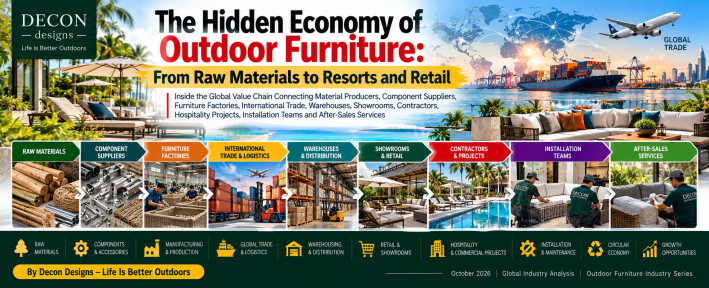
Inside the Global Value Chain Connecting Material Producers, Component Suppliers, Furniture Factories, International Trade, Warehouses, Showrooms, Contractors, Hospitality Projects, Installation Teams and After-Sales Services
By Decon Designs – Life Is Better Outdoors | Outdoor Furniture Industry | Global Furniture Value Chain | Furniture Manufacturing | Supply Chains | Hospitality Furniture | Furniture Retail | International Trade | Commercial Procurement | Circular Economy | Global Industry Intelligence
October 2026 | Global Industry Analysis | Outdoor Furniture Industry Series
Introduction: The Outdoor Furniture Economy Is Bigger Than the Furniture We See
When a customer purchases an outdoor dining set, a garden sofa or a commercial parasol, the transaction may appear straightforward.
A product is selected.
A price is agreed upon.
Payment is made.
The furniture is delivered.
But behind that transaction lies an extensive international economic network.
Before an outdoor chair reaches a residential balcony in Kuala Lumpur, a resort in Langkawi or a hotel swimming pool in Dubai, numerous businesses and skilled workers may have contributed to its production and delivery.
Raw materials must be sourced.
Metals must be processed.
Timber must be prepared.
Synthetic fibres and outdoor fabrics must be manufactured.
Frames must be fabricated.
Cushions must be cut and sewn.
Products must be assembled, inspected and packaged.
Shipping companies, customs agents, warehouses and transport operators may be involved.
Retailers, distributors, designers and contractors connect products with customers.
Installation teams prepare furniture for use.
Maintenance providers and replacement-component suppliers may support the product for years after its initial sale.
The outdoor furniture industry is not simply an economy of chairs, tables, sofas and loungers. It is an interconnected economy of materials, manufacturing, trade, services, property development, hospitality and long-term product ownership.
Much of this economic activity remains invisible to the final customer.
At Decon Designs – Life Is Better Outdoors, with more than two decades serving Malaysia’s outdoor and hospitality furniture market, we believe understanding this hidden value chain is essential for manufacturers, suppliers, retailers, commercial buyers and policymakers.
This report examines the complete outdoor furniture economy, from upstream material production to downstream customer service, and explains where businesses create value, face risks and discover new opportunities.
1. What Is the Hidden Economy of Outdoor Furniture?
The hidden economy refers to the business activities that support outdoor furniture before, during and after the final sale.
It includes the direct production of furniture and the wider network of services required to bring products into practical use.
The global outdoor furniture market itself is substantial.
Grand View Research estimates its value at approximately US$53.3 billion in 2025, with a forecast of US$86.6 billion by 2033.
However, these market estimates should not be interpreted as the total economic contribution of every upstream and downstream business associated with outdoor furniture.
A market-size estimate generally measures a defined set of product revenues.
The wider value chain includes businesses whose activities may also serve indoor furniture, construction, automotive, textiles and other industries.
Adding every supplier’s revenue to the finished furniture market would risk double-counting transactions.
The more useful question is:
How many economic activities must work together before outdoor furniture reaches its final customer?
The answer reveals a complex business ecosystem.
2. Mapping the Complete Outdoor Furniture Value Chain
The industry can be understood through ten interconnected stages.
| Stage | Economic activity | Main participants |
|---|---|---|
| 1 | Raw-material production | Timber, metal, polymer, textile and chemical suppliers |
| 2 | Component manufacturing | Frame, fitting, fabric, foam and hardware producers |
| 3 | Product design and development | Designers, engineers, product-development teams |
| 4 | Furniture manufacturing | Factories, fabricators, upholsterers and assemblers |
| 5 | Quality control and packaging | Inspectors, testing providers, packaging companies |
| 6 | International trade and logistics | Exporters, importers, freight forwarders, customs agents |
| 7 | Warehousing and distribution | Wholesalers, distributors and inventory operators |
| 8 | Retail and project procurement | Showrooms, online sellers, contractors and buyers |
| 9 | Delivery and installation | Transport teams, installers and project coordinators |
| 10 | Maintenance and end-of-life services | Repairers, upholsterers, refurbishment and recycling businesses |
These stages do not always occur in a fixed sequence.
Some manufacturers sell directly to customers.
Some retailers import finished products.
Some hospitality contractors coordinate sourcing, delivery and installation.
Some brands outsource manufacturing while managing design and distribution.
Nevertheless, the overall value chain demonstrates why the industry supports far more activities than furniture assembly alone.
3. Stage One: Raw Materials — Where the Furniture Economy Begins
Every outdoor furniture product begins with materials.
These materials may come from different countries and industries.
Aluminium
Aluminium is commonly used in outdoor furniture frames, chairs, dining tables and loungers.
Its value chain may involve primary or recycled metal production, extrusion, cutting, fabrication and surface finishing.
Steel
Steel is used in selected furniture frames, table structures, bases and components.
Appropriate protective finishes are important for many outdoor applications.
Timber
Suitable hardwoods and other wood products are used in outdoor dining furniture, benches, loungers and decorative components.
The value chain may involve forestry, sawmilling, drying, machining and finishing.
Polymers
Polymers are used in synthetic wicker, moulded furniture, fittings and other components.
Their performance depends on material formulation, product design and intended environmental exposure.
Textiles
Outdoor fabrics are used for cushions, upholstery, sling seating and shade products.
Fabric production involves yarns, weaving or knitting, finishing and other processing activities.
Foam and Cushion Fillings
Cushion manufacturers use appropriate foam and filling materials to provide comfort and support.
Coatings and Finishes
Powder coatings, paints and other finishes contribute to appearance and environmental protection.
Fasteners and Hardware
Bolts, screws, connectors, hinges and other fittings support structural assembly and product function.
A single outdoor furniture collection may involve several of these material industries.
That is why changes in raw-material prices or availability can influence furniture costs.
4. Stage Two: Component Manufacturing — The Suppliers Behind the Brands
Many furniture companies do not manufacture every component themselves.
Instead, they rely on specialist suppliers.
These may include:
- Aluminium extrusion companies.
- Metal fabrication workshops.
- Synthetic wicker producers.
- Rope manufacturers.
- Cushion factories.
- Outdoor fabric suppliers.
- Fastener manufacturers.
- Plastic moulding companies.
- Powder-coating specialists.
- Tabletop manufacturers.
- Furniture accessory suppliers.
Component specialization can improve efficiency and allow furniture factories to focus on assembly, design and customer requirements.
However, it also creates dependencies.
If a particular fabric becomes unavailable, a manufacturer may be unable to complete a collection.
If a fitting changes dimensions, assembly or product quality may be affected.
If a coating supplier experiences delays, production schedules may be disrupted.
The Business Opportunity
Component manufacturers can build competitive advantages through:
- Consistent specifications.
- Reliable delivery.
- Product development.
- Material testing.
- Traceability.
- Technical support.
- Replacement-part availability.
The hidden component economy is essential to the performance of finished furniture.
5. Stage Three: Furniture Design and Engineering
Before production begins, outdoor furniture requires design decisions.
These include:
- Product dimensions.
- Seating ergonomics.
- Structural construction.
- Material selection.
- Assembly methods.
- Finishes.
- Cushion specifications.
- Packaging dimensions.
- Intended usage.
- Maintenance requirements.
A designer may create an attractive outdoor sofa.
An engineer must determine whether its construction is appropriate for the intended application.
A production team must establish how it can be manufactured consistently.
A logistics team may recommend design adjustments to improve packaging and transportation.
A commercial buyer may require specific dimensions or finishes.
This creates opportunities for industrial designers, engineers, product-development consultants and technical specialists.
Design is not merely decoration. It is a commercial activity connecting customer expectations with manufacturing feasibility and product performance.
6. Stage Four: Furniture Factories — Where Materials Become Finished Products
Manufacturing converts materials and components into furniture.
Different products require different production processes.
Aluminium Furniture
Production may involve cutting, bending, welding, surface preparation, finishing and assembly.
Synthetic Wicker Furniture
Production may involve frame fabrication, weaving, cushion production and final assembly.
Timber Furniture
Production may involve machining, joinery, sanding, finishing and assembly.
Upholstered Outdoor Furniture
Production may involve frame construction, foam preparation, fabric cutting, sewing and upholstery.
Commercial Parasols
Production may involve frame fabrication, canopy production, mechanisms, fittings and final assembly.
These activities create demand for machinery, skilled labour, production supervisors, quality-control personnel and industrial services.
Manufacturing efficiency matters because wasted materials, rework and inconsistent production can reduce profitability.
However, efficiency improvements should not compromise product safety or essential quality.
7. Malaysia’s Manufacturing Position in the Wider Furniture Economy
Malaysia has an established furniture manufacturing and wood-products sector.
According to the Malaysian Investment Development Authority, the furniture and fixtures segment recorded 39 approved projects and RM692.7 million in approved investments in 2024.
MIDA also emphasizes the importance of design development, automation, technology adoption and moving toward higher-value manufacturing.
These figures relate to the broader furniture and fixtures sector, not exclusively to outdoor furniture.
Nevertheless, they illustrate the industrial base from which Malaysian furniture businesses can develop new products and services.
Opportunities for Malaysian Manufacturers
Businesses can explore:
- Specialized outdoor furniture production.
- Commercial furniture collections.
- Component manufacturing.
- Product design services.
- Customized hospitality furniture.
- Replacement parts.
- Export-oriented manufacturing.
- Repairable and modular furniture.
Malaysia’s opportunity is not limited to producing finished furniture.
It also includes the supply of knowledge, components, engineering and supporting services.
8. Stage Five: Quality Control — An Often-Overlooked Economic Activity
Furniture quality does not begin when a customer inspects the finished product.
It begins with material specifications and manufacturing controls.
Quality assurance may involve:
- Incoming material inspection.
- Dimensional checks.
- Frame inspection.
- Weld inspection.
- Finish evaluation.
- Assembly verification.
- Stability assessment.
- Packaging inspection.
- Product documentation.
Commercial furniture may require additional evaluation based on its intended application and relevant requirements.
Testing laboratories, inspection companies and technical consultants can support this process.
For outdoor furniture, environmental exposure creates additional considerations.
Products may experience sunlight, moisture, temperature changes and frequent use.
BIFMA’s 2025 outdoor furniture technical whitepaper discusses the industry’s interest in evaluating products for demanding exterior environments.
That whitepaper is informative and should not be described as an approved consensus standard.
Why Quality Control Matters Economically
Poor quality can create costs throughout the value chain.
A defective product may require:
- Replacement parts.
- Additional transportation.
- Customer service.
- Repairs.
- Refunds.
- Project delays.
These costs may be shared by manufacturers, suppliers, retailers and buyers.
Investing in appropriate quality systems can therefore support both customer satisfaction and operational efficiency.
9. Stage Six: Packaging — The Industry Behind Product Protection
Packaging is often overlooked when discussing furniture.
Yet outdoor furniture can be large, heavy, fragile or difficult to transport.
Packaging companies provide:
- Corrugated cartons.
- Protective wrapping.
- Corner protection.
- Pallets.
- Cushion protection.
- Labelling.
- Handling instructions.
Packaging design influences shipping volume, product damage and warehouse efficiency.
A poorly packaged outdoor dining table may arrive damaged even if it leaves the factory in excellent condition.
A bulky furniture design may require more shipping space.
Manufacturers therefore need to consider packaging during product development.
Opportunities
Packaging specialists can create value through:
- Better product protection.
- Space-efficient packaging.
- Reduced material waste.
- Improved handling.
- Clearer assembly instructions.
Packaging is not merely a final factory expense.
It is part of the furniture supply chain’s commercial performance.
10. Stage Seven: International Trade — How Outdoor Furniture Crosses Borders
Outdoor furniture is traded internationally.
Manufacturers may export finished products to distributors, retailers and commercial buyers.
Importers may source furniture from overseas factories.
Brands may coordinate production across several countries.
International trade involves:
- Export documentation.
- Customs classification.
- Freight booking.
- Shipping insurance.
- Customs clearance.
- Import duties and taxes.
- Currency management.
- Delivery coordination.
A product’s factory price is only one component of its final landed cost.
For example, a Malaysian retailer importing outdoor sofas must consider more than the supplier’s quotation.
The business may also incur freight, insurance, customs-related charges, local transportation, warehousing and other expenses.
Why Trade Expertise Matters
Importers and exporters create value by coordinating complex international transactions.
Their expertise can help buyers access products from different manufacturing markets.
However, businesses must understand applicable regulations and commercial risks.
Trade agreements may offer benefits for eligible goods, but requirements depend on product classification, origin and importing-country rules.
11. Stage Eight: Freight Forwarders, Shipping Companies and Transport Operators
Furniture logistics is a significant part of the hidden economy.
A shipment may involve:
- Factory collection.
- Inland transportation.
- Export handling.
- International shipping.
- Import clearance.
- Local warehousing.
- Final delivery.
Each activity may involve different service providers.
Outdoor furniture can create logistical challenges because of product size and packaging requirements.
Large sofas, loungers and dining tables occupy substantial storage and transport space.
Delivery damage can also create additional costs.
Opportunities for Logistics Businesses
Specialized services may include:
- Furniture handling.
- Container loading.
- Warehouse management.
- Project delivery.
- White-glove delivery.
- Assembly coordination.
- Returns management.
Logistics performance can influence customer satisfaction as much as the furniture itself.
12. Stage Nine: Warehousing and Inventory Management
Once furniture reaches a domestic market, it may enter a warehouse before reaching customers.
Warehousing creates economic activity through:
- Storage facilities.
- Warehouse staff.
- Material-handling equipment.
- Inventory systems.
- Security.
- Insurance.
- Order fulfilment.
- Stock inspection.
For outdoor furniture retailers, inventory management is particularly important.
Large furniture products require space.
Unsold stock ties up working capital.
Products may also be affected by prolonged storage conditions.
The Inventory Challenge
Too much inventory can create financial pressure.
Too little inventory can cause missed sales or delayed projects.
Businesses should evaluate:
- Historical demand.
- Product popularity.
- Supplier lead times.
- Seasonal patterns.
- Storage costs.
- Commercial project requirements.
- Slow-moving stock.
Efficient inventory management can improve the sustainability of furniture businesses.
13. Stage Ten: Wholesalers and Distributors
Wholesalers and distributors connect manufacturers with retail and commercial markets.
They may purchase furniture in larger quantities and supply smaller retailers or project customers.
Their activities can include:
- Product selection.
- Supplier negotiations.
- Import coordination.
- Inventory holding.
- Regional distribution.
- Customer support.
- Warranty administration.
Distributors may also provide market knowledge to manufacturers.
For example, a supplier may understand that certain outdoor furniture designs are popular in one country but unsuitable for another.
This information can influence future product development.
Commercial Value
Distributors create value when they reduce the complexity of sourcing and delivery for their customers.
However, they must manage inventory, margins and customer expectations carefully.
14. Furniture Showrooms: More Than Places to Display Products
Physical furniture showrooms remain relevant because outdoor furniture is a high-consideration purchase.
Customers may want to inspect:
- Materials.
- Seating comfort.
- Dimensions.
- Finishes.
- Cushion quality.
- Product stability.
- Actual appearance.
A photograph cannot always communicate these characteristics accurately.
Showrooms also provide opportunities for customer consultation.
A knowledgeable salesperson may help a buyer understand whether a product is suitable for a covered balcony, garden or commercial poolside.
The Hidden Showroom Economy
A showroom supports additional economic activities:
- Property rental.
- Interior display.
- Lighting.
- Cleaning.
- Sales employment.
- Inventory management.
- Advertising.
- Local delivery.
- Customer service.
The retail price of furniture must often support these operating costs.
This is one reason the final selling price can differ from a factory quotation.
15. E-Commerce and Digital Furniture Discovery
Digital platforms are becoming increasingly important in furniture purchasing.
Customers may discover outdoor furniture through:
- Search engines.
- Retail websites.
- Online marketplaces.
- Social media.
- Digital catalogues.
- Customer reviews.
- AI-assisted search tools.
Global Market Insights estimates that offline channels represented 73% of outdoor furniture market revenue in 2025 under its research model.
The same provider expects online channels to expand over the longer term.
This suggests that physical retail and digital commerce may continue to operate together.
The Digital Economy Behind Furniture Sales
Online furniture sales support:
- Website development.
- Digital marketing.
- Product photography.
- Content creation.
- Search optimization.
- Payment processing.
- Customer service systems.
- Delivery coordination.
A digital furniture business still depends on physical products and logistics.
An online sale is not complete until the customer receives the correct furniture in acceptable condition.
16. Architects and Interior Designers: Influencing Furniture Procurement
Outdoor furniture is often selected as part of a larger design project.
Architects and interior designers may influence product specifications for:
- Hotels.
- Resorts.
- Restaurants.
- Residential developments.
- Private homes.
- Rooftop spaces.
- Commercial courtyards.
Their work may include:
- Space planning.
- Furniture selection.
- Material coordination.
- Colour schemes.
- Product dimensions.
- Budget planning.
- Supplier coordination.
This creates economic value beyond the furniture transaction.
A well-planned outdoor environment may require fewer changes during installation.
Designers can also help clients avoid products that are unsuitable for the intended space.
17. Project Contractors: Connecting Furniture With Construction and Hospitality
Commercial outdoor furniture may be supplied through project contractors.
These contractors coordinate purchasing and installation for larger developments.
Potential customers include:
- Hotels.
- Resorts.
- Restaurants.
- Property developers.
- Corporate facilities.
- Institutions.
- Leisure operators.
Project contractors may work with architects, designers, furniture suppliers and installation teams.
Their responsibilities can include:
- Procurement planning.
- Supplier coordination.
- Budget management.
- Delivery scheduling.
- Site access.
- Installation.
- Final inspection.
Why Contractors Matter
A hotel may require hundreds of furniture items delivered according to a construction or renovation schedule.
Coordinating these requirements creates economic value.
However, project-based business can also involve payment delays, schedule changes and specification disputes.
Suppliers should establish clear commercial terms before accepting major orders.
18. Hotels and Resorts: The Commercial Destination of the Value Chain
Hotels and resorts are important end users of outdoor furniture.
A resort may purchase:
- Pool loungers.
- Outdoor sofas.
- Dining sets.
- Parasols.
- Daybeds.
- Garden benches.
- Outdoor cushions.
- Terrace furniture.
The products contribute to guest comfort and the functionality of hospitality environments.
However, the purchase also supports numerous upstream businesses.
Consider a hypothetical resort order for 100 loungers.
The order may create work for:
- Frame suppliers.
- Fabric producers.
- Cushion manufacturers.
- Furniture assemblers.
- Quality inspectors.
- Packaging companies.
- Transport operators.
- Project coordinators.
- Installation teams.
The resort’s furniture investment therefore supports a wider chain of commercial activity.
The exact economic contribution depends on the products, sourcing arrangements and services involved.
19. Restaurants and Cafés: A Recurring Commercial Market
Restaurants and cafés also contribute to outdoor furniture demand.
Products may be purchased for:
- Outdoor dining terraces.
- Courtyards.
- Garden restaurants.
- Rooftop dining.
- Café seating.
- Hospitality lounges.
Commercial furniture is exposed to frequent use and cleaning.
Operators may prioritize:
- Comfort.
- Durability.
- Ease of maintenance.
- Space efficiency.
- Stackability.
- Suitable materials.
- Replacement availability.
This creates opportunities for suppliers that understand restaurant operations.
The business relationship may continue after the initial purchase through replacement furniture, maintenance and future expansion.
20. Property Developers and Residential Amenities
Property developers are another important part of the outdoor furniture economy.
New residential developments may include:
- Swimming pools.
- Rooftop lounges.
- Landscaped gardens.
- Clubhouses.
- Outdoor dining areas.
- Recreational spaces.
These facilities require appropriate furniture.
Developers may work with designers, contractors and furniture suppliers during project planning.
Furniture procurement can therefore become part of a larger construction and property-development value chain.
The opportunity is not limited to selling furniture.
It also includes specification, delivery, installation and maintenance planning.
21. Installation Teams: The Final Step Before Furniture Becomes Usable
Furniture installation is an important service activity.
Some products require assembly.
Others require positioning, adjustment or coordination with site conditions.
Installation teams may be responsible for:
- Unpacking.
- Assembly.
- Positioning.
- Checking fittings.
- Removing packaging.
- Identifying damage.
- Final handover.
Commercial projects may involve additional coordination.
For example, a hotel may need furniture installed before a scheduled opening.
Delays can affect project readiness.
Why Installation Matters
Poor installation can undermine a good product.
Incorrect assembly may create safety concerns or reduce product performance.
Suppliers should provide clear assembly instructions and ensure appropriate installation procedures are followed.
22. After-Sales Service: The Economy That Begins After Delivery
The furniture industry’s economic activity does not end when the product reaches the customer.
After-sales services may include:
- Warranty administration.
- Customer support.
- Replacement parts.
- Cushion replacement.
- Repairs.
- Maintenance advice.
- Product inspections.
- Refurbishment.
These activities create opportunities for service providers.
They also influence customer trust.
A supplier that communicates clearly about product care and warranty conditions may help customers avoid misunderstandings.
However, after-sales obligations should be defined accurately.
Businesses should not promise services or replacement components that they cannot reliably provide.
23. The Replacement Economy: Why Furniture Generates Recurring Demand
Outdoor furniture experiences wear and environmental exposure.
Over time, products may require maintenance, refurbishment or replacement.
This creates recurring demand.
Examples include:
- Replacing worn cushions.
- Renewing upholstery.
- Repairing suitable frames.
- Replacing fittings.
- Refinishing appropriate surfaces.
- Replacing damaged furniture.
- Upgrading existing furniture collections.
Commercial customers may operate planned replacement cycles.
However, there is no universal replacement period that applies to every outdoor furniture product.
Actual service life depends on materials, construction, exposure, use and maintenance.
Suppliers should avoid unsupported lifespan guarantees.
24. The Circular Economy: Turning Furniture Maintenance Into Business Opportunity
The circular economy focuses on extending product usefulness and reducing avoidable waste.
Outdoor furniture can support circular practices when products are designed and maintained appropriately.
Potential activities include:
- Repair.
- Refurbishment.
- Reuse.
- Component replacement.
- Material recovery.
- Recycling where feasible.
A resort may be able to replace cushions without purchasing entirely new furniture.
A homeowner may refurbish a suitable timber table.
A manufacturer may design products with replaceable components.
These activities can create economic value while potentially reducing unnecessary replacement.
However, repair and refurbishment should be evaluated for safety, technical feasibility and cost-effectiveness.
Not every damaged product should remain in use.
25. The Financial Journey of an Outdoor Furniture Product
The price paid by the final customer is not the same as the profit earned by the manufacturer or retailer.
A furniture product may accumulate costs throughout the value chain.
Consider the following hypothetical example.
Illustrative Outdoor Furniture Retail Cost Structure
| Cost component | Illustrative amount |
|---|---|
| Materials and components | RM450 |
| Factory labour and production overhead | RM200 |
| Factory profit and selling margin | RM150 |
| Packaging and inbound logistics | RM80 |
| Import-related costs and local transport | RM120 |
| Warehousing and inventory handling | RM100 |
| Retail operating costs and selling expenses | RM250 |
| Retail profit contribution before tax | RM150 |
| Illustrative selling price | RM1,500 |
This example is hypothetical. It is not based on Decon Designs’ actual pricing or an industry-average cost structure. Actual taxes, margins and costs depend on the transaction.
The example illustrates why a retail selling price includes more than the cost of materials and factory assembly.
Each stage must cover operating costs.
Some stages may also generate profit or losses.
The important distinction is between revenue, cost, gross margin and net profitability.
A high selling price does not automatically mean that every participant in the supply chain earns a high profit.
26. The Hidden Employment Economy
Outdoor furniture supports many different occupations.
These may include:
- Industrial designers.
- Engineers.
- Timber workers.
- Metal fabricators.
- Welders.
- Weavers.
- Upholsterers.
- Sewing-machine operators.
- Quality inspectors.
- Warehouse workers.
- Freight coordinators.
- Customs specialists.
- Sales consultants.
- Digital marketers.
- Furniture installers.
- Maintenance technicians.
The sector also supports professional services such as accounting, insurance, finance, legal support and information technology.
However, not every worker in these occupations is employed exclusively by the outdoor furniture industry.
Therefore, employment across the wider supply chain should not be added together and described as outdoor-furniture-only employment without appropriate evidence.
The key point is that furniture demand supports economic activity across numerous occupations and businesses.
27. The Risks Hidden Within the Value Chain
The same complexity that creates opportunities also creates risks.
Raw-Material Risk
Material shortages or price increases may affect production.
Manufacturing Risk
Defects and inconsistent specifications can create returns and complaints.
Logistics Risk
Shipping delays and damage may increase costs.
Inventory Risk
Excess stock can tie up working capital.
Retail Risk
Weak customer demand and high operating costs may reduce profitability.
Project Risk
Commercial orders may involve schedule changes, disputes or delayed payments.
Installation Risk
Poor assembly or coordination can affect customer satisfaction and safety.
After-Sales Risk
Warranty disputes and unavailable components can damage supplier relationships.
Businesses should identify which risks they can control and which require contractual or operational safeguards.
28. Malaysia’s Opportunity in the Hidden Outdoor Furniture Economy
Malaysia can participate in multiple stages of the outdoor furniture value chain.
The country’s opportunities extend beyond finished furniture retailing.
Potential business areas include:
Manufacturing
Developing suitable furniture and components.
Regional Sourcing
Connecting customers with domestic and international manufacturers.
Hospitality Procurement
Coordinating products for hotels, resorts and commercial properties.
Warehousing and Distribution
Managing inventory and delivery.
Furniture Retail
Providing showrooms, customer guidance and product access.
Project Installation
Supporting commercial furniture delivery and assembly.
Maintenance and Refurbishment
Extending product usefulness where appropriate.
Digital Services
Developing catalogues, websites and customer-information systems.
For Malaysian SMEs, specialization may be particularly important.
A business does not need to participate in every stage of the value chain.
It can develop expertise in one commercially viable area.
29. What Manufacturers, Suppliers and Buyers Should Prepare for in 2027
The hidden outdoor furniture economy creates opportunities, but businesses must manage complexity.
Manufacturers Should
- Strengthen material sourcing.
- Improve quality consistency.
- Reduce avoidable production waste.
- Develop relevant products.
- Improve packaging.
- Maintain accurate specifications.
Importers and Distributors Should
- Verify suppliers.
- Calculate landed costs.
- Manage inventory.
- Improve delivery reliability.
- Clarify warranty arrangements.
Retailers Should
- Provide accurate product information.
- Understand customer requirements.
- Control operating costs.
- Improve showroom and digital experiences.
- Strengthen after-sales communication.
Hospitality Buyers Should
- Define specifications.
- Evaluate supplier capability.
- Plan delivery schedules.
- Understand maintenance requirements.
- Consider total ownership costs.
Designers and Contractors Should
- Coordinate furniture requirements early.
- Confirm dimensions and materials.
- Plan installation.
- Reduce specification changes.
- Clarify project responsibilities.
The businesses that understand the full value chain may be better positioned to manage costs and deliver reliable customer experiences.
30. Decon Designs: Connecting Products With the Wider Outdoor Furniture Ecosystem
At Decon Designs – Life Is Better Outdoors, we believe customers benefit from understanding what happens before and after a furniture purchase.
With more than two decades serving Malaysia’s outdoor and hospitality furniture market, our perspective is shaped by the practical requirements of homeowners, restaurants, hotels, resorts and commercial buyers.
A homeowner may focus on comfort and design.
A restaurant may prioritize easy maintenance and space efficiency.
A resort may need loungers, parasols and coordinated outdoor furniture.
A property developer may require furniture for shared amenities.
Behind each requirement lies a network of manufacturers, suppliers, transport providers and service businesses.
We believe informed purchasing decisions begin with understanding:
- What materials are used.
- How products are constructed.
- Whether furniture suits the intended environment.
- What delivery arrangements apply.
- What maintenance is required.
- What after-sales support is available.
The outdoor furniture industry is strongest when its participants understand their responsibilities throughout the value chain.
Manufacturers must produce suitable products.
Suppliers must communicate accurately.
Retailers must help customers evaluate options.
Commercial buyers must plan procurement responsibly.
And service providers must support products appropriately throughout their useful lives.
The hidden economy of outdoor furniture becomes visible when we recognize every business, worker and service that contributes to the final customer experience.
Conclusion: Outdoor Furniture Is an Economy of Connections
The outdoor furniture industry is much more than the sale of finished products.
It begins with raw materials.
It continues through component production, product design, manufacturing and quality control.
It depends on packaging, international trade, logistics and warehousing.
It reaches customers through distributors, retailers, designers and contractors.
It becomes functional through delivery and installation.
And it continues through maintenance, repair, refurbishment and eventual replacement.
Every stage creates economic activity.
Every stage introduces costs and risks.
Every stage offers opportunities for businesses to specialize and improve performance.
For manufacturers, understanding the complete value chain can reveal opportunities for efficiency and product development.
For suppliers and retailers, it can improve pricing, inventory and customer service decisions.
For commercial buyers, it can support better procurement and lifecycle planning.
For Malaysia, it highlights opportunities across manufacturing, sourcing, hospitality, distribution and technical services.
The future of the outdoor furniture industry will not be shaped by manufacturers and retailers alone. It will depend on the strength of the entire ecosystem connecting raw materials to the final customer.
At Decon Designs, we believe better outdoor living begins with better understanding of the products, people and businesses that make it possible.
Decon Designs – Life Is Better Outdoors.
Frequently Asked Questions About the Outdoor Furniture Value Chain
What is the outdoor furniture value chain?
It is the network of activities involved in producing, distributing, selling, installing and maintaining outdoor furniture.
What are the main raw materials used?
Common materials include aluminium, steel, timber, polymers, synthetic wicker, outdoor fabrics, foam, coatings and hardware.
Why are component manufacturers important?
They produce frames, fittings, cushions, fabrics and other parts needed for finished furniture.
How do logistics affect furniture prices?
Freight, packaging, warehousing, customs-related charges and delivery can contribute significantly to the final cost.
What role do furniture showrooms play?
Showrooms allow customers to inspect products, assess comfort and receive purchasing guidance.
Why are contractors involved in furniture procurement?
Commercial projects may require coordination between designers, suppliers, transport providers and installation teams.
Why is after-sales service part of the furniture economy?
Products may require maintenance, warranty support, repairs or replacement components after delivery.
What is the circular outdoor furniture economy?
It includes activities such as repair, refurbishment, reuse, component replacement and recycling where feasible.
How can Malaysian businesses participate?
Opportunities exist in manufacturing, importing, distribution, retailing, hospitality procurement, installation, maintenance and digital services.
What is the most important lesson for furniture buyers?
The purchase price is only one part of the decision. Buyers should also evaluate product suitability, delivery, maintenance and long-term ownership costs.
Research Sources and Industry References
- Grand View Research — Outdoor Furniture Market, 2026–2033
https://www.grandviewresearch.com/industry-analysis/outdoor-furniture-market - Mordor Intelligence — Global Outdoor Furniture Market and Value Chain Analysis
https://www.mordorintelligence.com/industry-reports/global-outdoor-furniture-market - Malaysian Investment Development Authority — Wood-Based and Furniture Industry
https://www.mida.gov.my/industries/manufacturing/wood-based-and-furniture/ - BIFMA — Outdoor Furniture Technical Whitepaper, 2025
https://www.bifma.org/news/706995/BIFMA-OF-2025–Outdoor-Furniture-Whitepaper.htm - Global Market Insights — Outdoor Furniture Market, 2026–2035
https://www.gminsights.com/industry-analysis/outdoor-furniture-market - Universiti Malaysia Pahang Al-Sultan Abdullah — Enhanced Value Stream Mapping for Furniture Manufacturing Supply Chains, 2025
https://umpir.ump.edu.my/id/eprint/44467/


