Why Smart Property Developers, Hotels, Resorts & Commercial Buyers Look Beyond Purchase Price
Property Developer Education Series | June 2026 | By Decon Designs – Life Is Better Outdoors
One of the most expensive mistakes made in outdoor furniture procurement is focusing exclusively on the purchase price.
Many property developers, hotel operators, resort owners, architects, project consultants, procurement teams, and commercial buyers compare furniture options primarily based on upfront cost. While this approach may appear financially responsible at the beginning of a project, it often leads to significantly higher long-term expenses.
The reality is simple:
The cheapest outdoor furniture is rarely the most economical outdoor furniture.
In today’s hospitality, commercial, and property development sectors, successful organizations increasingly evaluate furniture using a lifecycle cost analysis approach.
This method examines the total financial impact of furniture throughout its entire lifespan rather than simply considering the initial purchase price.
The result is better decision-making, lower operational costs, improved guest experiences, and stronger long-term returns on investment.
What Is Outdoor Furniture Lifecycle Cost Analysis?
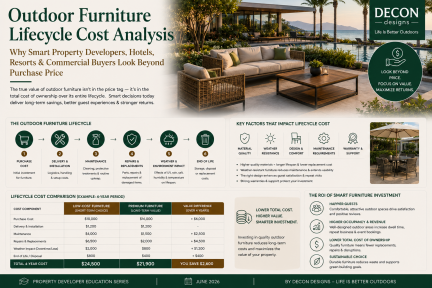
Lifecycle Cost Analysis (LCCA) evaluates all costs associated with furniture during its useful life.
These costs include:
- Purchase price
- Transportation
- Installation
- Maintenance
- Repairs
- Replacement parts
- Operational disruption
- Full replacement
Rather than asking:
“What does this furniture cost today?”
Developers ask:
“What will this furniture cost over the next 10, 15, or 20 years?”
This shift in thinking often changes procurement decisions dramatically.
Why Lifecycle Cost Analysis Matters
Outdoor furniture experiences significantly more environmental stress than indoor furniture.
It is exposed to:
- UV radiation
- Rain
- Humidity
- Salt air
- Chlorine
- Temperature fluctuations
- Frequent usage
As a result, furniture performance directly affects long-term operating costs.
For hotels, resorts, restaurants, commercial properties, residential developments, and public spaces, furniture should be evaluated as a long-term asset rather than a short-term purchase.
Understanding the Five Major Lifecycle Cost Categories
- Acquisition Costs
This includes:
- Furniture purchase price
- Shipping
- Delivery
- Installation
Most buyers focus only on this category.
However, acquisition costs often represent only a portion of total ownership costs.
- Maintenance Costs
Maintenance includes:
- Cleaning
- Protective treatments
- Upholstery care
- Hardware inspections
- Surface restoration
Furniture requiring extensive maintenance may become more expensive than higher-priced alternatives.
- Repair Costs
Repair costs can include:
- Frame repairs
- Cushion replacement
- Hardware replacement
- Structural restoration
Frequent repairs increase operational expenses and reduce user satisfaction.
- Replacement Costs
Premature replacement represents one of the largest hidden expenses in outdoor furniture ownership.
Furniture that lasts five years instead of fifteen years may require multiple replacement cycles during a property’s lifespan.
- Opportunity Costs
Furniture failures may result in:
- Closed amenities
- Reduced guest satisfaction
- Negative reviews
- Operational disruption
These indirect costs are often overlooked but can significantly affect business performance.
The Difference Between Purchase Price and Ownership Cost
Consider two outdoor dining chair options.
Option A
Purchase Price:
RM300 per chair
Expected Lifespan:
3–5 years
Maintenance:
High
Replacement Frequency:
Multiple times
Option B
Purchase Price:
RM800 per chair
Expected Lifespan:
10–15 years
Maintenance:
Low
Replacement Frequency:
Minimal
While Option B costs more initially, it often costs substantially less over its full lifecycle.
This principle applies across virtually all commercial furniture categories.
Material Selection and Lifecycle Costs
The choice of materials has a major influence on ownership costs.
Teak Furniture
Advantages:
- Exceptional durability
- Minimal structural deterioration
- Long lifespan
Expected Lifespan:
15–30+ years
Lifecycle Performance:
Excellent
While teak has a higher upfront investment, its longevity often produces outstanding long-term value.
Powder-Coated Aluminium
Advantages:
- Rust resistance
- Low maintenance
- Commercial durability
Expected Lifespan:
10–20 years
Lifecycle Performance:
Excellent
Particularly suitable for hotels, restaurants, and poolside environments.
Synthetic PE Rattan
Advantages:
- Weather resistance
- Hospitality appeal
- Lightweight construction
Expected Lifespan:
5–15 years
Lifecycle Performance:
Very Good when commercial-grade materials are specified.
Low-Grade Plastic Furniture
Advantages:
- Low purchase price
Disadvantages:
- UV degradation
- Cracking
- Short lifespan
Lifecycle Performance:
Poor
Often becomes the most expensive option over time.
Hospitality Industry Example
Consider a resort purchasing:
- Pool loungers
- Outdoor dining furniture
- Lounge seating
The project team chooses lower-cost products to reduce capital expenditure.
Five years later:
- Cushions require replacement
- Frames deteriorate
- Appearance declines
- Guest complaints increase
The resort now faces:
- Replacement costs
- Operational disruption
- Reputation concerns
Had the resort selected commercial-grade furniture initially, total ownership costs may have been significantly lower.
Lifecycle Analysis for Property Developers
Developers should evaluate:
Residential Projects
Furniture impacts:
- Amenity quality
- Resident satisfaction
- Maintenance fees
Hotels and Resorts
Furniture influences:
- Guest experience
- Brand positioning
- Operational efficiency
Mixed-Use Developments
Furniture supports:
- Community engagement
- Property value
- Asset performance
Lifecycle analysis helps developers make more sustainable and profitable decisions.
The Hidden Cost of Cheap Outdoor Cushions
Outdoor cushions often fail before furniture frames.
Common issues include:
- UV damage
- Water retention
- Mold growth
- Foam deterioration
Low-cost cushions may require replacement every few years.
Commercial-grade cushions with:
- Quick-dry foam
- UV-resistant fabrics
- Mold-resistant materials
Typically deliver significantly better lifecycle performance.
Maintenance Planning Improves Lifecycle Performance
Proper maintenance extends furniture lifespan.
Recommended practices include:
- Routine cleaning
- Scheduled inspections
- Protective treatments
- Prompt repairs
Preventive maintenance often costs far less than replacement.
Sustainability and Lifecycle Thinking
Lifecycle analysis aligns closely with sustainability objectives.
Long-lasting furniture reduces:
- Waste generation
- Resource consumption
- Replacement frequency
Sustainable procurement increasingly emphasizes durability over short-term cost savings.
Outdoor Furniture Lifecycle Evaluation Checklist
Before purchasing, ask:
✅ What is the expected lifespan?
✅ What maintenance is required?
✅ Are replacement parts available?
✅ What are the repair costs?
✅ Is the furniture suitable for local climate conditions?
✅ What is the total cost over 10 years?
✅ How does it affect guest experience?
✅ Does it support sustainability objectives?
These questions often reveal significant differences between competing products.
Future Trends in Furniture Procurement
The industry is increasingly adopting:
- Lifecycle procurement strategies
- Asset management systems
- Sustainability-focused purchasing
- Hospitality-grade specifications
- Long-term performance analysis
Organizations are shifting from price-based purchasing to value-based purchasing.
Final Thoughts
Outdoor furniture should never be evaluated solely on its purchase price.
The true cost of furniture includes maintenance, repairs, replacement, operational impact, and overall lifespan. Property developers, hotels, resorts, restaurants, architects, consultants, and commercial buyers who adopt a lifecycle cost analysis approach consistently make better procurement decisions and achieve stronger long-term returns.
The most successful projects are not built on the cheapest furniture.
They are built on furniture that delivers exceptional performance year after year.
At Decon Designs, we help developers, hospitality operators, architects, consultants, and commercial buyers evaluate furniture investments based on durability, lifecycle performance, maintenance requirements, and long-term value.
Because the smartest investment is not always the least expensive—it is the one that performs best over time.