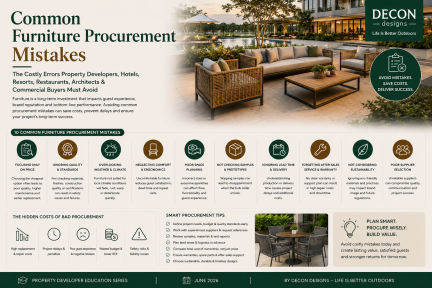
The Costly Errors Property Developers, Hotels, Resorts, Restaurants, Architects & Commercial Buyers Must Avoid
Property Developer Education Series | June 2026 | By Decon Designs – Life Is Better Outdoors
Furniture procurement is often viewed as the final stage of a project. However, experienced developers, hospitality operators, architects, designers, and project managers understand that furniture procurement can significantly influence project success, operational performance, customer satisfaction, maintenance costs, and long-term return on investment.
A single procurement mistake can lead to budget overruns, delayed project completion, premature replacements, guest complaints, operational inefficiencies, and even reputational damage.
Across hotels, resorts, residential developments, restaurants, cafés, office buildings, mixed-use projects, and commercial properties, many procurement challenges stem from the same avoidable mistakes.
Understanding these mistakes before procurement begins can save substantial time, money, and resources.
Why Furniture Procurement Matters
Furniture is more than an aesthetic element.
It directly impacts:
- User experience
- Property value
- Brand image
- Maintenance costs
- Operational efficiency
- Guest satisfaction
- Revenue performance
The right procurement strategy ensures furniture performs as expected throughout its lifecycle.
The wrong strategy often creates long-term operational challenges.
Mistake #1: Waiting Too Long to Start Procurement
One of the most common errors is treating furniture procurement as a final project activity.
Many project teams focus on:
- Construction
- Finishes
- Mechanical systems
- Landscaping
And only begin considering furniture shortly before handover.
This often results in:
- Limited product options
- Higher costs
- Project delays
- Compromised quality
Best Practice
Furniture planning should begin during the design and budgeting stages of the project.
Early planning creates greater flexibility and procurement efficiency.
Mistake #2: Choosing Furniture Based Solely on Price
Low-cost furniture can appear attractive during budgeting discussions.
However, the lowest purchase price rarely delivers the lowest overall cost.
Cheap furniture often results in:
- Higher maintenance costs
- Faster deterioration
- Frequent replacement
- Lower user satisfaction
The Better Approach
Evaluate:
- Durability
- Maintenance requirements
- Expected lifespan
- Total cost of ownership
The cheapest product frequently becomes the most expensive over time.
Mistake #3: Using Residential Furniture in Commercial Projects
Many commercial projects unknowingly specify residential-grade furniture.
This is particularly common in:
- Cafés
- Restaurants
- Boutique hotels
- Clubhouses
- Shared residential amenities
Residential furniture is not engineered for:
- Continuous use
- Heavy traffic
- Commercial cleaning
- Public environments
Best Practice
Always specify commercial-grade furniture for commercial applications.
Commercial furniture is designed for durability, safety, and long-term performance.
Mistake #4: Ignoring Climate Conditions
Furniture must match the environment in which it will operate.
This is especially important in tropical climates such as Malaysia and Southeast Asia.
Outdoor furniture faces:
- UV exposure
- Humidity
- Rain
- Corrosion risks
Selecting unsuitable materials often leads to premature failure.
Recommended Outdoor Materials
- Teak
- Powder-coated aluminium
- Synthetic rattan
- Outdoor rope furniture
Climate-specific procurement significantly improves furniture lifespan.
Mistake #5: Overlooking Maintenance Requirements
Beautiful furniture can become problematic if maintenance demands exceed operational capabilities.
Questions to consider:
- How often does the furniture require cleaning?
- Are specialized treatments necessary?
- Are replacement parts available?
Best Practice
Select furniture that balances aesthetics with practical maintenance requirements.
Operational teams should be involved during the selection process.
Mistake #6: Failing to Understand End Users
Furniture should support the needs of its intended users.
Examples:
Hotels
Focus on:
- Guest comfort
- Durability
- Luxury perception
Restaurants
Prioritize:
- Easy cleaning
- Frequent use
- Seating efficiency
Residential Developments
Require:
- Community engagement
- Lifestyle enhancement
- Long-term durability
Furniture should always align with user behavior and expectations.
Mistake #7: Ignoring Space Planning
Furniture that looks excellent in a catalogue may perform poorly in reality.
Common problems include:
- Oversized furniture
- Restricted circulation
- Poor seating arrangements
- Reduced functionality
Best Practice
Furniture should be selected alongside detailed space planning and layout studies.
Functionality should always accompany aesthetics.
Mistake #8: Choosing Style Over Comfort
Design attracts attention.
Comfort retains users.
Many projects prioritize appearance while neglecting:
- Ergonomics
- Seating comfort
- User experience
The Reality
Guests, customers, residents, and occupants remember comfort long after they forget furniture style.
Comfort directly affects satisfaction levels.
Mistake #9: Neglecting Outdoor Spaces
Developers increasingly invest in:
- Rooftop lounges
- Pool decks
- Outdoor cafés
- Garden spaces
- Community areas
However, outdoor furniture planning often receives less attention than interior furniture.
The Consequences
- Underutilized amenities
- Poor user experiences
- Increased maintenance issues
Outdoor spaces should receive equal strategic attention.
Mistake #10: Purchasing Without a Furniture Standards Program
Large developments often procure furniture from multiple suppliers without standardized guidelines.
This can create:
- Inconsistent aesthetics
- Variable quality
- Maintenance challenges
- Brand dilution
Best Practice
Develop a furniture standards framework covering:
- Materials
- Finishes
- Quality benchmarks
- Maintenance requirements
Consistency improves long-term project performance.
Mistake #11: Ignoring Supplier Capabilities
Not all furniture suppliers offer the same level of expertise.
Important considerations include:
- Industry experience
- Project portfolio
- Customization capabilities
- Installation services
- After-sales support
A supplier should be viewed as a project partner rather than simply a vendor.
Mistake #12: Not Planning for Future Expansion
Furniture requirements often evolve.
Many projects fail to consider:
- Future phases
- Additional units
- Expansion plans
- Replacement strategies
Best Practice
Select collections that can be expanded or replenished over time.
Future flexibility reduces procurement challenges.
Mistake #13: Overlooking Safety Requirements
Furniture contributes directly to risk management.
Areas requiring particular attention include:
- Pool decks
- Rooftop spaces
- Public areas
- Hospitality environments
Furniture should provide:
- Structural stability
- Rounded edges
- Appropriate weight capacity
- Commercial safety standards
Safety should never be compromised for aesthetics.
Mistake #14: Ignoring Sustainability Considerations
Modern developments increasingly evaluate:
- Sustainable sourcing
- Product longevity
- Environmental impact
- Lifecycle performance
Furniture procurement now plays an important role in ESG and sustainability initiatives.
Mistake #15: Failing to Measure Total Cost of Ownership
Many procurement decisions focus solely on purchase price.
However, furniture costs include:
- Installation
- Maintenance
- Repairs
- Replacement
- Operational downtime
Total Cost of Ownership Matters
Long-lasting furniture often provides substantially better financial performance over its lifecycle.
Furniture Procurement Checklist
Before making purchasing decisions, confirm:
✅ Furniture planning completed early
✅ Commercial-grade products specified
✅ Climate conditions evaluated
✅ User requirements identified
✅ Comfort tested
✅ Maintenance requirements reviewed
✅ Supplier capabilities verified
✅ Safety standards considered
✅ Future expansion planned
✅ Sustainability assessed
✅ Total cost of ownership calculated
Future Trends in Furniture Procurement
The industry is increasingly focused on:
- Lifecycle value
- Sustainability
- Hospitality-inspired environments
- Outdoor living spaces
- Flexible furniture systems
- Wellness-focused design
Procurement decisions are becoming more strategic and data-driven.
Final Thoughts
Furniture procurement is one of the most underestimated aspects of property development, hospitality operations, and commercial projects.
While furniture represents a significant investment, the true cost often lies in poor decision-making, inadequate planning, and short-term thinking.
The most successful developers, hotels, resorts, restaurants, architects, and commercial operators approach furniture procurement strategically—considering durability, comfort, maintenance, safety, sustainability, and long-term value.
At Decon Designs, we help property developers, hospitality operators, architects, consultants, contractors, and business owners avoid costly procurement mistakes by selecting furniture solutions designed for commercial performance, tropical climates, and long-term return on investment.
Because successful projects are not built on the cheapest furniture—they are built on the right furniture.