
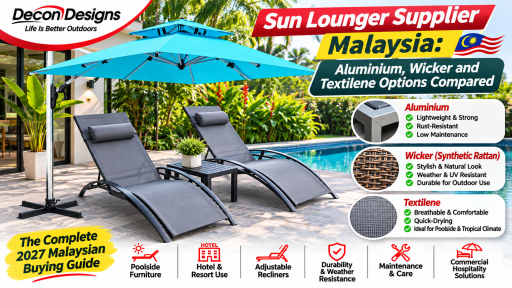
The Complete 2027 Malaysian Buying Guide to Outdoor Sun Loungers, Poolside Furniture, Adjustable Recliners, Aluminium Frames, Synthetic Wicker, Textilene Mesh, Cushions, Durability, Maintenance and Commercial Hospitality Furniture
By Decon Designs – Life Is Better Outdoors
Sun Lounger Supplier Malaysia | Poolside Loungers Malaysia | Outdoor Furniture Malaysia | Aluminium Sun Loungers | Wicker Sun Loungers | Textilene Loungers | Hotel Pool Furniture | Resort Furniture | Garden Loungers | Hospitality Furniture Procurement
Introduction: Choosing the Right Sun Lounger for Malaysia’s Tropical Climate
A sun lounger is more than a piece of outdoor furniture.
For homeowners, it creates a place to relax beside the swimming pool, enjoy the garden or spend a quiet afternoon outdoors.
For hotels and resorts, sun loungers contribute to the guest experience and influence the appearance, comfort and functionality of poolside areas.
For condominium management teams, they form part of the shared recreational facilities used by residents.
For commercial hospitality operators, sun loungers are also an investment that requires careful consideration of durability, cleaning, maintenance, storage and long-term replacement costs.
However, not all sun loungers are designed or manufactured in the same way.
Three popular material and construction options are:
-
Aluminium sun loungers, valued for their relatively lightweight frames and corrosion resistance.
-
Synthetic wicker sun loungers, selected for their woven appearance and lounge-style comfort.
-
Textilene sun loungers, which use breathable, outdoor-grade mesh seating materials.
These categories can overlap. A Textilene lounger may have an aluminium frame, while a wicker lounger may also use aluminium beneath its weaving.
Understanding these differences is essential.
Malaysia’s combination of strong sunlight, tropical rainfall, humidity and, in coastal locations, salt-laden air creates demanding conditions for outdoor furniture.
A lounger that performs satisfactorily on a sheltered residential terrace may not be appropriate for a heavily used hotel swimming pool.
Similarly, a luxurious cushioned wicker lounger may require more daily maintenance than a mesh lounger designed for frequent poolside use.
At Decon Designs – Life Is Better Outdoors, with more than 20 years of experience in Malaysia’s outdoor and hospitality furniture industry, we encourage buyers to look beyond product photographs and compare construction, intended use, comfort, maintenance and total ownership costs.
This guide explains the differences between aluminium, synthetic wicker and Textilene sun loungers and provides practical recommendations for Malaysian homeowners, hotels, resorts, condominiums, restaurants, property developers and commercial procurement teams.
1. What Is a Sun Lounger?
A sun lounger is an outdoor reclining chair or bed-like seating product designed for relaxation.
Unlike a conventional dining chair, a sun lounger typically allows the user to extend their legs and recline in a more relaxed position.
Some loungers include adjustable backrests, while others have fixed reclining positions.
Common features may include wheels, armrests, cushions, headrests or stackable frames.
Sun loungers are commonly installed in swimming pool areas, residential gardens, resort terraces, condominium facilities and hotel relaxation zones.
The terms sun lounger, sunbed, pool lounger and outdoor recliner are sometimes used interchangeably, although product designs and functions can differ.
2. Understanding the Three Main Sun Lounger Options
Before comparing products, it is important to understand that aluminium, wicker and Textilene describe different aspects of furniture construction.
Aluminium is primarily a structural material used for frames and sometimes seating surfaces.
Synthetic wicker is a woven material used around a supporting frame, often made from aluminium or steel.
Textilene is a type of outdoor mesh fabric used for seating and backrest surfaces, commonly supported by a metal frame.
This means a single sun lounger may combine two of these materials.
For example, an aluminium-frame Textilene lounger combines a metal structure with a fabric seating surface.
A synthetic wicker lounger may use an aluminium frame underneath the woven material.
Understanding the complete construction is more useful than comparing material names alone.
3. Aluminium vs Wicker vs Textilene Sun Loungers: Comparison
| Feature | Aluminium lounger | Synthetic wicker lounger | Textilene mesh lounger |
|---|---|---|---|
| Main characteristic | Metal frame or structure | Woven exterior | Breathable mesh seating |
| Typical frame | Aluminium | Aluminium or steel | Aluminium or steel |
| Appearance | Modern, minimalist | Resort-style, woven | Contemporary, functional |
| Cushion requirement | Design-dependent | Often supplied with cushions | Often usable without cushions |
| Rain management | Depends on seating materials | Weave may resist moisture; cushions need care | Mesh often drains and dries relatively quickly |
| Cleaning | Usually straightforward | Weave requires cleaning between strands | Usually straightforward |
| Portability | Often relatively lightweight | Depends on frame and construction | Often relatively lightweight |
| Stackability | Model-dependent | Model-dependent | Model-dependent |
| Poolside suitability | Often suitable when specified | Suitable models available | Particularly practical for wet areas |
| Commercial use | Product-specific | Product-specific | Product-specific |
Outdoor furniture manufacturers describe quick-drying mesh, synthetic wicker and powder-coated aluminium as common materials for poolside and outdoor furniture, while emphasizing product-specific care and maintenance.
KETTLER USA+2
4. Aluminium Sun Loungers: Modern, Practical and Versatile
Aluminium sun loungers are popular because they can combine a relatively lightweight structure with contemporary design.
They are used in residential and commercial outdoor environments.
Advantages
-
Aluminium does not develop ordinary red rust in the way carbon steel does.
-
Frames can be relatively easy to reposition.
-
Powder-coated finishes offer different colour options.
-
Designs may include adjustable backrests and wheels.
-
Suitable models can be used in poolside environments.
Limitations
Aluminium is not automatically maintenance-free.
Buyers should inspect the quality of the welds, frame connections, fasteners and protective finishes.
Aluminium can also experience corrosion under certain conditions, particularly where dissimilar metals, salts or damaged finishes are involved.
A poorly constructed aluminium lounger may still fail prematurely.
Best Applications
Aluminium sun loungers can be a practical choice for hotel swimming pools, condominium facilities, modern residential patios, rooftop terraces and resort decks.
The final decision should depend on the complete product specification.
5. Powder-Coated Aluminium: Why the Finish Matters
Powder coating is commonly used to finish outdoor aluminium furniture.
It can improve appearance and provide an additional protective surface.
However, coating quality varies.
Buyers should check whether the finish is consistent and whether scratches, chips or exposed areas are present.
Pay particular attention to joints, corners, moving components and areas where metal parts contact each other.
In coastal locations, maintenance and cleaning become particularly important.
A powder-coated finish should be considered part of a complete outdoor furniture design, not a guarantee of unlimited durability.
6. Synthetic Wicker Sun Loungers: Resort-Style Comfort
Synthetic wicker loungers are often selected for their woven appearance.
They can complement tropical gardens, resort pools, private villas and covered outdoor relaxation areas.
The weaving may imitate natural rattan, but outdoor-grade synthetic wicker is manufactured from polymer materials.
Advantages
Synthetic wicker can provide:
-
A warm, decorative appearance.
-
A variety of colours and weaving patterns.
-
Compatibility with cushioned designs.
-
A distinctive resort-style aesthetic.
-
Suitable weather resistance when properly specified.
Limitations
Not all synthetic wicker is identical.
Weave quality, polymer composition, UV stabilisation and frame construction can vary significantly.
Poor-quality weaving may become brittle, crack or fade under prolonged exposure.
Woven surfaces can also collect dirt between strands.
Cushions may require separate protection from rainfall.
Premium outdoor wicker manufacturers use polyethylene-based weaving over powder-coated aluminium frames, but the performance of individual products still depends on their construction and specifications.
KETTLER USA+1
7. Natural Wicker vs Synthetic Wicker for Sun Loungers
Buyers should distinguish natural rattan from synthetic wicker.
Natural rattan is a plant-based material generally better suited to indoor and protected environments.
Synthetic wicker is manufactured from polymers and may be designed for outdoor exposure.
For an uncovered swimming pool deck in Malaysia, purpose-designed synthetic wicker is generally a more appropriate starting point than natural rattan.
However, synthetic wicker does not automatically mean the entire lounger is waterproof.
The frame, cushions and fittings must also be considered.
8. PE Wicker and HDPE Wicker: What Buyers Should Know
Polyethylene-based weaving is commonly used in outdoor furniture.
HDPE stands for high-density polyethylene.
Both material terminology and product performance should be evaluated carefully.
Important considerations include polymer formulation, UV stabilisation, weave construction and the intended exposure conditions.
The label “PE rattan” does not establish a specific lifespan.
Buyers should request material specifications and product information rather than relying solely on marketing descriptions.
9. Textilene Sun Loungers: Practical Seating for Wet Areas
Textilene is commonly associated with outdoor mesh or sling seating.
Textilene-type materials generally use coated synthetic yarns woven into a flexible, supportive surface.
These products can be particularly practical for poolside use.
Advantages
-
Breathable seating surface.
-
Water can pass through many mesh constructions.
-
Often usable without thick cushions.
-
Relatively straightforward cleaning.
-
Modern appearance.
-
Suitable models can dry relatively quickly after rainfall or pool splashes.
Limitations
Comfort depends on mesh tension, frame design and ergonomics.
Some buyers may prefer additional padding.
Mesh can also deteriorate through UV exposure, abrasion, damage or ageing.
Poor attachment or stitching can affect performance.
Outdoor furniture care guidance identifies Textilene-type sling seating as quick-drying and relatively easy to clean, making it useful in wet environments.
KETTLER USA+1
10. Which Sun Lounger Is Best for Malaysian Swimming Pools?
For frequently used swimming pool areas, aluminium-frame Textilene loungers are often a practical option because they can provide relatively easy cleaning and reduced reliance on thick cushions.
Synthetic wicker loungers may be attractive where a more decorative resort appearance is desired.
Aluminium loungers with suitable slatted or other outdoor seating surfaces may also be appropriate.
The best choice depends on the required balance between appearance, comfort, maintenance and procurement costs.
For high-traffic pool areas, prioritize cleaning efficiency, structural suitability and replacement-part availability over appearance alone.
11. Sun Loungers for Hotels in Malaysia
Hotel pool furniture is used by guests with different needs and preferences.
Procurement teams should consider:
-
Guest comfort.
-
Stability.
-
Ease of getting in and out.
-
Cleaning requirements.
-
Product durability.
-
Maintenance frequency.
-
Storage.
-
Replacement components.
-
Suitable commercial-use specifications.
A hotel may prefer a combination of loungers.
For example, mesh loungers may be suitable around the main swimming pool, while cushioned wicker loungers may be selected for sheltered premium relaxation areas.
12. Sun Loungers for Resorts and Beachfront Properties
Resort furniture may experience substantial environmental exposure.
Coastal conditions can introduce additional corrosion risks.
Buyers should consider appropriate frame materials, fasteners, coatings and maintenance procedures.
Cushioned loungers may provide a premium guest experience but also require cleaning, drying and storage management.
For resorts, the purchasing decision should include operational costs rather than simply the initial furniture quotation.
13. Sun Loungers for Condominium Swimming Pools
Condominium management teams should consider furniture that can withstand regular shared use.
Important factors include:
-
Product stability.
-
Suitable dimensions.
-
Easy cleaning.
-
Safe positioning.
-
Appropriate spacing.
-
Maintenance requirements.
-
Availability of replacement components.
Loungers should not obstruct emergency access, pool circulation or required safety areas.
The layout should be reviewed against the property’s applicable safety requirements.
14. Sun Loungers for Private Homes
Homeowners may prioritize comfort and appearance more heavily than commercial operators.
A private pool or garden may accommodate:
-
Cushioned wicker loungers.
-
Adjustable aluminium loungers.
-
Textilene reclining chairs.
-
Folding or convertible loungers.
However, buyers should consider how frequently the furniture will be used.
A lounger that is used occasionally may have different practical requirements from one used every day.
15. Adjustable Backrests: A Feature Worth Checking
Many sun loungers offer multiple reclining positions.
However, the number of positions and adjustment mechanism vary by model.
Before purchasing, test:
-
Whether the backrest adjusts smoothly.
-
Whether the mechanism locks securely.
-
Whether the selected positions are comfortable.
-
Whether the backrest remains stable.
-
Whether fingers can be caught in moving parts.
Do not assume every sun lounger is adjustable.
Some models have fixed backrests.
16. Flat Loungers vs Reclining Loungers
Flat loungers may be useful for resting in a horizontal position.
Reclining loungers offer more flexibility for reading, relaxing or sitting upright.
The best choice depends on intended use.
Commercial properties may prefer adjustable models because guests have different comfort preferences.
However, adjustable mechanisms introduce components that require inspection and maintenance.
17. Sun Loungers With Wheels: Convenience and Limitations
Wheels can make repositioning easier.
They may be useful for moving loungers to clean pool decks or rearrange seating.
However, wheel quality and mounting construction matter.
Buyers should check whether wheels operate smoothly and whether the furniture remains stable when positioned.
On sloping surfaces, rolling furniture can create safety concerns.
18. Stackable Sun Loungers for Commercial Properties
Stackable loungers may help reduce storage space requirements.
They can be useful for hotels, resorts and condominium facilities that periodically rearrange their poolside areas.
However, stackability must be confirmed for the specific model.
Buyers should check the manufacturer’s recommended stacking method and limits.
Do not assume that all aluminium or Textilene loungers can be stacked.
19. Sun Lounger Cushions: Comfort Comes With Responsibility
Cushions may improve comfort, but they also introduce maintenance requirements.
A cushion typically includes fabric, foam, stitching and fasteners.
Water-resistant fabric does not necessarily mean the entire cushion is waterproof.
For uncovered poolside areas, cushions may need to be removed or protected during heavy rainfall.
Commercial operators should consider whether staff can realistically manage daily cushion cleaning and storage.
20. Quick-Drying Foam vs Conventional Foam
Some outdoor cushions use foam constructions designed to drain and dry more readily.
However, drying performance depends on the entire cushion assembly.
Important factors include:
-
Foam structure.
-
Fabric.
-
Lining.
-
Drainage.
-
Airflow.
-
Cushion thickness.
A quick-drying claim should be supported by relevant manufacturer information.
Even outdoor cushions should be maintained and dried according to their care instructions.
21. Which Lounger Is Easier to Clean?
Textilene-type mesh loungers often offer a practical cleaning advantage because they can be used without separate thick cushions.
Aluminium surfaces are also generally straightforward to wipe clean.
Synthetic wicker requires attention to the spaces between woven strands.
The complete furniture construction influences cleaning time.
For hotels and condominium facilities with many loungers, cleaning labour can become an important cost consideration.
22. Sun Lounger Maintenance in Malaysia
Outdoor loungers should be inspected and cleaned regularly.
A practical maintenance routine includes:
-
Removing dust and debris.
-
Cleaning with suitable mild products.
-
Checking frame connections.
-
Inspecting reclining mechanisms.
-
Checking mesh or wicker surfaces.
-
Inspecting wheels.
-
Monitoring corrosion.
-
Drying cushions properly.
Maintenance frequency depends on exposure and usage.
Manufacturers such as KETTLER recommend regular cleaning of outdoor furniture and material-specific care rather than assuming weather-resistant furniture requires no maintenance.
KETTLER USA+2
23. How to Clean Aluminium Sun Loungers
Use cleaning products suitable for the finish.
In general, a soft cloth, water and an appropriate mild detergent may be suitable, subject to manufacturer guidance.
Avoid abrasive cleaning methods that could damage the coating.
Inspect scratches and fasteners during cleaning.
24. How to Clean Synthetic Wicker Loungers
Remove loose debris using a soft brush or suitable cleaning tool.
Clean the weaving according to the manufacturer’s instructions.
Avoid aggressive pressure washing unless specifically permitted.
Check the underside of the lounger, where dirt may accumulate around the frame.
25. How to Clean Textilene Loungers
Textilene-type seating can often be cleaned with suitable mild soap and water.
Use a soft cloth or brush where appropriate.
Rinse according to product guidance and allow the material to dry.
Inspect attachment points and mesh tension periodically.
26. Pool Chemicals and Sun Lounger Materials
Swimming pool environments can expose furniture to chemically treated water.
Different materials respond differently.
Buyers should consider:
-
Frame corrosion resistance.
-
Fastener quality.
-
Mesh compatibility.
-
Weave specifications.
-
Cushion fabric.
-
Cleaning procedures.
Avoid assuming that all outdoor furniture is equally resistant to chlorine or other pool-treatment chemicals.
27. Sun Loungers for Coastal Hotels
Salt-laden air can increase corrosion risks.
For coastal properties, evaluate:
-
Aluminium construction.
-
Fastener specifications.
-
Protective coatings.
-
Maintenance procedures.
-
Manufacturer recommendations.
Even corrosion-resistant furniture may require periodic freshwater cleaning and inspection.
28. Sun Lounger Dimensions: Why Size Matters
Sun loungers can occupy substantial floor space.
Buyers should consider:
-
Overall length.
-
Width.
-
Seat height.
-
Backrest adjustment clearance.
-
Access around the lounger.
-
Space for side tables.
A lounger that fits physically into a location may still obstruct circulation.
For commercial layouts, sufficient space must remain for safe movement and operational access.
29. Seat Height and Accessibility
Low loungers may be comfortable for some users but difficult for others to enter or exit.
Hotels and condominium facilities should consider a range of user needs.
Seat height, armrests and stability can influence usability.
For accessible facilities, consult applicable accessibility requirements and qualified design professionals rather than assuming a standard lounger will meet every user’s needs.
30. Sun Lounger Weight Capacity
Weight capacity should be confirmed with the supplier.
Do not estimate capacity based only on appearance or frame material.
A heavy-looking lounger is not necessarily stronger.
Likewise, lightweight aluminium construction does not automatically mean low load capacity.
Commercial buyers should request appropriate load and durability information.
31. Sun Lounger Safety: What Buyers Should Inspect
Before purchasing, examine:
-
Frame stability.
-
Sharp edges.
-
Moving mechanisms.
-
Backrest locking.
-
Wheel attachment.
-
Seat support.
-
Fasteners.
-
Visible corrosion.
-
Mesh tension.
-
General workmanship.
Where appropriate, request information about product-specific mechanical testing and intended-use classifications.
32. Sun Lounger Colours for Hotels and Homes
Popular design approaches include neutral, natural and contemporary colour palettes.
For example:
-
White or light grey for modern pool decks.
-
Black or charcoal for minimalist spaces.
-
Brown or natural-looking wicker for tropical resort aesthetics.
-
Beige or earth tones for relaxed outdoor environments.
Colour selection should also consider heat, cleaning and maintenance.
Dark surfaces may become hotter under direct sunlight than comparable lighter surfaces.
33. Should You Buy Loungers With Armrests?
Armrests may improve comfort and assist some users when getting up.
However, they may increase overall width and affect storage.
Armrest suitability depends on the product design.
Buyers should test the lounger where possible.
34. Sun Lounger vs Daybed: What’s the Difference?
A sun lounger is generally designed for one person.
An outdoor daybed may provide a larger reclining or lounging surface.
Daybeds can occupy considerably more space.
For compact residential pool areas, sun loungers may be more practical.
For larger resort relaxation zones, daybeds may complement individual loungers.
35. Sun Lounger vs Outdoor Reclining Chair
A reclining chair typically has a more upright seating orientation and may be more compact.
A sun lounger generally provides extended leg support.
Some convertible products offer both functions.
For example, Decon Designs has previously featured the Victron Lounger Cum Chair, model JHA-4099, a folding convertible lounger-and-chair design with wheels.
Customers should confirm current product availability and specifications before purchasing.
36. Buying Sun Loungers for a Hotel Project
Commercial procurement should begin with a clear specification.
The purchasing team should identify:
-
Number of loungers required.
-
Intended installation areas.
-
Required dimensions.
-
Preferred materials.
-
Cushion requirements.
-
Expected usage.
-
Cleaning procedures.
-
Delivery schedule.
-
Warranty expectations.
-
Replacement requirements.
A detailed specification helps suppliers prepare more comparable quotations.
37. Bulk Sun Lounger Purchasing in Malaysia
For bulk orders, buyers should ask suppliers about:
-
Available quantities.
-
Production or sourcing lead times.
-
Consistency between units.
-
Packaging.
-
Delivery arrangements.
-
Assembly.
-
Replacement parts.
-
Warranty coverage.
Do not assume that an online listing for one lounger guarantees availability of dozens of identical units.
38. Ready Stock vs Special-Order Sun Loungers
| Consideration | Ready stock | Special order |
|---|---|---|
| Availability | Existing inventory, subject to confirmation | Depends on sourcing or production |
| Delivery | May be faster | May require longer lead time |
| Colours | Limited to available stock | Additional choices may be possible |
| Quantities | Inventory-dependent | Supplier-dependent |
| Customization | Usually limited | May be available |
| Pricing | Product-dependent | Order-dependent |
Hotels planning seasonal openings or renovations should allow time for delivery and installation.
39. Sun Lounger Supplier vs Manufacturer vs Retailer
These terms describe different roles.
A manufacturer produces furniture.
A supplier provides furniture to customers or projects, potentially sourcing from different manufacturers.
A retailer sells products directly to end customers.
Some companies perform more than one role.
Commercial buyers should verify the company’s actual capabilities rather than relying only on business labels.
40. How to Evaluate a Sun Lounger Supplier in Malaysia
A reliable supplier should be able to provide clear product information.
Ask for:
-
Product dimensions.
-
Frame materials.
-
Seating materials.
-
Available colours.
-
Weight capacity.
-
Adjustment features.
-
Intended use.
-
Maintenance instructions.
-
Warranty terms.
-
Delivery information.
For commercial projects, request written quotations and confirm whether replacement parts or future matching orders are possible.
41. How to Compare Sun Lounger Prices
Price should be compared alongside specifications.
Two loungers may look similar but differ in:
-
Frame construction.
-
Aluminium thickness and design.
-
Mesh quality.
-
Wicker formulation.
-
Adjustable mechanisms.
-
Wheels.
-
Cushions.
-
Warranty.
-
Delivery.
A lower initial price does not necessarily mean lower long-term cost.
42. The Hidden Cost of Cheap Poolside Loungers
Low-cost loungers may be attractive when purchasing multiple units.
However, commercial buyers should consider potential additional expenses.
These may include:
-
Repairs.
-
Replacement.
-
Cleaning labour.
-
Cushion replacement.
-
Storage.
-
Transport.
-
Operational disruption.
A product that requires frequent replacement may become more expensive over time.
The objective is to evaluate lifecycle value, not simply purchase price.
43. Illustrative Sun Lounger Budget Planning
The following figures are hypothetical budgeting examples, not verified current Malaysian retail quotations.
| Product category | Illustrative planning budget per unit |
|---|---|
| Basic outdoor reclining lounger | RM300–RM800 |
| Aluminium-frame mesh lounger | RM600–RM1,800 |
| Synthetic wicker lounger | RM900–RM2,500 |
| Premium cushioned outdoor lounger | RM1,500–RM4,000+ |
| Specialized hospitality lounger | Quotation-dependent |
Actual prices can vary substantially.
For reference, Malaysian suppliers currently advertise both aluminium-frame synthetic wicker loungers and outdoor mesh or sling loungers, with product specifications and prices varying by model.
Horestco+2
44. Which Lounger Should You Choose?
For a busy hotel swimming pool, consider a commercial-grade aluminium-frame Textilene lounger when ease of cleaning and quick drying are priorities.
For a tropical resort lounge, consider a suitable synthetic wicker lounger when appearance and cushioned comfort are important.
For a modern residential pool, an aluminium lounger may offer a practical balance of design and handling convenience.
For a compact garden, consider a folding or convertible model where appropriate.
For a coastal hotel, pay particular attention to corrosion resistance, fasteners and maintenance.
These are starting points rather than universal rules.
The complete product specification should determine the final choice.
45. Decon Designs Year-End Stock Clearance Sale 2026
Decon Designs is conducting its Year-End Stock Clearance Sale 2026 as part of a business downsizing exercise.
Official promotion period: 1 November – 31 December 2026.
Selected existing outdoor furniture inventory is offered at promotional prices, subject to availability.
Depending on remaining stock, categories may include sun loungers, patio sets, outdoor sofas, dining sets, parasols, garden swings, chairs and accessories.
The promotion operates on a limited-stock, first-come, first-served basis.
Explore the official promotion page:
Customers should confirm current prices, product specifications, availability and delivery arrangements before purchasing.
46. The Ultimate Sun Lounger Buying Checklist
Before purchasing sun loungers for your home, hotel, resort or condominium, confirm:
47. Frequently Asked Questions About Sun Loungers in Malaysia
1. What is the best sun lounger material for Malaysia?
There is no single best material. Aluminium frames, synthetic wicker and Textilene-type mesh can all be suitable, depending on product quality, weather exposure and intended use.
2. Are aluminium sun loungers rustproof?
Aluminium does not develop ordinary red rust like carbon steel, but it can still experience corrosion under certain conditions. Fasteners and coatings also require attention.
3. Are Textilene sun loungers comfortable?
Many are comfortable without thick cushions, but comfort depends on mesh tension, ergonomic design and personal preference.
4. Is synthetic wicker suitable for swimming pools?
Outdoor-grade synthetic wicker can be suitable for poolside furniture when combined with appropriate frames and components.
5. Which sun loungers dry fastest after rain?
Textilene-type mesh loungers often dry relatively quickly because water can pass through the seating surface.
6. Which loungers are best for hotels?
Commercial-grade loungers with suitable construction, easy cleaning, appropriate comfort and dependable maintenance support are generally preferable.
7. Are all sun loungers adjustable?
No. Some have fixed backrests, while others offer multiple reclining positions.
8. Can sun loungers remain outdoors permanently?
Some products are designed for extended outdoor exposure. Suitability depends on their materials, construction and manufacturer recommendations.
9. Do synthetic wicker loungers need cushions?
Not necessarily. Cushion requirements depend on the design and intended comfort level.
10. Are Textilene loungers waterproof?
The mesh is generally designed to allow water to pass through, but this does not mean every component of the lounger is waterproof.
11. What is the difference between a sun lounger and a sunbed?
The terms often overlap. Sunbed may describe a larger or flatter lounging design, while sun lounger commonly refers to a reclining outdoor chair.
12. Can sun loungers be stacked?
Certain models are stackable, but this must be confirmed with the supplier.
13. Are wheels useful on sun loungers?
Wheels may make repositioning easier, particularly for commercial poolside operations.
14. How many sun loungers should a hotel purchase?
The number depends on available deck space, expected guest demand, safe circulation, operating requirements and the property’s design.
15. Where can I buy sun loungers in Malaysia?
Sun loungers are available through specialist outdoor furniture suppliers, showrooms, commercial furniture providers and online retailers. Customers can also check current Decon Designs clearance inventory.
Conclusion: The Best Sun Lounger Is the One That Fits Your Environment, Users and Maintenance Requirements
Choosing the right sun lounger in Malaysia involves more than comparing photographs and prices.
Aluminium, synthetic wicker and Textilene each offer different advantages.
Aluminium is an important structural material for outdoor loungers, particularly where relatively low weight and corrosion resistance are priorities.
Synthetic wicker can provide a warm, resort-inspired appearance, especially for decorative and cushioned lounge settings.
Textilene mesh can be particularly practical for swimming pools and high-use outdoor areas because many designs drain and dry relatively quickly.
For homeowners, comfort, design and available space may be the leading considerations.
For hotels, resorts and condominium management teams, durability, cleaning efficiency, safety and long-term maintenance deserve equal attention.
The right supplier should help customers understand these differences rather than simply recommending the most expensive product.
A good sun lounger should look attractive, feel comfortable, suit its environment and remain practical to maintain.
For more than two decades, Decon Designs has served Malaysia’s outdoor and hospitality furniture market with a focus on outdoor living.
Decon Designs – Life Is Better Outdoors.
Explore current promotions: https://decondesigns.com/product-category/promotion/


