
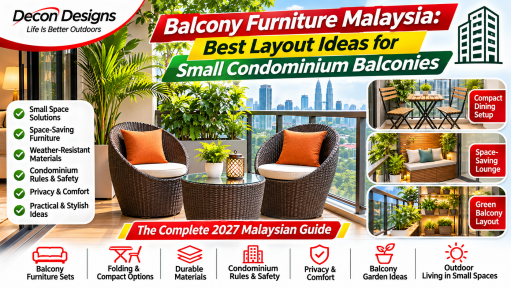
The Complete 2027 Malaysian Guide to Small Balcony Furniture, Space-Saving Patio Sets, Compact Outdoor Chairs, Folding Tables, Balcony Sofas, Weather-Resistant Materials, Condominium Management Rules, Safety, Privacy and Practical Outdoor Living Ideas
By Decon Designs – Life Is Better Outdoors
Balcony Furniture Malaysia | Condominium Furniture Malaysia | Small Balcony Design | Outdoor Furniture Malaysia | Compact Patio Sets | Balcony Chairs | Space-Saving Furniture | High-Rise Living | Outdoor Living Malaysia
Introduction: Small Balconies Can Become Beautiful Outdoor Living Spaces
In Malaysia’s growing condominium and apartment market, outdoor living space is often limited.
Many residents in Kuala Lumpur, Petaling Jaya, Shah Alam, Subang Jaya, Puchong, Damansara, Cyberjaya, Johor Bahru and Penang live in high-rise properties where a balcony may be the only private outdoor area.
Some balconies are wide enough for a small dining set.
Others are narrow spaces that can accommodate only one chair and a compact table.
Certain condominium balconies are partially sheltered, while others experience strong sunlight, wind-driven rain and significant exposure to the elements.
Despite these limitations, a small balcony can become one of the most enjoyable areas of a home.
It may serve as:
- A morning coffee corner.
- A quiet reading space.
- A compact outdoor dining area.
- A relaxation corner.
- A place to enjoy fresh air.
- A small urban garden.
- A private seating area for conversations.
The challenge is choosing furniture that fits the space without making it feel crowded or creating safety problems.
The best balcony furniture is not necessarily the smallest furniture available. It is furniture that fits the balcony’s dimensions, supports the intended activity and remains appropriate for the building’s conditions.
At Decon Designs – Life Is Better Outdoors, with more than 20 years of experience in Malaysia’s outdoor and hospitality furniture industry, we believe that good balcony furniture selection begins with practical planning.
This comprehensive guide explores furniture layouts, suitable materials, space-saving designs, high-rise safety, maintenance, buying considerations and common mistakes.
Whether you are furnishing a new condominium, renovating an apartment balcony or upgrading an existing outdoor space, these ideas can help you make better use of the space available.
1. Why Balcony Furniture Requires a Different Buying Approach
Balconies are not simply smaller versions of gardens.
They are elevated outdoor spaces with structural, access and safety considerations.
Compared with a ground-level patio, a condominium balcony may have:
- Limited floor space.
- Narrow access doors.
- Fixed railings.
- Drainage outlets.
- Greater wind exposure.
- Building management restrictions.
- Weight limitations.
- Neighbouring units.
- Restricted furniture delivery access.
Furniture that works well in a landed home’s garden may not be suitable for a high-rise balcony.
For example, a large cantilever parasol may be inappropriate in an exposed balcony environment because of wind-related risks.
A heavy stone dining table may raise concerns about load capacity.
An oversized outdoor sofa may obstruct access or drainage.
Balcony furniture should be selected according to the specific building and space, not simply according to showroom appearance.
2. Understand Your Balcony Before Buying Furniture
Before purchasing anything, evaluate the balcony itself.
Ask the following questions:
- What is the balcony’s actual width and depth?
- Is the balcony covered or uncovered?
- Does rain enter the space?
- How strong is the wind?
- Where is the drainage outlet?
- How high is the railing?
- Does the balcony have a sliding or hinged door?
- Are there management restrictions?
- Is the balcony exposed to afternoon sunlight?
- What is the balcony’s permitted load capacity?
These answers influence the furniture layout, material selection and safety requirements.
3. Measure Your Balcony Correctly
One of the most common mistakes is buying furniture before measuring the available space.
Measure:
- Total balcony width.
- Total balcony depth.
- Door opening.
- Door swing, where applicable.
- Railing position.
- Drainage location.
- Fixed equipment.
- Available circulation space.
A balcony may appear spacious when empty but feel crowded once furniture is installed.
Remember that chairs require additional space when occupied.
A table measuring 60 cm wide does not mean the entire dining arrangement requires only 60 cm.
The chairs and user movement must also be considered.
4. Common Balcony Sizes and Suitable Furniture Ideas
The following are illustrative space-planning examples, not standardized Malaysian condominium dimensions.
| Approximate balcony area | Potential furniture approach |
|---|---|
| Under 2 m² | Single compact chair or minimal furniture |
| 2–3 m² | Small chair and side table, subject to layout |
| 3–4 m² | Compact two-seater bistro arrangement |
| 4–6 m² | Small dining or lounge arrangement |
| 6–8 m² | Two chairs with coffee table or compact sofa |
| Above 8 m² | More flexible dining and lounge layouts |
Usability depends on the balcony’s shape, access, structural capacity and required clearances—not area alone.
5. The Best Balcony Furniture Layouts for Malaysian Condominiums
Different balcony shapes require different layouts.
A narrow rectangular balcony should not be furnished in the same way as a wide square balcony.
The following layouts can provide useful starting points.
Layout 1: The Morning Coffee Corner
Best for: Small balconies and one- or two-person households.
Furniture:
- Two compact chairs.
- One small coffee table.
Place the table between the chairs where space allows.
Choose furniture with relatively slim frames to avoid unnecessary bulk.
This arrangement is suitable for residents who primarily want a place to sit and enjoy a drink.
Layout 2: The Single-Chair Reading Corner
Best for: Very narrow balconies.
Furniture:
- One comfortable outdoor chair.
- One compact side table.
This layout avoids overcrowding.
It can be more practical than forcing a two-seater arrangement into a space that cannot accommodate it comfortably.
Layout 3: The Compact Bistro Layout
Best for: Small balconies used for occasional dining.
Furniture:
- One compact bistro table.
- Two chairs.
A round table may be useful where circulation is limited, depending on the balcony’s shape.
Choose a table height appropriate for the chairs.
Layout 4: The Folding Furniture Layout
Best for: Balconies that serve multiple purposes.
Furniture:
- Folding table.
- Folding chairs.
Furniture can be repositioned or stored when not in use.
However, folding mechanisms should be stable and suitable for the intended environment.
Layout 5: The Compact Outdoor Sofa Layout
Best for: Wider balconies with sufficient clearance.
Furniture:
- One small outdoor sofa.
- One compact coffee table.
A two-seater sofa may create a comfortable lounge arrangement.
However, sofa depth should be checked carefully.
Layout 6: The Corner Seating Layout
Best for: Balconies with usable corners.
Furniture:
- Compact corner seating.
- Small table.
This can make use of otherwise underutilized space.
Avoid blocking doors, drainage or access routes.
Layout 7: The Minimalist Balcony Layout
Best for: Residents who prefer open space.
Furniture:
- One or two lightweight chairs.
- One small table.
Minimal furniture can make a small balcony feel less crowded.
6. Visual Planning: Seven Balcony Layout Concepts
The following simplified diagrams illustrate possible furniture arrangements. They are conceptual only and are not to scale.
A. Narrow Balcony — Single Chair
┌─────────────────────┐
│                     │
│   CHAIR    TABLE    │
│                     │
│     OPEN SPACE      │
│                     │
│       DOOR          │
└─────────────────────┘
B. Two-Seater Coffee Corner
┌─────────────────────┐
│                     │
│ CHAIR  TABLE  CHAIR │
│                     │
│    CLEAR ACCESS     │
│                     │
│        DOOR         │
└─────────────────────┘
C. Compact Bistro Arrangement
┌─────────────────────┐
│                     │
│       CHAIR         │
│        TABLE        │
│       CHAIR         │
│                     │
│        DOOR         │
└─────────────────────┘
D. Compact Sofa Arrangement
┌─────────────────────┐
│                     │
│    SMALL SOFA       │
│                     │
│   COFFEE TABLE      │
│                     │
│        DOOR         │
└─────────────────────┘
E. Folding Furniture Arrangement
┌─────────────────────┐
│                     │
│  FOLDING TABLE      │
│                     │
│  FOLDING CHAIRS     │
│                     │
│        DOOR         │
└─────────────────────┘
F. Corner Seating Arrangement
┌─────────────────────┐
│ CORNER SEATING      │
│          TABLE      │
│                     │
│     OPEN SPACE      │
│                     │
│        DOOR         │
└─────────────────────┘
G. Minimalist Balcony
┌─────────────────────┐
│                     │
│  CHAIR      CHAIR   │
│                     │
│      SMALL TABLE    │
│                     │
│        DOOR         │
└─────────────────────┘
These layouts should be adapted to the actual balcony geometry, door position, drainage, railing and required clearances.
7. Compact Bistro Sets: A Popular Choice for Small Balconies
Bistro sets typically include a small table and two chairs.
They may be suitable for:
- Morning coffee.
- Light meals.
- Reading.
- Relaxation.
- Casual conversations.
Their main advantage is a relatively compact footprint.
However, customers should still measure the complete arrangement.
A bistro set with bulky chairs may require more space than expected.
8. Folding Balcony Furniture: Flexible Use of Limited Space
Folding furniture can be useful when the balcony serves several purposes.
For example, a balcony may be used for seating in the evening but kept open during the day.
Folding chairs and tables can provide flexibility.
Before buying, check:
- Frame stability.
- Locking mechanisms.
- Folded dimensions.
- Material suitability.
- Weight.
- Storage requirements.
Folding furniture should not be assumed safe or suitable simply because it is compact.
9. Stackable Chairs for Condominium Balconies
Stackable chairs may be useful where additional seating is occasionally needed.
When not in use, compatible chairs can be stacked according to the manufacturer’s instructions.
However, stacking height and stability must be considered.
In windy high-rise environments, unsecured stacks may create risks.
Customers should follow product-specific storage guidance.
10. Small Outdoor Sofas for Balcony Living
A compact outdoor sofa may create a more relaxed seating environment than individual dining chairs.
However, sofas can occupy considerable floor depth.
Before purchasing, measure:
- Sofa width.
- Sofa depth.
- Seat height.
- Coffee table dimensions.
- Remaining circulation space.
Also consider cushion storage.
For balconies exposed to rain, removable cushions may require a suitable dry storage area.
11. Should You Buy a Two-Seater or Three-Seater Balcony Sofa?
The answer depends on the available space.
A two-seater sofa may suit smaller balconies.
A three-seater sofa may be appropriate only where sufficient width and circulation remain.
Do not select furniture based solely on seating capacity.
A deep two-seater sofa may occupy more floor space than a slim three-seater bench.
Actual dimensions matter more than the label.
12. Balcony Dining Sets: What Size Works Best?
Small balconies generally benefit from compact dining arrangements.
Possible options include:
- Two-seater bistro sets.
- Narrow dining tables.
- Compact square tables.
- Folding dining furniture.
For larger balconies, four-seater arrangements may be considered.
However, buyers should ensure chairs can be used without obstructing doors or access routes.
13. Round vs Square Balcony Tables
| Feature | Round table | Square table |
|---|---|---|
| Corners | No sharp corners | Has corners |
| Placement | Often useful in open seating layouts | May fit neatly against walls |
| Circulation | Depends on diameter | Depends on dimensions |
| Seating arrangement | Flexible for small groups | Straightforward for compact layouts |
| Space efficiency | Layout-dependent | Layout-dependent |
Neither shape is universally better.
The balcony’s geometry should determine the choice.
14. Balcony Furniture Materials for Malaysia’s Climate
Malaysia’s climate creates challenges for outdoor furniture.
Balcony furniture may experience:
- Sunlight.
- Rain.
- Humidity.
- Wind.
- Temperature changes.
Common material options include:
- Powder-coated aluminium.
- Powder-coated steel.
- Suitable synthetic rattan.
- Outdoor mesh.
- Selected hardwoods.
- Suitable outdoor rope materials.
The correct choice depends on the product and the balcony’s actual exposure.
15. Aluminium Balcony Furniture
Aluminium is often considered for balcony furniture because it is relatively lightweight and resistant to ordinary red rust.
Potential advantages include:
- Ease of movement.
- Modern designs.
- Relatively straightforward cleaning.
- Suitability for various outdoor furniture applications.
However, buyers should inspect:
- Welds.
- Frame construction.
- Coating.
- Fasteners.
- Stability.
Lightweight furniture must be evaluated carefully in windy environments.
16. Steel Balcony Furniture
Steel can provide strength and rigidity.
However, ordinary steel may corrode if protective finishes are damaged.
Buyers should check:
- Powder-coating quality.
- Welded joints.
- Exposed edges.
- Fasteners.
- Signs of corrosion.
For balconies exposed to rain, maintenance requirements should be considered.
17. Synthetic Rattan Balcony Furniture
Synthetic rattan is commonly used in patio sets and outdoor sofas.
It can create a warm woven appearance.
However, not all synthetic rattan is suitable for the same conditions.
Quality depends on:
- Weave polymer.
- UV stabilisation.
- Frame construction.
- Weaving quality.
- Cushion specifications.
For uncovered balconies, choose products specifically intended for outdoor exposure.
18. Natural Rattan on Condominium Balconies
Natural rattan is generally better suited to protected environments.
It may be considered for sufficiently sheltered balconies.
However, high humidity and wind-driven rain can still affect the material.
For continuously exposed balconies, purpose-designed outdoor furniture is generally more appropriate.
19. Outdoor Mesh Chairs for Small Balconies
Mesh seating may be practical because certain outdoor-grade fabrics allow water to drain more readily than thick upholstered cushions.
Potential applications include:
- Compact dining chairs.
- Lounge chairs.
- Folding chairs.
Buyers should confirm the mesh specifications and frame construction.
20. Balcony Cushions: Comfort vs Maintenance
Cushions can improve seating comfort.
However, they may require protection from rainfall.
Customers should distinguish between:
- Water-resistant fabrics.
- Waterproof fabrics.
- Quick-drying constructions.
- Removable cushion covers.
A water-resistant fabric does not necessarily mean the entire cushion is waterproof.
For exposed balconies, removable cushions may be easier to manage.
21. How to Protect Balcony Furniture From Rain
Practical measures include:
- Select suitable outdoor furniture.
- Follow manufacturer care instructions.
- Remove cushions before heavy rain where practical.
- Allow wet cushions to dry thoroughly.
- Keep drainage outlets clear.
- Use appropriate furniture covers where suitable.
- Avoid trapping moisture beneath covers.
Furniture should not obstruct water drainage.
22. Balcony Furniture and Strong Wind
Wind is an important high-rise safety consideration.
Wind conditions can vary according to building height, orientation and surrounding structures.
Lightweight furniture, loose cushions, decorative objects and parasols may be affected.
Customers should:
- Assess wind exposure.
- Follow building management rules.
- Avoid unsecured loose items.
- Store lightweight accessories appropriately.
- Avoid using unsuitable parasols.
- Seek building management guidance where necessary.
A balcony should never be treated as a completely sheltered outdoor space simply because it has a roof.
23. Why Large Parasols May Be Unsuitable for High-Rise Balconies
Large parasols can experience substantial wind forces.
A heavy base does not automatically make a parasol suitable for an exposed high-rise balcony.
The risks depend on:
- Canopy size.
- Wind conditions.
- Base design.
- Installation.
- Manufacturer limitations.
- Building rules.
For many small condominium balconies, permanent building-approved shading arrangements may be more appropriate than freestanding large umbrellas.
Customers should not install parasols or shading structures without checking applicable requirements.
24. Condominium Management Rules in Malaysia
Condominium management bodies may impose rules concerning balcony use.
These can relate to:
- Exterior appearance.
- Safety.
- Structural alterations.
- Fixed installations.
- Drainage.
- Items placed near railings.
- Furniture or equipment restrictions.
Rules differ between properties.
Before purchasing furniture or installing shade structures, residents should review their building’s applicable house rules and obtain necessary approvals.
25. Balcony Load Capacity: Why Furniture Weight Matters
Balconies are structural elements with design load requirements.
Residents should not assume that any furniture arrangement is acceptable simply because it physically fits.
Heavy furniture, large planters, water-filled containers and concentrated loads may require particular attention.
The safe load capacity depends on the building’s design and condition.
If you are considering unusually heavy furniture or equipment, consult building management and, where necessary, a qualified structural professional.
Do not rely on generic internet weight limits for a specific balcony.
26. Balcony Railing Safety
Furniture placement near railings requires careful consideration.
Avoid arrangements that could create climbing hazards, particularly where children may be present.
Do not position furniture in ways that compromise railing safety.
Residents should follow building rules and relevant safety guidance.
Furniture should also be secured or stored appropriately to reduce the risk of items falling from balconies.
27. Balcony Privacy Without Overcrowding
Privacy is a common concern in high-density residential developments.
Possible approaches include:
- Thoughtful furniture positioning.
- Suitable privacy screens where permitted.
- Approved shading arrangements.
- Appropriate planting.
However, screens and planters may create wind or load concerns.
Residents should confirm building rules before installing them.
28. Balcony Plants and Furniture: Creating a Balanced Space
Plants can complement balcony furniture.
However, too many large planters may reduce usable space.
Consider:
- Plant size.
- Pot weight.
- Drainage.
- Watering.
- Wind exposure.
- Maintenance.
Avoid placing unsecured pots on railings.
Furniture and plants should be arranged so that access and drainage remain clear.
29. Balcony Lighting Ideas
Lighting can improve the usability of a balcony in the evening.
Possible options include suitable outdoor-rated lighting products.
However, electrical safety is important.
Residents should avoid unsuitable indoor electrical products in exposed outdoor conditions.
Permanent electrical modifications may require approval and qualified installation.
30. Minimalist Balcony Design for Malaysian Condominiums
Minimalist design can work particularly well in small spaces.
A simple arrangement may include:
- Two compact chairs.
- One small table.
- A limited number of decorative items.
Avoid filling every available corner.
Leaving open floor space can make the balcony more comfortable to use.
31. Modern Balcony Furniture Design
Modern balcony furniture often emphasizes:
- Clean lines.
- Simple forms.
- Neutral colours.
- Slim frames.
- Functional layouts.
However, design should not override practical considerations.
A visually attractive chair may be uncomfortable or unsuitable for outdoor exposure.
32. Tropical Balcony Design
A tropical-inspired balcony may combine:
- Natural-looking furniture.
- Suitable synthetic rattan.
- Outdoor plants.
- Warm colours.
- Comfortable seating.
The objective is to create a relaxing environment without compromising safety or maintenance.
Natural materials should be selected according to actual weather exposure.
33. Balcony Furniture Colour Selection
Furniture colours can influence the appearance of a small balcony.
Light colours may create a visually open atmosphere.
Dark colours may provide contrast.
However, surface temperatures and maintenance requirements should also be considered.
Colour choice should complement the surrounding building and comply with applicable management rules.
34. Balcony Furniture for Rental Properties
Tenants should consider furniture that can be moved without permanent installation.
Potential options include:
- Compact chairs.
- Small tables.
- Folding furniture.
- Lightweight but stable seating.
However, tenants must still follow building rules and tenancy requirements.
Avoid drilling, fixing or modifying building elements without appropriate permission.
35. Balcony Furniture for Airbnb and Short-Stay Properties
Short-stay accommodation operators may use balcony furniture to improve guest comfort.
However, safety and maintenance are particularly important.
Consider:
- Stable furniture.
- Appropriate dimensions.
- Clear safety instructions.
- Easy cleaning.
- Weather suitability.
- Building and regulatory requirements.
Do not overcrowd balconies to increase seating capacity.
36. Balcony Furniture for Families With Children
Families should prioritize safety.
Consider:
- Stable furniture.
- Appropriate placement.
- Rounded edges where practical.
- Avoiding climbing opportunities near railings.
- Securing loose items.
- Keeping access clear.
Children should be supervised appropriately.
Furniture should not be positioned in ways that increase fall risks.
37. Balcony Furniture for Elderly Residents
Comfort and accessibility may be particularly important.
Consider:
- Appropriate seat height.
- Stable armrests.
- Firm seating support.
- Easy access.
- Adequate circulation space.
- Non-slip conditions.
Avoid unstable furniture or layouts that make standing and sitting difficult.
38. Common Small Balcony Furniture Mistakes
Mistake 1: Buying Furniture Before Measuring
The furniture may not fit.
Mistake 2: Choosing Oversized Sofas
The balcony may become overcrowded.
Mistake 3: Ignoring Wind Exposure
Loose items may create safety risks.
Mistake 4: Blocking Drainage
Water may accumulate.
Mistake 5: Ignoring Management Rules
Installations may violate building requirements.
Mistake 6: Buying Indoor Furniture for Exposed Balconies
Materials may deteriorate.
Mistake 7: Using Large Parasols Without Assessment
Wind-related risks may be significant.
Mistake 8: Ignoring Cushion Storage
Cushions may remain damp.
Mistake 9: Choosing Furniture Based Only on Price
Construction and suitability may be overlooked.
Mistake 10: Overdecorating
The balcony may lose its practical function.
39. Balcony Furniture Price Malaysia: What Affects Cost?
Prices depend on:
- Frame materials.
- Furniture dimensions.
- Construction quality.
- Cushion specifications.
- Design.
- Brand.
- Warranty.
- Delivery.
- Inventory status.
A compact furniture set may cost less than a large sofa arrangement, but specifications matter.
Customers should compare total value rather than price alone.
40. Illustrative Small Balcony Furniture Budgets
The following are hypothetical planning examples, not verified current Malaysian market prices.
| Balcony furniture arrangement | Illustrative budget |
|---|---|
| Single chair and side table | RM200–RM700 |
| Compact two-seater bistro set | RM400–RM1,500 |
| Folding table and two chairs | RM300–RM1,200 |
| Small outdoor sofa arrangement | RM1,200–RM3,500 |
| Larger balcony lounge | RM2,500–RM6,000+ |
Actual prices vary by supplier, materials and specifications.
41. How to Buy Balcony Furniture Online
Before purchasing online:
- Review dimensions.
- Confirm materials.
- Check product photographs.
- Understand assembly requirements.
- Verify seller information.
- Review delivery arrangements.
- Confirm warranty terms.
- Check stock availability.
For bulky products, verify lift and doorway access.
42. Buying Balcony Furniture From a Showroom
A showroom visit can help buyers assess:
- Comfort.
- Stability.
- Materials.
- Seat height.
- Product size.
- Finishing.
Customers should bring their balcony measurements.
A product that looks compact in a large showroom may feel much larger in a small condominium balcony.
43. Decon Designs Year-End Stock Clearance Sale 2026
Decon Designs is conducting its Year-End Stock Clearance Sale from 1 November to 31 December 2026 as part of a business downsizing exercise.
Selected existing furniture inventory is available at promotional prices, subject to stock availability.
Customers looking for compact patio sets, chairs, side tables and other suitable furniture may explore the advertised clearance products.
Official Promotion Page:
https://decondesigns.com/product-category/promotion/
Customers should confirm dimensions, product suitability, stock availability and delivery arrangements before purchasing.
Not every clearance product will be appropriate for a condominium balcony.
44. The Ultimate Balcony Furniture Buying Checklist
Before purchasing, confirm:
-
I have measured the balcony.
-
I know the available circulation space.
-
The furniture fits through the access door.
-
The balcony’s load requirements have been considered.
-
Building management rules have been reviewed.
-
The furniture is suitable for the weather exposure.
-
Wind-related risks have been assessed.
-
Furniture will not obstruct drainage.
-
Furniture placement will not compromise railing safety.
-
The frame material is appropriate.
-
Cushion maintenance is manageable.
-
Furniture is stable.
-
Delivery arrangements are confirmed.
-
Warranty terms are understood.
-
The total cost fits my budget.
45. Frequently Asked Questions
1. What is the best furniture for a small condominium balcony in Malaysia?
Compact chairs, small bistro sets and space-efficient tables may be suitable, depending on dimensions and building conditions.
2. Can I put an outdoor sofa on my condominium balcony?
Possibly, if the sofa fits, is suitable for the environment and complies with building requirements.
3. Is synthetic rattan suitable for balcony furniture?
Certain outdoor-grade synthetic rattan products may be suitable, depending on material quality, frame construction and exposure.
4. Is aluminium balcony furniture a good choice?
Aluminium is relatively lightweight and resistant to ordinary red rust, but stability and construction quality remain important.
5. Can I use a parasol on a high-rise balcony?
This requires careful consideration of wind exposure, product limitations and building rules. Large freestanding parasols may be inappropriate.
6. What table shape is best for a small balcony?
The best shape depends on the balcony layout. Compact round or square tables may work in different configurations.
7. Are folding chairs good for balconies?
They can provide flexibility, provided they are stable, suitable for the environment and stored safely.
8. How do I protect balcony furniture from rain?
Use suitable outdoor furniture, follow maintenance instructions, protect cushions and keep drainage clear.
9. Can I use natural rattan furniture on a balcony?
Natural rattan is generally better suited to protected spaces with limited moisture exposure.
10. How much balcony furniture should I buy?
Purchase only what fits comfortably while maintaining safe access and circulation.
11. Are heavy planters safe on balconies?
This depends on the building’s structural capacity and the arrangement. Seek building management or professional guidance where necessary.
12. Can I install a privacy screen?
Building rules and wind-related considerations should be reviewed before installation.
13. Is balcony furniture suitable for Airbnb properties?
Suitable furniture may improve guest comfort, but safety, maintenance and applicable building rules are essential.
14. Where can I buy balcony furniture in Selangor?
Customers can explore outdoor furniture showrooms, specialist suppliers and online stores serving Selangor.
15. Where can I find balcony furniture clearance deals?
Explore reputable furniture suppliers’ promotional inventory, including the official Decon Designs promotion page.
Conclusion: A Small Balcony Deserves Smart Furniture, Not More Furniture
A small condominium balcony can become a comfortable and attractive outdoor living space.
However, successful balcony design requires careful planning.
The goal is not to fit as many chairs, tables and decorations as possible.
It is to create a space that feels comfortable, remains functional and respects the building’s safety requirements.
For Malaysian condominium residents, the most important considerations include:
- Accurate measurements.
- Space-efficient layouts.
- Suitable outdoor materials.
- Wind exposure.
- Drainage.
- Furniture stability.
- Management rules.
- Cushion maintenance.
- Safe circulation.
A single comfortable chair and small table may provide more everyday value than an oversized sofa that leaves little room to move.
Likewise, a compact two-seater bistro set may be more practical than a large dining arrangement.
The best balcony furniture is furniture that makes a small space more enjoyable without compromising comfort, safety or practicality.
Decon Designs – Life Is Better Outdoors.
Explore current outdoor furniture promotions:


