
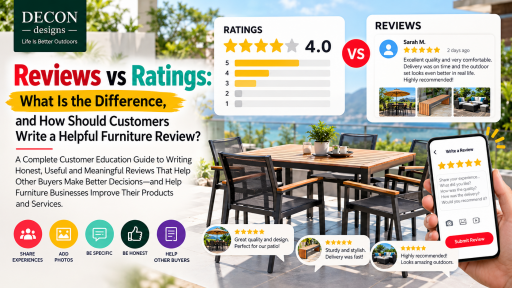
A Complete Customer Education Guide to Writing Honest, Useful and Meaningful Reviews That Help Other Buyers Make Better Decisions—and Help Furniture Businesses Improve Their Products and Services
By Decon Designs – Life Is Better Outdoors | Customer Education | Furniture Reviews | Google Reviews | FurniReviewology | Customer Experience | Digital Trust | Furniture Buying Decisions
In today’s digital marketplace, a customer can influence the buying decisions of hundreds or even thousands of people simply by sharing an experience.
A few stars.
A few sentences.
A photograph.
A description of what happened before, during and after a purchase.
These small contributions can become valuable sources of information for future customers.
But there is an important question that many consumers have never considered:
What is the difference between giving a rating and writing a review?
Are five stars enough?
Should a customer explain why they are satisfied?
What should someone write when a product does not meet expectations?
How can a customer share a negative experience without being unfair?
And what makes a review genuinely useful to another buyer?
At Decon Designs, a brand serving Malaysia’s outdoor and hospitality furniture market for more than two decades, we believe that customer education should go beyond teaching people how to choose furniture.
It should also help customers understand how to evaluate businesses, share their experiences and contribute to a more transparent marketplace.
Whether feedback is shared through Google Reviews, FurniReviewology or another credible review platform, customers have an opportunity to help other buyers make better-informed decisions.
However, a rating and a review are not exactly the same thing.
Understanding the difference is the first step toward becoming a more informed consumer.
1. Reviews vs Ratings: Understanding the Fundamental Difference
A rating is usually a numerical or visual score.
A review is a description or evaluation of an experience.
Both are useful, but they serve different purposes.
What Is a Rating?
A rating provides a quick assessment of a product, service or business.
Most online platforms use a five-star system.
For example:
- 5 Stars: Excellent experience
- 4 Stars: Good experience
- 3 Stars: Average or mixed experience
- 2 Stars: Below expectations
- 1 Star: Very poor experience
These are illustrative interpretations; individual platforms do not necessarily define each star level in exactly the same way.
Ratings allow customers to communicate their general level of satisfaction quickly.
A furniture company might have an average rating of 4.5 out of 5 stars.
That provides an immediate impression of how customers have evaluated the business.
But it does not explain the reasons behind those scores.
What Is a Review?
A review goes deeper.
It describes the customer’s actual experience.
For example:
“I purchased an outdoor dining set for my patio. The chairs were comfortable, the table matched the product description, and delivery was completed within the agreed timeframe. After several months of use, the furniture is still performing well.”
This review gives future buyers information they can use.
It explains what was purchased, what happened and why the customer was satisfied.
A rating tells people how you feel. A review helps them understand why.
2. Reviews vs Ratings: A Side-by-Side Comparison
| Feature | Rating | Review |
|---|---|---|
| Format | Stars or numerical score | Written feedback, sometimes with images |
| Detail | Limited | Can be detailed |
| Time required | A few seconds | Usually several minutes |
| Main purpose | Summarize satisfaction | Explain the experience |
| Buyer usefulness | Quick comparison | Deeper understanding |
| Business usefulness | Overall performance signal | Specific feedback for improvement |
| Context | Usually minimal | Can explain circumstances |
| Best approach | Score fairly | Describe honestly and clearly |
A rating and a review work best together.
A five-star rating supported by a meaningful explanation is generally more informative than five stars alone.
Likewise, a one-star rating accompanied by a clear, factual description helps other customers understand the issue rather than simply seeing a negative score.
3. Why Written Reviews Are Especially Important in the Furniture Industry
Furniture is not an ordinary impulse purchase.
A sofa may remain in a home for years.
A dining table may be used every day.
An outdoor lounger may be exposed to sunlight, rain and humidity.
A restaurant may purchase dozens of chairs.
A hotel may invest in hundreds of furniture items.
These purchasing decisions involve different expectations, budgets and performance requirements.
Customers need more than attractive product photographs.
They want to know:
- Is the furniture comfortable?
- Does it match the description?
- Are the materials suitable for the intended use?
- Was the delivery experience satisfactory?
- Was the supplier responsive?
- Was installation completed properly?
- Did the company provide reasonable after-sales assistance?
- Would the customer purchase from the company again?
A meaningful review can answer several of these questions.
This is why detailed furniture reviews can be particularly valuable to homeowners, hospitality operators, developers, restaurants, retailers and procurement professionals.
4. How Customers Should Write a Helpful Review
A good review does not need to be long.
It needs to be genuine, relevant and specific.
Customers can follow six practical steps.
Step 1: Identify What You Purchased
Start by explaining the product or service.
For example:
“I purchased a six-seater outdoor dining set.”
Or:
“Our hotel ordered pool loungers and parasols.”
This immediately helps future readers determine whether the experience is relevant to their needs.
A review about a writing desk may not help someone evaluating commercial outdoor umbrellas.
Specificity improves usefulness.
Step 2: Explain Why You Chose the Product or Business
If relevant, mention the reason for purchasing.
Examples include:
- Product design
- Price
- Material
- Supplier experience
- Availability
- Recommendation
- Commercial requirements
A customer might write:
“We selected this outdoor sofa because we needed something suitable for a covered patio in Malaysia.”
This provides valuable context.
Step 3: Describe the Actual Product Experience
Explain what you personally observed.
Consider:
Quality: Did the furniture feel sturdy and well constructed?
Comfort: Was it comfortable for its intended use?
Appearance: Did it match the photographs or showroom display?
Functionality: Did it perform the job it was purchased for?
Value: Did the customer feel the price was reasonable for the product received?
Avoid vague statements when more useful detail is available.
Instead of writing:
“Good furniture.”
Consider:
“The chairs feel stable, the cushions are comfortable and the finish matches what we selected.”
Step 4: Explain the Service and Delivery Experience
Furniture buying is not only about the product.
Service also matters.
Customers can mention:
- Staff communication
- Product explanations
- Ordering process
- Delivery coordination
- Installation
- Packaging
- After-sales assistance
For example:
“The sales team explained the available materials, confirmed the dimensions and kept us informed about delivery.”
This helps future customers understand what dealing with the supplier was like.
Step 5: Mention Problems Fairly
Not every experience is perfect.
A useful review should not hide genuine problems.
However, it should describe them accurately.
Instead of writing:
“This company is terrible!”
A more informative review might say:
“Our delivery arrived two days later than the date originally communicated. The team subsequently explained the delay and completed delivery.”
This allows readers to understand both the issue and the outcome.
Where a problem remains unresolved, the customer can state that clearly.
Avoid speculation about a company’s motives or making accusations that cannot be supported.
Step 6: Give an Overall Assessment
Conclude with a practical summary.
Examples:
“Overall, I am satisfied with the quality and would consider purchasing again.”
Or:
“The product was good, but delivery communication could be improved.”
Or:
“The furniture did not meet my expectations, and the issue remains unresolved.”
The best conclusion reflects the customer’s actual experience.
5. Examples of Good and Poor Furniture Reviews
Example A: A Five-Star Review
Weak review:
“Excellent!”
More helpful review:
“Purchased an outdoor dining set for our garden. The furniture looks like the product photographs, the chairs are comfortable and delivery was completed as agreed. The team also explained how to maintain the furniture. Very satisfied with the overall experience.”
Both express satisfaction.
But the second provides useful information.
Example B: A Four-Star Review
Weak review:
“Good.”
More helpful review:
“The sofa set looks beautiful and the cushions are comfortable. The ordering process was straightforward. Delivery took slightly longer than expected, but the team communicated the revised date. Overall, a good experience.”
A four-star review does not have to be negative.
It can recognize a positive experience while identifying an area for improvement.
Example C: A Three-Star Review
Weak review:
“Average.”
More helpful review:
“The dining chairs look attractive and feel sturdy, but the seat cushions were firmer than I expected. Delivery was on time. I would recommend trying the chairs in person before purchasing if softer seating is important to you.”
This is constructive and balanced.
Example D: A One-Star Review
Weak review:
“Never buy here!”
More helpful review:
“The table arrived with visible damage to one corner. I contacted the supplier and submitted photographs. At the time of writing, I am still waiting for confirmation of a replacement or repair. I hope the issue can be resolved.”
A factual negative review can be far more credible and helpful than an emotional accusation.
6. Should Customers Include Photographs in Their Reviews?
Where a platform allows photographs, they can make a review more informative.
For furniture, images can help show:
- Product appearance
- Colour and finish
- Furniture placement
- Assembly results
- Visible damage
- Product condition after use
A photograph of an outdoor dining set in a real garden can help future buyers understand its proportions and appearance.
However, customers should protect their privacy.
Avoid including identifiable people without permission, private addresses, invoices showing personal details or other sensitive information.
Photographs should accurately represent the actual product and experience.
7. When Is the Best Time to Write a Furniture Review?
There is no single perfect time.
Different stages provide different information.
Immediately after purchase: Customers can evaluate sales communication, product selection and the ordering process.
After delivery: Customers can evaluate packaging, installation, delivery coordination and initial product condition.
After several weeks: Customers can discuss comfort, everyday functionality and initial performance.
After six months or longer: Customers may be able to provide more meaningful observations about wear, durability and maintenance.
Long-term reviews can be particularly valuable for outdoor furniture because weather exposure and regular use influence performance.
Customers can also update reviews when their experience changes, subject to the platform’s features.
8. How to Review Outdoor Furniture in Malaysia
Malaysia’s tropical environment creates particular challenges for outdoor furniture.
Customers reviewing patio sets, parasols, loungers, outdoor sofas, swings or garden furniture can help other buyers by explaining the conditions in which the furniture is used.
For example:
Is the furniture placed under a roof?
Does it receive direct sunlight?
Is it exposed to rain?
Is it located near a swimming pool?
Is the property close to the sea?
How frequently is the furniture used?
These details matter.
A customer using a sofa under a covered terrace may have a different experience from someone leaving a similar sofa fully exposed to the weather.
A good outdoor furniture review should distinguish product performance from environmental conditions and maintenance practices.
This helps other buyers interpret the experience fairly.
9. Google Reviews, FurniReviewology and Other Review Platforms
Customers may share their experiences across different platforms.
Google Reviews
Google Reviews can be useful for evaluating local businesses, including showrooms, warehouses, furniture retailers and suppliers.
Customers can share experiences involving service, product purchases, communication and delivery.
FurniReviewology
FurniReviewology is a furniture-focused review platform intended to support the broader furniture ecosystem.
A specialist platform can provide an additional channel for experiences involving furniture companies, brands, manufacturers, suppliers, retailers and other industry participants.
Marketplaces and E-Commerce Reviews
Product reviews on shopping platforms can help customers assess specific furniture models, specifications, packaging and delivery experiences.
Social Media and Other Independent Platforms
Customer feedback may also appear on social networks, consumer review websites and other channels.
Each source can provide a different perspective.
No single review platform should be treated as the complete truth about a business.
Buyers benefit from comparing multiple credible sources and examining the substance of the feedback.
10. What Customers Should Never Do When Writing Reviews
Reviews become less useful when they are misleading or manipulated.
Customers should avoid:
- Writing reviews for purchases or experiences that never happened
- Exaggerating problems
- Making unsupported accusations
- Publishing another person’s private information
- Copying someone else’s review
- Posting irrelevant personal attacks
- Accepting undisclosed incentives for misleading feedback
- Confusing a product problem with an unrelated complaint
Businesses should likewise avoid creating fake reviews, pressuring customers to give five stars or selectively rewarding only positive feedback.
Trust requires honesty from both sides.
11. What Should a Customer Do When Something Goes Wrong?
A dissatisfied customer has every right to describe a genuine experience.
Before publishing, however, it can be useful to gather the relevant facts.
Keep:
- Order confirmation
- Product specifications
- Delivery records
- Photographs of the issue
- Relevant communication
- Warranty information
Where appropriate, contact the supplier and allow a reasonable opportunity to respond.
This is not a requirement to stay silent.
It is a practical way to establish what happened and whether the problem can be resolved.
If the business resolves the issue, a customer can explain both the original problem and the resolution.
If the problem remains unresolved, the review can say so.
A balanced review is not necessarily a positive review.
It is an accurate review.
12. Why Businesses Should Welcome Honest Reviews
For furniture businesses, customer feedback is a valuable source of information.
A review can reveal:
- Which products customers appreciate
- Where comfort needs improvement
- Whether product descriptions are clear
- How delivery processes perform
- Whether staff communicate effectively
- How after-sales issues are handled
Repeated feedback can reveal patterns that management should investigate.
For example, if several customers report that the assembly instructions are confusing, the company may need to improve its documentation.
If customers consistently praise the comfort of a particular chair, that may be valuable product-development information.
Reviews can therefore support continuous improvement.
Businesses should not merely collect ratings.
They should study the experiences behind them.
13. Why Customers Should Not Depend on Star Ratings Alone
Imagine two furniture suppliers.
Supplier A: 5.0 stars from four ratings, with no written explanations.
Supplier B: 4.6 stars from 180 reviews, including detailed experiences, photographs and business responses.
Which supplier should a buyer choose?
There is no automatic answer.
But Supplier B provides more information to evaluate.
Buyers should consider:
- Number of reviews
- Recent feedback
- Specific details
- Relevance to their intended purchase
- Consistency of experiences
- Responses to complaints
- Evidence of genuine transactions
A high rating can attract attention.
A detailed review history can help buyers investigate whether that attention is justified.
14. How Reviews Can Influence Furniture Buying Decisions
Customer reviews can influence several stages of purchasing.
Discovery: A buyer encounters a furniture company and notices customer feedback.
Evaluation: The buyer reads reviews to understand products and service.
Comparison: The buyer compares multiple suppliers.
Confidence: Relevant experiences help reduce uncertainty.
Decision: The buyer combines reviews with specifications, price, product suitability and other information.
For commercial purchases, reviews may also help buyers identify questions to ask during supplier evaluation.
However, major furniture procurement decisions should still include appropriate technical, financial and contractual due diligence.
Reviews are supporting evidence—not a substitute for professional evaluation.
15. Decon Designs: Customer Feedback Is Part of Better Furniture Buying
At Decon Designs – Life Is Better Outdoors, we believe customers should feel confident asking questions before purchasing furniture.
With more than two decades serving Malaysia’s hospitality and furniture market, we recognize that customer expectations extend far beyond appearance.
Customers want quality.
They want comfort.
They want reasonable prices.
They want accurate information.
They want reliable communication.
And when problems occur, they want to know how the supplier will respond.
Customer feedback helps communicate these experiences.
We encourage buyers to make informed decisions by studying product specifications, comparing options, reading genuine reviews and asking questions relevant to their requirements.
Whether someone is purchasing a patio set for a home, loungers for a hotel, parasols for a restaurant or furniture for an entire hospitality project, the decision deserves proper consideration.
We also believe customers should be free to share their genuine experiences—positive, negative or mixed—without pressure to provide a particular rating.
Because the objective of reviews should never be to create an artificial image of perfection.
It should be to create greater understanding.
16. A Simple Review-Writing Formula Every Customer Can Use
Customers who are unsure what to write can use this straightforward structure:
I purchased: Name or type of furniture.
I needed it for: Home, hotel, restaurant, office, garden or another application.
My experience: What happened during ordering, delivery and use.
What I liked: Specific positive observations.
What could improve: Any genuine concerns.
My overall assessment: Whether the product and service met expectations.
Sample Furniture Review
“I purchased a four-seater outdoor patio set for our home in Malaysia. We wanted furniture that would be comfortable and suitable for our covered terrace. The team explained the material options, and the set arrived in good condition. The chairs are comfortable, and the table fits the space well. After two months of regular use, we are satisfied with the purchase. I would recommend checking the dimensions carefully before ordering.”
This is a useful review because it is specific, balanced and based on an actual experience.
A customer does not need to be a professional writer.
A few honest sentences can make a meaningful contribution.
17. The Future of Furniture Reviews: From Simple Stars to Meaningful Experiences
As furniture discovery becomes increasingly digital, buyers need better ways to understand businesses and products.
Ratings will continue to play a role because they provide a quick summary.
But written reviews offer something different.
They explain experiences.
They provide context.
They identify strengths.
They reveal weaknesses.
They help businesses improve.
And they can help future customers ask better questions.
The future of review culture should not be about collecting the highest possible number of stars at any cost.
It should be about creating a marketplace where genuine customer experiences are accessible, relevant and useful.
That is good for buyers.
It is good for responsible businesses.
And it is good for the furniture industry.
Final Thoughts: Don’t Just Give Stars—Share Your Experience
A rating takes seconds.
A meaningful review may take a few minutes.
But those few minutes can help someone avoid a poor purchasing decision, discover a reliable supplier or understand whether a product suits their needs.
The next time you purchase furniture, consider sharing more than a star rating.
Explain what you bought.
Describe the quality.
Mention the service.
Discuss the delivery.
Share what worked well.
Explain what could improve.
Be factual.
Be fair.
Be specific.
Because ratings measure satisfaction, but reviews communicate experience.
And experience is what future buyers need to understand.
At Decon Designs, we believe a stronger furniture industry begins with informed buyers, responsible businesses and authentic customer voices.
Decon Designs – Life Is Better Outdoors.