
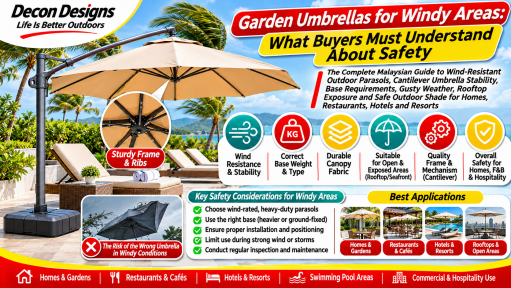
The Complete Malaysian Guide to Wind-Resistant Outdoor Parasols, Cantilever Umbrella Stability, Base Requirements, Gusty Weather, Rooftop Exposure and Safe Outdoor Shade for Homes, Restaurants, Hotels and Resorts
By Decon Designs – Life Is Better Outdoors | Garden Umbrella Malaysia | Wind Safety | Outdoor Parasol | Cantilever Parasol | Commercial Outdoor Furniture | Hospitality Shade Solutions
Introduction: A Beautiful Garden Umbrella Can Become Dangerous When the Wind Changes
A garden umbrella is designed to make outdoor living more comfortable.
It provides shade over a patio dining table, garden seating area, swimming pool lounge or café terrace.
For homeowners, it creates a more inviting outdoor space.
For restaurants and resorts, it can help customers enjoy outdoor dining and relaxation.
But there is one factor that every buyer must take seriously.
Wind.
An outdoor umbrella may look stable on a calm day.
Its frame may appear strong.
Its base may feel heavy.
Its canopy may be made from a material described as heavy-duty.
Yet none of these characteristics alone proves that the umbrella is suitable for windy conditions.
A sudden gust can place substantial force on an open canopy.
If the parasol, base or anchoring system is unsuitable, the umbrella may tilt, slide, overturn or suffer structural damage.
In serious cases, a displaced parasol can cause injury or property damage.
This concern is particularly relevant in Malaysia, where thunderstorms and sudden changes in weather can occur.
Outdoor umbrellas used in exposed gardens, coastal resorts, rooftop restaurants and high-rise terraces require especially careful consideration.
Unfortunately, buyers sometimes receive oversimplified advice.
They may be told to buy the heaviest base available.
They may assume that a vented canopy is windproof.
They may believe that a square umbrella is automatically stronger than a round umbrella.
Or they may interpret a marketing description such as wind-resistant as permission to leave the parasol open during storms.
These assumptions can be dangerous.
There is no universally windproof garden umbrella. Every parasol has design, installation and operating limitations.
This guide by Decon Designs – Life Is Better Outdoors explains what Malaysian buyers should understand about wind exposure, umbrella design, base compatibility, manufacturer specifications and responsible operation.
The objective is not simply to help customers choose a parasol.
It is to help them choose and use outdoor shade equipment with a realistic understanding of safety.
1. Why Wind Is a Major Concern for Garden Umbrellas
A garden umbrella canopy creates a surface exposed to moving air.
When wind acts on the canopy, it can generate forces that affect the entire parasol assembly.
These forces may influence:
- Canopy fabric.
- Supporting ribs.
- Main pole.
- Cantilever arm.
- Joints and fasteners.
- Opening and locking mechanisms.
- Base or anchoring system.
- Supporting surface.
The effect depends on the parasol’s design and the direction and intensity of the wind.
A parasol that remains stable under one set of conditions may behave differently when wind direction or speed changes.
This is why wind suitability cannot be determined from appearance alone.
2. What Does Wind-Resistant Mean?
The term wind-resistant is often used in outdoor furniture marketing.
However, it can be ambiguous unless accompanied by a clear technical specification.
A supplier may use the term to describe a particular frame construction or canopy design.
But the description does not automatically establish a verified operating wind limit.
Buyers should ask what the claim means.
Is it based on manufacturer testing?
Does it apply to the complete parasol with a specified base?
Does it assume a particular installation surface?
Does it refer to sustained wind, gusts or a defined laboratory test?
Without this information, wind-resistant should not be treated as a safety guarantee.
3. Wind-Resistant vs Windproof: An Important Difference
Wind-resistant generally suggests that a product is intended to tolerate some degree of wind exposure under specified conditions.
Windproof suggests a much stronger claim that can be misleading for outdoor parasols.
A garden umbrella should not be considered safe in all wind conditions.
Even a well-designed commercial parasol can have operating restrictions.
Severe gusts, thunderstorms and unsuitable installation conditions may exceed the product’s intended use.
Buyers should avoid relying on unsupported windproof claims.
4. Why Sudden Wind Gusts Matter
Wind does not always blow at a constant speed.
A location may experience relatively calm conditions followed by a sudden gust.
Gusts can create rapidly changing forces on an open canopy.
This can affect the parasol before a person has time to react.
For this reason, waiting until a parasol begins moving violently is not a reliable safety procedure.
Commercial operators should establish clear weather-response procedures.
Parasols should be closed and secured before conditions become unsafe, following manufacturer guidance.
5. Malaysia’s Tropical Weather and Outdoor Parasols
Malaysia experiences tropical weather conditions that can include heavy rain, thunderstorms and sudden wind gusts.
These conditions can affect outdoor shade installations.
A parasol suitable for normal sunny-day use may not be appropriate during a thunderstorm.
The fact that a canopy can resist light rain does not mean it is safe to leave open during severe weather.
Buyers should distinguish between everyday shade use and storm exposure.
A garden umbrella is not a storm shelter.
6. Why Canopy Size Affects Wind Exposure
Larger canopies generally present more surface area to moving air.
However, wind forces depend on more than size.
Canopy shape, orientation, height, porosity, structural design and wind direction also matter.
A larger parasol may require a different frame and support system.
Do not assume that a larger canopy can be made safe simply by adding more ballast.
The complete product must be suitable for the intended installation.
7. Round vs Square Parasols: Which Is Better in Wind?
Round and square parasols have different geometries.
However, neither shape is automatically safer in windy conditions.
Performance depends on the complete design.
A well-engineered square parasol may be suitable for certain applications.
A poorly supported round parasol may be unsuitable even in relatively sheltered conditions.
Buyers should not choose based solely on shape.
Instead, request product-specific wind-use guidance and support requirements.
8. Centre-Pole vs Cantilever Parasols in Windy Areas
Centre-pole parasols support the canopy through a pole positioned beneath it.
Cantilever parasols use an offset support arrangement.
These configurations create different structural demands.
Cantilever parasols may require specialised bases or anchoring because of the offset canopy.
However, neither design is universally more wind-resistant.
The correct choice depends on the exact model and installation.
| Consideration | Centre-pole parasol | Cantilever parasol |
|---|---|---|
| Pole location | Beneath canopy | Offset |
| Support system | Model-specific | Often specialised |
| Wind performance | Product-specific | Product-specific |
| Base compatibility | Must be verified | Must be verified |
| Operating limits | Manufacturer-defined | Manufacturer-defined |
| Suitability for exposed sites | Requires assessment | Requires assessment |
9. Why Cantilever Parasols Need Particular Attention
Cantilever parasols extend the canopy away from the support pole.
This arrangement can create substantial forces on the arm, pole and base.
The correct support system is essential.
Some models use proprietary ballast blocks.
Others use approved fixed anchoring.
A base intended for a centre-pole umbrella should not automatically be used with a cantilever parasol.
Do not assume that a heavy-looking base provides sufficient stability.
10. How Much Weight Does a Parasol Base Need?
There is no universal safe base weight for every garden umbrella.
The required support depends on:
- Exact parasol model.
- Canopy dimensions.
- Canopy shape.
- Pole height.
- Support geometry.
- Manufacturer requirements.
- Wind exposure.
- Installation surface.
- Anchoring method.
Generic advice such as use a 40 kg base for a 3-metre umbrella may be inappropriate for a particular product.
Always use the manufacturer-approved base or anchoring system.
11. Why Base Weight Alone Is Not Enough
Two bases can have the same mass but different dimensions.
Their geometry can affect stability.
The connection between the pole and base also matters.
A narrow base may behave differently from a broad support system.
The surface beneath the base can influence movement.
Therefore, base weight alone cannot establish whether the complete installation is suitable.
12. HDPE Water-Filled Bases: What Buyers Should Understand
Some parasol bases use HDPE shells filled with water.
These can be convenient to transport when empty.
However, the filled mass depends on the manufacturer’s specified capacity.
A water-filled base can also lose ballast if it leaks.
Buyers should inspect the shell, cap and seals.
Do not assume that every HDPE base is suitable for windy locations.
Compatibility must be confirmed.
13. Sand-Filled Bases: Are They Safer?
Sand can provide more mass than water for the same container volume, depending on density and packing.
However, this does not automatically make a sand-filled base safer.
The base must be designed for the selected filling material.
The complete support system must be appropriate for the parasol.
Do not substitute sand for water unless the manufacturer permits it.
14. Concrete, Granite and Marble Bases
Concrete and natural stone bases can provide substantial mass.
However, heavy materials do not automatically establish wind suitability.
The base’s dimensions, connection system and installation conditions remain important.
Heavy bases can also create handling and structural loading concerns.
For balconies, rooftops and elevated terraces, these issues deserve particular attention.
15. Can You Add Bricks or Extra Weights to a Parasol Base?
Improvised ballast is not a substitute for an approved support system.
Loose bricks, stones or concrete blocks may shift.
They may create trip hazards.
They may damage the base or supporting surface.
And they may not address the forces acting on the parasol.
Use the manufacturer’s specified ballast or anchoring arrangement.
Do not assume that adding weight makes an umbrella safe during strong winds.
16. Fixed Anchoring Systems for Exposed Areas
Some commercial parasols may use fixed anchoring systems.
These can involve engineered base plates, structural fixings or other approved arrangements.
However, fixed anchoring does not mean that the canopy can remain open in all weather.
The complete system still has operating limitations.
Installation may require structural assessment and permission from the property owner or building management.
Do not drill into a roof deck, terrace or structural slab without appropriate approval and technical assessment.
17. Why Rooftop Parasols Require Special Caution
Rooftop restaurants and elevated terraces may experience complex airflow.
Building height and geometry can influence local wind conditions.
A standard garden parasol should not be assumed suitable for rooftop use.
The installation may also be subject to structural loading restrictions.
A site-specific technical assessment may be necessary.
A heavier base does not automatically make a rooftop parasol safe.
18. High-Rise Condominium Balconies
Condominium balconies can be exposed to sudden gusts.
They may also have limited space and building-management restrictions.
A large umbrella may create substantial wind-related risks.
Do not assume that a parasol is suitable simply because it fits physically.
Before installing any outdoor umbrella on a high-rise balcony, confirm the product’s suitability, structural requirements and applicable building rules.
Where necessary, consult appropriately qualified professionals.
19. Coastal Resorts and Beachfront Locations
Coastal locations may experience demanding wind conditions and airborne salts.
This can affect both the canopy and metal components.
A parasol suitable for a sheltered inland garden may not be appropriate for an exposed beachfront terrace.
Commercial buyers should evaluate the complete installation.
Corrosion protection and maintenance requirements are also important.
20. Open Gardens vs Sheltered Patios
An open garden may have different wind exposure from a courtyard surrounded by buildings.
However, sheltered locations are not automatically safe.
Wind can accelerate or change direction around walls and structures.
A patio that feels calm at ground level may still experience sudden gusts.
Site conditions should be considered carefully.
21. Does a Vented Canopy Improve Wind Performance?
Some parasols have ventilation openings near the top of the canopy.
These may allow some airflow through the canopy.
However, the presence of a vent does not establish a particular wind rating.
A vented canopy is not windproof.
The complete parasol design and installation determine suitability.
Buyers should request manufacturer documentation rather than relying on the vent alone.
22. Do Flexible Ribs Make a Parasol Safer?
Some parasols use ribs designed to flex under certain conditions.
However, flexibility alone does not establish wind resistance.
Material quality, joint design, canopy geometry and the support system all matter.
Excessive bending may also indicate that the product is being used outside its intended conditions.
Do not interpret visible movement as proof that the parasol is safely absorbing wind.
23. Aluminium vs Steel Frames in Windy Conditions
Aluminium and steel are used in different parasol designs.
Aluminium is relatively lightweight and does not rust in the same way as iron or steel.
Steel can provide structural strength but requires appropriate corrosion protection.
However, material names alone do not establish wind performance.
Frame dimensions, construction, joints and engineering are also important.
A well-designed aluminium parasol may be suitable for some applications.
A poorly designed steel parasol may not be.
24. Why Frame Joints and Fasteners Matter
Wind forces affect more than the main pole.
Joints, bolts, hinges and locking mechanisms can be critical components.
Loose or damaged fasteners may compromise the assembly.
Commercial operators should inspect parasols according to manufacturer guidance.
Do not continue using a parasol with damaged structural connections.
25. Can a Parasol Be Left Open During Light Wind?
Whether a parasol may remain open depends on the manufacturer’s operating limits and actual conditions.
Do not rely solely on subjective descriptions such as light wind.
Wind exposure can change quickly.
A product’s permitted operating conditions should be confirmed.
If the conditions are uncertain or deteriorating, close and secure the parasol according to manufacturer instructions when it is safe to do so.
26. When Should You Close a Garden Umbrella?
Follow the manufacturer’s specific wind and weather instructions.
Close the parasol before conditions exceed its intended operating limits.
Do not wait until the canopy begins lifting, twisting or moving violently.
If dangerous weather has already developed, do not put yourself or others at risk attempting to control a large moving parasol.
Move to safety and follow the site’s emergency procedures.
27. Can You Use a Parasol During a Thunderstorm?
A garden parasol should not be used as shelter during a thunderstorm.
Thunderstorms can involve lightning, strong gusts and heavy rain.
People should move to appropriate shelter.
Do not remain beneath an outdoor umbrella because its fabric is described as waterproof.
Weather protection claims do not establish storm safety.
28. Can You Leave a Garden Umbrella Open Overnight?
Leaving a parasol open and unattended can expose it to unexpected weather.
For many applications, closing and securing the canopy when not in use is an important precaution.
Follow the manufacturer’s instructions.
Restaurants and resorts should establish end-of-day checks.
Do not assume that a heavy base makes unattended operation safe.
29. Can You Tie an Open Parasol to a Wall or Fence?
Improvised tying or restraint systems should not be used as substitutes for approved anchoring.
A wall, fence or railing may not be designed to resist parasol loads.
Unapproved restraints may create additional hazards or damage the structure.
Use only manufacturer-approved support arrangements.
30. Why Umbrellas Can Overturn Even With Heavy Bases
Overturning can occur when the forces acting on the parasol exceed the resisting capacity of the support system.
The outcome depends on canopy geometry, wind conditions, base dimensions, mass, connection design and surface characteristics.
A heavy base may still be unsuitable for a particular parasol.
This is why complete-system compatibility matters.
31. Why a Parasol May Slide Instead of Overturning
Some parasol bases may move across a surface when subjected to lateral forces.
Surface friction, base contact and installation conditions influence this behaviour.
A base that remains upright may still slide into furniture or people.
The support system must be appropriate for the intended surface and conditions.
Do not assume that preventing overturning alone is sufficient.
32. What If the Parasol Base Is on Tiles?
Tiled patios can vary in surface texture and slip resistance.
A heavy base may damage tiles if dragged.
The surface may also become slippery when wet.
The manufacturer may specify installation requirements.
Do not assume that any base is suitable for every tiled surface.
33. Parasol Safety on Wooden Decking
Wooden decking may have specific load and anchoring limitations.
A heavy base can create concentrated loads.
Fixed anchoring may require technical assessment.
The decking structure must be suitable for the intended installation.
Consult the decking provider or an appropriately qualified professional where necessary.
34. Parasol Safety on Grass and Soil
Soft or uneven ground can affect base stability.
Rain may change soil conditions.
A freestanding base may become uneven or unstable.
Some parasol systems may use approved ground anchors.
However, these should be selected according to manufacturer requirements and site conditions.
Do not improvise support using loose stones or other objects.
35. Wind Safety for Restaurants and Cafés
Restaurants and cafés may have customers seated beneath or near outdoor parasols.
This creates additional responsibilities.
Commercial operators should:
- Use suitable products.
- Follow manufacturer installation instructions.
- Inspect bases and mechanisms.
- Train staff.
- Monitor changing weather.
- Establish closing procedures.
- Remove damaged parasols from service.
A parasol should not remain open merely because customers are still seated outdoors.
Safety takes priority.
36. Wind Safety for Hotels and Resorts
Hotels and resorts may operate multiple parasols across different outdoor areas.
A standard operating procedure can help staff respond consistently.
The procedure should identify who is responsible for monitoring conditions and closing parasols.
Different locations may have different exposure levels.
A sheltered garden and an exposed pool deck should not automatically use identical operating assumptions.
37. Wind Safety for Swimming Pool Areas
Poolside parasols should not obstruct circulation or emergency equipment.
Their bases must be appropriate for the location.
Wind-related movement near a pool can create additional hazards.
Commercial operators should coordinate parasol procedures with the facilities or safety team.
38. Staff Training: What Commercial Operators Should Teach
Staff should understand the specific parasol model and its operating instructions.
Training may cover:
- Correct opening procedure.
- Correct closing procedure.
- Locking arrangements.
- Rotation or tilt limitations.
- Base inspection.
- Weather-related restrictions.
- Reporting damage.
- Emergency response.
- End-of-day securing procedures.
Do not assume that every employee already knows how to operate a commercial parasol safely.
39. What Should Be Included in a Parasol Safety Inspection?
| Component | What to inspect |
|---|---|
| Canopy fabric | Tears, damaged seams, unusual tension |
| Ribs | Bending, cracks, damaged connections |
| Main pole | Deformation, corrosion, looseness |
| Cantilever arm | Damage, unusual movement |
| Crank mechanism | Jamming, slipping, abnormal operation |
| Locking system | Correct engagement |
| Base | Cracks, leakage, instability |
| Ballast | Correct manufacturer-approved configuration |
| Fasteners | Missing, loose or damaged parts |
| Anchoring | Visible damage or looseness |
| Overall assembly | Unexpected movement or defects |
Any parasol with structural, mechanical or stability-related defects should be removed from service until appropriately assessed.
40. What Happens After a Parasol Overturns?
An overturned parasol may have damage that is not immediately visible.
The frame, joints, base and mechanisms should be inspected.
Do not simply reopen the canopy and continue using it.
If structural damage is suspected, seek an appropriate assessment.
Replacement may be necessary.
41. Can a Wind-Damaged Parasol Be Repaired?
Some components may be replaceable.
However, repairability depends on the exact model and damage.
A torn canopy is different from a bent main pole or damaged cantilever arm.
Structural repairs should not be improvised.
Use manufacturer-approved parts and procedures where available.
If the product cannot be restored appropriately, replacement may be the safer decision.
42. How to Evaluate a Supplier’s Wind Claims
Before purchasing, ask the supplier:
- What is the exact model?
- Is there a documented wind-use specification?
- What test or standard supports the claim?
- Does the claim apply to the complete parasol and specified base?
- What installation conditions are assumed?
- Does the rating concern sustained wind or gusts?
- What closing procedures are required?
- Is the product intended for commercial use?
- What warranty exclusions apply?
- Are installation instructions available?
If a supplier cannot explain a wind-related claim, do not treat the marketing description as proof of suitability.
43. Understanding Wind Ratings and Test Conditions
Some manufacturers may publish wind-related performance information.
However, ratings can be based on different methods and assumptions.
A test result may apply only to a particular product configuration.
It may require a specific anchoring system.
It may not represent every real-world site.
Buyers should understand the test conditions and limitations.
Do not compare wind ratings from different manufacturers without checking whether the methods and assumptions are comparable.
44. Why Generic Wind-Speed Claims Can Be Misleading
Statements such as withstands 50 km/h winds may appear reassuring.
However, without supporting information, the claim may be incomplete.
Important questions include:
- Was the product tested with the specified base?
- Was it tested in an open or controlled configuration?
- Was the measurement based on sustained wind or gusts?
- What installation surface was used?
- What safety factors or limitations apply?
A single number should not replace a proper product and site assessment.
45. Commercial Parasol Procurement Checklist
Before ordering parasols for a windy or exposed location, confirm:
- Exact product model.
- Intended-use category.
- Canopy dimensions.
- Canopy shape.
- Frame construction.
- Manufacturer wind-use guidance.
- Required base or anchoring.
- Approved ballast configuration.
- Installation surface requirements.
- Structural loading considerations.
- Operating mechanism.
- Locking arrangements.
- Closing procedures.
- Inspection requirements.
- Maintenance schedule.
- Replacement-part availability.
- Warranty conditions.
- Installation responsibilities.
- Staff training requirements.
- Site-specific technical assessment where necessary.
A commercial parasol should be procured as a complete shade and support system.
46. Ten Dangerous Assumptions About Garden Umbrellas
Assumption 1: A heavy base makes any umbrella safe.
False. Compatibility and geometry matter.
Assumption 2: A vented canopy is windproof.
False. Ventilation does not establish unlimited wind resistance.
Assumption 3: A steel frame is always stronger than aluminium.
False. Complete construction and engineering matter.
Assumption 4: A small umbrella cannot be dangerous.
False. Even smaller parasols can create hazards if displaced.
Assumption 5: A cantilever parasol is safe because the base is large.
False. The complete support system must be appropriate.
Assumption 6: A rooftop umbrella only needs extra ballast.
False. Wind exposure and structural loading require assessment.
Assumption 7: Waterproof fabric means storm protection.
False. Rain resistance and wind safety are separate.
Assumption 8: A parasol can remain open until it starts moving.
False. Closing should occur before conditions become unsafe.
Assumption 9: A damaged parasol is safe if it still opens.
False. Structural or mechanical defects may remain.
Assumption 10: All products described as commercial-grade have the same wind performance.
False. Specifications and intended-use conditions vary.
47. Decon Designs: Outdoor Parasols and Shade Solutions in Malaysia
Decon Designs has more than 20 years of experience in Malaysia’s outdoor and hospitality furniture market.
Its product categories have included centre-pole parasols, cantilever parasols, outdoor dining furniture, garden seating, lounge furniture and related accessories.
Different parasol models have different designs, support requirements and operating limitations.
Customers should confirm the exact specifications before purchasing.
A parasol suitable for a sheltered residential patio should not automatically be assumed appropriate for an exposed rooftop, coastal resort or high-rise balcony.
Decon Designs – Life Is Better Outdoors.
48. Decon Designs Parasol and Base Examples
As part of its Year-End Stock Clearance 2026, Decon Designs has previously advertised selected parasol-related products.
JHA-0112 Garden Parasol
Model: JHA-0112
Previously specified canopy size: Approximately 300 cm
Frame: Grey powder-coated metal
Fabric colour: Chocolate
Base: HDPE water-fillable base in the previously supplied configuration
Previous listed price: RM1,999
Clearance price: RM999
This product is included as an example of a garden parasol.
Its suitability for windy locations must be confirmed using the exact manufacturer specifications and intended installation conditions.
Do not assume that the product offers 360-degree rotation or adjustable tilt.
JHA-008 HDPE Parasol Base
Material: HDPE
Previously specified dimensions: 85 × 85 × 18 cm
Previously specified filling options: Water or sand
Previous listed price: RM1,218
Clearance price: RM449
The base is included as an example of a fillable parasol support product.
Its compatibility with any particular parasol must be verified.
Previously advertised prices are not confirmation of current inventory, compatibility or wind suitability.
49. Decon Designs Year-End Stock Clearance 2026
Decon Designs is conducting its Year-End Stock Clearance 2026 as part of a business downsizing and inventory-reduction exercise.
Selected existing outdoor furniture and accessories are being offered at promotional prices.
Campaign: Decon Designs Year-End Stock Clearance 2026
Campaign message: Everything Must Go!
Sale period: 1 November – 31 December 2026
Availability: Limited stock, first come, first served.
Official promotion page:
https://decondesigns.com/product-category/promotion/
The campaign is an inventory-reduction exercise, not an announcement that the Decon Designs brand is closing.
Customers should confirm current prices, availability, specifications, product condition, delivery arrangements and sale terms.
50. Frequently Asked Questions About Garden Umbrellas for Windy Areas
Are there windproof garden umbrellas?
No garden umbrella should be assumed safe in all wind conditions. Product-specific operating limits apply.
What does wind-resistant mean?
It should refer to a defined level of performance, but marketing claims require clarification and supporting information.
Is a round parasol better than a square parasol in wind?
Neither shape is universally safer. Performance depends on the complete design and installation.
Are cantilever parasols suitable for windy areas?
Some may be suitable for specified conditions, but the exact product and support system must be assessed.
How heavy should a parasol base be?
There is no universal safe weight. Follow the manufacturer’s approved support requirements.
Is a concrete base safer than an HDPE base?
Not automatically. Stability depends on the complete system.
Can I add extra weights to make my umbrella safer?
Do not use improvised ballast as a substitute for the manufacturer’s approved support system.
Do vented canopies resist wind better?
Some vent designs may affect airflow, but a vent does not establish a particular wind rating.
Can I leave my garden umbrella open during rain?
Follow the manufacturer’s operating limits. Rain may be accompanied by dangerous wind or thunderstorms.
Should I close my parasol during a thunderstorm?
Yes. Do not use a garden parasol as storm shelter.
Can I use a garden umbrella on a rooftop?
Only where the product and installation are suitable for the site and any necessary technical approvals have been obtained.
Are parasols suitable for condominium balconies?
Do not assume so. Wind exposure, structural loading and building rules require assessment.
Can a wind-damaged parasol be repaired?
Some components may be repairable, but structural damage requires appropriate assessment.
What should restaurants do when wind conditions change?
Follow established weather-response procedures and manufacturer operating instructions.
Where can I explore Decon Designs parasol promotions?
Visit https://decondesigns.com/product-category/promotion/ and confirm current availability and suitability.
Conclusion: The Safest Garden Umbrella Is the One Used Within Its Limits
Garden umbrellas can make outdoor living more comfortable.
They can provide shade over residential patios, restaurant terraces, resort lounges and selected poolside areas.
However, wind exposure must be taken seriously.
A large canopy can experience substantial forces.
A heavy base may not be sufficient.
A vented canopy is not windproof.
And a product described as commercial-grade still has operating limitations.
The correct decision requires an understanding of the complete parasol system.
This includes the canopy, frame, base, anchoring, installation surface and manufacturer instructions.
BEFORE BUYING A GARDEN UMBRELLA FOR A WINDY AREA, ASK FIVE QUESTIONS:
1. IS THIS PARASOL SUITABLE FOR THE INTENDED LOCATION?
2. WHAT DOCUMENTED WIND-USE LIMITATIONS APPLY?
3. WHAT BASE OR ANCHORING SYSTEM IS REQUIRED?
4. HOW AND WHEN SHOULD THE PARASOL BE CLOSED?
5. WHO WILL INSPECT AND MAINTAIN THE INSTALLATION?
A good parasol purchase is not about finding an umbrella that claims to withstand every storm.
It is about choosing a suitable product and operating it responsibly.
WIND SAFETY IS NOT A FEATURE TO ASSUME. IT IS A REQUIREMENT TO VERIFY.
Explore selected outdoor parasols and furniture during the Decon Designs Year-End Stock Clearance 2026.
EVERYTHING MUST GO!
1 NOVEMBER – 31 DECEMBER 2026
LIMITED STOCK | FIRST COME, FIRST SERVED
EXPLORE THE CLEARANCE COLLECTION:
https://decondesigns.com/product-category/promotion/
Decon Designs – Life Is Better Outdoors.


