
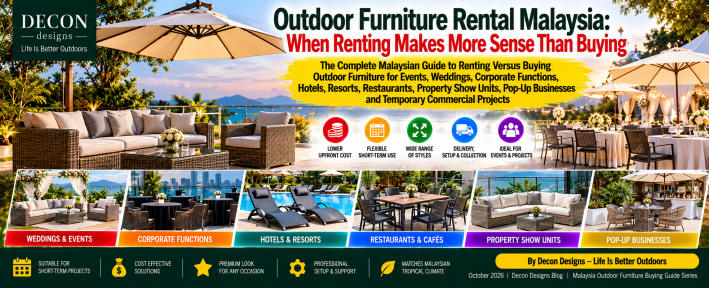
The Complete Malaysian Guide to Renting Versus Buying Outdoor Furniture for Events, Weddings, Corporate Functions, Hotels, Resorts, Restaurants, Property Show Units, Pop-Up Businesses and Temporary Commercial Projects
By Decon Designs – Life Is Better Outdoors | Outdoor Furniture Rental Malaysia | Furniture Hire Malaysia | Event Furniture | Outdoor Sofa Rental | Garden Furniture | Commercial Furniture | Hospitality Furniture | Furniture Procurement | Rental Versus Purchase
Decon Designs Blog | Malaysia Outdoor Furniture Buying Guide Series
Introduction: Why Buy Outdoor Furniture When You Only Need It for a Few Days?
Imagine organizing an outdoor corporate event in Kuala Lumpur.
You need 100 chairs, 20 tables, several lounge sofas and suitable shade arrangements.
The event lasts two days.
Would purchasing all the furniture make financial sense?
Now consider a restaurant in Selangor planning to operate an outdoor dining terrace for the next five years.
It needs 15 tables and 60 chairs for everyday use.
Would renting that furniture indefinitely be the best decision?
The answer depends on how frequently the furniture will be used, how long it is needed, the cost of ownership and the operational responsibilities involved.
Across Malaysia, outdoor furniture is required for many temporary and permanent applications.
Wedding organizers need garden seating.
Corporate event companies need temporary outdoor lounges.
Property developers furnish sales galleries and show units.
Hotels may require additional furniture during special functions.
Restaurants may expand seating for seasonal promotions.
Exhibition organizers create temporary hospitality areas.
At the same time, homeowners, cafés, resorts and property managers often need furniture for continuous use.
For these buyers, renting may offer flexibility, while purchasing may provide better long-term value.
The key question is:
When does outdoor furniture rental make more sense than buying, and when should Malaysian businesses invest in owning their furniture?
At Decon Designs – Life Is Better Outdoors, with more than two decades serving Malaysia’s outdoor and hospitality furniture market, we believe furniture decisions should be based on actual usage, commercial requirements and total costs—not simply the initial quotation.
This guide explores both options, explains how to compare rental and purchase proposals, and provides practical tools for homeowners, event organizers, businesses and procurement teams.
Important clarification: This is an educational comparison of the Malaysian outdoor furniture rental and purchasing market. Rental availability, product selection and rental services should be confirmed directly with the relevant provider. The discussion does not imply that every product offered by Decon Designs is available for rental.
1. What Is Outdoor Furniture Rental?
Outdoor furniture rental is an arrangement in which a customer pays to use furniture for an agreed period without purchasing ownership of the products.
The rental period may cover:
- A single day.
- A weekend.
- Several days.
- A few weeks.
- Several months.
- A longer contractual period.
Rental agreements vary.
Some providers may offer furniture-only hire.
Others may include transportation, setup, collection and additional services.
Commercial buyers should never assume that all services are included.
Commonly Rented Outdoor Furniture
- Garden chairs.
- Outdoor dining tables.
- Café tables.
- Bistro sets.
- Outdoor sofas.
- Lounge chairs.
- Coffee tables.
- Benches.
- Selected parasols.
- Event seating.
- Temporary hospitality furniture.
Availability depends on the supplier’s inventory and service model.
2. Renting Versus Buying: The Fundamental Difference
Renting and buying solve different business problems.
Renting provides temporary access to furniture.
Buying provides ownership and control of an asset.
| Consideration | Renting | Buying |
|---|---|---|
| Ownership | Remains with rental provider | Transfers to purchaser under sale terms |
| Initial expenditure | Usually a rental fee and possible deposit | Purchase price |
| Duration | Contractual period | Continued ownership |
| Storage after use | Often not required after collection | Owner’s responsibility |
| Customization | Usually limited to available stock | Potentially more options |
| Repairs | Governed by rental agreement | Owner’s responsibility, subject to warranty |
| Repeated use | May involve repeated charges | No recurring rental fee |
| End of use | Return furniture | Store, sell, repair or dispose |
Neither option is automatically better.
The appropriate choice depends on the intended application.
3. The Most Important Question: How Long Will You Use the Furniture?
Duration is often the starting point.
A one-day event has different requirements from a five-year restaurant operation.
Short-Term Applications
Renting may be attractive when furniture is required temporarily.
Medium-Term Applications
Both renting and buying should be evaluated.
Long-Term Applications
Buying may become more economical when furniture is used regularly, although maintenance, financing and storage costs still matter.
The longer and more frequently furniture is used, the more important it becomes to compare total rental expenditure against the total cost of ownership.
4. When Renting Outdoor Furniture Makes More Sense
Rental can be useful when the furniture requirement is temporary or uncertain.
Common examples include:
- Weddings and private celebrations.
- Corporate functions.
- Product launches.
- Exhibitions.
- Temporary outdoor cafés.
- Seasonal hospitality events.
- Property marketing events.
- Short-term promotional campaigns.
- Temporary additional hotel seating.
- Pilot projects.
Renting can reduce the need to purchase, store and later dispose of furniture used only occasionally.
However, the financial advantage should be calculated rather than assumed.
5. When Buying Outdoor Furniture Makes More Sense
Buying may be preferable when furniture is required continuously.
Examples include:
- Permanent restaurant terraces.
- Hotel poolside areas.
- Resort lounges.
- Condominium common facilities.
- Residential gardens.
- Long-term café seating.
- Permanent office breakout spaces.
- Regularly used hospitality facilities.
Ownership can provide greater control over product selection and availability.
However, buyers must also consider cleaning, repairs, storage and eventual replacement.
6. Outdoor Furniture Rental for Weddings in Malaysia
Outdoor weddings may require temporary furniture.
Typical settings include:
- Garden venues.
- Hotel lawns.
- Resort properties.
- Private estates.
- Outdoor marquees.
- Courtyards.
Furniture requirements may include:
- Guest seating.
- Dining tables.
- Lounge sofas.
- Coffee tables.
- Decorative benches.
- Reception-area furniture.
Why Renting May Be Appropriate
Wedding furniture is often required for a limited period.
Purchasing large quantities may create unnecessary storage and disposal costs.
What Organizers Should Check
- Furniture condition.
- Exact quantities.
- Delivery timing.
- Setup responsibilities.
- Collection arrangements.
- Damage charges.
- Weather contingency plans.
A rental agreement should clearly identify the furniture and services provided.
7. Corporate Events: Flexibility Can Be More Valuable Than Ownership
Corporate events often have changing furniture requirements.
A company may organize a product launch one month and a staff appreciation event several months later.
Each event may require a different layout.
Rental can provide access to different furniture configurations without permanent ownership.
Common Applications
- Product launches.
- Networking events.
- Company anniversaries.
- Outdoor conferences.
- Staff gatherings.
- Brand activations.
For event companies that repeatedly use similar furniture, purchasing may become more economical.
The decision should consider annual utilization.
8. Outdoor Sofa Rental for Premium Events
Outdoor sofas can create comfortable lounge areas.
Potential applications include:
- VIP hospitality zones.
- Corporate networking.
- Wedding lounges.
- Product launches.
- Private celebrations.
However, sofas can be bulky.
Transportation and handling may represent a significant part of the rental cost.
Buyers should confirm:
- Sofa dimensions.
- Configuration.
- Cushion condition.
- Delivery access.
- Setup.
- Collection.
- Damage responsibility.
An attractive rental photograph should not replace a clear written specification.
9. Outdoor Dining Furniture Rental for Restaurants and Pop-Up Cafés
Temporary food-service operations may benefit from rental furniture.
Examples include:
- Weekend markets.
- Food festivals.
- Temporary cafés.
- Seasonal restaurant extensions.
- Promotional dining events.
A business testing a new location may prefer renting before committing to a permanent furniture investment.
However, if the operation becomes permanent, ownership should be reassessed.
Repeated rental fees may eventually exceed the cost of buying suitable furniture.
10. Hotels and Resorts: Rental for Temporary Capacity
Hotels and resorts generally need permanent furniture for everyday operations.
However, special events may require additional seating.
Examples include:
- Weddings.
- Conferences.
- Seasonal functions.
- Outdoor banquets.
- Corporate gatherings.
Renting additional furniture can help meet temporary demand without permanently increasing inventory.
For regularly used pool loungers, dining sets and outdoor sofas, purchasing may be more appropriate.
11. Condominium Events and Temporary Furniture Requirements
Condominium management teams may occasionally require extra furniture for approved events.
Potential applications include:
- Community gatherings.
- Festive celebrations.
- Resident activities.
- Special functions.
Renting may reduce storage requirements.
However, JMBs, MCs and property managers should follow applicable purchasing and approval procedures.
Furniture must also be appropriate for the location and should not obstruct required circulation.
12. Property Developers and Sales Galleries
Property developers may use furniture in:
- Sales galleries.
- Show units.
- Launch events.
- Temporary display areas.
- Outdoor marketing spaces.
The choice between renting and buying depends on the project duration and whether the furniture can be reused.
Renting May Make Sense When
- The project is short.
- Furniture needs may change.
- Storage is limited.
Buying May Make Sense When
- The furniture will be used for a longer period.
- Products can be transferred to another project.
- Consistent furniture specifications are required.
Developers should compare the complete project cost.
13. Furniture Rental for Exhibitions and Trade Shows
Exhibitions often require temporary seating and lounge arrangements.
These may include:
- Outdoor trade fairs.
- Hospitality exhibitions.
- Property showcases.
- Lifestyle events.
- Furniture exhibitions.
Renting may be practical when the event lasts only a few days.
However, buyers should verify delivery schedules and venue access requirements.
Late delivery can disrupt event preparation.
14. Outdoor Furniture Rental for Film, Photography and Advertising
Furniture may be required temporarily for:
- Photography.
- Video production.
- Advertising campaigns.
- Product styling.
- Promotional content.
A production company may need a particular sofa or dining set for only one day.
Renting may avoid unnecessary ownership.
However, product availability, handling restrictions and damage responsibilities should be clarified.
15. Glamping and Temporary Outdoor Hospitality
Temporary glamping sites or seasonal hospitality projects may require outdoor furniture.
Potential products include:
- Lounge chairs.
- Small dining sets.
- Benches.
- Outdoor sofas.
Renting may be useful during pilot operations.
However, furniture should be suitable for the environment.
A short-term rental agreement does not eliminate the need to evaluate safety, stability and weather exposure.
16. The Hidden Costs of Renting Outdoor Furniture
Rental quotations may not include every expense.
Potential additional costs include:
- Transportation.
- Loading.
- Unloading.
- Setup.
- Dismantling.
- Collection.
- Cleaning.
- Security deposits.
- Damage charges.
- Late-return fees.
- Extended rental periods.
Buyers should request a complete written quotation.
A low advertised rental price may not represent the final project cost.
17. The Hidden Costs of Buying Outdoor Furniture
Ownership also involves expenses beyond the purchase price.
Potential costs include:
- Delivery.
- Installation.
- Cleaning.
- Repairs.
- Replacement cushions.
- Storage.
- Insurance, where applicable.
- Disposal.
- Replacement furniture.
These costs should be included when comparing purchasing with rental.
18. Rental Versus Purchase: The Break-Even Concept
A break-even comparison estimates when cumulative rental expenditure may equal the cost of ownership.
A simplified formula is:
Break-even number of rentals = Net ownership cost ÷ Cost per rental
Net ownership cost may include purchase, delivery, storage and maintenance, less any realistic resale value.
For an accurate comparison, avoid counting costs that are common to both options twice.
This is a planning tool, not a guarantee that buying becomes preferable at a specific number of events.
19. Illustrative Example: Renting Versus Buying 40 Outdoor Chairs
Consider a hypothetical event organizer.
The organizer needs 40 outdoor chairs for repeated events.
Option A: Renting
| Item | Illustrative amount |
|---|---|
| Rental per chair per event | RM25 |
| Number of chairs | 40 |
| Rental furniture cost per event | RM1,000 |
Option B: Buying
| Item | Illustrative amount |
|---|---|
| Purchase price per chair | RM180 |
| Number of chairs | 40 |
| Total purchase cost | RM7,200 |
Ignoring other costs, the purchase price equals approximately 7.2 events of rental furniture charges.
However, a real decision must include delivery, storage, maintenance, damage, collection and possible resale value.
These figures are hypothetical illustrations, not current Malaysian rental or retail market quotations.
20. Interactive Rental Versus Buying Calculator
Use this calculator to compare estimated costs for a furniture requirement. Enter your own supplier quotations and expected usage.
{@body const [quantity,setQuantity] = DIL.useState(40)}
{@body const [buyPrice,setBuyPrice] = DIL.useState(180)}
{@body const [rentalPrice,setRentalPrice] = DIL.useState(25)}
{@body const [events,setEvents] = DIL.useState(8)}
{@body const [ownershipExtras,setOwnershipExtras] = DIL.useState(1500)}
{@body const [rentalExtras,setRentalExtras] = DIL.useState(300)}
{@body const buyingTotal = quantitybuyPrice+ownershipExtras}
{@body const rentingTotal = events(quantityrentalPrice+rentalExtras)}
{@body const breakEven = (quantityrentalPrice+rentalExtras)>0 ? Math.ceil(buyingTotal/(quantity*rentalPrice+rentalExtras)) : 0}
<box border radius=”xl” padding={3} gap={3}>
<text weight=”medium”>Illustrative furniture cost calculator (RM)</text>
<grid columns={2} gap={3}>
<grid-item>
<label>Furniture quantity</label>
<input inputType=”number” value={String(quantity)} onChange={v=>setQuantity(Math.max(0,Number(v)||0))}/>
</grid-item>
<grid-item>
<label>Number of events</label>
<input inputType=”number” value={String(events)} onChange={v=>setEvents(Math.max(0,Number(v)||0))}/>
</grid-item>
<grid-item>
<label>Purchase price per item (RM)</label>
<input inputType=”number” value={String(buyPrice)} onChange={v=>setBuyPrice(Math.max(0,Number(v)||0))}/>
</grid-item>
<grid-item>
<label>Rental price per item per event (RM)</label>
<input inputType=”number” value={String(rentalPrice)} onChange={v=>setRentalPrice(Math.max(0,Number(v)||0))}/>
</grid-item>
<grid-item>
<label>Total extra ownership costs (RM)</label>
<input inputType=”number” value={String(ownershipExtras)} onChange={v=>setOwnershipExtras(Math.max(0,Number(v)||0))}/>
</grid-item>
<grid-item>
<label>Extra rental costs per event (RM)</label>
<input inputType=”number” value={String(rentalExtras)} onChange={v=>setRentalExtras(Math.max(0,Number(v)||0))}/>
</grid-item>
</grid>
<divider/>
<grid columns={2} gap={2}>
<grid-item>
<box background=”surface-secondary” padding={3} radius=”lg” gap={1}>
<caption>Estimated buying cost</caption>
<title size=”xl” color=”default” tabularNums>{RM ${buyingTotal.toLocaleString("en-MY")}}</title>
</box>
</grid-item>
<grid-item>
<box background=”surface-secondary” padding={3} radius=”lg” gap={1}>
<caption>Estimated renting cost</caption>
<title size=”xl” color=”default” tabularNums>{RM ${rentingTotal.toLocaleString("en-MY")}}</title>
</box>
</grid-item>
</grid>
<text weight=”medium”>{buyingTotal===rentingTotal ? “Both options have the same estimated cost.” : buyingTotal<rentingTotal ? Buying is RM ${(rentingTotal-buyingTotal).toLocaleString("en-MY")} lower under these assumptions. : Renting is RM ${(buyingTotal-rentingTotal).toLocaleString("en-MY")} lower under these assumptions.}</text>
<text color=”secondary” size=”sm”>{breakEven>0 ? Simple break-even: approximately ${breakEven} event${breakEven===1?"":"s"} at these prices. : “Enter a positive rental price to calculate break-even.”} This excludes financing, inflation, tax treatment, residual value and any other costs not entered.</text>
<button color=”primary” variant=”outline” block onClick={()=>GenUI.copy(Outdoor Furniture Cost Comparison\nQuantity: ${quantity}\nEvents: ${events}\nEstimated buying cost: RM ${buyingTotal.toLocaleString("en-MY")}\nEstimated renting cost: RM ${rentingTotal.toLocaleString("en-MY")}\nSimple break-even: ${breakEven} events\nFigures are illustrative.)}><icon name=”copy” size=”sm”/> Copy comparison</button>
</box>
21. Why Furniture Utilization Matters More Than the Rental Period Alone
A furniture item may be rented for a month but used only a few days.
Another item may be purchased and used every day.
The frequency of use matters.
Commercial buyers should estimate:
- Days of actual use.
- Number of events.
- Expected years of operation.
- Storage periods.
- Transportation frequency.
A furniture asset used regularly may justify ownership more easily than one used occasionally.
22. Storage: A Major Advantage of Renting
Storage can be an important cost.
Outdoor sofas, dining tables and chairs may require significant space when not in use.
Rental may reduce the need for long-term storage.
However, rental providers may still charge for storage or extended possession under certain agreements.
Buyers should verify the terms.
For businesses with their own warehouse, purchasing may be more practical.
23. Transportation and Handling Costs
Outdoor furniture can be bulky.
Transportation may involve:
- Trucks.
- Loading crews.
- Protective packaging.
- Site access.
- Lift arrangements.
- Unloading.
- Collection.
Repeated transportation can increase rental costs.
For owned furniture, transportation between event locations may also be expensive.
Commercial buyers should compare both scenarios fairly.
24. Furniture Condition: A Critical Rental Consideration
Rental furniture may have been used previously.
Buyers should confirm its condition before the event.
Inspect:
- Frames.
- Seat supports.
- Table stability.
- Cushions.
- Upholstery.
- Surface finishes.
- Fasteners.
Request photographs of the actual furniture where possible.
The product delivered should match the agreed specifications and condition.
25. Damage Deposits and Liability
Rental agreements may include deposits or damage charges.
Buyers should understand:
- Deposit amount.
- Refund conditions.
- Damage assessment.
- Missing-item charges.
- Cleaning charges.
- Late-return penalties.
- Responsibility for weather-related damage.
These terms should be documented before the furniture is delivered.
26. Weather Risk: An Important Malaysian Consideration
Outdoor furniture may be exposed to:
- Heavy rain.
- Sunlight.
- Humidity.
- Wind.
Rental customers should understand who is responsible for protecting furniture during an event.
Commercial parasols require particular attention to operating limits and base compatibility.
A rental agreement does not eliminate the need to follow manufacturer safety instructions.
27. Renting Outdoor Parasols: What Buyers Should Check
Outdoor parasols may be useful for temporary events.
However, they must be suitable for the intended site.
Buyers should request:
- Canopy dimensions.
- Frame specifications.
- Compatible bases.
- Setup requirements.
- Operating instructions.
- Wind-related limitations.
Do not assume that every parasol can be installed safely at an exposed rooftop or coastal venue.
Professional assessment may be necessary.
28. Renting Outdoor Furniture for Rooftop Events
Rooftop events may involve additional requirements.
These include:
- Wind exposure.
- Building access.
- Lift dimensions.
- Furniture stability.
- Management approval.
- Loading restrictions.
Furniture suitable for a ground-level event may not be appropriate for a high-rise rooftop.
Organizers should coordinate with the venue and qualified professionals where necessary.
29. Renting Versus Buying for Event Management Companies
Event companies often face repeated furniture requirements.
A business organizing one or two events annually may prefer rental.
A company organizing frequent events may benefit from owning selected furniture.
However, the correct choice depends on:
- Annual utilization.
- Storage capacity.
- Transportation capability.
- Maintenance resources.
- Furniture consistency.
- Customer requirements.
Some event companies may benefit from a hybrid model.
30. The Hybrid Strategy: Own Core Furniture and Rent Additional Pieces
A hybrid strategy combines ownership and rental.
For example, an event company may own:
- Frequently used chairs.
- Standard tables.
- Basic lounge furniture.
It may rent:
- Specialized sofas.
- Additional seating.
- Unusual furniture designs.
- Extra furniture for large events.
This approach can balance flexibility and asset utilization.
However, the financial benefit should be evaluated using actual costs.
31. Buying Furniture for Repeated Rental Use
Some businesses may consider purchasing outdoor furniture to establish their own rental inventory.
This creates additional requirements.
The business must consider:
- Product suitability.
- Storage.
- Cleaning.
- Transportation.
- Inventory management.
- Repairs.
- Damage policies.
- Customer contracts.
Furniture purchased for rental operations should be evaluated for repeated handling and intended commercial use.
32. Rental Business Opportunity: Understanding the Economics
A furniture rental business earns revenue when its inventory is rented.
However, revenue alone does not establish profitability.
Costs may include:
- Furniture acquisition.
- Warehousing.
- Transportation.
- Labour.
- Cleaning.
- Repairs.
- Marketing.
- Administration.
- Insurance.
- Asset replacement.
Inventory utilization and pricing are important.
A rental business should calculate contribution margins and expected asset recovery periods before investing.
33. Illustrative Furniture Rental Business Calculation
Consider a hypothetical business purchasing 50 chairs.
| Item | Illustrative amount |
|---|---|
| Purchase price per chair | RM200 |
| Total furniture investment | RM10,000 |
| Rental price per chair per event | RM25 |
| Revenue from 50 chairs per fully booked event | RM1,250 |
At this illustrative rate, eight fully booked events would generate RM10,000 in gross rental revenue.
However, this does not mean the business has recovered its investment profitably.
Transportation, labour, storage, cleaning, repairs, taxes and other expenses must be deducted.
The example is hypothetical and not a forecast of achievable Malaysian rental demand or prices.
34. Commercial Furniture Rental Agreements: What Should Be Included?
A written rental agreement should clearly identify:
- Furniture description.
- Quantity.
- Rental period.
- Delivery date.
- Collection date.
- Rental charges.
- Deposit.
- Payment terms.
- Setup responsibilities.
- Damage policy.
- Cleaning requirements.
- Cancellation terms.
- Extension charges.
- Liability allocation.
Larger projects may require legal review.
35. Supplier Evaluation: What Makes a Reliable Rental Provider?
A rental provider should be evaluated on more than price.
Important factors include:
Inventory Availability
Can the provider supply the required quantity?
Furniture Condition
Are the products suitable for the intended use?
Delivery Reliability
Can the supplier meet the schedule?
Setup Capability
Are assembly and placement included?
Commercial Transparency
Are fees and deposits clearly explained?
Collection Arrangements
Will the furniture be collected at the agreed time?
Damage Terms
Are responsibilities documented?
These factors can influence the success of a temporary project.
36. How to Compare Outdoor Furniture Rental Quotations
| Comparison item | Provider A | Provider B |
|---|---|---|
| Furniture models | Confirm | Confirm |
| Quantity | Confirm | Confirm |
| Rental duration | Confirm | Confirm |
| Furniture condition | Confirm | Confirm |
| Delivery | Confirm | Confirm |
| Setup | Confirm | Confirm |
| Collection | Confirm | Confirm |
| Deposit | Confirm | Confirm |
| Damage terms | Confirm | Confirm |
| Extension fees | Confirm | Confirm |
| Total cost | Confirm | Confirm |
The lowest quoted rental rate may not represent the lowest complete cost.
37. Buying From a Supplier: What to Compare Instead
If purchasing is more appropriate, buyers should evaluate:
- Frame materials.
- Furniture construction.
- Cushion specifications.
- Product dimensions.
- Intended-use suitability.
- Warranty.
- Delivery.
- Installation.
- Replacement parts.
- Maintenance.
A purchasing decision should focus on long-term ownership requirements.
38. Renting Versus Buying: Decision Matrix by Application
| Application | Often worth considering first | Main reason |
|---|---|---|
| One-day wedding | Renting | Temporary use |
| Weekend corporate event | Renting | Limited duration |
| Short-term pop-up café | Renting | Business uncertainty |
| Permanent restaurant terrace | Buying | Continuous use |
| Hotel poolside furniture | Buying | Ongoing operations |
| One-off hotel banquet | Renting | Temporary additional capacity |
| Condominium common-area seating | Buying | Regular shared use |
| Property launch event | Renting | Short-term requirement |
| Long-running sales gallery | Compare both | Depends on project duration |
| Event company with frequent bookings | Compare both or hybrid | Utilization and storage |
These are starting points, not universal rules.
Actual costs and operational conditions determine the appropriate decision.
39. Common Outdoor Furniture Rental Mistakes
Mistake 1: Comparing Only the Daily Rental Rate
Additional charges may be overlooked.
Mistake 2: Not Confirming Furniture Condition
Delivered furniture may not meet expectations.
Mistake 3: Ignoring Transportation Costs
Logistics may represent a significant expense.
Mistake 4: Not Understanding Damage Liability
Unexpected charges may arise.
Mistake 5: Renting Repeatedly Without Comparing Purchase Costs
Ownership may eventually become more economical.
Mistake 6: Buying Furniture for a One-Time Event
Storage and disposal costs may be unnecessary.
Mistake 7: Ignoring Weather Conditions
Furniture may be unsuitable for the venue.
Mistake 8: Not Confirming Collection Timing
Late collection may disrupt venue operations.
Mistake 9: Selecting Furniture Without Measuring the Space
The layout may become overcrowded.
Mistake 10: Not Obtaining a Written Agreement
Responsibilities may be unclear.
40. Outdoor Furniture Rental Checklist
Before confirming a rental, verify:
-
The event or project dates are confirmed.
-
The furniture quantity is correct.
-
The intended site has been measured.
-
Product dimensions are available.
-
Furniture condition is acceptable.
-
The rental period is clearly defined.
-
Delivery is included or separately quoted.
-
Setup responsibilities are confirmed.
-
Collection arrangements are documented.
-
Deposit requirements are understood.
-
Damage charges are explained.
-
Weather responsibilities are clear.
-
Cancellation terms are understood.
-
The total project cost is confirmed.
41. Outdoor Furniture Purchase Checklist
Before buying furniture instead of renting, confirm:
-
The furniture will be used frequently enough.
-
The available budget is sufficient.
-
Storage arrangements are practical.
-
Maintenance responsibilities are clear.
-
Product specifications are suitable.
-
Delivery costs are understood.
-
Warranty terms are reviewed.
-
Replacement components are considered.
-
Expected ownership costs have been estimated.
-
Rental alternatives have been compared.
42. What Malaysian Buyers Should Prioritize in 2027
As businesses plan events, hospitality operations and property improvements, several purchasing priorities deserve attention.
More Accurate Cost Comparisons
Compare complete rental and ownership costs.
Better Inventory Planning
Understand how frequently furniture will be used.
Flexible Procurement
Consider renting, buying or hybrid arrangements.
Stronger Supplier Evaluation
Verify delivery capability and product specifications.
Better Maintenance Planning
Understand responsibilities before committing.
More Careful Contract Review
Clarify deposits, damage and cancellation terms.
Practical Sustainability
Consider repair, reuse and responsible asset management.
These are procurement priorities, not predictions of guaranteed market trends.
43. Decon Designs: Our Perspective on Renting Versus Buying Outdoor Furniture
At Decon Designs – Life Is Better Outdoors, we believe outdoor furniture procurement should begin with understanding how the furniture will be used.
With more than two decades serving Malaysia’s outdoor and hospitality furniture market, our experience has reinforced the importance of matching products to their intended applications.
A restaurant operating every day may benefit from owning suitable dining furniture.
A hotel may purchase permanent pool loungers but rent additional furniture for special events.
An event organizer may prefer renting specialized furniture for occasional functions.
A property developer may compare rental and purchase options for temporary sales-gallery requirements.
A homeowner furnishing a permanent garden lounge may prefer ownership.
There is no universal answer.
The right decision depends on duration, utilization, budget, storage, maintenance and long-term value.
For customers considering furniture ownership, Decon Designs encourages careful comparison of product specifications, materials, configurations, warranty terms and maintenance requirements.
Good furniture procurement is not simply about whether renting or buying costs less today. It is about choosing the arrangement that best fits the intended use and overall project economics.
Conclusion: Rent for Flexibility, Buy for Long-Term Use—But Calculate Before Deciding
Outdoor furniture rental can be a practical option for temporary events and short-term projects.
It may reduce the need for permanent storage and ownership.
Buying may provide better long-term value for furniture that is used frequently.
However, neither option is automatically cheaper.
Rental involves recurring charges and contractual responsibilities.
Ownership involves purchase costs, maintenance, storage and eventual replacement.
For Malaysian homeowners, event organizers, hotels, restaurants, property developers and commercial buyers, the best approach is to compare both options using realistic assumptions.
Estimate the duration.
Calculate the number of uses.
Include transportation and handling.
Consider maintenance and storage.
Review supplier terms.
And evaluate the furniture’s intended application.
The smartest outdoor furniture decision is not simply renting or buying. It is choosing the option that provides the most appropriate value for the way the furniture will actually be used.
Decon Designs – Life Is Better Outdoors.
Frequently Asked Questions
1. Is outdoor furniture rental available in Malaysia?
Outdoor and event furniture rental services are available through various providers. Product categories, locations and availability vary by company.
2. Is renting outdoor furniture cheaper than buying?
Renting may be cheaper for temporary use. Buying may become more economical for repeated or continuous use. Compare complete costs.
3. Can I rent outdoor sofas for a wedding?
Some event furniture providers offer lounge sofas. Availability and specifications should be confirmed.
4. Can restaurants rent outdoor dining furniture?
Rental may be available, but restaurants should compare ongoing rental charges with purchasing suitable commercial furniture.
5. Is outdoor furniture rental suitable for corporate events?
It may be practical for temporary corporate functions, subject to furniture suitability and supplier availability.
6. Can hotels rent additional furniture for events?
Hotels may use rental furniture for temporary functions while maintaining owned furniture for everyday operations.
7. What costs are usually involved in furniture rental?
Potential costs include rental fees, delivery, setup, collection, deposits and damage charges.
8. Who is responsible if rented furniture is damaged?
Responsibility depends on the rental agreement and applicable law.
9. Should an event company rent or buy furniture?
The decision depends on booking frequency, storage, transportation, maintenance and total costs.
10. Can outdoor parasols be rented?
Some rental providers may offer parasols. Buyers should confirm base compatibility, operating limits and site suitability.
11. What should I check before renting outdoor furniture?
Verify product condition, quantities, dimensions, delivery, setup, collection, deposit and damage terms.
12. Does Decon Designs offer outdoor furniture rental?
Customers should contact Decon Designs directly to confirm current services and product availability. This guide does not represent a standing rental offer.
13. Is buying furniture better for a permanent café?
Buying may be more economical for continuous use, but the decision should consider capital availability and total ownership costs.
14. Can furniture purchased for events be reused?
Yes, where the products remain suitable and safe. Reuse may improve asset utilization.
Research and Industry References
1. Malaysian Investment Development Authority (MIDA)
Furniture manufacturing and industry background.
https://www.mida.gov.my/
2. Malaysian Meteorological Department (METMalaysia)
Weather and climate information relevant to outdoor event planning.
https://www.met.gov.my/
3. Department of Standards Malaysia
Standards and conformity-assessment information.
https://www.jsm.gov.my/
4. Companies Commission of Malaysia (SSM)
Business registration and company information.
https://www.ssm.com.my/
5. Forest Research Institute Malaysia (FRIM)
Furniture materials and related research.
https://www.frim.gov.my/
Editorial note: This article provides general educational and procurement guidance. Rental availability, rates, contractual conditions and product specifications vary by provider. All numerical examples are hypothetical and are not verified current market prices, Decon Designs quotations or profitability forecasts. Readers should obtain written supplier quotations and appropriate professional advice for significant commercial commitments.

