
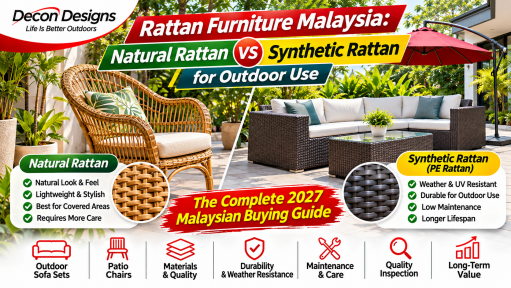
The Complete 2027 Malaysian Buying Guide to Natural Rattan, PE Synthetic Rattan, Wicker Furniture, Outdoor Sofa Sets, Patio Chairs, Materials, Durability, Weather Resistance, Maintenance, Quality Inspection and Long-Term Value in Malaysia’s Tropical Climate
By Decon Designs – Life Is Better Outdoors
Rattan Furniture Malaysia | Natural Rattan Furniture | Synthetic Rattan Furniture | PE Rattan | Outdoor Wicker Furniture | Garden Furniture Malaysia | Patio Furniture | Outdoor Sofa Sets | Tropical Climate Furniture | Furniture Buying Guide
Introduction: Natural Rattan or Synthetic Rattan — Which Should You Choose for Outdoor Furniture in Malaysia?
Rattan furniture has long been associated with comfortable living spaces, tropical design and natural-looking furniture.
From traditional woven chairs to contemporary outdoor sofa sets, rattan-style furniture remains a familiar choice for Malaysian homes, gardens, patios, balconies, hotels, resorts and restaurants.
However, there is an important distinction that many furniture buyers do not fully understand.
Natural rattan and synthetic rattan are not the same material.
Although they may look similar, their composition, weather resistance, maintenance requirements and suitability for outdoor use can be very different.
A beautiful natural rattan chair may be an excellent choice for a protected veranda or indoor lounge.
The same chair may deteriorate prematurely if left permanently exposed to heavy rain.
A well-manufactured synthetic rattan sofa may be designed for outdoor use, but that does not mean every synthetic rattan product has the same quality or lifespan.
The type of synthetic material, frame construction, weaving quality, ultraviolet protection and cushion specifications all matter.
Malaysia’s tropical climate makes these distinctions particularly important.
High humidity, strong sunlight, frequent rainfall and occasional prolonged wet conditions can affect furniture in different ways.
For homeowners, the wrong material choice can lead to disappointing performance and unnecessary replacement costs.
For restaurants, hotels and resorts, poor furniture selection may also increase maintenance expenses and disrupt operations.
At Decon Designs – Life Is Better Outdoors, with more than 20 years of experience in Malaysia’s outdoor and hospitality furniture market, we encourage customers to understand the materials behind the furniture before making purchasing decisions.
This comprehensive guide explains the differences between natural rattan and synthetic rattan, how to evaluate product quality, which materials suit covered and uncovered spaces, and what Malaysian buyers should check before purchasing.
1. What Is Rattan Furniture?
Rattan furniture refers to furniture made from natural rattan or, in common retail usage, furniture manufactured to resemble traditional rattan weaving.
Natural rattan is a plant-based material obtained from climbing palms.
It has traditionally been used to manufacture:
- Chairs.
- Sofas.
- Tables.
- Benches.
- Headboards.
- Storage furniture.
- Decorative accessories.
Synthetic rattan furniture, by contrast, uses manufactured weaving materials designed to imitate natural rattan.
Synthetic rattan is commonly used for:
- Outdoor sofa sets.
- Patio chairs.
- Garden dining sets.
- Poolside furniture.
- Lounge chairs.
- Commercial outdoor seating.
The word “rattan” alone does not tell buyers whether the furniture is natural or synthetic.
Always confirm the actual material.
2. Natural Rattan vs Synthetic Rattan: The Fundamental Difference
| Feature | Natural rattan | Synthetic rattan |
|---|---|---|
| Material origin | Plant-based | Manufactured polymer |
| Appearance | Natural texture and variation | Can imitate natural or contemporary finishes |
| Direct rainfall | Generally unsuitable for prolonged exposure | Depends on polymer and product design |
| Sun exposure | Can cause drying and colour changes | UV performance depends on formulation |
| Moisture sensitivity | Greater sensitivity to prolonged dampness | Weave may resist moisture, but frame and cushions still matter |
| Maintenance | Requires protection and appropriate cleaning | Usually easier to wipe clean |
| Typical use | Indoor and protected spaces | Often outdoor and semi-outdoor spaces |
| Repair | May be repairable by skilled craftspeople | Depends on weave material and replacement availability |
| Environmental considerations | Renewable biological material, subject to sourcing | Fossil-based or other polymers; recyclability varies |
| Quality variation | Significant | Significant |
Neither material is automatically superior in every application.
The correct choice depends on the installation environment and the buyer’s priorities.
3. What Is Natural Rattan?
Natural rattan comes from climbing palm species, many of which grow in tropical regions.
It has been used for furniture and handicrafts for generations.
Its properties include flexibility, a natural woven appearance and the ability to be shaped into different furniture forms.
Natural rattan furniture can create a warm and organic atmosphere.
It is particularly popular in:
- Living rooms.
- Covered verandas.
- Indoor lounges.
- Protected terraces.
- Boutique hospitality interiors.
- Decorative seating areas.
However, natural rattan is not generally the preferred material for furniture that will remain continuously exposed to rain.
4. Why Natural Rattan Is Popular in Malaysian Interior Design
Natural rattan furniture offers several aesthetic advantages.
Organic Appearance
Its natural texture can complement tropical and contemporary interiors.
Traditional Craftsmanship
Woven rattan furniture can reflect established furniture-making techniques.
Lightweight Construction
Many natural rattan furniture designs are relatively easy to move.
Design Flexibility
Natural rattan can be used in classic, rustic, coastal and contemporary interiors.
Warm Visual Character
Its natural colours and woven patterns can soften modern spaces.
These qualities make natural rattan attractive for protected environments.
5. Why Natural Rattan Is Vulnerable to Outdoor Weather
Natural rattan is an organic material.
Its properties can change when exposed to environmental conditions.
Prolonged Moisture
Repeated wetting and insufficient drying can contribute to deterioration.
High Humidity
Persistent dampness may encourage mould growth when conditions are favourable.
Strong Sunlight
Prolonged exposure may contribute to drying, fading or changes in the material.
Temperature and Moisture Changes
Environmental changes may affect the material’s dimensions and condition.
Inadequate Maintenance
Accumulated dirt and moisture can accelerate problems.
For these reasons, natural rattan is generally better suited to indoor or well-protected semi-outdoor locations.
6. Can Natural Rattan Furniture Be Used Outdoors in Malaysia?
Yes, but only under suitable conditions and with appropriate care.
Natural rattan may be used in protected spaces such as:
- Covered verandas.
- Sheltered patios.
- Indoor-outdoor lounges protected from rain.
- Covered balconies.
- Roofed terraces with limited moisture exposure.
However, buyers should understand that a roof alone does not eliminate humidity or wind-driven rain.
Natural rattan should not automatically be treated as weatherproof.
For fully exposed gardens, uncovered patios and poolside locations, purpose-designed outdoor furniture is generally more appropriate.
7. What Is Synthetic Rattan?
Synthetic rattan is a manufactured weaving material designed to imitate the appearance of natural rattan.
It is also commonly described as:
- Artificial rattan.
- PE rattan.
- Resin wicker.
- Synthetic wicker.
- Outdoor wicker.
However, these terms are not always technically interchangeable.
Synthetic weaving can be made from different polymer materials.
The composition matters because different materials and formulations can behave differently under sunlight, heat and moisture.
8. PE Rattan: What Malaysian Buyers Should Know
PE stands for polyethylene.
PE-based synthetic rattan is commonly used in outdoor furniture.
It can be manufactured in different shapes, colours and textures.
Potential advantages include:
- Resistance to ordinary moisture absorption.
- Ease of cleaning.
- Design flexibility.
- Compatibility with outdoor furniture frames.
- Availability in different weave profiles.
However, not all PE rattan is equal.
Product performance depends on:
- Polymer formulation.
- UV stabilisers.
- Manufacturing quality.
- Weave thickness and geometry.
- Frame construction.
- Installation environment.
- Maintenance.
A product labelled “PE rattan” should not automatically be assumed to have a particular service life.
9. PE Rattan vs PVC Wicker
Polyethylene and polyvinyl chloride are different polymers.
Both may be used in manufactured weaving materials, but their performance depends on formulation and construction.
| Consideration | PE-based wicker | PVC-based wicker |
|---|---|---|
| Polymer | Polyethylene | Polyvinyl chloride |
| Flexibility | Formulation-dependent | Formulation-dependent |
| UV resistance | Depends on stabilisation | Depends on stabilisation |
| Heat performance | Depends on grade and design | Depends on grade and design |
| Outdoor suitability | Product-specific | Product-specific |
| Maintenance | Generally straightforward | Generally straightforward |
| Quality variation | Significant | Significant |
It is not technically accurate to assume that every PE product is superior to every PVC product.
Buyers should request manufacturer specifications and suitability information.
10. Why Some Synthetic Rattan Furniture Cracks Outdoors
Synthetic rattan can deteriorate under prolonged environmental exposure.
Potential contributing factors include:
- UV degradation.
- Inadequate stabilisation.
- Heat exposure.
- Material formulation.
- Mechanical stress.
- Excessive tension.
- Ageing.
- Poor weaving construction.
Signs of deterioration may include:
- Brittleness.
- Cracking.
- Splitting.
- Discolouration.
- Broken strands.
- Loss of flexibility.
A furniture product may look attractive when new but develop problems if its materials are unsuitable for the intended environment.
11. The Importance of UV Protection in Synthetic Rattan
Ultraviolet radiation can contribute to polymer degradation.
Manufacturers may use UV stabilisers or other additives to improve resistance.
However, the phrase “UV protected” does not provide enough information by itself to predict a product’s lifespan.
Buyers should ask:
- Is the weaving intended for outdoor use?
- Does the supplier provide material specifications?
- Is there documented testing or manufacturer information?
- What are the recommended exposure conditions?
- What warranty terms apply?
Claims of specific UV resistance should be supported by relevant product information.
12. Synthetic Rattan Is Not the Entire Furniture Structure
One of the most important buying considerations is the frame beneath the weaving.
A synthetic rattan sofa may have attractive weaving but an unsuitable internal frame.
The complete furniture structure matters.
Common frame materials include:
- Aluminium.
- Steel.
- Other metal constructions.
- Selected engineered or composite components.
The frame influences stability, weight, corrosion resistance and overall furniture performance.
13. Aluminium Frames for Synthetic Rattan Furniture
Aluminium is commonly used in outdoor wicker furniture.
Potential advantages include:
- Relatively low weight.
- Resistance to ordinary red rust.
- Ease of handling.
- Compatibility with different furniture designs.
However, aluminium frames vary in construction.
Buyers should inspect:
- Welds.
- Tube dimensions.
- Joint quality.
- Frame rigidity.
- Surface finish.
- Fasteners.
An aluminium frame does not automatically guarantee high-quality furniture.
14. Steel Frames for Synthetic Rattan Furniture
Steel frames may also be used.
Steel can provide structural strength, but ordinary steel is susceptible to corrosion when exposed to moisture without adequate protection.
Buyers should check:
- Coating quality.
- Welded areas.
- Exposed metal.
- Fasteners.
- Drainage details.
- Signs of rust.
For fully exposed outdoor locations, corrosion protection deserves particular attention.
15. How to Inspect Synthetic Rattan Weaving Quality
Before purchasing, inspect the weaving carefully.
Check 1: Weave Consistency
Look for reasonably consistent spacing and tension.
Check 2: Loose Strands
Inspect for unsecured or protruding ends.
Check 3: Sharp Edges
Check whether weaving ends could cause discomfort or snag clothing.
Check 4: Frame Coverage
Examine how the weaving is attached to the frame.
Check 5: Seat Support
Confirm that the seating structure feels stable.
Check 6: Flexibility
Look for brittle or visibly cracked strands.
Check 7: Colour Consistency
Inspect for unusual fading or discolouration.
Check 8: Corners and Curves
Check weaving quality around difficult shapes.
Check 9: Underside Construction
Inspect visible support components.
Check 10: Overall Stability
Sit on the furniture where appropriate and assess its stability.
These visual checks are useful but do not replace formal structural testing.
16. Why Weaving Tension Matters
Synthetic wicker is often woven under tension.
If the weaving is too loose, the furniture may appear uneven or develop movement.
If it is excessively tight, it may place unnecessary stress on the material or attachment points.
Appropriate tension depends on the product design.
Customers should look for consistent construction and avoid products showing obvious defects.
17. Natural Rattan vs Synthetic Rattan: Comfort Comparison
Comfort depends on more than the weaving material.
Important factors include:
- Seat height.
- Seat depth.
- Backrest angle.
- Armrest position.
- Cushion thickness.
- Seat support.
- Overall dimensions.
A well-designed natural rattan chair may be comfortable for indoor use.
A synthetic rattan sofa may provide suitable outdoor seating.
Neither material guarantees comfort.
Where possible, test the furniture before purchasing.
18. Outdoor Rattan Sofa Sets in Malaysia
Synthetic rattan sofa sets are widely associated with outdoor living spaces.
Common configurations include:
- Two-seater sofas.
- Three-seater sofas.
- Armchairs.
- L-shaped sofas.
- Modular arrangements.
- Sofa-and-coffee-table sets.
Before buying, consider the available space and how the furniture will be used.
A large sofa may look attractive in a showroom but overcrowd a small patio.
19. Choosing a Rattan Sofa for a Covered Patio
Covered patios generally provide greater protection from direct rainfall.
This may allow more flexibility in furniture and cushion selection.
However, customers should still consider:
- Humidity.
- Wind-driven rain.
- Sunlight direction.
- Airflow.
- Cushion storage.
- Cleaning.
Natural rattan may be considered for sufficiently protected locations.
Outdoor-grade synthetic rattan may also be suitable.
The correct choice depends on the actual exposure.
20. Choosing a Rattan Sofa for an Uncovered Patio
An uncovered patio may expose furniture to:
- Direct sunlight.
- Heavy rainfall.
- Standing moisture.
- Temperature changes.
- Wind.
For these conditions, buyers should prioritize products specifically intended for outdoor exposure.
Suitable synthetic rattan furniture may be considered, but the frame and cushions must also be evaluated.
Natural rattan is generally not recommended for continuous direct rain exposure.
21. Rattan Furniture for Condominium Balconies
Condominium balconies often have limited space.
They may also experience significant wind exposure.
Before buying:
- Measure the balcony.
- Check door clearance.
- Review building management rules.
- Consider furniture stability.
- Avoid obstructing drainage.
- Evaluate cushion storage.
Compact synthetic rattan chairs or small patio sets may be practical where suitable.
However, furniture should not be selected solely because it is lightweight.
Stability and wind-related risks matter.
22. Rattan Furniture for Malaysian Gardens
Garden furniture may be placed under trees, pergolas or open skies.
The level of exposure can vary considerably.
For uncovered gardens, purpose-designed outdoor synthetic rattan furniture may be more appropriate than natural rattan.
However, buyers should confirm:
- Weave material.
- Frame construction.
- Weather suitability.
- Cushion requirements.
- Maintenance instructions.
A garden location with poor drainage may create additional maintenance challenges.
23. Rattan Furniture for Restaurants and Cafés
Restaurants and cafés may use rattan-style furniture to create a welcoming atmosphere.
Potential applications include:
- Outdoor dining chairs.
- Lounge seating.
- Waiting areas.
- Covered terraces.
- Café patios.
Commercial buyers should evaluate:
- Structural suitability.
- Frequency of use.
- Cleaning.
- Stackability, where applicable.
- Replacement availability.
- Maintenance.
- Product dimensions.
Furniture intended for occasional residential use should not automatically be assumed suitable for high-traffic commercial applications.
24. Rattan Furniture for Hotels and Resorts
Hotels and resorts may use synthetic rattan furniture in:
- Guest terraces.
- Poolside lounges.
- Outdoor restaurants.
- Garden seating areas.
- Private villas.
- Covered relaxation spaces.
Commercial procurement teams should request detailed specifications.
Important considerations include:
- Frame materials.
- Weave composition.
- Cushion fabrics.
- Cleaning requirements.
- Replacement components.
- Product testing information.
- Warranty terms.
Large hospitality projects should evaluate lifecycle costs rather than relying only on initial prices.
25. Rattan Furniture Near Swimming Pools
Poolside furniture may experience moisture, sunlight and exposure to pool-related chemicals.
Synthetic rattan furniture may be suitable where designed for such environments.
However, buyers should inspect:
- Frame corrosion resistance.
- Fasteners.
- Weave material.
- Cushion construction.
- Cleaning requirements.
- Drainage.
Natural rattan is generally not the preferred material for continuously exposed poolside environments.
26. Rattan Furniture in Coastal Areas
Coastal properties may experience salt-laden air.
This can increase corrosion risks for susceptible metal components.
For synthetic rattan furniture, the underlying frame and fasteners are particularly important.
Buyers should confirm whether the furniture is appropriate for coastal use.
More frequent cleaning and inspection may be necessary.
27. Outdoor Rattan Cushions: A Separate Buying Decision
A synthetic rattan frame may be designed for outdoor use, but its cushions may require additional protection.
Outdoor cushions can include:
- Fabric covers.
- Foam inserts.
- Linings.
- Zippers.
- Stitching.
The complete cushion construction determines how it responds to moisture.
Buyers should not assume that all outdoor cushions are waterproof.
28. Water-Resistant vs Waterproof Rattan Sofa Cushions
Water-resistant fabrics may repel limited moisture.
Waterproof fabrics are designed to prevent water penetration under specified conditions.
However, seams, zippers and cushion construction can affect the performance of the complete cushion.
A waterproof fabric does not automatically make the entire cushion waterproof.
For uncovered patios, removable cushions and suitable storage arrangements are often practical.
29. Why Outdoor Rattan Sofa Cushions Develop Odours
Cushions may develop unpleasant odours when moisture remains trapped.
Potential causes include:
- Repeated rainfall.
- Inadequate drying.
- Poor ventilation.
- Damp storage.
- Accumulated dirt.
To reduce these problems:
- Remove cushions before heavy rain where practical.
- Dry wet cushions thoroughly.
- Follow fabric cleaning instructions.
- Avoid sealing damp cushions inside covers.
- Maintain airflow around stored cushions.
30. How to Clean Natural Rattan Furniture
Natural rattan requires careful cleaning.
General considerations include:
- Remove dust regularly.
- Use suitable soft cleaning tools.
- Avoid prolonged soaking.
- Follow manufacturer instructions.
- Allow appropriate drying.
- Avoid harsh chemicals unless specifically approved.
Natural rattan furniture should not be cleaned as though it were waterproof plastic furniture.
31. How to Clean Synthetic Rattan Furniture
Synthetic rattan is often relatively straightforward to clean.
However, cleaning methods depend on the product.
A general approach may include:
- Remove loose dirt.
- Use suitable mild cleaning products.
- Clean between weaving strands.
- Rinse only where permitted.
- Allow the furniture to dry.
- Inspect the frame and fasteners.
Avoid high-pressure washing unless the manufacturer specifically permits it.
Excessive pressure may damage weaving or force water into vulnerable components.
32. How Often Should Rattan Furniture Be Maintained?
Maintenance frequency depends on:
- Weather exposure.
- Usage.
- Location.
- Product materials.
- Manufacturer recommendations.
Furniture in fully exposed gardens may require more frequent inspection than furniture in protected indoor areas.
Commercial furniture may require additional cleaning because of frequent use.
A regular inspection routine can help identify problems before they become severe.
33. Common Natural Rattan Furniture Problems
Potential issues include:
Loose Weaving
Strands may become displaced.
Moisture Damage
Prolonged dampness may affect the material.
Mould
Poor ventilation and persistent moisture can contribute to mould growth.
Surface Changes
Colour and finish may change with age and exposure.
Structural Wear
Joints and support components may require attention.
Some problems may be repairable by experienced furniture craftspeople.
34. Common Synthetic Rattan Furniture Problems
Potential issues include:
Broken Strands
The weaving may crack or split.
Fading
Colours may change after prolonged sunlight exposure.
Loose Weaving
Tension may deteriorate.
Frame Corrosion
Metal components may corrode if inadequately protected.
Cushion Deterioration
Foam and fabric may wear or retain moisture.
Damaged Fasteners
Connections may loosen or corrode.
Buyers should evaluate whether repairs are practical before replacing the entire set.
35. Can Natural Rattan Furniture Be Repaired?
Some natural rattan furniture can be repaired.
Potential repairs may include:
- Reweaving.
- Replacing damaged strands.
- Tightening joints.
- Refinishing.
- Structural repairs.
Repair feasibility depends on the design, material condition and availability of skilled craftspeople.
Not every damaged product can be restored economically.
36. Can Synthetic Rattan Furniture Be Repaired?
Some synthetic rattan furniture may be repairable.
Possible repairs include:
- Replacing damaged weaving.
- Repairing frame components.
- Replacing cushions.
- Tightening fasteners.
However, matching the original weave material and colour may be difficult.
Older products may no longer have compatible replacement materials.
Customers should ask suppliers about repair options and replacement availability.
37. Natural Rattan vs Synthetic Rattan: Which Lasts Longer?
There is no universal lifespan that applies to all natural or synthetic rattan furniture.
Durability depends on:
- Material quality.
- Construction.
- Weather exposure.
- Maintenance.
- Usage.
- Storage.
- Repairability.
Natural rattan furniture can remain useful for many years in suitable protected environments.
Well-manufactured synthetic rattan furniture may provide good service in appropriate outdoor conditions.
Poor-quality products of either type may deteriorate prematurely.
The correct comparison is not simply natural versus synthetic. It is the complete furniture product in its intended environment.
38. Is Natural Rattan More Environmentally Friendly?
Natural rattan is a renewable biological material.
However, environmental performance depends on factors such as:
- Sourcing.
- Harvesting practices.
- Processing.
- Transportation.
- Finishing.
- Product lifespan.
Synthetic rattan is commonly made from manufactured polymers.
Its environmental impacts depend on material composition, production methods, durability and end-of-life management.
A simple natural-versus-synthetic label does not provide a complete environmental assessment.
Long service life, repairability and responsible sourcing are important considerations.
39. Rattan Furniture Price Malaysia: What Determines the Cost?
Rattan furniture prices vary significantly.
Factors include:
- Natural or synthetic material.
- Weave quality.
- Frame material.
- Furniture dimensions.
- Cushion specifications.
- Design complexity.
- Manufacturing methods.
- Brand.
- Warranty.
- Delivery.
- Inventory status.
A low-priced synthetic rattan sofa may differ considerably from a higher-priced commercial product.
Likewise, natural rattan furniture may vary in price depending on craftsmanship and construction.
Buyers should compare specifications before comparing prices.
40. Illustrative Rattan Furniture Budget Planning
The following figures are hypothetical planning examples, not verified Malaysian market quotations.
| Furniture requirement | Illustrative budget |
|---|---|
| Small rattan-style accent chair | RM250–RM900 |
| Compact two-seater patio arrangement | RM700–RM2,000 |
| Four-seater synthetic rattan dining set | RM1,200–RM3,500 |
| Outdoor rattan sofa set | RM2,000–RM6,000 |
| Larger lounge arrangement | RM4,000–RM10,000+ |
Actual prices may be substantially different.
Customers should obtain current quotations based on specific products.
41. How to Compare Two Synthetic Rattan Sofa Sets
Suppose two sofa sets look almost identical.
One is advertised at a lower price.
Before deciding, compare:
| Specification | Sofa A | Sofa B |
|---|---|---|
| Weave polymer | Confirm | Confirm |
| Frame material | Confirm | Confirm |
| Frame construction | Confirm | Confirm |
| Cushion fabric | Confirm | Confirm |
| Foam specification | Confirm | Confirm |
| Dimensions | Confirm | Confirm |
| Outdoor suitability | Confirm | Confirm |
| Warranty | Confirm | Confirm |
| Delivery | Confirm | Confirm |
| Replacement parts | Confirm | Confirm |
The comparison may reveal important differences that are not visible in product photographs.
42. Natural Rattan vs Synthetic Rattan: Which Is Better for Different Spaces?
| Application | Generally more appropriate starting point |
|---|---|
| Indoor living room | Natural or synthetic rattan |
| Protected veranda | Natural or suitable synthetic rattan |
| Fully covered patio | Depends on moisture exposure |
| Partially covered terrace | Outdoor-grade synthetic rattan often worth considering |
| Uncovered garden | Purpose-designed outdoor synthetic rattan |
| Poolside lounge | Suitable outdoor synthetic rattan with appropriate frame |
| Coastal patio | Product specifically suited to coastal exposure |
| Restaurant terrace | Commercially suitable synthetic rattan |
| Boutique indoor hotel lounge | Natural or synthetic rattan |
| High-rise balcony | Suitable, stable outdoor furniture after site assessment |
These are general starting points.
The specific product and environment should determine the final choice.
43. Ten Questions to Ask a Rattan Furniture Supplier
Before purchasing, ask:
- Is the furniture made from natural or synthetic rattan?
- If synthetic, what polymer is used?
- What is the frame material?
- Is the furniture intended for direct outdoor exposure?
- What UV-resistance information is available?
- What cushion fabric and foam are included?
- What maintenance is required?
- What warranty applies?
- Can damaged weaving or cushions be replaced?
- Is the product available from stock?
A supplier should be able to provide clear information about the furniture being sold.
44. Buying Rattan Furniture Online in Malaysia
Online shopping makes it easier to compare designs.
However, product photographs may not reveal:
- Weave thickness.
- Frame construction.
- Cushion quality.
- Actual colours.
- Product stability.
- Manufacturing details.
Customers should request specifications and confirm seller credibility.
For expensive furniture, physical inspection may be useful where practical.
45. Buying Rattan Furniture From a Showroom or Warehouse
A showroom or warehouse viewing area may allow buyers to inspect the furniture directly.
Check:
- Seating comfort.
- Weave consistency.
- Frame stability.
- Cushion thickness.
- Product dimensions.
- Visible finishing.
For clearance products, confirm whether the item is regular stock, a display unit or another specifically identified clearance item.
46. Decon Designs Year-End Stock Clearance Sale 2026
Decon Designs is conducting a Year-End Stock Clearance Sale from 1 November to 31 December 2026 as part of its business downsizing.
Selected existing furniture inventory is being offered at promotional prices.
Depending on availability, promotional categories may include:
- Synthetic rattan patio sets.
- Outdoor sofa sets.
- Garden furniture.
- Dining sets.
- Lounge furniture.
- Chairs.
- Coffee tables.
- Accessories.
The promotion is subject to limited stock and first-come, first-served availability.
Visit the Official Decon Designs Promotion Page:
https://decondesigns.com/product-category/promotion/
Customers should confirm current prices, specifications, stock and delivery arrangements before purchasing.
47. The Ultimate Rattan Furniture Buying Checklist
Before buying natural or synthetic rattan furniture, confirm:
-
I know whether the material is natural or synthetic.
-
I understand the furniture’s intended use.
-
The product is suitable for my location.
-
The weave material has been identified.
-
The frame material is known.
-
The frame construction has been checked.
-
The weaving appears consistent.
-
There are no obvious broken strands.
-
The furniture feels stable.
-
The dimensions fit my space.
-
Cushion specifications are understood.
-
Weather exposure has been considered.
-
Maintenance requirements are acceptable.
-
Warranty terms have been reviewed.
-
Replacement options have been considered.
-
Delivery arrangements are confirmed.
-
The total price fits my budget.
48. Frequently Asked Questions
1. What is the difference between natural rattan and synthetic rattan?
Natural rattan is plant-based, while synthetic rattan is manufactured from polymer materials designed to imitate woven rattan.
2. Is natural rattan suitable for outdoor use in Malaysia?
Natural rattan is generally better suited to indoor and well-protected semi-outdoor environments. Prolonged direct rain exposure is usually unsuitable.
3. Is synthetic rattan waterproof?
The synthetic weaving material may resist moisture, but the complete furniture product—including frame and cushions—should not automatically be considered waterproof.
4. Is PE rattan better than PVC wicker?
Performance depends on the formulation, stabilisation, construction and intended use. The polymer name alone is insufficient to determine quality.
5. Why does synthetic rattan crack?
Potential causes include UV degradation, ageing, mechanical stress, poor material formulation and unsuitable exposure.
6. Does synthetic rattan fade in sunlight?
Some products may fade or deteriorate under prolonged UV exposure. Resistance depends on the material and manufacturing quality.
7. What frame is best for synthetic rattan furniture?
Aluminium is commonly used for outdoor furniture because of its relatively low weight and resistance to ordinary red rust, but construction quality remains important.
8. Can synthetic rattan furniture stay outside during rain?
Some products are designed for outdoor exposure, but suitability depends on the complete product specifications. Cushions may require protection.
9. Is natural rattan more expensive than synthetic rattan?
Prices vary according to materials, craftsmanship, construction, design and supplier.
10. Can synthetic rattan furniture be repaired?
Some products can be repaired, but replacement weaving material and matching colours may not always be available.
11. How do I clean synthetic rattan furniture?
Use cleaning methods appropriate to the product, generally involving removal of debris and suitable mild cleaning products.
12. Is rattan furniture suitable for restaurants?
Some synthetic rattan furniture is designed for commercial use. Buyers should confirm specifications and intended-use suitability.
13. Is rattan furniture suitable for poolside areas?
Purpose-designed synthetic rattan furniture may be suitable, subject to frame, fastener and cushion specifications.
14. How long does rattan furniture last?
Lifespan varies according to materials, construction, exposure, maintenance and usage. No single duration applies to all products.
15. Where can I buy rattan furniture in Malaysia?
Buyers can explore furniture showrooms, specialist outdoor furniture suppliers, online retailers and clearance promotions, including available products from Decon Designs.
Conclusion: Choose Rattan Furniture Based on Material, Environment and Long-Term Value
Natural rattan and synthetic rattan may share a similar woven appearance, but they serve different purposes.
Natural rattan offers organic character and traditional craftsmanship.
It is generally best suited to indoor or well-protected environments.
Synthetic rattan can provide a practical alternative for outdoor furniture, particularly when manufactured from suitable materials and combined with an appropriate frame.
However, synthetic does not automatically mean durable, waterproof or maintenance-free.
For Malaysian buyers, the most important considerations are the complete furniture construction and the environment in which it will be used.
Before purchasing, understand the weave material, inspect the frame, review cushion specifications and confirm the product’s intended exposure conditions.
For homeowners, this can help prevent unnecessary replacements.
For restaurants, hotels and resorts, it can support better procurement decisions and maintenance planning.
The best rattan furniture is not simply the one that looks most attractive. It is the furniture whose materials, construction and maintenance requirements match the way and place it will be used.
Decon Designs – Life Is Better Outdoors.
Explore current furniture promotions at: