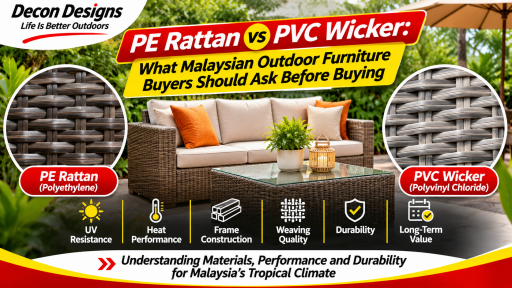
Understanding Polyethylene Rattan, PVC Wicker, UV Resistance, Heat Performance, Frame Construction, Weaving Quality, Durability and Long-Term Value in Malaysia’s Tropical Climate
By Decon Designs – Life Is Better Outdoors
Outdoor Furniture Malaysia | PE Rattan Furniture | PVC Wicker Furniture | Synthetic Rattan Malaysia | Wicker Furniture Buying Guide | Outdoor Furniture Materials | Garden Furniture Malaysia | Rattan Sofa Sets | Patio Furniture | Tropical Climate Furniture | Furniture Quality and Durability
Introduction: Two Outdoor Furniture Sets May Look the Same — But Are They Made From the Same Material?
Imagine walking into two outdoor furniture showrooms in Malaysia.
Both display attractive woven garden sofa sets.
Both have similar colours.
Both feature comfortable-looking cushions.
Both are described as synthetic rattan furniture.
Yet one costs RM1,200 while another costs RM3,500.
Why such a difference?
Is one made from better material?
Will one survive Malaysia’s hot and humid climate longer?
Does the cheaper product use PVC wicker while the more expensive product uses polyethylene rattan?
And, most importantly, how can buyers tell the difference?
These are important questions because the appearance of woven outdoor furniture does not necessarily reveal the quality or composition of its materials.
Synthetic wicker furniture can be manufactured using different polymers, including polyethylene (PE) and polyvinyl chloride (PVC).
Both materials can be formed into flexible strands and woven around furniture frames.
However, the performance of the finished product depends on much more than the polymer name.
Material formulation, UV stabilisation, strand dimensions, manufacturing quality, frame construction, exposure conditions and maintenance can all influence durability.
For Malaysian buyers, these differences matter.
Outdoor furniture may be exposed to strong sunlight, high humidity, heavy rainfall and repeated heating and cooling.
A product that looks attractive when new may behave differently after prolonged exposure.
This guide by Decon Designs – Life Is Better Outdoors explains the differences between PE rattan and PVC wicker, highlights common misconceptions and provides practical questions buyers should ask before purchasing synthetic wicker furniture in Malaysia.
The objective is not simply to decide which material sounds better. It is to understand what makes a woven outdoor furniture product suitable for its intended environment.
1. What Is Synthetic Rattan Furniture?
Synthetic rattan furniture is made using manufactured strands woven around a supporting frame.
The woven strands are designed to create a rattan-like or wicker appearance.
Unlike natural rattan, which is derived from climbing palms, synthetic rattan uses polymer-based materials.
The terms synthetic rattan, artificial rattan, PE rattan, plastic wicker and resin wicker are often used in furniture marketing.
However, they do not always describe the same material.
Some products use polyethylene.
Others use PVC or different polymer formulations.
The term wicker describes a weaving technique rather than a particular raw material.
This distinction is important.
Wicker is how the furniture is woven. PE and PVC describe materials that may be used to make the strands.
A chair can therefore be described as wicker furniture without identifying whether the woven material is polyethylene, PVC, natural rattan or something else.
Buyers should ask for the actual material specification.
2. What Is PE Rattan?
PE stands for polyethylene, a widely used thermoplastic polymer.
In outdoor furniture, polyethylene can be processed into strands that are woven around metal or other supporting frames.
PE rattan is commonly marketed as synthetic rattan or resin wicker.
Depending on the product, the strands may have round, half-round or flat profiles.
Their appearance can vary in colour, texture and thickness.
Common characteristics of PE rattan
- It can be manufactured in different strand shapes.
- It does not absorb water like natural plant fibres.
- It can be formulated for outdoor applications.
- It is available in different colours and textures.
- It can be woven into different furniture designs.
- Its flexibility and mechanical performance depend on formulation and processing.
However, not all PE rattan is UV-stabilised or suitable for prolonged outdoor exposure.
Polyethylene can degrade under sunlight if it lacks appropriate protection.
The presence and effectiveness of UV stabilisers therefore matter.
A product labelled PE rattan should not automatically be assumed to have excellent outdoor durability.
3. What Is PVC Wicker?
PVC stands for polyvinyl chloride, another widely used thermoplastic polymer.
PVC can be manufactured in rigid or flexible forms.
Flexible PVC formulations can be processed into strands for woven furniture.
PVC wicker may be available in different colours, textures and profiles.
Its properties depend significantly on the formulation, including the additives used to achieve flexibility, colour stability and weathering performance.
Common characteristics of PVC wicker
- It can be manufactured into flexible weaving strands.
- It can provide different colours and textures.
- Its flexibility depends on formulation.
- It can be used in woven furniture designs.
- Its weathering performance depends on additives and manufacturing quality.
- Its suitability for outdoor exposure must be assessed at the product level.
Some PVC formulations may become harder, discoloured or brittle after prolonged weathering.
However, this does not mean every PVC wicker product will fail quickly.
Properly formulated PVC materials can be engineered for outdoor applications.
The polymer name alone does not establish the quality of the finished furniture.
4. PE Rattan vs PVC Wicker: The Main Differences
The following comparison explains the general characteristics of the two materials.
Actual product performance depends on the specific formulation and manufacturing process.
| Comparison factor | PE rattan | PVC wicker |
|---|---|---|
| Base polymer | Polyethylene | Polyvinyl chloride |
| Common furniture application | Synthetic woven furniture | Synthetic woven furniture |
| Flexibility | Depends on PE grade and strand design | Depends on PVC formulation and plasticisers |
| Water absorption | Low | Low |
| UV performance | Requires suitable stabilisation for prolonged exposure | Requires suitable weathering formulation |
| Heat performance | Depends on polymer grade and product design | Depends on formulation and product design |
| Colour retention | Depends on pigments and UV protection | Depends on pigments and stabilisers |
| Long-term brittleness | Possible with ageing and degradation | Possible with ageing and degradation |
| Maintenance | Generally cleaned according to product instructions | Generally cleaned according to product instructions |
| Overall outdoor suitability | Must be verified for the specific product | Must be verified for the specific product |
The most important conclusion is that a well-engineered product made with one material may perform better than a poorly manufactured product made with the other.
It is therefore misleading to treat all PE products as premium and all PVC products as inferior.
5. Why Malaysian Weather Makes Material Selection Important
Malaysia’s tropical environment presents several challenges for outdoor furniture.
These include high humidity, frequent rainfall, strong sunlight and elevated surface temperatures.
Furniture exposed to these conditions may experience material ageing, colour changes and deterioration over time.
Strong sunlight
Ultraviolet radiation can contribute to polymer degradation.
Without appropriate stabilisation, synthetic strands may lose mechanical properties or become brittle.
High temperatures
Furniture exposed to direct sunlight can become considerably hotter than the surrounding air.
Temperature can influence flexibility, dimensional stability and long-term material behaviour.
Heavy rainfall
Although PE and PVC are both relatively water-resistant materials, rain can affect the complete furniture assembly.
Water may collect in joints, under cushions or inside inadequately protected frame sections.
Humidity
Humidity may affect metal components, fasteners and other materials used in the furniture.
The woven strands are only one part of the product.
For Malaysian outdoor furniture buyers, it is essential to evaluate the complete furniture construction rather than focusing only on the synthetic weave.
6. Is PE Rattan Better Than PVC Wicker for Outdoor Use?
There is no universally correct answer without knowing the exact product specifications.
PE rattan is widely used in outdoor furniture, and suitably formulated polyethylene strands can perform well in outdoor applications.
PVC wicker can also be manufactured for outdoor use.
However, the quality of additives, strand design, processing and overall furniture construction can make substantial differences.
A buyer comparing two products should ask:
- What is the actual polymer?
- Is the strand formulated for outdoor exposure?
- What evidence supports the manufacturer’s durability claims?
- What is the frame material?
- What warranty applies?
- How should the furniture be maintained?
If the supplier cannot identify the material or explain its intended use, buyers should be cautious about unsupported performance claims.
7. UV Resistance: One of the Most Important Questions
Sunlight exposure is a major consideration for synthetic wicker furniture.
Ultraviolet radiation can gradually affect polymers.
Depending on the material and formulation, degradation may contribute to colour changes, cracking or loss of flexibility.
Manufacturers may use UV stabilisers, pigments and other additives to improve weathering performance.
However, the phrase UV resistant can be vague.
Buyers should ask what the claim means.
Questions to ask about UV resistance
- Is the material specifically formulated for outdoor use?
- Does the supplier have weathering test information?
- Which test method was used?
- What exposure conditions were tested?
- What changes were measured?
- Does the warranty cover UV-related deterioration?
- Are there recommended limits on continuous sun exposure?
A claim such as UV protected should ideally be supported by product-specific information.
8. Does PE Rattan Melt in the Sun?
This is a common concern.
Polyethylene is a thermoplastic material, meaning it softens as temperature increases and melts within a temperature range that depends on its grade and structure.
However, normal outdoor use should not be confused with laboratory melting temperatures.
In practice, the relevant questions concern how the finished strand performs under prolonged heat and sunlight.
Potential issues may include deformation, changes in flexibility or ageing.
These depend on formulation, product design and exposure conditions.
It would be inaccurate to claim that all PE rattan melts under Malaysian sunlight.
It would also be inaccurate to assume that every PE rattan product is unaffected by heat.
Buyers should request suitable product specifications and follow the manufacturer’s intended-use guidance.
9. Can PVC Wicker Become Brittle?
Some flexible PVC products can change properties over time due to ageing, weathering or changes involving formulation components.
Possible effects may include increased stiffness, discolouration or cracking.
However, the extent of these changes depends on the specific PVC formulation and environmental conditions.
Well-formulated PVC products may be designed to resist outdoor weathering.
A blanket statement that PVC wicker always becomes brittle quickly would therefore be misleading.
The more useful question is whether the supplier can demonstrate that the particular product is appropriate for the intended outdoor environment.
10. Why Strand Thickness and Shape Matter
Synthetic wicker is manufactured in different strand profiles.
Common examples include:
- Flat strands.
- Half-round strands.
- Round strands.
- Textured strands.
- Multi-colour strands.
Strand dimensions and geometry can influence flexibility, appearance, weaving behaviour and material usage.
However, thicker strands are not automatically superior.
A thicker strand made from an unsuitable formulation may perform worse than a thinner strand engineered for the application.
The quality of the material and weave construction should be considered together.
11. Weaving Quality: What Buyers Should Inspect
The quality of woven furniture depends on workmanship as well as raw materials.
A good weave should be appropriate for the furniture’s structure and intended use.
Buyers should inspect:
Weave consistency
Are the strands arranged evenly?
Tension
Does the weave appear properly secured without excessive looseness?
Strand ends
Are the ends finished and secured appropriately?
Corners and edges
Are there loose or protruding strands?
Seat support
Does the seat have adequate structural support?
Overall stability
Does the furniture sit evenly and feel stable?
A visually attractive weave should not be treated as proof of structural quality.
12. The Hidden Frame: Why It May Matter More Than the Wicker
A woven chair or sofa usually depends on an internal supporting frame.
This frame carries much of the structural load.
The woven material contributes to the furniture’s surface, appearance and, depending on the design, seating support.
But a high-quality weave cannot compensate for a poorly constructed frame.
Aluminium frames
Aluminium is commonly used in outdoor furniture because it is relatively lightweight and resistant to rusting in the way iron and steel do.
However, alloy selection, wall thickness, weld quality and construction details still matter.
Steel frames
Steel can provide structural strength but requires appropriate corrosion protection.
Powder-coated steel should be inspected for coating damage and suitable finishing.
Fasteners and fittings
Bolts, screws, connectors and other fittings also influence product performance.
When buying synthetic rattan furniture, ask what is underneath the weave.
13. PE Rattan on Aluminium Frames vs PVC Wicker on Steel Frames
A comparison between two furniture sets may involve more than one material difference.
For example:
Furniture Set A
- PE rattan weave.
- Aluminium frame.
- Outdoor cushions.
- Powder-coated finish.
Furniture Set B
- PVC wicker weave.
- Steel frame.
- Outdoor cushions.
- Protective coating.
If Set A costs more, the price difference may reflect the frame material, weave formulation, cushions, construction or other specifications.
It would be incorrect to attribute the entire price difference to PE versus PVC.
Buyers should compare the complete product.
14. Why Some Synthetic Rattan Furniture Costs More
Synthetic rattan furniture prices may be influenced by:
- Polymer formulation.
- UV stabilisation.
- Strand dimensions.
- Colour and texture.
- Weaving complexity.
- Labour requirements.
- Frame material.
- Frame construction.
- Cushion specifications.
- Furniture size.
- Manufacturing quality.
- Shipping and distribution.
- Warranty and after-sales support.
A premium-looking product is not necessarily premium quality.
Likewise, a lower-priced product is not necessarily unsuitable.
The important issue is whether the selling price is supported by appropriate specifications and performance.
15. Is PE Rattan More Environmentally Friendly Than PVC?
Environmental comparisons require careful analysis.
Polyethylene and PVC have different chemical compositions, production processes and end-of-life considerations.
PVC contains chlorine in its polymer structure, and flexible PVC products may use plasticisers and other additives.
Polyethylene products also involve fossil-derived feedstocks in conventional production and may contain stabilisers, pigments and other additives.
The environmental impact of a finished furniture product depends on more than the polymer alone.
Relevant factors include manufacturing, material quantity, transport, product lifespan, repairability and waste management.
Recyclability in principle does not guarantee that a particular woven furniture product will be recycled locally.
Mixed-material furniture can be difficult to separate and process.
Therefore, buyers should avoid assuming that PE furniture is automatically environmentally superior or that PVC furniture is always worse without credible product-specific evidence.
16. How Long Does Synthetic Rattan Furniture Last in Malaysia?
There is no single reliable lifespan that applies to all synthetic rattan furniture.
Actual service life depends on:
- Material formulation.
- UV exposure.
- Heat.
- Rain and humidity.
- Frame construction.
- Weaving quality.
- Frequency of use.
- Maintenance.
- Storage.
- Product design.
A sheltered residential patio and a fully exposed commercial terrace present different operating conditions.
Manufacturers may provide estimated service-life claims, but buyers should understand the assumptions behind them.
A product’s durability should be evaluated through specifications, testing and real-world suitability rather than an unsupported number of years.
17. How to Maintain PE Rattan and PVC Wicker Furniture
Maintenance requirements depend on the product, but several general practices may help.
Clean regularly
Remove dirt and debris using cleaning methods recommended by the manufacturer.
Avoid harsh chemicals
Aggressive solvents or unsuitable cleaning products may affect synthetic materials or finishes.
Inspect the weave
Check for loose, damaged or cracked strands.
Maintain the frame
Inspect exposed metal components and fittings.
Manage rain exposure
Allow furniture to dry appropriately and avoid unnecessary water accumulation.
Protect cushions
Follow the cushion manufacturer’s cleaning and storage instructions.
Follow storage recommendations
Where practical, protect furniture from prolonged exposure beyond its intended-use conditions.
Do not assume that a furniture cover is always beneficial; unsuitable covers can trap moisture if ventilation is inadequate.
18. Synthetic Rattan Furniture for Condominiums
Condominium balconies often have limited space.
A compact synthetic rattan patio set may provide practical seating.
However, buyers should consider:
- Balcony dimensions.
- Building-management rules.
- Wind exposure.
- Drainage.
- Furniture stability.
- Ease of cleaning.
- Storage requirements.
Lightweight furniture should be secured or managed appropriately in exposed locations.
19. Synthetic Rattan Furniture for Terrace Houses
Terrace houses may have covered front patios or rear outdoor spaces.
Synthetic rattan furniture may suit some of these areas, depending on the product’s intended use.
Homeowners should assess sunlight, rain exposure and available space.
A sheltered patio may place different demands on furniture than an uncovered garden.
20. Synthetic Rattan Furniture for Hotels and Resorts
Hospitality environments may involve frequent use and demanding maintenance requirements.
Hotels and resorts should evaluate structural performance, cleaning requirements, replacement availability and weathering characteristics.
The polymer name alone is not enough to determine suitability.
Commercial buyers should request appropriate specifications and test information where available.
21. Synthetic Rattan Furniture for Cafés and Restaurants
Outdoor restaurant furniture may experience repeated movement, cleaning and daily use.
Buyers should evaluate:
- Frame strength.
- Seating stability.
- Ease of cleaning.
- Weave durability.
- Matching quantities.
- Maintenance requirements.
- Suitability for commercial applications.
A residential patio set should not automatically be assumed suitable for intensive commercial use.
22. Can You Identify PE and PVC Wicker by Looking at Them?
Not reliably.
Colour, texture and flexibility may provide clues, but they are not definitive identification methods.
Manufacturers can produce different appearances using different formulations.
Visual inspection alone cannot establish the polymer composition or UV performance.
For accurate identification, buyers should request product documentation or credible material information from the supplier.
If material composition is critical for procurement, appropriate laboratory identification methods may be necessary.
23. What Should Malaysian Buyers Ask Before Purchasing?
Here is a practical checklist.
| Question | Why it matters |
|---|---|
| Is the weave PE, PVC or another material? | Establishes the actual polymer |
| Is it intended for outdoor use? | Confirms intended application |
| Is the material UV-stabilised? | Addresses sunlight exposure |
| Is weathering test information available? | Supports performance claims |
| What is the strand profile? | Helps assess construction |
| What material is used for the frame? | Influences structural and corrosion performance |
| Are the fittings suitable for the environment? | Affects durability |
| What cushions are included? | Influences comfort and maintenance |
| Are cushions water-resistant or waterproof? | Prevents incorrect assumptions |
| What is the product’s intended exposure? | Helps match furniture to location |
| What warranty applies? | Clarifies after-sales terms |
| What maintenance is recommended? | Supports long-term care |
| Are replacement components available? | May improve repairability |
| Is the product suitable for commercial use? | Important for hospitality buyers |
A responsible furniture seller should be able to explain the product’s material specifications and intended application.
24. Common Myths About PE Rattan and PVC Wicker
Myth 1: All PE rattan furniture is premium quality
Not necessarily.
PE formulations and manufacturing quality vary.
Myth 2: All PVC wicker furniture is poor quality
Not necessarily.
PVC performance depends on formulation and product design.
Myth 3: Synthetic rattan furniture is completely maintenance-free
False.
Furniture still requires appropriate cleaning, inspection and care.
Myth 4: Waterproof strands mean the entire sofa is waterproof
False.
Frames, cushions, fittings and other components may have different moisture-resistance characteristics.
Myth 5: Thicker wicker always means better quality
Not necessarily.
Material formulation and construction matter.
Myth 6: Expensive synthetic rattan always lasts longer
Not automatically.
Price alone does not prove durability.
Myth 7: PE and PVC can always be distinguished by touch
False.
Visual and tactile characteristics are not reliable material-identification methods.
Myth 8: UV-resistant furniture cannot fade
False.
UV resistance does not necessarily mean zero colour change under all exposure conditions.
25. Decon Designs Synthetic Rattan Furniture: What Buyers Should Know
Decon Designs has more than 20 years of experience in Malaysia’s outdoor and hospitality furniture market.
The company has offered different categories of outdoor furniture, including selected synthetic rattan patio and sofa sets.
Product specifications can vary by model.
Customers should therefore confirm the actual weave material, frame construction, dimensions, cushion specifications and intended-use conditions for the particular product they are considering.
Do not assume that every Decon Designs woven furniture product uses the same polymer or frame.
26. Selected Decon Designs Synthetic Rattan Clearance Examples
The following products have previously been included in the Decon Designs Year-End Stock Clearance 2026 information.
Prices are reference examples from previously supplied campaign details and are not confirmation of live stock.
Orphic Patio Set
Model: JHA-50376
Previous listed price: RM2,198
Clearance price: RM999
Previously specified features include synthetic rattan construction, water-resistant cushions, tempered glass and a space-saving arrangement.
The precise polymer grade should be confirmed before purchasing.
Nick Louis Sofa Set
Model: JHA-16010
Previous listed price: RM7,100
Clearance price: RM3,749
Previously specified features include synthetic rattan, water-resistant cushions, a knockdown construction and tinted glass.
The exact weave material and frame specifications should be confirmed.
Rattan Coffee Table
Model: JHA-0963
Previous listed price: RM1,599
Clearance price: RM499
Previously specified features include synthetic rattan, a wood-grain aluminium frame and glass.
Again, the precise polymer composition should not be assumed without product documentation.
Important: The label synthetic rattan does not, by itself, establish whether a product is made from PE or PVC.
27. Decon Designs Year-End Stock Clearance 2026
Decon Designs is conducting its Year-End Stock Clearance 2026 as part of a business downsizing and inventory-reduction exercise.
Selected existing furniture inventory is being offered at promotional prices.
Campaign: Decon Designs Year-End Stock Clearance 2026
Campaign message: Everything Must Go!
Sale period: 1 November – 31 December 2026
Availability: Limited stock, first come, first served.
Official promotion page:
https://decondesigns.com/product-category/promotion/
The campaign is an inventory-reduction exercise, not an announcement that the Decon Designs brand is closing.
Customers should confirm current availability, prices, specifications, product condition and applicable sale terms before purchasing.
28. Frequently Asked Questions About PE Rattan and PVC Wicker
What is the difference between PE rattan and PVC wicker?
PE rattan uses polyethylene-based strands, while PVC wicker uses polyvinyl chloride-based strands. Their performance depends on formulation and product construction.
Is PE rattan suitable for Malaysia’s weather?
Suitably formulated PE rattan can be used in outdoor furniture, but UV protection, frame quality and exposure conditions matter.
Is PVC wicker suitable for outdoor furniture?
Some PVC wicker products are formulated for outdoor applications. Buyers should verify product-specific weathering and durability information.
Is PE rattan always better than PVC?
No. The actual formulation, construction and intended use determine performance.
Which material is more UV-resistant?
Neither polymer name alone establishes UV resistance. Appropriate stabilisers, pigments and product-specific testing matter.
Can PVC wicker become brittle?
Some formulations may become brittle or change flexibility with ageing and weathering. Actual performance varies.
Can PE rattan fade?
Yes. PE rattan may experience colour changes under prolonged exposure, depending on pigments and UV stabilisation.
Is synthetic rattan waterproof?
The polymer strands generally absorb little water, but the complete furniture assembly may contain components that require protection.
Is synthetic rattan furniture suitable for commercial use?
Some products may be suitable, but commercial buyers should verify structural performance, intended use and specifications.
Can I tell whether furniture is PE or PVC by touching it?
Not reliably. Ask for product documentation.
Does thicker wicker mean better quality?
Not necessarily. Strand formulation, design and workmanship also matter.
Is aluminium-framed synthetic rattan furniture better?
Aluminium can offer advantages for outdoor use, but construction quality and product suitability still matter.
Where can I find synthetic rattan furniture promotions in Malaysia?
Explore the Decon Designs promotional collection at https://decondesigns.com/product-category/promotion/ and confirm current stock and specifications.
Conclusion: Don’t Buy Wicker Furniture Based on Appearance Alone
PE rattan and PVC wicker can look remarkably similar.
Both can be used to create attractive woven furniture.
Both can be manufactured in different colours, textures and strand profiles.
Both can be used in outdoor applications when appropriately formulated.
And both can experience deterioration if their materials or construction are unsuitable for the environment.
For Malaysian outdoor furniture buyers, the important questions go beyond the label.
What is the actual material?
Is it formulated for outdoor exposure?
What UV protection is provided?
What frame supports the weave?
How is the furniture constructed?
What maintenance is required?
What evidence supports the durability claims?
A well-informed buyer evaluates the complete furniture product rather than relying on a single material name.
PE RATTAN VS PVC WICKER: ASK ABOUT THE MATERIAL. INSPECT THE CONSTRUCTION. UNDERSTAND THE ENVIRONMENT.
BUY OUTDOOR FURNITURE THAT SUITS YOUR SPACE, CLIMATE AND EXPECTATIONS.
Explore selected outdoor furniture during the Decon Designs Year-End Stock Clearance 2026.
EVERYTHING MUST GO!
1 NOVEMBER – 31 DECEMBER 2026
LIMITED STOCK | FIRST COME, FIRST SERVED
EXPLORE THE CLEARANCE COLLECTION:
https://decondesigns.com/product-category/promotion/
Decon Designs – Life Is Better Outdoors.