The Complete Malaysian Buying Guide to Garden Umbrella Bases, Water-Filled and Sand-Filled HDPE Bases, Concrete Stands, Marble and Granite Bases, Steel Plates, Cantilever Parasol Supports, Wind Safety and Commercial Outdoor Furniture
By Decon Designs – Life Is Better Outdoors
Parasol Base Malaysia | Garden Umbrella Base Malaysia | HDPE Parasol Base | Concrete Umbrella Stand | Marble Parasol Base | Cantilever Parasol Base | Outdoor Umbrella Stand | Garden Parasol Accessories | Commercial Parasol Malaysia | Outdoor Furniture Malaysia
Introduction: The Most Important Part of a Parasol May Be the Part You Hardly Notice
When customers purchase a garden parasol, they usually focus on the canopy.
They compare colours.
They look at the size.
They examine the frame.
They ask whether the parasol is round or square.
They consider whether it has a centre pole or a side-pole design.
And, naturally, they compare prices.
But one essential component is often overlooked.
The parasol base.
A parasol may have an attractive canopy, a strong-looking pole and a convenient operating mechanism. Yet none of these features guarantees that it will remain stable in its intended location.
The base or anchoring system plays a critical role in supporting the parasol.
Choosing the wrong base can create serious risks, particularly when wind acts on an open canopy.
In Malaysia, this matters because outdoor environments may experience sudden thunderstorms, strong gusts, heavy rainfall and changing weather conditions.
A lightweight garden umbrella used in a sheltered residential patio may have different support requirements from a large cantilever parasol installed at a restaurant.
Similarly, a freestanding parasol beside a hotel swimming pool may require a different support arrangement from a centre-pole parasol used with a garden dining table.
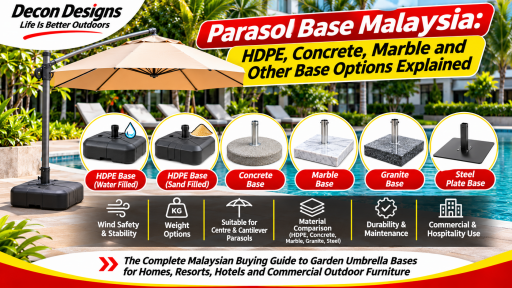
There are several types of parasol bases available, including:
- High-density polyethylene (HDPE) fillable bases.
- Concrete bases.
- Marble and granite bases.
- Steel and cast-iron bases.
- Cross-base systems with compatible ballast.
- Fixed ground sleeves and engineered anchoring systems.
Each option has advantages, limitations and specific applications.
However, the material or weight of a base alone does not establish whether it is safe for a particular parasol.
The correct selection depends on the complete parasol system, including canopy dimensions, pole design, manufacturer requirements, installation surface and environmental exposure.
This guide by Decon Designs – Life Is Better Outdoors explains the different parasol base options available to Malaysian buyers and the questions that should be answered before purchasing.
1. What Is a Parasol Base?
A parasol base is a support component designed to help hold a compatible parasol in position.
Depending on the design, it may provide ballast, support the pole, connect to a structural fixing or form part of a larger anchoring system.
Not every parasol uses the same type of base.
A centre-pole parasol may use a weighted stand with a central pole holder.
A cantilever parasol may require a cross-shaped support with ballast blocks or a specific proprietary base.
A fixed commercial installation may use a ground sleeve or an engineered anchor arrangement.
These systems are not automatically interchangeable.
The base must be compatible with the exact parasol model and its intended installation conditions.
2. Why the Correct Parasol Base Matters
A parasol canopy creates a surface that can catch wind.
When wind acts on the canopy, it can generate forces that affect the pole, frame, base and surrounding structure.
A suitable base or anchoring system is therefore essential.
An unsuitable arrangement may allow the parasol to tilt, slide, overturn or move unexpectedly.
Such movement can damage furniture and property or cause injury.
This is particularly concerning in commercial environments where customers, staff and other members of the public may be nearby.
A parasol base should never be selected merely because it looks attractive or feels heavy.
The first question should always be: Is this base approved by the parasol manufacturer for this exact model and installation?
3. Understanding the Main Parasol Base Options in Malaysia
Different base materials and designs offer different practical characteristics.
The following table provides an overview.
| Base type | General characteristics | Important considerations |
|---|---|---|
| HDPE fillable base | Hollow polymer body filled with water or sand where specified | Filling method, capacity, compatibility and maintenance |
| Concrete base | Uses concrete mass for ballast | Weight, handling, cracking and surface protection |
| Marble base | Natural stone with decorative appearance | Stability, fragility, weight and fitting compatibility |
| Granite base | Dense natural stone with varied finishes | Weight, edges, movement and compatibility |
| Steel plate base | Metal support plate or ballast system | Corrosion protection, dimensions and manufacturer approval |
| Cast-iron base | Heavy metal construction | Corrosion, handling and pole-holder design |
| Cross-base system | Often used with certain cantilever parasols | Requires specified ballast or anchoring |
| Fixed ground sleeve | Installed into an appropriate supporting structure | Engineering, permissions and installation |
| Engineered anchor system | Fixed support designed for a particular application | Structural suitability and professional installation |
These are broad categories, not interchangeable products.
4. HDPE Parasol Bases: What Are They?
HDPE stands for high-density polyethylene.
It is a thermoplastic polymer used in many products, including containers, tanks and certain outdoor furniture accessories.
Some parasol bases use HDPE shells that can be filled with water or sand.
The shell is relatively lightweight when empty, making transportation and handling easier.
Once filled according to the manufacturer’s instructions, the base provides additional ballast.
HDPE bases are available in different shapes and configurations.
Some are designed for centre-pole parasols.
Others form part of specific cantilever parasol support systems.
Potential advantages
HDPE fillable bases may offer:
- Easier transport when empty.
- Resistance to rusting of the polymer shell.
- Different filling options where approved.
- Practical handling compared with permanently solid heavy bases.
- A range of shapes and sizes.
However, the shell’s resistance to rust does not mean that all fittings are corrosion-proof.
Metal connectors and other components may still require maintenance.
5. Water-Filled Parasol Bases: How Do They Work?
A water-fillable base uses water as ballast.
The manufacturer specifies how the base should be filled and used.
A key advantage is that the base may be easier to transport before filling.
However, there are important limitations.
Water can leak if the shell, cap or seal is damaged.
The base may lose ballast if it is not properly filled.
Its stability depends on the complete design and the manufacturer’s instructions.
A water-fillable base should be inspected periodically for leakage or damage.
Do not assume that any water-filled base is suitable for a large parasol.
6. Sand-Filled Parasol Bases: Are They Better Than Water?
Some fillable bases are designed to accept sand.
For a given container volume, dry sand generally provides more mass than water.
However, actual mass depends on the sand’s density, moisture content and how it is packed.
This does not mean that sand is automatically the correct choice.
Some bases are designed specifically for water.
Others permit sand or particular filling combinations.
Using an unapproved filling material may affect the product’s intended performance or make it difficult to empty.
Always follow the base manufacturer’s filling instructions.
Do not assume that adding more weight than specified makes the system safer.
7. HDPE Base vs Concrete Base: Which Is Better?
HDPE fillable bases and concrete bases have different practical characteristics.
A fillable HDPE base may be easier to transport when empty.
A concrete base generally has a more permanent mass.
However, neither is universally better.
The correct choice depends on the parasol model, support design, location and manufacturer requirements.
| Comparison | HDPE fillable base | Concrete base |
|---|---|---|
| Transport before use | Often easier when empty | Usually heavier |
| Ballast | Depends on approved filling | Built-in mass |
| Water leakage | Possible in water-filled designs | Not applicable as a filling system |
| Surface damage | Depends on design and handling | Can be significant if dragged |
| Appearance | Various moulded finishes | Various concrete finishes |
| Maintenance | Shell, cap and fittings | Surface, cracks and fittings |
| Compatibility | Model-specific | Model-specific |
The material comparison is useful, but compatibility remains the deciding factor.
8. Concrete Parasol Bases: Traditional and Practical
Concrete is widely used as ballast in different outdoor support applications.
A concrete parasol base may be manufactured as a single solid unit or as part of a composite design.
Its mass can contribute to stability when properly designed and matched to the parasol.
However, concrete bases can be difficult to move.
They may also damage tiles or other surfaces if dragged.
Cracking, exposed reinforcement or damaged fittings should be assessed.
Some concrete bases have decorative finishes or protective coverings.
The base should be placed on a suitable, stable surface.
9. Marble Parasol Bases: Appearance and Weight
Marble parasol bases are sometimes chosen for their decorative appearance.
Natural stone can complement garden furniture, café terraces and selected outdoor seating arrangements.
However, marble is not automatically the best choice for outdoor parasol support.
Important considerations include:
- Base dimensions.
- Total weight.
- Pole-holder construction.
- Surface stability.
- Resistance to chipping or cracking.
- Exposure conditions.
- Manufacturer compatibility.
Natural stone can be damaged by impact or improper handling.
A marble base should not be selected purely for its appearance.
10. Granite Parasol Bases: A Natural Stone Alternative
Granite is another natural stone used in some parasol base designs.
It is available in different colours and finishes.
Granite can provide substantial mass in a compact form, depending on the design.
However, stability depends on the overall base geometry and connection system—not simply stone density.
Commercial buyers should examine the fittings, edges and installation requirements.
Granite bases can also be heavy and difficult to reposition.
11. Steel Plate Bases: Compact but Not Automatically Suitable
Some parasol systems use steel plates as part of their support arrangement.
A plate may be designed to sit beneath a table or support a compatible parasol pole.
However, a compact steel plate should not be assumed to provide adequate stability for every canopy.
The plate’s dimensions, mass, connection details and installation conditions matter.
Steel components may also require appropriate corrosion protection.
For poolside and coastal environments, maintenance requirements deserve particular attention.
12. Cast-Iron Parasol Bases
Cast iron is used in certain traditional umbrella stand designs.
It can provide substantial mass and may feature decorative patterns.
However, cast iron can corrode if protective finishes deteriorate.
Some designs may have relatively small footprints despite their weight.
The stability of the complete assembly should be confirmed.
Do not assume that a heavy cast-iron stand is suitable for a large commercial canopy.
13. Cantilever Parasol Bases: Why They Are Different
Cantilever parasols have an offset support pole.
The canopy extends away from the pole rather than being centred directly above it.
This changes how forces act on the support system.
Cantilever parasols often require specific base configurations.
These may include proprietary ballast blocks, cross-base arrangements or approved fixed installations.
The required support cannot be determined from canopy size alone.
A base suitable for a centre-pole parasol should not automatically be used with a cantilever parasol.
Always use the support arrangement specified for the exact cantilever model.
14. Cross Bases: Why the Cross Alone May Not Be Enough
Some cantilever parasols include a cross-shaped metal support.
Buyers may mistakenly assume that the cross base is the complete support system.
In many designs, the cross must be used with compatible ballast or an approved anchoring arrangement.
Without the required support, the parasol may be unstable.
Check the product documentation carefully.
Ask whether ballast blocks are included in the quotation.
If they are not included, confirm their specifications and cost before ordering.
15. Fixed Parasol Bases and Ground Sleeves
Some commercial installations use fixed support systems.
A ground sleeve may be installed within a suitable structural element.
Other designs use engineered anchors or base plates.
These arrangements require careful consideration.
Installation may affect waterproofing, structural elements or underground services.
For restaurants, hotels and resorts, approval from the property owner or management may be necessary.
Where structural anchoring is involved, use appropriately qualified professionals.
Do not drill into a terrace, pool deck or structural slab without the required assessment and permission.
16. How Heavy Should a Parasol Base Be?
This is one of the most frequently asked questions.
Unfortunately, there is no universal answer.
The appropriate support depends on:
- Parasol model.
- Canopy size.
- Canopy shape.
- Pole height.
- Support geometry.
- Base dimensions.
- Wind conditions.
- Surface type.
- Manufacturer instructions.
- Installation method.
A generic recommendation such as “use a 30 kg base for a 3-metre parasol” may be unsafe if applied without checking the specific product.
Use the manufacturer-approved base or anchoring system. Do not rely on generic weight charts.
17. Why Base Shape Matters
Two bases can have the same weight but different shapes.
Their geometry can influence stability.
A tall, narrow base may behave differently from a broad, low-profile base.
The location of the support pole and the distribution of mass also matter.
This is why total weight alone cannot determine suitability.
A properly designed base system considers both ballast and geometry.
18. Parasol Pole Diameter and Base Compatibility
The pole holder must be compatible with the parasol.
A base designed for one pole diameter may not safely accommodate another.
Some bases include sleeves or adaptors.
However, these should be used only as intended by the manufacturer.
An improvised adaptor or loosely fitted pole can create instability.
Before purchasing, confirm:
- Pole diameter.
- Pole-holder dimensions.
- Connection method.
- Locking arrangement.
- Manufacturer-approved compatibility.
19. Centre-Pole Parasols and Dining Tables
Some garden dining tables have central openings for parasol poles.
This can help position a parasol above the seating area.
However, the table is not necessarily designed to provide the required ballast or anchoring.
A compatible base may still be necessary beneath the table.
The table’s opening should not be treated as proof that any parasol can be used safely.
Check the table and parasol specifications together.
20. Can You Use a Parasol Base on Outdoor Tiles?
Parasol bases are often placed on tiled patios and terraces.
However, the surface must be suitable.
Consider:
- Tile condition.
- Surface levelness.
- Slip resistance.
- Drainage.
- Base contact points.
- Potential surface damage.
Heavy bases should not be dragged across tiles.
For elevated terraces, structural loading must also be considered.
Do not assume that a heavy base is appropriate for a balcony or rooftop simply because it fits physically.
21. Parasol Bases for Wooden Decking
Wooden decking can create an attractive outdoor environment.
However, it may have specific loading and support limitations.
A heavy parasol base can create concentrated loads.
The decking structure must be suitable for the intended installation.
Fixed anchoring may require additional engineering consideration.
Buyers should consult the decking provider or an appropriately qualified professional where necessary.
22. Parasol Bases for Grass and Garden Areas
Garden surfaces can be uneven or soft.
A freestanding base placed directly on soil or grass may not remain level.
Rain can also change ground conditions.
Some parasol systems may use approved ground anchors or other support arrangements.
However, these should be selected according to manufacturer guidance and site conditions.
Do not improvise a support system using stones, bricks or other loose objects.
23. Parasol Bases for Swimming Pool Areas
Poolside installations require additional attention.
Water, cleaning chemicals and frequent pedestrian movement can affect the suitability of the base.
The base should not create an unnecessary trip hazard.
It must not obstruct pool access, emergency equipment or circulation routes.
Metal fittings should be appropriate for the environment.
For commercial pools, the installation should be coordinated with the facilities or safety team.
24. Parasol Bases for Restaurants and Cafés
Restaurants and cafés may need to move tables and chairs regularly.
A parasol base can interfere with service routes if poorly positioned.
Commercial buyers should consider how staff and customers move through the seating area.
The base should not obstruct doorways or create hazards beneath tables.
The complete arrangement must be appropriate for the location and operating conditions.
25. Parasol Bases for Hotels and Resorts
Hotels and resorts may require multiple parasols across different outdoor areas.
However, the same base system may not be suitable everywhere.
A sheltered garden terrace may have different conditions from an exposed poolside or coastal area.
For larger projects, prepare a site-specific installation plan.
Document the exact parasol models, approved bases and operating requirements.
This can help facilities teams manage the equipment consistently.
26. Rooftop and High-Rise Parasol Bases: Special Caution
Rooftop restaurants and high-rise terraces can experience demanding wind conditions.
A heavier base does not automatically make a parasol safe at height.
Building geometry can create complex airflow.
The supporting structure may also have load restrictions.
Standard garden parasols and bases should not be installed in exposed high-rise locations without establishing their suitability.
Consult building management, the manufacturer and appropriately qualified professionals where necessary.
27. Water vs Sand: A Simple Ballast Comparison
For illustration, consider a container with an internal volume of 20 litres.
If filled with water, the water mass would be approximately 20 kg.
If filled with dry sand, the mass could be greater, depending on the sand’s bulk density and packing.
However, this is only a comparison of material mass.
It does not determine the safety of a parasol installation.
The manufacturer may prohibit certain filling materials or require a particular filling procedure.
Never modify the filling method solely to increase weight without manufacturer approval.
28. Can You Mix Water and Sand in a Parasol Base?
Some buyers assume that combining water and sand will automatically improve stability.
However, the mixture may behave differently from either material alone.
It can also make emptying and cleaning more difficult.
Only use a combination if the manufacturer specifically permits it.
Otherwise, follow the approved filling instructions.
29. Can You Add Extra Weights to a Parasol Base?
Adding bricks, stones, concrete blocks or other objects may seem like a simple way to increase stability.
However, improvised ballast can create additional hazards.
Loose objects may shift.
They may interfere with circulation.
They may damage the base or supporting surface.
And they may not address the actual forces acting on the parasol.
If the manufacturer requires a particular ballast system, use that system.
Do not assume that improvised additional weight makes the installation safe.
30. Parasol Base Maintenance in Malaysia
Parasol bases should be inspected and maintained according to manufacturer instructions.
For HDPE fillable bases, check the shell, caps, seals and fittings.
For concrete or stone bases, inspect for cracks, chips and damaged connectors.
For steel or cast-iron bases, monitor protective coatings and corrosion.
For fixed systems, inspect visible connections and arrange appropriate technical maintenance.
Any base showing significant damage or instability should be removed from service until assessed.
31. What Happens if an HDPE Base Develops a Leak?
A leaking water-filled base may lose ballast.
This can compromise the intended support arrangement.
If a leak is suspected, stop using the parasol until the base has been inspected and the issue resolved according to manufacturer guidance.
Do not assume that temporary tape or adhesive repairs restore the original performance.
Replacement may be necessary.
32. Common Parasol Base Buying Mistakes
Mistake One: Choosing by appearance
A decorative base may not be suitable for the parasol.
Mistake Two: Buying by weight alone
Mass does not establish compatibility or stability.
Mistake Three: Ignoring pole diameter
An incompatible holder may create a loose connection.
Mistake Four: Assuming the base is included
Some parasol quotations exclude bases or ballast.
Mistake Five: Using the wrong filling material
The base may not be designed for the chosen filling.
Mistake Six: Improvising ballast
Loose weights can introduce additional hazards.
Mistake Seven: Ignoring wind exposure
Even a correctly assembled parasol has operating limitations.
Mistake Eight: Using a standard base on a rooftop
Elevated locations may require specialised assessment.
Mistake Nine: Forgetting surface loading
Heavy bases can create concentrated loads.
Mistake Ten: Failing to inspect the base
Damage, leakage or loose fittings can affect performance.
33. How to Compare Parasol Base Prices in Malaysia
The selling price of a parasol base may depend on several factors.
These include:
- Material.
- Dimensions.
- Weight.
- Fillable capacity.
- Pole-holder design.
- Manufacturing quality.
- Surface finish.
- Compatibility.
- Packaging.
- Delivery requirements.
- Warranty.
A marble base may cost more than an HDPE shell because of material and processing differences.
A heavy concrete base may have higher handling or delivery costs.
A proprietary cantilever ballast system may be priced differently from a generic umbrella stand.
However, a higher price does not automatically establish better stability.
The correct base is the one specified for the parasol and installation.
34. Commercial Parasol Base Quotation Checklist
Before ordering, request the following information.
| Item | What to confirm |
|---|---|
| Base model | Exact product identification |
| Material | HDPE, concrete, stone, steel or other |
| Compatible parasol | Exact approved models |
| Pole diameter | Required dimensions |
| Base dimensions | Length, width and height |
| Empty weight | Where applicable |
| Approved filling | Water, sand or other specified material |
| Filled weight | Manufacturer-specified value |
| Installation surface | Approved conditions |
| Wind-use guidance | Applicable operating restrictions |
| Base inclusion | Whether supplied with the parasol |
| Accessories | Sleeves, bolts, ballast or fittings |
| Delivery | Charges and handling |
| Warranty | Coverage and exclusions |
| Maintenance | Cleaning and inspection requirements |
This checklist helps buyers avoid incomplete quotations.
35. Decon Designs: Parasol Bases and Outdoor Shade Accessories
Decon Designs has more than 20 years of experience in Malaysia’s outdoor and hospitality furniture market.
Its product categories have included garden parasols, cantilever parasols, centre-pole umbrellas, outdoor dining furniture and related accessories.
Different parasol models require different support arrangements.
Customers should confirm the exact base compatibility and installation requirements before purchasing.
A base that fits physically is not necessarily approved for use with a particular parasol.
Decon Designs – Life Is Better Outdoors.
36. Decon Designs Parasol Base JHA-008
As part of the Decon Designs Year-End Stock Clearance 2026, the following product has previously been advertised.
HDPE Parasol Base
Model: JHA-008
Material: HDPE
Previously specified dimensions: 85 × 85 × 18 cm
Filling options previously specified: Water or sand
Previous listed price: RM1,218
Clearance price: RM449
This product provides an example of a fillable HDPE parasol base.
However, its dimensions and filling options do not establish compatibility with every parasol.
Customers must confirm the exact approved parasol models, required filling procedure and intended-use conditions.
The advertised clearance price is based on previously supplied campaign information and is not confirmation of live stock.
37. Decon Designs JHA-0112 Parasol
Another previously advertised clearance product is the JHA-0112 parasol.
Model: JHA-0112
Previously specified canopy size: Approximately 300 cm
Frame: Grey powder-coated metal
Fabric colour: Chocolate
Base: HDPE water-fillable base included in the previously supplied configuration
Previous listed price: RM1,999
Clearance price: RM999
Buyers should verify the exact configuration and base specifications before ordering.
Do not assume that this parasol offers 360-degree rotation or adjustable tilt.
The correct support arrangement should be confirmed for the actual installation.
38. Decon Designs Year-End Stock Clearance 2026
Decon Designs is conducting its Year-End Stock Clearance 2026 as part of a business downsizing and inventory-reduction exercise.
Selected existing furniture and outdoor accessories are being offered at promotional prices.
Campaign: Decon Designs Year-End Stock Clearance 2026
Campaign message: Everything Must Go!
Sale period: 1 November – 31 December 2026
Availability: Limited stock, first come, first served.
Official promotion page:
https://decondesigns.com/product-category/promotion/
The campaign is an inventory-reduction exercise, not an announcement that the Decon Designs brand is closing.
Customers should confirm current prices, availability, product specifications, compatibility, delivery arrangements and sale terms.
39. Frequently Asked Questions About Parasol Bases in Malaysia
What is the best parasol base material?
There is no universally best material. The correct base depends on the exact parasol model, installation and manufacturer requirements.
Is an HDPE parasol base suitable for outdoor use?
Some HDPE bases are designed for outdoor applications. Their suitability depends on the product design and intended conditions.
Is sand better than water for a parasol base?
Sand can provide greater mass for the same volume, but the manufacturer must approve its use.
Are concrete parasol bases better than plastic bases?
Not necessarily. Each design has advantages and limitations.
Are marble parasol bases suitable for gardens?
Some may be suitable, provided they are compatible with the parasol and intended installation.
Can I use a centre-pole base with a cantilever parasol?
Do not assume so. Cantilever parasols often require specific support systems.
How heavy should a base be for a three-metre parasol?
There is no universal safe weight. Follow the exact parasol manufacturer’s requirements.
Can I use a parasol base on a condominium balcony?
Only where the complete installation is appropriate for the balcony’s wind exposure, structural loading and building rules.
Can I place a parasol base on wooden decking?
Only where the decking and installation are suitable for the load and support arrangement.
Can a water-filled base leak?
Yes. Inspect the shell, caps and seals according to manufacturer instructions.
Can I add bricks to make a base heavier?
Improvised ballast should not be used as a substitute for an approved support system.
Does a heavy base make a parasol windproof?
No. Parasols have operating limitations and should not be used in unsuitable weather.
Where can I find parasol base promotions in Malaysia?
Explore the Decon Designs promotional collection at https://decondesigns.com/product-category/promotion/ and confirm current stock and compatibility.
Conclusion: The Right Parasol Base Is About Compatibility, Not Just Weight
HDPE, concrete, marble, granite, steel and other parasol base options each have different characteristics.
HDPE fillable bases may offer easier transport before filling.
Concrete bases provide permanent mass.
Marble and granite bases can offer decorative appearances.
Steel and cast-iron bases provide other design options.
Cantilever parasols may require specialised ballast systems.
Fixed installations may require engineered anchoring.
But no base material is automatically suitable for every parasol.
The most important factors are compatibility, support design, installation conditions and manufacturer requirements.
BEFORE BUYING A PARASOL BASE, ASK FIVE QUESTIONS:
1. IS IT APPROVED FOR MY EXACT PARASOL MODEL?
2. WHAT FILLING OR ANCHORING SYSTEM IS REQUIRED?
3. IS THE INSTALLATION SURFACE SUITABLE?
4. WHAT WIND-USE RESTRICTIONS APPLY?
5. WHAT IS INCLUDED IN THE QUOTATION?
A parasol base should never be an afterthought.
THE RIGHT BASE SUPPORTS THE PARASOL. THE RIGHT INSTALLATION SUPPORTS SAFETY.
Explore selected outdoor furniture and parasol accessories during the Decon Designs Year-End Stock Clearance 2026.
EVERYTHING MUST GO!
1 NOVEMBER – 31 DECEMBER 2026
LIMITED STOCK | FIRST COME, FIRST SERVED
EXPLORE THE CLEARANCE COLLECTION:
https://decondesigns.com/product-category/promotion/
Decon Designs – Life Is Better Outdoors.