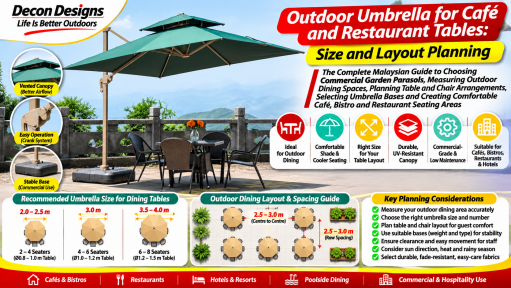
The Complete Malaysian Guide to Choosing Commercial Garden Parasols, Measuring Outdoor Dining Spaces, Planning Table and Chair Arrangements, Selecting Umbrella Bases and Creating Comfortable Café, Bistro and Restaurant Seating Areas
By Decon Designs – Life Is Better Outdoors | Outdoor Umbrella Malaysia | Café Furniture | Restaurant Outdoor Furniture | Commercial Parasols | Outdoor Dining Layout | Hospitality Furniture | Patio Shade Planning
Introduction: A Restaurant Umbrella Is More Than a Shade Accessory
For a café or restaurant, outdoor seating can be valuable commercial space.
A well-planned terrace, courtyard, garden or pavement dining area can create an inviting environment where customers enjoy food, beverages and social interaction.
However, outdoor dining introduces practical challenges.
Customers may be exposed to direct sunlight.
Tables can become uncomfortable during hot afternoons.
Sudden rain may interrupt service.
Poorly positioned parasol poles can obstruct chairs and walkways.
Oversized umbrella bases can create trip hazards.
And unsuitable parasols may present risks when wind conditions change.
This is why selecting an outdoor umbrella for a café or restaurant requires more than choosing a canopy colour or buying the largest available model.
The right parasol must work with the dining layout, furniture dimensions, customer circulation, operating conditions and the restaurant’s overall design.
A 3-metre round umbrella may suit one arrangement but not another.
A square canopy may align conveniently with a group of tables.
A centre-pole parasol may work well with a compatible dining table.
A cantilever parasol may create an open seating area without a central pole.
But none of these options is universally superior.
For Malaysian restaurants, climate adds another consideration.
Outdoor parasols may be exposed to intense sunshine, humidity, rainfall and sudden thunderstorms.
Commercial operators therefore need to evaluate both customer comfort and responsible operation.
This guide by Decon Designs – Life Is Better Outdoors explains how to plan café and restaurant umbrella layouts, calculate nominal canopy coverage, measure seating areas, select appropriate support systems and avoid common purchasing mistakes.
Whether you operate a small neighbourhood café, a garden restaurant, a hotel terrace or a resort dining venue, the objective is the same:
Create outdoor seating that is comfortable, practical, attractive and appropriately designed for its location.
1. Why Outdoor Umbrellas Matter for Cafés and Restaurants
Outdoor umbrellas can serve several purposes.
They may provide shade over dining tables.
They can help define individual seating areas.
They may contribute to the restaurant’s visual identity.
They can also make an outdoor terrace more inviting during suitable weather.
However, an umbrella should not be treated as a substitute for a permanent roof or engineered weather shelter.
Its primary purpose and operating limitations depend on the specific product.
A commercial outdoor dining plan should consider the umbrella as part of the complete furniture and site arrangement.
2. Start With the Dining Layout — Not the Umbrella Catalogue
One of the most common purchasing mistakes is choosing umbrellas before measuring the outdoor dining space.
A café owner may see a large parasol and assume it will cover several tables.
But the actual arrangement may not work.
The canopy may interfere with a building wall.
The base may obstruct a service route.
The pole may occupy the space needed for a chair.
Or the shade may move away from the tables during peak business hours.
Before selecting a parasol, prepare a basic layout showing:
- Available outdoor area.
- Table positions.
- Chair dimensions.
- Walkways.
- Entrances and exits.
- Service routes.
- Existing columns and walls.
- Drainage points.
- Nearby trees or structures.
- Proposed umbrella positions.
This simple planning exercise can prevent expensive purchasing mistakes.
3. Measure the Complete Outdoor Dining Area
Begin with the usable dimensions of the site.
Do not rely only on the property’s total floor area.
Some portions may be unavailable because of access requirements, landscaping, building services or local restrictions.
Measure the actual space where furniture and umbrellas may be installed.
For irregularly shaped terraces, divide the area into smaller sections.
Record any fixed obstacles.
A scaled drawing is particularly useful for larger commercial projects.
4. Measure Tables and Chairs Together
The table dimensions alone do not represent the complete dining footprint.
Chairs extend beyond the table.
Customers need space to sit down and stand up.
Staff need room to serve food and clear tables.
For example, a compact two-person café table may occupy relatively little floor space.
However, the surrounding chair and movement requirements can substantially increase the usable area needed.
Measure the table, occupied chairs and circulation space as one arrangement.
5. Common Café and Restaurant Table Configurations
Different table arrangements create different shade requirements.
| Seating arrangement | Typical planning consideration |
|---|---|
| Two-seater café table | Compact canopy and circulation clearance |
| Four-seater dining table | Shade over table and occupied chairs |
| Six-seater dining table | Larger or carefully positioned coverage |
| Long communal table | Extended shade coverage |
| Multiple small tables | Flexible parasol arrangement |
| Outdoor lounge seating | Canopy placement around sofas and chairs |
| Poolside dining | Access, safety and environmental exposure |
The correct umbrella size depends on actual furniture dimensions rather than seating capacity alone.
6. How Much Shade Does a 3-Metre Round Umbrella Provide?
A round umbrella with a nominal canopy diameter of 3 metres has a radius of 1.5 metres.
Its theoretical flat circular area is:
[A=\pi r^2
] [
A=\pi(1.5)^2\approx7.07\text{ m}^2
]
<box gap={1}> <text color=”secondary” weight=”medium” size=”xs”>3-METRE ROUND CANOPY</text> <title size=”2xl” tabularNums={true}>7.07 m²</title> <caption>Nominal flat canopy area, approximately 76.1 square feet.</caption> </box>
This is a geometric calculation, not a guarantee of usable shade.
Actual shade depends on the sun’s position, canopy height and orientation.
7. How Much Shade Does a 3 × 3-Metre Square Umbrella Provide?
A square canopy measuring 3 metres by 3 metres has a nominal area of:
[A=3\times3=9\text{ m}^2
]
<box gap={1}> <text color=”secondary” weight=”medium” size=”xs”>3 × 3-METRE SQUARE CANOPY</text> <title size=”2xl” tabularNums={true}>9 m²</title> <caption>Nominal flat canopy area, approximately 96.9 square feet.</caption> </box>
A square canopy may align conveniently with certain restaurant table layouts.
However, its actual shade coverage still changes throughout the day.
8. Round vs Square Umbrellas for Commercial Dining
<box border radius=”xl” padding={3} gap={2}> <svg viewBox=”0 0 340 180″ width=”100%” xmlns=”http://www.w3.org/2000/svg“> <circle cx=”85″ cy=”75″ r=”55″ fill=”#57d9c2″ fillOpacity=”0.25″ stroke=”#168b78″ strokeWidth=”2″/> <rect x=”205″ y=”20″ width=”110″ height=”110″ rx=”3″ fill=”#ffb606″ fillOpacity=”0.25″ stroke=”#b98500″ strokeWidth=”2″/> <g fill=”currentColor” fontSize=”13″ textAnchor=”middle”> <text x=”85″ y=”71″ fontWeight=”bold”>Round</text> <text x=”85″ y=”88″>7.07 m²</text> <text x=”260″ y=”71″ fontWeight=”bold”>Square</text> <text x=”260″ y=”88″>9 m²</text> <text x=”85″ y=”155″>3 m diameter</text> <text x=”260″ y=”155″>3 m × 3 m</text> </g> </svg> <caption textAlign=”center”>Illustrative comparison at the same scale. The actual shade pattern changes with sun angle and canopy construction.</caption> </box>
Round umbrellas may suit individual café tables or informal garden seating.
Square umbrellas may be useful where tables are arranged in regular rows.
The best choice depends on the dining layout and operating conditions.
9. Can One 3-Metre Umbrella Cover a Four-Seater Table?
In some arrangements, yes.
A 3-metre umbrella may be considered for a compact four-seater dining set.
However, the entire seating arrangement must be measured.
A large rectangular table may extend beyond the canopy.
Even when the tabletop is shaded, some chairs may receive direct sunlight during the morning or afternoon.
For this reason, restaurants should test the proposed shade position during the hours customers are likely to use the area.
10. Can One Umbrella Cover Two Café Tables?
Possibly, depending on the canopy dimensions and table arrangement.
However, placing two tables beneath one canopy can create practical difficulties.
The umbrella pole may occupy valuable space.
Customers may sit outside the shaded area.
The base may interfere with chairs.
Service access may be restricted.
Do not assume that two tables can be covered simply because their combined tabletop area is smaller than the canopy area.
The full layout matters.
11. Can a 3-Metre Umbrella Cover Six Diners?
It may provide useful shade over some compact six-person arrangements.
However, it should not be assumed to provide complete shade for six people throughout the day.
A long rectangular table can be particularly challenging.
The canopy’s shadow may move away from the outer seats.
For commercial dining, the actual furniture layout and sun exposure should determine the canopy size.
12. Centre-Pole Parasols for Café Tables
Centre-pole parasols have a supporting pole positioned beneath the canopy.
They are commonly associated with outdoor dining tables that have a compatible umbrella opening.
This can create a visually balanced arrangement.
However, the table opening does not replace the need for an appropriate base or anchoring system.
The parasol must be supported according to the manufacturer’s requirements.
A table should not be assumed to provide sufficient stability by itself.
13. Cantilever Parasols for Restaurant Seating
Cantilever parasols use an offset support pole.
This can leave the area beneath the canopy free of a central pole.
They may be useful for selected restaurant layouts and outdoor lounge arrangements.
However, cantilever parasols often require specialised bases or anchoring.
The support pole and base must be positioned carefully.
Rotation and tilt features vary by model.
Do not assume that every cantilever parasol offers 360-degree rotation.
14. Centre-Pole vs Cantilever: Which Is Better for Restaurants?
| Consideration | Centre-pole parasol | Cantilever parasol |
|---|---|---|
| Pole position | Beneath canopy | Offset |
| Table compatibility | May suit tables with umbrella holes | Can keep central table area unobstructed |
| Base requirements | Model-specific | Often specialised |
| Seating flexibility | Depends on pole position | Can offer open space beneath canopy |
| Rotation | Depends on model | Depends on model |
| Installation | Depends on support system | May require more planning |
| Wind suitability | Must be verified | Must be verified |
| Commercial use | Model-specific | Model-specific |
Neither design is universally superior.
The correct choice depends on the exact site and product.
15. Why Sun Direction Matters for Restaurant Tables
A canopy does not create a fixed shaded area throughout the day.
The shadow changes with the sun’s position.
A restaurant terrace may receive morning sunlight from one direction and afternoon sunlight from another.
A parasol positioned perfectly at noon may provide less shade during dinner preparation or late-afternoon service.
For this reason, operators should observe the site during actual business hours.
This is particularly important for west-facing terraces.
16. Lunch Service vs Evening Service
A café that operates mainly in the morning may have different shade requirements from a restaurant serving lunch and dinner.
For lunch service, overhead sunlight may be an important consideration.
For late-afternoon dining, lower-angle sunlight may enter beneath the canopy.
Evening operations may require lighting rather than shade.
The parasol layout should reflect the business’s actual operating schedule.
17. Why Canopy Height Matters
Canopy height affects headroom and shade position.
A higher canopy may provide more clearance but can change the shadow’s location.
It may also affect wind exposure.
The parasol should be installed according to the manufacturer’s intended configuration.
Do not modify pole height without approval.
Commercial operators should confirm suitable clearance for customers and staff.
18. How Much Space Should Be Left Between Umbrellas?
There is no universal spacing rule that applies to every parasol.
The correct clearance depends on canopy dimensions, operating mechanisms and manufacturer instructions.
Nearby canopies should not interfere with one another.
The arrangement should allow safe opening and closing.
Bases should not obstruct circulation.
A scaled layout can help identify potential conflicts.
19. Should Restaurant Umbrellas Overlap?
Overlapping canopy footprints may appear attractive in a drawing.
However, physical interference between canopies can create problems.
The umbrellas may strike one another during movement.
Wind can cause unexpected contact.
Water may still pass through gaps.
Any arrangement involving closely spaced canopies should follow manufacturer clearance requirements.
Do not assume that overlapping canopies create a continuous weatherproof roof.
20. Planning Customer Walkways
Walkways are essential to outdoor dining operations.
Customers must be able to enter and leave their seats.
Staff need access to tables.
Emergency routes must remain unobstructed.
Parasol bases and poles should not create unnecessary hazards.
The required circulation dimensions depend on the venue, layout and applicable rules.
A commercial design should account for accessibility and local requirements.
21. Why Parasol Bases Can Become Trip Hazards
A base may extend beyond the umbrella pole.
Customers may not notice it when walking between tables.
This is particularly relevant in crowded café terraces.
A heavy base should not be positioned where it obstructs circulation.
However, base placement must also follow the manufacturer’s approved installation configuration.
Do not compromise stability merely to make the base less visible.
22. Choosing the Correct Parasol Base
The base must be compatible with the exact umbrella model.
Different parasols may require different support arrangements.
Some use HDPE fillable bases.
Others use concrete, stone, steel or proprietary ballast systems.
Certain commercial installations may require fixed anchoring.
There is no universal safe base weight for every canopy size.
The correct base is determined by the complete parasol system and installation conditions.
23. HDPE Water-Filled Bases for Cafés
HDPE fillable bases may be convenient to transport before filling.
However, their suitability depends on the parasol model.
The manufacturer may specify water, sand or another approved filling.
A leaking base can lose ballast.
Restaurant staff should inspect fillable bases according to the manufacturer’s instructions.
Do not assume that every HDPE base is suitable for commercial use.
24. Concrete and Stone Bases
Concrete and stone bases can provide substantial mass.
However, weight alone does not establish stability.
The base geometry, connection system and supporting surface matter.
Heavy bases can also create handling difficulties.
For rooftop or elevated restaurant terraces, structural loading requires careful assessment.
25. Fixed Anchoring for Commercial Parasols
Some commercial parasols may use approved fixed anchoring systems.
These can be appropriate for certain installations when properly designed and installed.
However, fixed anchoring does not eliminate wind-related operating limitations.
Drilling into terraces or roof decks may affect waterproofing or structural elements.
Obtain necessary permissions and technical advice.
26. Wind Safety for Café and Restaurant Umbrellas
An open parasol can experience substantial wind forces.
This can affect the canopy, frame, base and anchoring system.
A restaurant should not rely on generic descriptions such as heavy-duty or windproof.
Ask for the manufacturer’s documented operating limitations.
Staff should know when and how to close parasols.
Do not wait until the canopy begins moving violently.
27. What Should Restaurants Do During Thunderstorms?
Garden parasols should not be used as storm shelters.
During dangerous weather, customers and staff should move to appropriate shelter.
Commercial operators should establish procedures for monitoring weather and closing parasols before conditions become unsafe.
If dangerous conditions have already developed, staff should not put themselves at risk trying to control a moving canopy.
Safety takes priority over maintaining outdoor seating.
28. Outdoor Umbrella Fabric for Commercial Dining
The canopy fabric affects appearance, shade and maintenance.
Common materials include polyester and acrylic-based fabrics.
However, performance varies by product.
Commercial buyers should ask about:
- Fabric composition.
- UV protection.
- Colourfastness.
- Water resistance.
- Cleaning instructions.
- Replacement availability.
- Warranty.
Do not assume that every fabric described as outdoor-grade has identical performance.
29. Choosing Parasol Colours for Restaurants
Canopy colour can influence the visual character of a restaurant.
Neutral colours may suit minimalist or contemporary interiors.
Green or earthy tones may complement garden settings.
Maroon or darker shades may create a different visual impression.
However, colour alone does not establish UV protection or durability.
Choose colours based on design requirements and verified fabric specifications.
30. Should a Café Use Matching Umbrellas?
Matching parasols can create a consistent visual identity.
This may be particularly useful for restaurants with multiple outdoor tables.
However, uniform appearance should not take priority over site suitability.
Different parts of the terrace may require different canopy sizes or support systems.
A coordinated design can still use more than one parasol configuration.
31. Branded Parasols for Cafés and Restaurants
Some commercial parasols may be available with printed branding or custom colours.
This can support visual identity.
However, customisation depends on the manufacturer and product.
Buyers should confirm printing methods, minimum order quantities, lead times and replacement availability.
A printed logo does not establish any particular fabric performance.
32. Outdoor Umbrellas for Small Cafés
Small cafés often have limited outdoor space.
A large canopy may obstruct the entrance or neighbouring seating.
A compact parasol may be more practical.
The correct size depends on the actual layout.
Operators should consider whether a parasol base can be positioned without obstructing customers.
A smaller but appropriately positioned canopy may offer better practical results than an oversized umbrella.
33. Outdoor Umbrellas for Garden Restaurants
Garden restaurants may have more flexible layouts.
However, trees, landscaping and uneven ground can create installation challenges.
Canopies should not interfere with branches or lighting.
Bases must be suitable for the supporting surface.
Operators should also consider drainage and maintenance access.
34. Outdoor Umbrellas for Pavement Cafés
Pavement seating may be subject to local authority rules.
Parasol placement must respect pedestrian circulation and permitted outdoor dining areas.
A canopy should not extend into restricted spaces.
Bases should not obstruct public access.
Operators should confirm applicable permissions before installation.
35. Outdoor Umbrellas for Hotel Restaurants
Hotel restaurants may operate outdoor terraces, courtyards and poolside dining areas.
Different locations may have different wind exposure.
A sheltered courtyard may not require the same installation approach as an exposed rooftop.
Hotel procurement teams should evaluate each location separately.
36. Outdoor Umbrellas for Rooftop Restaurants
Rooftop terraces require particular caution.
Wind conditions may be more demanding than at ground level.
A standard garden parasol should not be assumed suitable.
Structural loading and building-management requirements may also apply.
Site-specific technical assessment may be necessary.
Do not assume that adding a heavier base makes a rooftop installation safe.
37. Outdoor Umbrellas for Beachfront Restaurants
Beachfront dining areas may experience airborne salts, sand and demanding wind conditions.
The complete parasol should be suitable for the environment.
Corrosion protection and maintenance requirements matter.
A product suitable for a sheltered urban café may not be appropriate for an exposed coastal site.
38. How Many Umbrellas Does a Restaurant Need?
There is no universal formula based only on the number of tables.
The correct quantity depends on:
- Table dimensions.
- Seating arrangement.
- Canopy size.
- Sun direction.
- Circulation requirements.
- Operating clearance.
- Site exposure.
- Base positions.
- Intended operating hours.
A scaled layout can help determine the appropriate number and placement.
39. Example: Planning a Small Café Terrace
Consider a hypothetical café terrace measuring 6 metres by 4 metres.
The total rectangular area is 24 square metres.
However, the full area cannot automatically be used for dining tables.
Space may be required for entrances, walkways and other functions.
A proposed parasol layout should begin with the usable seating arrangement.
Then identify where canopies can be positioned without interfering with circulation.
The final quantity should be based on actual measurements and product specifications.
40. Example: Planning a Garden Restaurant
A garden restaurant may have several groups of tables separated by landscaping.
Instead of selecting one large umbrella for the entire area, the operator may consider multiple appropriately positioned parasols.
However, each umbrella requires a suitable support system.
The arrangement should avoid canopy interference.
Maintenance and staff operation should also be considered.
41. Example: Planning a Hotel Poolside Dining Area
A hotel may combine dining tables and lounge seating near a swimming pool.
Different furniture arrangements may require different shade solutions.
A cantilever parasol may suit selected lounge areas.
A centre-pole parasol may suit compatible dining tables.
However, pool circulation and emergency access must remain unobstructed.
The installation should be coordinated with the hotel’s facilities and safety team.
42. Why Restaurant Umbrellas Need Maintenance
Commercial parasols may be opened and closed frequently.
They may also be exposed to food residue, dust and cleaning chemicals.
Maintenance should follow manufacturer instructions.
Relevant tasks may include inspecting:
- Canopy fabric.
- Stitching.
- Frame joints.
- Fasteners.
- Crank mechanisms.
- Locking systems.
- Bases.
- Ballast.
- Signs of corrosion or damage.
A damaged parasol should be removed from service until appropriately assessed.
43. Staff Training for Outdoor Umbrellas
Restaurant staff should understand the exact parasol model.
Training may include:
- Opening procedures.
- Closing procedures.
- Locking arrangements.
- Rotation and tilt limitations.
- Weather-related restrictions.
- Base inspection.
- Reporting damage.
- End-of-day securing procedures.
Do not assume that every employee knows how to operate a commercial parasol safely.
44. Replacement Canopies and Spare Parts
Replacement availability can affect long-term ownership costs.
Restaurants with multiple parasols may benefit from keeping records of exact models and canopy colours.
However, replacement parts are not universally available.
A new canopy must match the correct frame.
Do not assume that any fabric canopy of similar dimensions will fit.
45. How Much Do Commercial Outdoor Umbrellas Cost in Malaysia?
Prices vary according to:
- Canopy dimensions.
- Canopy shape.
- Frame material.
- Fabric specifications.
- Operating mechanism.
- Rotation or tilt features.
- Base inclusion.
- Ballast requirements.
- Commercial-use suitability.
- Warranty.
- Delivery.
- Installation.
- Order quantity.
A lower purchase price may not represent the lowest total ownership cost.
Buyers should compare complete quotations.
46. What Should Be Included in a Commercial Parasol Quotation?
| Quotation item | What to confirm |
|---|---|
| Model | Exact product identification |
| Canopy dimensions | Actual size and shape |
| Frame | Material and construction |
| Fabric | Composition and performance |
| Operating mechanism | Opening and closing method |
| Rotation or tilt | Exact model features |
| Base | Included or excluded |
| Ballast | Approved requirements |
| Wind-use guidance | Manufacturer limitations |
| Warranty | Coverage and exclusions |
| Replacement parts | Availability |
| Delivery | Charges and handling |
| Installation | Included or excluded |
| Quantity | Number of units |
| Lead time | Stock or production schedule |
| Total price | Complete cost |
This helps restaurants compare the full installation rather than canopy prices alone.
47. Ten Common Restaurant Parasol Planning Mistakes
Mistake 1: Buying umbrellas before measuring the site.
Mistake 2: Measuring only the tabletop instead of the full seating arrangement.
Mistake 3: Assuming canopy area equals usable shade throughout the day.
Mistake 4: Positioning poles or bases in customer walkways.
Mistake 5: Choosing a cantilever parasol without checking support requirements.
Mistake 6: Assuming every side-pole parasol rotates 360 degrees.
Mistake 7: Using an unapproved base.
Mistake 8: Ignoring wind exposure and thunderstorms.
Mistake 9: Buying without checking replacement canopy availability.
Mistake 10: Comparing only purchase price instead of total cost.
48. Restaurant Umbrella Layout Planning Checklist
Before purchasing, confirm:
- Total usable outdoor area.
- Table dimensions.
- Chair dimensions.
- Number of seating positions.
- Customer circulation routes.
- Staff service routes.
- Entrances and exits.
- Canopy shape.
- Canopy dimensions.
- Pole position.
- Base footprint.
- Operating clearance.
- Morning and afternoon sun exposure.
- Wind exposure.
- Manufacturer operating limitations.
- Approved base or anchoring.
- Fabric specifications.
- Maintenance requirements.
- Replacement-part availability.
- Total delivered and installed cost.
A successful outdoor dining layout balances customer comfort, circulation, appearance and appropriate installation.
49. Decon Designs: Outdoor Parasols and Restaurant Furniture in Malaysia
Decon Designs has more than 20 years of experience in Malaysia’s outdoor and hospitality furniture market.
Its product categories have included garden parasols, centre-pole umbrellas, cantilever parasols, outdoor dining sets, patio furniture, café chairs, lounge seating and related accessories.
Different parasol models have different dimensions, operating features and support requirements.
Customers should confirm the exact specifications before purchasing.
A product suitable for a residential patio should not automatically be assumed appropriate for a demanding commercial or exposed location.
Decon Designs – Life Is Better Outdoors.
50. Decon Designs Outdoor Dining and Parasol Product Examples
Decon Designs has previously advertised selected outdoor dining and parasol products during its Year-End Stock Clearance 2026.
JHA-0112 Garden Parasol
Previously specified canopy size: Approximately 300 cm
Frame: Grey powder-coated metal
Fabric colour: Chocolate
Base: HDPE water-fillable base in the previously supplied configuration
Previous listed price: RM1,999
Clearance price: RM999
JHA-008 HDPE Parasol Base
Material: HDPE
Previously specified dimensions: 85 × 85 × 18 cm
Previously specified filling options: Water or sand
Previous listed price: RM1,218
Clearance price: RM449
Immo Patio Set JHA-90318B
Material: Powder-coated metal mesh wire
Design: Folding table and chairs
Previously supplied table dimensions: 55 × 44 × 72 cm
Previously supplied chair dimensions: 50 × 46 × 80 cm
Previous listed price: RM899
Clearance price: RM499
These products are examples of outdoor furniture and parasol-related inventory.
They should not be assumed to form a compatible combined installation without verification.
Previously advertised prices do not confirm current stock.
51. Decon Designs Year-End Stock Clearance 2026
Decon Designs is conducting its Year-End Stock Clearance 2026 as part of a business downsizing and inventory-reduction exercise.
Selected existing outdoor furniture and accessories are being offered at promotional prices.
Campaign: Decon Designs Year-End Stock Clearance 2026
Campaign message: Everything Must Go!
Sale period: 1 November – 31 December 2026
Availability: Limited stock, first come, first served.
Official promotion page:
https://decondesigns.com/product-category/promotion/
The campaign is an inventory-reduction exercise, not an announcement that the Decon Designs brand is closing.
Customers should confirm current prices, stock, specifications, product condition, delivery arrangements and sale terms.
52. Frequently Asked Questions About Outdoor Umbrellas for Cafés and Restaurants
What size umbrella is suitable for a café table?
It depends on the table dimensions, occupied chairs, sun exposure and available space.
Can a 3-metre umbrella cover four diners?
It may suit some compact four-seater arrangements, but coverage is not guaranteed throughout the day.
Can one umbrella cover two café tables?
Possibly, depending on the canopy and seating layout.
Is a round or square parasol better for restaurants?
Neither is universally better. Choose according to the layout and product specifications.
Are cantilever parasols suitable for restaurants?
Some models may be suitable for commercial use, provided the installation and support system are appropriate.
Do all cantilever parasols rotate 360 degrees?
No. Rotation features vary by model.
What base does a restaurant parasol need?
Use the manufacturer-approved base or anchoring system for the exact product and location.
Can an umbrella pole pass through a restaurant table?
Only where the table and parasol are compatible, with the required independent support system.
Can restaurant umbrellas remain open during rain?
Follow manufacturer operating limits. Do not use parasols during dangerous weather.
Are commercial parasols windproof?
No parasol should be assumed safe in all wind conditions.
Can I use a garden umbrella on a rooftop restaurant?
Only where the product and installation are suitable and any necessary technical approvals have been obtained.
Should restaurants use matching parasol colours?
Matching colours may support visual consistency, but suitability and safety come first.
Can restaurant parasol canopies be replaced?
Some models offer compatible replacement canopies.
How many umbrellas does a café need?
The quantity depends on the complete layout, canopy coverage and circulation requirements.
Where can I explore Decon Designs outdoor furniture promotions?
Visit https://decondesigns.com/product-category/promotion/ and confirm current availability.
Conclusion: Good Outdoor Dining Begins With Good Shade Planning
Outdoor umbrellas can help cafés and restaurants create more comfortable and attractive seating areas.
However, a successful installation requires more than selecting a canopy.
The dining layout must be measured.
Tables and occupied chairs must be considered together.
Sun direction affects the location of useful shade.
Poles and bases must not obstruct circulation.
The support system must match the exact parasol.
And commercial operators must understand weather-related operating limitations.
BEFORE BUYING OUTDOOR UMBRELLAS FOR A CAFÉ OR RESTAURANT, ASK FIVE QUESTIONS:
1. HOW MANY TABLES AND CHAIRS NEED SHADE?
2. WHAT CANOPY SIZE AND SHAPE SUIT THE LAYOUT?
3. WHERE WILL THE POLES AND BASES BE POSITIONED?
4. HOW WILL CUSTOMERS AND STAFF MOVE THROUGH THE AREA?
5. ARE THE PARASOLS SUITABLE FOR THE LOCATION AND INTENDED USE?
A good outdoor dining environment should look attractive, function efficiently and be appropriately planned.
DON’T JUST BUY UMBRELLAS FOR YOUR RESTAURANT. DESIGN A BETTER OUTDOOR DINING EXPERIENCE.
Explore selected outdoor parasols, café furniture and dining sets during the Decon Designs Year-End Stock Clearance 2026.
EVERYTHING MUST GO!
1 NOVEMBER – 31 DECEMBER 2026
LIMITED STOCK | FIRST COME, FIRST SERVED
EXPLORE THE CLEARANCE COLLECTION:
https://decondesigns.com/product-category/promotion/
Decon Designs – Life Is Better Outdoors.