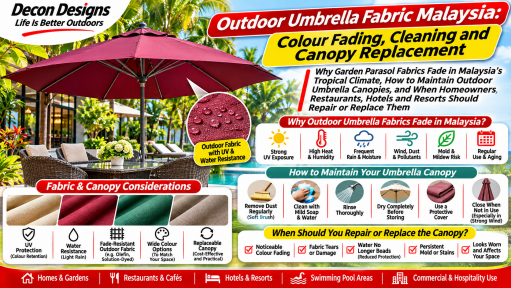
Why Garden Parasol Fabrics Fade in Malaysia’s Tropical Climate, How to Maintain Outdoor Umbrella Canopies, and When Homeowners, Restaurants, Hotels and Resorts Should Repair or Replace Them
By Decon Designs – Life Is Better Outdoors | Outdoor Umbrella Malaysia | Garden Parasol Fabric | UV Protection | Outdoor Fabric Maintenance | Canopy Replacement | Hospitality Furniture Care
Introduction: Your Parasol Frame May Still Be Strong — But What About the Fabric?
A garden parasol can transform an ordinary outdoor space into a more comfortable place to relax, dine or entertain.
For Malaysian homeowners, outdoor umbrellas provide shade over garden furniture, patio dining sets and swimming pool areas.
For cafés, restaurants, hotels and resorts, parasols can also contribute to customer comfort and the appearance of outdoor seating areas.
But after months or years of exposure, a common problem may appear.
The canopy begins to lose its original colour.
A rich maroon becomes lighter.
A deep green looks dull.
An off-white canopy develops stains.
A chocolate-coloured umbrella begins to show uneven fading.
Sometimes the fabric remains functional despite the colour change.
In other cases, the material becomes brittle, stitching deteriorates or water begins passing through the canopy more easily.
This raises several important questions:
Why do outdoor umbrella fabrics fade? Can faded fabric be restored? How should a parasol canopy be cleaned? When is replacement better than repair? And can an old umbrella frame be fitted with a new canopy?
The answers depend on the fabric, manufacturing quality, exposure conditions and maintenance history.
Malaysia’s tropical climate presents particular challenges because outdoor fabrics may experience prolonged sunlight, high humidity, frequent rain and periods of intense heat.
However, not all outdoor fabrics behave the same way.
A polyester canopy, an acrylic canopy and a specially coated technical fabric may have different performance characteristics.
Even two fabrics made from the same fibre can vary considerably in durability.
This guide by Decon Designs – Life Is Better Outdoors explains how outdoor umbrella fabrics age, what causes colour fading, how to clean them responsibly and how to determine whether a replacement canopy is a worthwhile investment.
The objective is simple: help Malaysian buyers protect their outdoor shade investment and avoid replacing an entire parasol unnecessarily.
1. What Is Outdoor Umbrella Fabric?
Outdoor umbrella fabric is the material used to form the canopy of a garden parasol, patio umbrella or commercial shade umbrella.
Its main purpose is to provide shade and, depending on the product specification, some degree of protection from light rain.
A suitable canopy must also work with the umbrella’s frame, ribs, tensioning arrangement and opening mechanism.
Outdoor canopy fabrics can differ in:
- Fibre composition.
- Yarn construction.
- Weave density.
- Fabric weight.
- Dyeing method.
- Surface coating.
- UV stabilisation.
- Water resistance.
- Colourfastness.
- Tear strength.
- Cleaning requirements.
The term outdoor fabric is broad.
It does not guarantee a particular lifespan, UV rating or level of water resistance.
2. Why Malaysia’s Climate Is Challenging for Parasol Fabrics
Malaysia’s tropical climate exposes outdoor umbrellas to several environmental stresses.
Strong sunlight
Prolonged ultraviolet exposure can affect dyes, coatings and certain textile fibres.
High humidity
Humid conditions can encourage microbial growth when fabrics remain damp or dirty.
Frequent rainfall
Repeated wetting and drying may affect coatings, stitching and accumulated dirt.
Heat
High temperatures can accelerate some material ageing processes.
Pollution and airborne dirt
Urban environments may expose canopies to dust, soot and other deposits.
Coastal exposure
Beachfront locations may experience airborne salts and additional environmental demands.
These conditions do not affect every canopy equally.
Performance depends on the specific material and construction.
3. Why Do Outdoor Umbrella Colours Fade?
Colour fading occurs when the appearance of a dyed or pigmented material changes over time.
Ultraviolet radiation is an important contributor, but it is not the only cause.
Heat, moisture, chemical exposure, pollution and inappropriate cleaning products can also affect colour.
Different pigments and dyeing methods have different resistance to weathering.
Some fabrics may fade gradually and relatively evenly.
Others may develop noticeable differences between exposed and sheltered sections.
A fading canopy does not necessarily mean that the fabric has lost all its structural strength, but fading can be a sign that further inspection is needed.
4. Why Some Parasol Colours Fade Faster Than Others
It is tempting to assume that all dark-coloured canopies fade quickly or that light colours last longer.
The reality is more complicated.
Colourfastness depends on the dye or pigment chemistry, fabric construction and manufacturing process.
A high-quality dark fabric may retain its appearance better than a poorly manufactured light fabric.
Likewise, two maroon canopies may perform very differently under similar exposure.
Buyers should not judge durability solely by colour.
Where available, request documented colourfastness or weathering information for the specific fabric.
5. Polyester Parasol Fabric: What Buyers Should Know
Polyester is commonly used in outdoor umbrella canopies.
It can offer practical strength, relatively low weight and a variety of colours and finishes.
However, polyester canopy quality varies.
Differences may include:
- Fabric weight.
- Yarn quality.
- Dyeing process.
- UV treatment.
- Water-repellent coating.
- Manufacturing consistency.
A basic polyester canopy should not automatically be considered equivalent to a higher-specification outdoor polyester fabric.
Similarly, a heavier fabric is not necessarily better in every performance category.
The complete specification matters.
6. Acrylic Parasol Fabric: Is It Better for Colour Retention?
Acrylic-based fabrics are used in some outdoor shade applications.
Certain solution-dyed acrylic fabrics are valued for their colour-retention characteristics.
In solution dyeing, pigment is incorporated into the fibre during production rather than applied only after the fibre is formed.
This can improve colourfastness under some conditions.
However, performance still depends on the particular product.
Not every acrylic fabric is solution-dyed.
Not every polyester fabric is poorly suited to outdoor use.
Buyers should compare documented specifications rather than relying only on fibre names.
7. Polyester vs Acrylic Outdoor Umbrella Fabric
| Comparison factor | Polyester | Acrylic |
|---|---|---|
| Common use | Widely used for outdoor canopies | Used in selected outdoor shade products |
| Colour options | Broad range | Broad range |
| UV performance | Depends on construction and treatment | Depends on construction and dyeing |
| Water resistance | Depends on coating and finish | Depends on fabric and finish |
| Cleaning | Follow product instructions | Follow product instructions |
| Price | Varies by specification | Varies by specification |
| Colour retention | Product-specific | Product-specific |
| Suitability for Malaysia | Must be verified | Must be verified |
Neither fibre name alone establishes the quality or expected service life of a parasol canopy.
8. What Does Fabric GSM Mean?
GSM stands for grams per square metre.
It describes the mass of a fabric per unit area.
For example, a fabric rated at 250 GSM has a mass of approximately 250 grams per square metre.
Buyers sometimes assume that a higher GSM automatically means better quality.
That is not necessarily correct.
Fabric weight does not independently establish UV resistance, colourfastness, waterproof performance or tensile strength.
A lower-GSM technical fabric may outperform a heavier material in a particular application.
GSM should be considered alongside other specifications.
9. Does Thicker Fabric Last Longer?
Not always.
Thickness can influence certain physical properties, but longevity depends on more than thickness.
The fibre, weave, coatings, stitching and environmental exposure all matter.
A thick fabric with poor UV stability may deteriorate faster than a thinner fabric engineered for prolonged outdoor exposure.
Commercial buyers should request performance information relevant to the intended application.
10. UV Protection: What Does UPF Mean?
UPF stands for ultraviolet protection factor.
It is a measure of how much ultraviolet radiation passes through a textile under defined test conditions.
For example, a fabric with a verified UPF 50 rating transmits approximately one-fiftieth of the relevant ultraviolet radiation under the test conditions.
However, a UPF rating applies to the tested fabric and conditions.
It does not mean that a parasol provides complete sun protection in every situation.
Sunlight can enter from the sides or reflect from surrounding surfaces.
The position of the sun also affects exposure.
If UV protection is important, request documented UPF information for the specific canopy fabric.
11. UV-Resistant Does Not Mean Fade-Proof
A fabric may be marketed as UV-resistant.
However, this does not necessarily mean its colour will remain unchanged indefinitely.
UV resistance can refer to different performance characteristics.
These may include fibre stability, colourfastness or the ability to reduce ultraviolet transmission.
Buyers should ask what the claim means and whether it is supported by appropriate testing.
Avoid assuming that UV-resistant means permanent colour retention.
12. Water-Resistant vs Waterproof Umbrella Fabrics
These terms are often confused.
Water-resistant fabric is designed to resist water penetration to a specified degree.
Waterproof fabric is designed to prevent water penetration under defined conditions.
However, the performance of the complete canopy also depends on seams, stitching, coatings and construction.
A canopy that repels light rain may still allow water through during prolonged rainfall.
A waterproof fabric also does not make the umbrella safe during strong winds or thunderstorms.
Rain protection and wind safety are separate considerations.
13. Why Water Starts Passing Through an Older Canopy
A parasol that previously resisted light rain may begin to leak.
Possible causes include:
- Deterioration of water-repellent finishes.
- Damage to coatings.
- Worn stitching.
- Open seams.
- Fabric abrasion.
- Tears or punctures.
- Improper cleaning.
- General ageing.
Before replacing the canopy, identify where the water is entering.
A local seam issue may be different from widespread fabric deterioration.
However, repairs should follow manufacturer guidance.
14. Why Outdoor Umbrella Fabric Develops Mould or Mildew
Mould and mildew are commonly associated with damp conditions.
A canopy that remains wet, dirty or poorly ventilated may develop visible microbial growth.
Organic deposits such as dust, leaves and food residue can provide material on which microorganisms grow.
High humidity can make drying more difficult.
Mould can create unpleasant odours and visible staining.
It may also indicate that storage or cleaning practices need improvement.
The best prevention is appropriate cleaning, drying and ventilation.
15. Why Folding a Wet Parasol Can Cause Problems
Closing a parasol while wet may sometimes be unavoidable during changing weather.
However, leaving a wet canopy tightly folded for an extended period can encourage staining, odours and microbial growth.
Where the manufacturer’s instructions permit, the canopy should be reopened for drying when weather conditions are safe.
Never reopen a parasol merely to dry it during strong winds or dangerous weather.
The correct procedure should balance fabric care with safe operation.
16. How to Clean Outdoor Umbrella Fabric
Cleaning methods depend on the fabric and its coating.
Always check the manufacturer’s care instructions first.
For many suitable outdoor fabrics, a general cleaning approach may involve the following steps.
Step 1: Inspect the canopy
Check for tears, loose stitching, coating damage or other defects.
Step 2: Remove loose dirt
Use a soft brush or suitable cloth to remove dust and debris.
Step 3: Prepare a mild cleaning solution
Where permitted by the manufacturer, use a small amount of mild soap in water.
Step 4: Clean gently
Use a soft sponge or brush without excessive scrubbing.
Step 5: Rinse appropriately
Remove cleaning residue using the method recommended for the fabric.
Step 6: Allow the canopy to dry
Dry thoroughly under suitable conditions before prolonged storage.
Step 7: Inspect again
Check for remaining stains or signs of deterioration.
This is general guidance, not a substitute for model-specific care instructions.
17. Can You Use a Pressure Washer on Parasol Fabric?
Pressure washing may damage some canopy fabrics, coatings, stitching or seams.
It can also place unwanted stress on the frame.
Do not assume that a parasol canopy can be pressure-washed.
Only use pressure washing if the manufacturer explicitly permits it and provides suitable instructions.
For many products, gentler cleaning methods are preferable.
18. Can You Use Bleach on Outdoor Umbrella Fabric?
Bleach can damage certain fibres, dyes, coatings and stitching.
Some specialised fabrics may have manufacturer-approved cleaning procedures involving particular solutions.
However, those instructions should not be applied to other materials.
Do not use bleach unless the fabric manufacturer specifically permits it.
Never mix bleach with ammonia, acids or other cleaning chemicals.
For ordinary cleaning, use the approved care method.
19. Can You Machine-Wash a Parasol Canopy?
Some removable canopy fabrics may be suitable for machine washing.
Others are not.
Machine washing can affect coatings, dimensions, stitching and fabric tension.
Before removing a canopy, confirm whether it is designed to be detached.
Check whether machine washing is permitted.
If not, clean the fabric according to the manufacturer’s instructions.
Do not force the canopy off the frame.
20. Cleaning Light-Coloured Parasols
Off-white, cream and other light-coloured canopies can show dirt and stains more visibly.
Regular removal of dust and debris may help maintain their appearance.
However, aggressive cleaning can damage the fabric.
For stubborn stains, follow the manufacturer’s recommended method.
Do not assume that whitening agents or strong detergents are suitable.
21. Cleaning Dark-Coloured Parasols
Dark-coloured canopies may show dust, water marks or uneven fading.
A gentle cleaning process may remove surface dirt.
However, cleaning cannot reverse every type of colour change.
If pigments or dyes have degraded, washing may not restore the original shade.
A faded canopy may need replacement if appearance is important.
22. Can a Faded Outdoor Umbrella Be Restored?
It depends on the cause of the discolouration.
If the canopy looks dull because of accumulated dirt, appropriate cleaning may improve its appearance.
If the colour has changed because of dye or pigment degradation, cleaning will not restore the original colour.
Fabric recolouring or coating products may be available for certain materials, but they should not be used without confirming compatibility.
An unsuitable treatment could affect the fabric’s appearance, water resistance or other properties.
For severely faded canopies, replacement may be the more practical option.
23. Can You Paint or Dye an Outdoor Umbrella Canopy?
Painting or dyeing may seem like an inexpensive way to refresh an old canopy.
However, outdoor fabrics can contain specialised coatings and finishes.
Applying an incompatible paint or dye may affect flexibility, breathability, water resistance or appearance.
It may also increase stiffness and interfere with folding.
Do not assume that ordinary textile dye or spray paint is suitable.
Any treatment should be compatible with the specific fabric and approved by the relevant manufacturer.
24. When Should You Replace a Parasol Canopy?
Replacement may be appropriate when the fabric is no longer suitable for continued use.
Possible indicators include:
- Significant tears.
- Extensive seam deterioration.
- Brittle fabric.
- Widespread coating failure.
- Persistent staining that cannot be safely removed.
- Severe colour fading affecting the desired appearance.
- Repeated leakage.
- Damage that cannot be repaired economically.
However, the decision should consider the condition of the entire parasol.
A new canopy should not be installed on a damaged or unsafe frame.
25. Can You Replace Only the Fabric Without Buying a New Parasol?
Sometimes.
Certain parasol models have removable or replaceable canopies.
Replacing the fabric may allow the frame to remain in use.
However, compatibility is essential.
The replacement canopy must match the correct frame geometry and attachment system.
It is not enough for the fabric to have approximately the same diameter.
The number of ribs, rib lengths, canopy shape and attachment points may differ.
A replacement canopy must be compatible with the exact parasol model.
26. Why Universal Replacement Canopies May Not Fit
Online sellers may advertise universal replacement umbrella canopies.
However, a nominal size such as 3 metres does not guarantee compatibility.
Two 3-metre parasols may have different:
- Rib counts.
- Rib lengths.
- Canopy shapes.
- Centre openings.
- Vent designs.
- Fabric attachment points.
- Tensioning arrangements.
- Frame geometry.
An incompatible canopy may fit poorly or interfere with the operating mechanism.
Buyers should verify measurements and manufacturer compatibility before purchasing.
27. What Measurements Are Needed for Canopy Replacement?
Before ordering a replacement, identify the original parasol model.
Useful information may include:
- Manufacturer or brand.
- Model number.
- Canopy shape.
- Nominal canopy dimensions.
- Number of ribs.
- Rib lengths.
- Centre opening design.
- Attachment method.
- Vent configuration.
- Any special fittings.
Where possible, obtain a manufacturer-approved replacement canopy.
Do not modify the frame or canopy attachment system without appropriate approval.
28. Round Parasol Canopy Replacement
Round canopies may appear similar, but their construction can vary.
The number of ribs and their lengths affect the canopy shape.
A replacement with the wrong dimensions may be too loose or too tight.
This can affect appearance and operation.
Buyers should confirm exact compatibility rather than relying only on the advertised diameter.
29. Square Parasol Canopy Replacement
Square parasols require attention to corner geometry, rib arrangement and attachment points.
A 3 × 3-metre square canopy from one manufacturer may not fit another manufacturer’s frame.
The same applies to rectangular canopies.
Confirm the original model before ordering.
30. Cantilever Parasol Canopy Replacement
Cantilever parasols may have more specialised canopy configurations.
Their offset support systems can involve different centre openings, attachment methods and tensioning arrangements.
Replacing the canopy may require specific procedures.
Do not assume that a conventional centre-pole umbrella canopy will fit a cantilever frame.
Use a compatible replacement and follow the manufacturer’s instructions.
31. Is Replacing the Canopy Cheaper Than Buying a New Umbrella?
It can be, but not always.
The decision depends on:
- Replacement fabric price.
- Labour requirements.
- Frame condition.
- Availability of compatible parts.
- Age of the parasol.
- Warranty considerations.
- Expected remaining service life.
If the frame is in good condition and a compatible canopy is available, replacement may be economical.
If the frame is corroded, bent or mechanically damaged, replacing only the fabric may not be worthwhile.
32. Repair vs Replace: A Practical Decision Table
| Canopy condition | Possible action |
|---|---|
| Surface dust | Clean using approved method |
| Light removable staining | Clean according to fabric instructions |
| Minor seam issue | Assess repair suitability |
| Small tear | Check whether an approved repair is possible |
| Noticeable fading, fabric otherwise sound | Continue use or replace for appearance |
| Extensive fading and fabric deterioration | Consider replacement |
| Widespread coating failure | Assess replacement |
| Severe mould contamination | Evaluate safe cleaning or replacement |
| Damaged parasol frame | Assess entire product before canopy replacement |
This table provides general guidance.
The actual decision should reflect the product’s condition and manufacturer recommendations.
33. Outdoor Umbrella Fabric for Restaurants and Cafés
Restaurants and cafés may expose parasol canopies to additional dirt and staining.
Food residue, beverages, airborne grease and frequent handling can affect appearance.
Commercial buyers should consider how easily the canopy can be cleaned.
Replacement availability is also important.
A restaurant may prefer a product for which matching replacement canopies can be obtained.
This can help maintain visual consistency across the outdoor seating area.
34. Outdoor Umbrella Fabric for Hotels and Resorts
Hotels and resorts may prioritise both appearance and operational practicality.
A faded canopy can affect the presentation of an outdoor lounge.
However, frequent replacement can increase operating costs.
Procurement teams should evaluate fabric specifications, maintenance requirements and replacement availability before ordering.
For larger projects, keeping records of canopy models and colours can simplify future replacement planning.
35. Coastal Resort Parasols: Additional Considerations
Beachfront environments can expose parasols to airborne salts, sand and strong sunlight.
These conditions may affect fabric appearance and hardware.
Sand can cause abrasion if trapped in folds or moving components.
Coastal operators should follow appropriate cleaning and maintenance procedures.
The suitability of the entire parasol, including the frame and support system, should be assessed for the intended environment.
36. Poolside Parasols: Chlorine and Cleaning Chemical Exposure
Poolside parasols may be exposed to splashes and cleaning chemicals.
Chemical exposure can affect certain fabrics, coatings and fittings.
The effects depend on concentration, contact time and material compatibility.
Operators should avoid applying pool-cleaning chemicals directly to parasol fabrics unless specifically approved.
Follow the manufacturer’s cleaning instructions.
37. How Often Should Outdoor Umbrella Fabric Be Cleaned?
There is no universal cleaning schedule for every parasol.
The appropriate frequency depends on exposure, use and manufacturer recommendations.
A parasol near a busy road may accumulate dirt faster than one in a sheltered garden.
A restaurant canopy may need more frequent attention than a lightly used residential umbrella.
Inspect the canopy regularly and clean it when necessary using approved methods.
Do not allow heavy dirt accumulation to remain indefinitely.
38. How to Store a Parasol Canopy Properly
Storage can influence fabric condition.
Where the manufacturer permits removal or storage, follow these principles:
- Clean the canopy appropriately.
- Allow it to dry thoroughly.
- Avoid prolonged storage while damp.
- Protect it from sharp objects.
- Avoid unnecessary compression.
- Store it in a suitable, ventilated environment.
- Follow any recommended cover or packaging instructions.
Do not store a damaged or unstable parasol in a way that creates hazards.
39. Should You Use a Parasol Protective Cover?
A compatible protective cover may help reduce exposure to dust and dirt when the parasol is closed.
However, the cover must fit the product and be used according to manufacturer instructions.
A cover should not trap moisture against a wet canopy for prolonged periods.
It also does not make the parasol safe to leave open in strong winds.
Buyers should confirm whether a protective cover is supplied or available separately.
40. Can a Protective Cover Prevent Colour Fading?
A suitable cover can reduce direct sunlight exposure while the parasol is closed.
This may help limit some weathering during periods of non-use.
However, it cannot prevent all ageing.
Fabric performance also depends on the material and environmental conditions.
A cover should be viewed as one part of appropriate care, not a guarantee against fading.
41. How Long Does Outdoor Umbrella Fabric Last in Malaysia?
There is no single reliable lifespan for all outdoor umbrella fabrics.
Service life depends on:
- Fabric composition.
- Manufacturing quality.
- UV exposure.
- Rain and humidity.
- Cleaning practices.
- Frequency of use.
- Storage.
- Mechanical wear.
- Local environmental conditions.
A canopy used daily at an exposed resort may age differently from one used occasionally in a sheltered residential garden.
Buyers should avoid relying on unsupported universal lifespan claims.
42. What Affects Outdoor Umbrella Fabric Prices in Malaysia?
Canopy fabric prices may vary according to several factors.
These include:
- Fibre composition.
- Fabric weight.
- Dyeing method.
- UV-performance specifications.
- Water-repellent treatments.
- Colour.
- Manufacturing quality.
- Canopy dimensions.
- Shape.
- Stitching complexity.
- Replacement compatibility.
- Order quantity.
- Custom branding.
A more expensive fabric is not automatically the best choice for every application.
The specification should match the intended use and maintenance requirements.
43. Commercial Canopy Replacement: Why Matching Colours Matters
Hotels, resorts and restaurants often use multiple parasols in the same area.
If one canopy is replaced, the new fabric may look noticeably different from older faded canopies.
Even when the original colour code is used, weathering can create visible differences.
For larger projects, operators should consider whether to replace individual canopies or plan coordinated replacements.
This is an appearance and budgeting decision rather than a universal technical requirement.
44. Custom Parasol Fabrics and Branding
Some commercial parasols can be supplied with custom colours or printed branding.
However, availability depends on the manufacturer and model.
Customisation may affect price, lead time and minimum order quantity.
Printed designs may have different weathering characteristics from the underlying fabric.
Commercial buyers should confirm:
- Artwork requirements.
- Colour matching.
- Printing method.
- Weathering information.
- Minimum order quantity.
- Replacement availability.
- Warranty terms.
Do not assume that every parasol canopy can be customised.
45. Outdoor Umbrella Fabric Buying Checklist
Before purchasing a new parasol or replacement canopy, ask:
- What is the fabric composition?
- What is the fabric weight?
- How is the fabric dyed?
- Is UV-performance information available?
- Is colourfastness information available?
- Is the fabric water-resistant or waterproof under specified conditions?
- What cleaning method is approved?
- Can the canopy be removed?
- Is machine washing permitted?
- Are replacement canopies available?
- What is the exact parasol model?
- What are the canopy dimensions?
- How many ribs does the frame have?
- What attachment system is used?
- Does the replacement match the original frame?
- What warranty applies?
- Are commercial-use conditions covered?
- What is the total replacement cost?
- Is the frame still suitable for continued use?
- Are there any operating or storage restrictions?
A good outdoor fabric purchase begins with verified specifications and realistic maintenance expectations.
46. Common Mistakes That Shorten Parasol Fabric Life
Mistake One: Leaving the canopy wet for prolonged periods
This can encourage staining and microbial growth.
Mistake Two: Using strong cleaning chemicals without approval
Some chemicals can damage fibres, dyes or coatings.
Mistake Three: Pressure-washing the canopy without checking instructions
High pressure may damage fabric or stitching.
Mistake Four: Assuming UV-resistant means fade-proof
Colour changes may still occur over time.
Mistake Five: Buying replacement fabric by diameter alone
The rib arrangement and attachment system also matter.
Mistake Six: Ignoring small tears
Damage may worsen with continued use.
Mistake Seven: Storing a dirty canopy
Accumulated deposits can make later cleaning more difficult.
Mistake Eight: Using an incompatible protective cover
An unsuitable cover may trap moisture or interfere with the product.
Mistake Nine: Replacing the canopy without inspecting the frame
A damaged frame may make replacement impractical or unsafe.
Mistake Ten: Treating a parasol as a storm shelter
Fabric performance does not establish safe use during severe weather.
47. Decon Designs: Garden Parasols and Outdoor Shade in Malaysia
Decon Designs has more than 20 years of experience in Malaysia’s outdoor and hospitality furniture market.
Its product categories have included garden parasols, centre-pole umbrellas, cantilever parasols, outdoor dining furniture, lounge furniture and related accessories.
Parasol models may differ in fabric composition, canopy colour, frame design, operating mechanism and replacement compatibility.
Customers should confirm the exact product specifications and care requirements before purchasing.
The availability of replacement canopies or other components should also be checked for the specific model.
Decon Designs – Life Is Better Outdoors.
48. Decon Designs Parasol Colours
Decon Designs has offered parasols in various canopy colours, including:
- Maroon.
- Off-white.
- Green.
- Khaki.
- Coffee.
Colour availability depends on the particular product and existing stock.
Different models may have different operating features and fabric specifications.
Customers should confirm the exact canopy material, dimensions and colour before ordering.
A colour name alone does not establish UV performance, water resistance or colourfastness.
49. Decon Designs JHA-0112 Garden Parasol
As part of its Year-End Stock Clearance 2026, Decon Designs has previously advertised the following product.
JHA-0112 Parasol
Model: JHA-0112
Previously specified canopy size: Approximately 300 cm
Frame: Grey powder-coated metal
Fabric colour: Chocolate
Base: HDPE water-fillable base in the previously supplied configuration
Previous listed price: RM1,999
Clearance price: RM999
Customers should verify the exact canopy fabric, operating mechanism, care requirements and current availability.
Do not assume that this model has 360-degree rotation or adjustable tilt.
The previously advertised price does not confirm live inventory.
50. Decon Designs Year-End Stock Clearance 2026
Decon Designs is conducting its Year-End Stock Clearance 2026 as part of a business downsizing and inventory-reduction exercise.
Selected existing outdoor furniture and accessories are being offered at promotional prices.
Campaign: Decon Designs Year-End Stock Clearance 2026
Campaign message: Everything Must Go!
Sale period: 1 November – 31 December 2026
Availability: Limited stock, first come, first served.
Official promotion page:
https://decondesigns.com/product-category/promotion/
The campaign is an inventory-reduction exercise, not an announcement that the Decon Designs brand is closing.
Customers should confirm current prices, stock, specifications, product condition, delivery arrangements and sale terms.
51. Frequently Asked Questions About Outdoor Umbrella Fabric in Malaysia
Why does outdoor umbrella fabric fade?
Sunlight, heat, moisture, pollution and other environmental factors can contribute to colour changes.
Which parasol fabric is best for Malaysia?
There is no universal best fabric. Compare the specific product’s UV performance, colourfastness, water resistance, maintenance and intended use.
Is polyester suitable for outdoor umbrellas?
Many outdoor umbrellas use polyester, but quality varies by construction and treatment.
Is acrylic better than polyester?
Some acrylic fabrics offer strong colour-retention characteristics, but performance is product-specific.
Does higher GSM mean better quality?
Not necessarily. Fabric weight alone does not establish overall performance.
Can a faded umbrella canopy be cleaned?
Cleaning may remove dirt, but it cannot necessarily reverse dye or pigment degradation.
Can I use bleach on parasol fabric?
Only if the manufacturer specifically permits it.
Can I pressure-wash a garden umbrella?
Do not do so unless the manufacturer approves the method.
Can mould be removed from parasol fabric?
Some contamination may be removable using approved cleaning methods. Severe cases may require replacement.
Can I replace only the canopy fabric?
Sometimes, if a compatible replacement is available and the frame remains suitable.
Will any 3-metre replacement canopy fit my umbrella?
No. Canopy dimensions, rib count and attachment systems can vary.
Are cantilever parasol canopies replaceable?
Some are, but compatibility depends on the exact model.
How long does parasol fabric last in Malaysia?
Service life varies with material, exposure, use and maintenance. There is no universal lifespan.
Does a protective cover prevent fading?
It may reduce some exposure while the parasol is closed, but it does not guarantee permanent colour retention.
Where can I explore Decon Designs parasol promotions?
Visit https://decondesigns.com/product-category/promotion/ and confirm current availability.
Conclusion: Protect the Fabric, Preserve the Shade and Replace Only When Appropriate
Outdoor umbrella fabric is an important part of the parasol’s performance and appearance.
In Malaysia, prolonged sunlight, humidity, rainfall and environmental exposure can affect canopy colours, coatings and stitching.
However, fading does not always mean that the entire umbrella must be replaced.
Some canopies may benefit from appropriate cleaning.
Others may require repair.
And where the frame remains suitable and compatible replacement fabric is available, replacing only the canopy may be a practical option.
The key is to understand the material and its limitations.
BEFORE CLEANING OR REPLACING YOUR OUTDOOR UMBRELLA FABRIC, ASK FIVE QUESTIONS:
1. WHAT FABRIC IS USED?
2. IS THE PROBLEM DIRT, FADING OR MATERIAL DAMAGE?
3. WHAT CLEANING METHOD DOES THE MANUFACTURER APPROVE?
4. IS A COMPATIBLE REPLACEMENT CANOPY AVAILABLE?
5. IS THE EXISTING FRAME STILL SUITABLE FOR CONTINUED USE?
A well-maintained parasol can continue to contribute to outdoor comfort and appearance.
DON’T REPLACE AN ENTIRE PARASOL WITHOUT FIRST CHECKING WHETHER THE CANOPY CAN BE SAFELY CLEANED, REPAIRED OR REPLACED.
Explore selected outdoor parasols and furniture during the Decon Designs Year-End Stock Clearance 2026.
EVERYTHING MUST GO!
1 NOVEMBER – 31 DECEMBER 2026
LIMITED STOCK | FIRST COME, FIRST SERVED
EXPLORE THE CLEARANCE COLLECTION:
https://decondesigns.com/product-category/promotion/
Decon Designs – Life Is Better Outdoors.