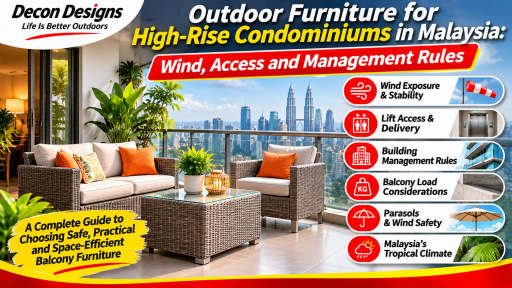
The Complete Guide to Choosing Safe, Practical and Space-Efficient Balcony Furniture for High-Rise Apartments — Understanding Wind Exposure, Furniture Stability, Lift Access, Building Regulations, Balcony Loads, Parasols and Malaysia’s Tropical Climate
By Decon Designs – Life Is Better Outdoors
High-Rise Condominium Furniture Malaysia | Balcony Furniture Malaysia | Outdoor Furniture Safety | Condo Balcony Design | Wind-Resistant Outdoor Furniture | Strata Management Rules | Outdoor Furniture Selangor | Patio Furniture Malaysia | Small Balcony Furniture | High-Rise Living Malaysia
Introduction: A Beautiful Balcony Is Not Enough — It Must Also Be Safe
High-rise condominium living has become an important part of Malaysia’s urban residential landscape.
From Kuala Lumpur and Petaling Jaya to Shah Alam, Subang Jaya, Penang and Johor Bahru, condominium developments offer residents access to elevated views, shared facilities and compact outdoor spaces.
For many residents, the balcony is one of the most attractive features of their home.
It can become a quiet place for morning coffee.
A reading corner.
A small garden.
A relaxation space.
Or an extension of the living room.
However, furnishing a high-rise balcony is not the same as furnishing a ground-level garden.
A furniture arrangement that works perfectly on a landed property’s patio may be unsuitable or unsafe on a condominium balcony.
At higher elevations, wind conditions can be different.
Furniture must pass through lifts, corridors and apartment entrances.
Balcony dimensions may be limited.
The structure has load restrictions.
Building management may regulate furniture placement, exterior appearance, renovations, drainage and the use of certain accessories.
Items that are lightweight and convenient at ground level can become dangerous if displaced by wind at height.
A large garden parasol may look attractive in a photograph but may not be suitable for an exposed high-rise balcony.
Similarly, a heavy outdoor dining set may create access difficulties or raise questions about structural loading.
For Malaysian condominium residents, the right approach is to consider safety, building rules and practicality before choosing furniture.
This guide by Decon Designs – Life Is Better Outdoors explains the major considerations involved in furnishing high-rise condominium balconies.
It covers wind exposure, furniture stability, material selection, balcony loads, management rules, delivery access, space planning, maintenance and purchasing decisions.
The goal is not simply to create a beautiful balcony. It is to create an outdoor space that can be used responsibly, comfortably and safely.
1. Why High-Rise Balcony Furniture Requires Special Planning
A balcony is an outdoor area connected to a building.
Unlike a garden, it is elevated above ground level and may be exposed to wind, rain and sunlight from different directions.
The design of the building can also influence airflow.
Wind may accelerate around corners or between towers.
Some balconies are recessed and relatively sheltered.
Others are exposed on several sides.
Two balconies on the same floor may experience different conditions depending on orientation and surrounding structures.
This means furniture selection should be based on the actual balcony rather than the building’s height alone.
Important considerations include:
- Wind exposure.
- Balcony dimensions.
- Structural load limits.
- Furniture stability.
- Building management requirements.
- Delivery and lift access.
- Rainwater drainage.
- Sun exposure.
- Maintenance.
- Emergency and maintenance access.
A suitable high-rise furniture arrangement should address all these factors.
2. Wind Exposure: The Biggest Difference Between a Garden and a High-Rise Balcony
Wind is one of the most important safety considerations for high-rise outdoor furniture.
At elevated locations, furniture may experience strong gusts, turbulent airflow or sudden changes in wind direction.
Building geometry can intensify local wind conditions.
A chair that remains stable in a sheltered garden may behave differently on an exposed balcony.
Lightweight objects can shift, overturn or become airborne.
This creates potential risks for residents, neighbouring properties and people below.
Why wind matters
Wind can act on furniture surfaces.
Large tabletops, chair backs, cushions and parasol canopies can catch airflow.
The risk depends on the object’s shape, weight, stability, placement and exposure.
It is not possible to determine whether a piece of furniture is safe for a particular high-rise balcony based only on its weight.
Furniture stability must be evaluated in relation to the actual environment and manufacturer guidance.
3. Can Outdoor Furniture Blow Off a Condominium Balcony?
Yes, unsecured or unsuitable items may be displaced by strong winds.
The risk is especially concerning for loose cushions, lightweight accessories, small tables and objects with large exposed surfaces.
A heavy item is not automatically safe.
Wind can also cause furniture to slide or overturn.
Residents should avoid placing loose items near balcony edges or railings.
Furniture should never be positioned in a way that creates a foreseeable falling-object hazard.
If the balcony is exposed to strong winds, consult building management and follow the furniture manufacturer’s recommendations.
For unusual or demanding conditions, professional advice may be necessary.
4. Are Garden Parasols Suitable for High-Rise Balconies?
Garden parasols require particular caution.
A parasol canopy presents a relatively large surface to wind.
Even when a parasol has a weighted base, strong gusts may create overturning or displacement forces.
A standard garden parasol should not be assumed suitable for an exposed high-rise balcony.
A heavy base does not guarantee safety.
A product described as wind-resistant is not necessarily safe for every balcony.
Residents should check whether the building permits parasols and whether the manufacturer specifically approves the product for the intended installation.
If suitability cannot be established, do not use the parasol.
Parasols should be closed and secured when not in use and during unsuitable weather, but closing one does not replace the need for an appropriate installation.
Questions to ask before considering a balcony parasol
- Does building management permit parasols?
- Is the balcony sufficiently sheltered?
- Does the manufacturer approve this application?
- What are the installation and securing requirements?
- Is the base appropriate for the product and conditions?
- Could the canopy extend beyond the balcony boundary?
- Could the parasol obstruct emergency access or maintenance?
For some high-rise balconies, avoiding a freestanding parasol may be the safest choice.
5. Furniture Weight: Why Heavier Is Not Always Better
Buyers sometimes assume that heavier furniture is automatically safer in windy conditions.
Weight can influence stability, but it is only one factor.
A heavy table with an unsuitable shape or support configuration may still overturn.
A heavy furniture set may also create difficulties with delivery and structural loading.
The correct approach is to balance stability, dimensions, intended use and the balcony’s structural limits.
Do not add improvised weights or permanently attach furniture to building elements without appropriate approval and technical guidance.
6. Understanding Balcony Structural Load Limits
Every balcony is designed to support loads within specified engineering limits.
The permissible load depends on the building’s structural design.
It should not be guessed from the balcony’s appearance, size or age.
Furniture, occupants, planters, storage items and other objects all contribute to loading.
Concentrated loads can also matter.
For example, a heavy planter or furniture leg may apply force over a relatively small contact area.
What condominium residents should do
Request the applicable balcony loading information from building management or the relevant building documentation.
If the information is unavailable or a proposed arrangement involves unusually heavy items, consult a qualified structural engineer.
Do not assume that a generic internet load figure applies to your specific condominium.
Never use an unverified balcony load estimate to justify placing heavy furniture or equipment on an elevated structure.
7. Malaysian Strata Management Rules: What Residents Should Understand
Many condominiums in Malaysia operate under strata management arrangements.
Relevant legislation includes the Strata Management Act 2013 (Act 757) and its subsidiary regulations, including prescribed by-laws and any valid additional by-laws applicable to the development.
Depending on the building and its management arrangements, rules may affect balcony use, alterations, external appearance and activities that create safety risks or nuisance.
The exact requirements can vary.
Residents should obtain the current house rules and applicable by-laws from their Joint Management Body (JMB), Management Corporation (MC) or appointed building management.
Do not assume that a practice permitted in one condominium is automatically permitted in another.
8. What Balcony Furniture Restrictions Might Building Management Impose?
Depending on the development, management rules may address:
- Items placed on balcony railings.
- Objects that could fall from height.
- Changes to the building’s exterior appearance.
- Installation of awnings or shade structures.
- Drilling into structural elements.
- Balcony enclosures.
- Drainage and water discharge.
- Obstruction of common property.
- Delivery and renovation procedures.
- Noise and nuisance.
- Storage of unsuitable materials.
Some developments may have specific rules regarding planters, laundry racks, screens, furniture or parasols.
Residents should obtain written clarification where necessary.
Building management approval and structural safety are separate considerations. Approval does not automatically establish that a furniture installation is technically safe.
9. Can You Install Privacy Screens on a Condominium Balcony?
Privacy screens may seem useful for creating a more comfortable outdoor space.
However, they can affect wind loading, exterior appearance and building maintenance.
Some screens may require fixing to railings, walls or other structural elements.
Residents should not install such products without checking applicable management rules and obtaining any necessary technical advice.
A screen can also act like a sail in strong wind.
The installation method, material and dimensions matter.
For some balconies, movable furniture arrangements may be preferable to permanent modifications.
10. Can You Install Artificial Grass or Outdoor Decking?
Artificial grass, interlocking deck tiles and other flooring products may be attractive options for balconies.
However, they can introduce practical concerns.
These include drainage obstruction, trapped moisture, slip resistance, added weight and interference with waterproofing or maintenance access.
Before installing flooring products, residents should check building rules and the balcony’s drainage requirements.
Do not cover drains or modify waterproofing systems without appropriate approval.
A decorative floor surface should not compromise the building’s performance.
11. Lift Access: Will Your Furniture Actually Reach Your Apartment?
One of the most common purchasing mistakes is choosing furniture without checking delivery access.
A large sofa may fit the balcony perfectly but fail to fit inside the service lift.
A dining table may be too wide for the apartment entrance.
A long bench may be difficult to manoeuvre around corridor corners.
For high-rise buyers, product dimensions are only the beginning.
Measure the entire delivery route
Check:
- Loading bay access.
- Service lift dimensions.
- Lift door opening.
- Lift weight capacity.
- Corridor widths.
- Corridor turning points.
- Apartment entrance dimensions.
- Internal doorways.
- Balcony access doors.
- Any steps or level changes.
Measure the packaged furniture where possible, not only the assembled product.
Packaging can increase the dimensions significantly.
12. Knockdown and Flat-Pack Furniture: Why It Can Be Useful
Knockdown furniture is designed to be assembled from separate components.
For condominium residents, this can offer practical advantages.
Smaller packages may be easier to move through lifts and corridors.
However, assembly still requires suitable space, tools and instructions.
The product must be assembled correctly.
Incorrect assembly can affect stability and performance.
Buyers should confirm whether professional assembly is required or recommended.
13. Delivery Rules in Malaysian Condominiums
Many condominium developments regulate large-item deliveries.
Requirements may include advance booking of service lifts, approved delivery hours, registration of contractors or delivery personnel, and protection of common areas.
Some buildings may require deposits or impose charges under their applicable rules.
These requirements are development-specific.
Before ordering furniture, confirm the delivery procedures with building management.
Also clarify whether the furniture seller’s delivery service includes moving items to the unit, unpacking and assembly.
A furniture purchase is not complete until the delivery arrangements are practical and agreed.
14. Small Balcony Furniture: Choosing the Right Size
High-rise balconies often have limited floor space.
A large sofa or dining set may occupy most of the available area.
This can reduce comfort and restrict movement.
A compact patio set may be more appropriate.
The goal is to create a useful outdoor space without overcrowding it.
Consider how the balcony will be used.
For morning coffee, a small table and two suitable chairs may be enough.
For reading, one comfortable chair and a compact side table may be more practical.
For a narrow balcony, avoid furniture that blocks the doorway or access to drains.
15. How to Measure a Condominium Balcony
Begin with the usable floor dimensions.
Record the width and depth.
Identify any columns, raised edges, doors, drains or permanent fixtures.
Consider the space needed to move chairs and walk around furniture.
Do not rely on the total balcony area shown in a property advertisement.
The usable furniture area may be smaller.
Example: A compact balcony layout
Imagine a balcony measuring 1.5 metres deep and 3 metres wide.
A small table and two chairs might fit, depending on their exact dimensions and placement.
However, a large outdoor sofa could leave insufficient circulation space.
The correct layout must be checked using actual product measurements.
This example illustrates planning only; it is not a structural or safety assessment.
16. Aluminium Furniture for High-Rise Balconies
Aluminium is commonly used in outdoor furniture.
It is relatively lightweight and does not rust in the same way as iron or steel.
These characteristics can make it practical for some condominium applications.
However, lightweight construction does not establish wind safety.
Frame design, stability, dimensions and intended use remain important.
Buyers should also check the quality of joints, finishes and fittings.
17. Powder-Coated Metal Furniture for Condominiums
Powder-coated metal chairs and tables may offer practical furniture options.
Some designs are stackable or compact.
However, the coating should be maintained appropriately.
Damaged coatings can expose susceptible metal to corrosion.
For high-rise balconies, stability and wind exposure must be evaluated independently of material choice.
A powder-coated steel chair is not automatically safe simply because it is heavier than an aluminium chair.
18. Synthetic Rattan Furniture for High-Rise Living
Synthetic rattan furniture is available in many compact patio and sofa designs.
Its woven appearance may complement residential balconies.
However, buyers should assess the complete product.
Important considerations include:
- Frame material.
- Weave quality.
- Overall dimensions.
- Cushion specifications.
- Furniture stability.
- Intended weather exposure.
- Maintenance requirements.
The term synthetic rattan does not identify a single material grade or guarantee outdoor durability.
19. Wooden Outdoor Furniture on Condominium Balconies
Wooden furniture may provide a natural appearance.
However, buyers should consider weight, dimensions, maintenance and moisture exposure.
Solid wood furniture can be relatively heavy depending on the design.
It may also require periodic care.
For high-rise use, the furniture’s stability and suitability must be assessed along with the balcony’s loading and access requirements.
20. Cushions and Loose Accessories: Small Items, Serious Wind Risks
Loose cushions may seem harmless.
But strong wind can displace them.
The same applies to lightweight decorative objects, table accessories and unsecured covers.
Residents should follow manufacturer guidance for securing or storing removable components.
Do not leave loose items exposed during strong winds or when the balcony is unattended if displacement is possible.
Avoid placing objects on balcony railings.
A well-organised balcony should minimise falling-object hazards.
21. Glass-Top Tables: What Buyers Should Consider
Some outdoor furniture includes glass tabletops.
Glass can provide an attractive and practical surface, but it must be suitable for the furniture design and intended application.
Buyers should confirm the type of glass, how it is supported and secured, and the manufacturer’s care instructions.
Do not assume that every glass tabletop is appropriate for exposed high-rise use.
If the tabletop is removable, ask how it should be handled and secured.
22. Stackable Chairs: Practical, but Storage Matters
Stackable chairs can help save space.
They may be useful when extra seating is needed only occasionally.
However, stacked furniture should not be left in an unstable arrangement.
A tall stack may present additional risks in windy conditions.
Follow the manufacturer’s stacking instructions.
Store unused chairs in a suitable location.
23. Folding Furniture for Small Balconies
Folding chairs and tables can offer flexibility.
They may be useful for compact balconies where permanent furniture would restrict movement.
However, folding mechanisms must be used correctly.
Check locking features and stability.
Do not assume that folded furniture can safely remain outdoors in strong winds.
Store it appropriately when not in use.
24. Creating a Balcony Coffee Corner
A simple coffee corner may require only a compact table and suitable seating.
Choose furniture that fits comfortably without blocking access.
Avoid placing items near the balcony edge where they could create a falling-object risk.
Consider the direction of sunlight and wind.
The arrangement should be practical for everyday use and easy to clear when necessary.
25. Creating a High-Rise Reading Corner
A reading corner can be a pleasant use of a sheltered balcony.
One comfortable chair and a small side table may be sufficient.
However, comfort should not take priority over safety.
Choose furniture suitable for the exposure conditions.
Keep loose books, cushions and accessories appropriately secured or stored.
26. Balcony Dining: Is It Practical?
Some condominium balconies may accommodate compact dining arrangements.
Others may be too narrow.
Before purchasing, consider:
- Seating capacity.
- Table dimensions.
- Chair movement.
- Door clearance.
- Wind exposure.
- Building rules.
- Structural loading.
- Cleaning and drainage.
A small patio set may be more practical than a full dining arrangement.
27. High-Rise Balcony Furniture and Malaysia’s Tropical Climate
Malaysia’s climate creates additional maintenance requirements.
Outdoor furniture may experience strong sunlight, heavy rainfall and humidity.
Balconies can also have different exposure conditions depending on orientation.
A sheltered balcony may receive little direct rain.
An exposed balcony may experience wind-driven rain.
Materials and cushions should be selected according to the actual environment.
Follow product-specific maintenance instructions.
28. Drainage: Never Block Balcony Water Outlets
Balcony drainage is an important building function.
Furniture, planters and flooring accessories should not obstruct drainage outlets.
Blocked drains can contribute to standing water and other problems.
Keep access available for cleaning and maintenance.
If drainage appears inadequate, report the issue to building management rather than making unapproved modifications.
29. Balcony Furniture and Fire Safety
Furniture should not obstruct doors, designated escape routes or access required for emergency response and maintenance.
Residents should comply with applicable building and fire-safety requirements.
Avoid storing combustible materials or hazardous items in prohibited locations.
Do not assume that a balcony can safely be used as a general storage area.
30. Balcony Furniture and Children
High-rise balconies require particular attention where children are present.
Furniture should not be positioned in a way that makes balcony railings easier to climb.
Chairs, tables, benches and storage items placed near railings can create serious hazards.
Children should be appropriately supervised, and balcony access should be managed according to household circumstances and building safety requirements.
Do not place climbable furniture near balcony barriers.
This is more important than achieving a particular decorative layout.
31. Balcony Furniture and Pets
Pets may also be exposed to risks on high-rise balconies.
Furniture placement should not create routes over or through balcony barriers.
Residents should consider the pet’s behaviour, the balcony design and applicable building rules.
Do not assume that a balcony is safe for an unattended pet.
32. How to Choose Furniture for a Wind-Exposed Balcony
The correct decision depends on the specific balcony.
For exposed locations, consider whether outdoor furniture is appropriate at all under the prevailing conditions.
Where furniture is permitted and suitable, prioritise products whose manufacturers provide relevant use and stability guidance.
Avoid large wind-catching surfaces and unsecured accessories.
Do not rely on improvised anchoring methods.
If there is uncertainty about wind safety, consult building management and an appropriately qualified professional.
33. High-Rise Balcony Furniture Buying Checklist
Before buying, ask the following questions.
| Question | Why it matters |
|---|---|
| Is the furniture permitted by building management? | Compliance with applicable rules |
| Is the balcony suitable for the intended use? | Safety and practicality |
| What wind conditions affect the balcony? | Stability and falling-object risk |
| Is the furniture approved for the intended exposure? | Product suitability |
| What is the balcony’s structural load limit? | Structural safety |
| What are the furniture dimensions? | Space planning |
| What are the packaged dimensions? | Delivery access |
| Will the product fit in the lift? | Delivery feasibility |
| Does the furniture require assembly? | Installation planning |
| Can the furniture be safely stored? | Wind and space management |
| Are there loose cushions or accessories? | Falling-object risk |
| What materials are used? | Maintenance and weather performance |
| Are drains and doors kept clear? | Building function and access |
| What warranty and return terms apply? | Purchase protection |
A responsible high-rise furniture purchase begins with these questions, not with the product photograph.
34. Common Mistakes When Furnishing Condominium Balconies
Mistake One: Buying a large patio set without measuring
This can result in overcrowding or delivery problems.
Mistake Two: Assuming all outdoor furniture is suitable for high-rise use
Outdoor suitability does not automatically establish high-rise wind safety.
Mistake Three: Using a large parasol without approval
Parasols can create significant wind-related hazards.
Mistake Four: Placing furniture near balcony railings
This may increase falling-object or climbing risks.
Mistake Five: Ignoring balcony load limits
Heavy furniture and planters should not be installed based on assumptions.
Mistake Six: Forgetting lift dimensions
Furniture may not fit through the delivery route.
Mistake Seven: Ignoring management rules
Unauthorised installations may create compliance problems.
Mistake Eight: Leaving loose accessories exposed
Wind can displace cushions and other objects.
Mistake Nine: Blocking drainage
This can interfere with water management.
Mistake Ten: Choosing appearance over safety
A visually attractive arrangement is not worthwhile if it creates hazards.
35. Decon Designs: Outdoor Furniture for Malaysian Homes
Decon Designs has more than 20 years of experience in Malaysia’s outdoor and hospitality furniture market.
Its product categories have included garden chairs, patio sets, dining furniture, sofas, tables, parasols and other outdoor living products.
However, not every outdoor furniture product is suitable for every environment.
For high-rise condominium applications, customers should confirm the specific model’s dimensions, materials, construction and intended-use limitations.
Building management requirements and relevant technical advice should also be considered.
Decon Designs – Life Is Better Outdoors means creating practical and enjoyable outdoor spaces while respecting the conditions in which furniture will be used.
36. Selected Decon Designs Furniture Examples for Space Planning
The following products have previously appeared in Decon Designs clearance campaign information.
They are examples for comparison, not endorsements or safety certifications for high-rise balcony use.
Immo Patio Set
Model: JHA-90318B
Previous listed price: RM899
Clearance price: RM499
Previously specified features include powder-coated metal mesh construction and folding components.
The stated table dimensions are approximately 55 × 44 × 72 cm.
Customers should confirm the complete configuration and whether the product is appropriate for the intended balcony.
Domi Dining Chair
Model: JHA-0202C
Previous listed price: RM398
Clearance price: RM199
Previously specified features include powder-coated iron construction, HDPE seat and backrest, and stackable design.
Its stated dimensions are approximately 54 × 63 × 83 cm.
Stackability does not establish suitability for exposed high-rise conditions.
Aliyas Side Table
Model: JHA-50881
Previous listed price: RM199
Clearance price: RM79
Previously specified dimensions are approximately 45 × 45 × 36.5 cm.
A compact size does not automatically establish wind stability.
Orphic Patio Set
Model: JHA-50376
Previous listed price: RM2,198
Clearance price: RM999
Previously specified features include synthetic rattan, water-resistant cushions, tempered glass and a space-saving design.
The actual dimensions, component security and intended exposure should be confirmed.
Important: These previously advertised prices are not a live stock check. Current availability, specifications and suitability must be verified before purchasing.
37. Decon Designs Year-End Stock Clearance 2026
Decon Designs is conducting its Year-End Stock Clearance 2026 as part of a business downsizing and inventory-reduction exercise.
Selected existing outdoor furniture inventory is being offered at promotional prices.
Campaign: Decon Designs Year-End Stock Clearance 2026
Campaign message: Everything Must Go!
Sale period: 1 November – 31 December 2026
Availability: Limited stock, first come, first served.
Official promotion page:
https://decondesigns.com/product-category/promotion/
The clearance is an inventory-reduction exercise, not an announcement that the Decon Designs brand is closing.
Customers should confirm current prices, stock, product conditions, delivery arrangements and sale terms.
For high-rise installations, they should also confirm management approval and product suitability before purchasing.
38. Frequently Asked Questions About High-Rise Balcony Furniture in Malaysia
Can I put outdoor furniture on my condominium balcony?
That depends on the building’s applicable rules, the balcony’s structural limits and the suitability of the furniture.
What is the best outdoor furniture for a high-rise balcony?
There is no universally best product. Furniture must be selected according to dimensions, wind exposure, stability, structural loading and management requirements.
Are lightweight aluminium chairs safe for high-rise balconies?
Not automatically. Lightweight furniture may be vulnerable to displacement in strong winds.
Is heavier furniture always safer?
No. Weight alone does not establish wind stability or structural suitability.
Can I use a garden parasol on a high-rise balcony?
Do not assume so. Confirm building rules, manufacturer approval and the suitability of the installation. In exposed locations, a standard freestanding parasol may be inappropriate.
Can I install outdoor decking on my balcony?
Check applicable management rules, drainage requirements, waterproofing considerations and structural loading before installation.
Do I need permission to install a privacy screen?
Permission may be required, particularly where the screen affects exterior appearance or building elements. Confirm with management.
Can I place a large outdoor sofa on my balcony?
Only if it fits, the structural and safety requirements are satisfied, and building rules permit it.
What if my furniture does not fit in the service lift?
Discuss the delivery route and alternatives with the seller before ordering. Do not attempt unsafe lifting or unapproved external hoisting.
Are glass-top patio tables suitable for high-rise balconies?
Suitability depends on the specific product, its design, component security and the exposure conditions.
Can I leave cushions outside permanently?
Follow the product’s care instructions and consider wind, rain and storage requirements.
Can I place furniture beside the balcony railing?
Avoid arrangements that create falling-object or climbing hazards, particularly where children may have access.
Who should I ask about balcony load limits?
Contact building management for the relevant structural information. Consult a qualified structural engineer where necessary.
Where can I explore compact outdoor furniture in Malaysia?
Visit the Decon Designs promotional collection at https://decondesigns.com/product-category/promotion/ and confirm product suitability before ordering.
Conclusion: The Best High-Rise Balcony Furniture Is Furniture That Fits the Building, Not Just the Space
A condominium balcony can become a comfortable extension of the home.
It may provide a place for morning coffee, reading, relaxation or enjoying the surrounding view.
But high-rise outdoor living requires more planning than a ground-level patio.
Wind exposure matters.
Structural loading matters.
Furniture stability matters.
Lift access matters.
Building management rules matter.
And the safety of residents and people below matters most.
A compact patio set may be attractive.
A garden chair may be comfortable.
A parasol may offer shade.
But no product should be selected without considering the specific conditions of the balcony.
BEFORE BUYING HIGH-RISE BALCONY FURNITURE, ASK THREE QUESTIONS:
IS IT SAFE FOR THE LOCATION?
CAN IT REACH AND FIT THE SPACE?
DOES BUILDING MANAGEMENT PERMIT IT?
When these questions are properly addressed, residents can make more informed furniture decisions.
Explore selected outdoor furniture during the Decon Designs Year-End Stock Clearance 2026.
EVERYTHING MUST GO!
1 NOVEMBER – 31 DECEMBER 2026
LIMITED STOCK | FIRST COME, FIRST SERVED
EXPLORE THE CLEARANCE COLLECTION:
https://decondesigns.com/product-category/promotion/
Decon Designs – Life Is Better Outdoors.