
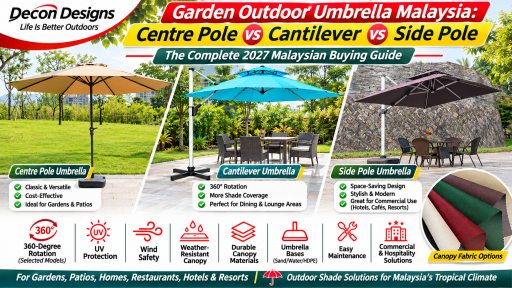
The Complete 2027 Malaysian Buying Guide to Garden Parasols, Outdoor Umbrellas, Centre-Pole Umbrellas, Cantilever Parasols, Side-Pole Designs, 360-Degree Rotation, Canopy Materials, UV Protection, Wind Safety, Umbrella Bases, Maintenance and Commercial Outdoor Shade Solutions
By Decon Designs – Life Is Better Outdoors
Garden Outdoor Umbrella Malaysia | Outdoor Parasol Supplier Malaysia | Centre Pole Umbrella | Cantilever Parasol | Side Pole Umbrella | Garden Shade | Patio Umbrella Malaysia | Hotel & Resort Parasols | Restaurant Outdoor Umbrellas | Outdoor Furniture Malaysia
Introduction: Choosing the Right Outdoor Umbrella for Malaysia’s Tropical Climate
A garden umbrella is more than a decorative outdoor accessory.
It is an important part of creating comfortable, functional and attractive outdoor living spaces.
In Malaysia, where strong sunlight, high temperatures, tropical rainfall and changing weather conditions influence outdoor activities, the right umbrella can make a substantial difference to how people use their gardens, patios, swimming pool areas and outdoor dining spaces.
For homeowners, an outdoor umbrella may provide shade for family meals, afternoon relaxation or weekend gatherings.
For restaurants and cafés, it can help make outdoor seating areas more comfortable.
For hotels and resorts, a well-chosen parasol can contribute to the appearance and usability of poolside facilities.
For condominium management teams, outdoor umbrellas may form part of shared recreational areas.
However, choosing the right umbrella is not simply a matter of selecting a canopy colour or size.
One of the most important decisions is choosing between three common umbrella configurations:
Centre-pole umbrellas, cantilever umbrellas and side-pole umbrellas.
These designs differ in how they support the canopy, where the pole is positioned, how shade is distributed and which furniture arrangements they accommodate.
Some umbrellas offer fixed shade positions.
Others may include tilting or rotation mechanisms.
Certain cantilever and side-pole models offer 360-degree rotation, while others do not.
The base, canopy material, frame construction and operating limitations are equally important.
At Decon Designs – Life Is Better Outdoors, with more than 20 years of experience in Malaysia’s outdoor and hospitality furniture industry, we encourage customers to understand the differences between umbrella designs before making a purchase.
This comprehensive guide explains how to compare centre-pole, cantilever and side-pole umbrellas, evaluate shade coverage, understand materials and bases, and select suitable products for Malaysian homes and commercial environments.
1. What Is a Garden Outdoor Umbrella?
A garden outdoor umbrella is a freestanding or otherwise appropriately supported shade structure designed for outdoor use.
It generally consists of:
- A canopy.
- A supporting pole or frame.
- An opening mechanism.
- Ribs or supporting arms.
- A base or approved mounting system.
Some models also include adjustable arms, tilt mechanisms or rotation features.
Garden umbrellas are commonly used in:
- Residential gardens.
- Patios.
- Outdoor dining areas.
- Restaurants and cafés.
- Hotel swimming pools.
- Resorts.
- Commercial courtyards.
- Rooftop terraces, where appropriate.
- Outdoor event spaces.
The umbrella must be suitable for the location and operated according to its manufacturer’s instructions.
2. Centre Pole vs Cantilever vs Side Pole: Understanding the Difference
The primary distinction is the position of the supporting pole.
A centre-pole umbrella has a pole positioned beneath the central part of the canopy.
A cantilever umbrella supports the canopy from an offset arm or structure.
A side-pole umbrella also places the main supporting pole to one side of the shaded area.
In common retail terminology, cantilever and side-pole umbrellas often describe overlapping designs.
However, manufacturers may use these terms to distinguish different frame structures or product collections.
Buyers should compare actual mechanisms rather than relying only on the product name.
3. Quick Comparison: Which Outdoor Umbrella Is Right for You?
| Feature | Centre pole | Cantilever | Side pole |
|---|---|---|---|
| Pole position | Central | Offset | Offset |
| Typical application | Dining tables and compact seating | Lounge and dining areas | Patios and lounge areas |
| Central space | Occupied by pole | Generally unobstructed | Generally unobstructed |
| Canopy shapes | Round, square, rectangular | Round, square, rectangular | Round, square, rectangular |
| Rotation | Model-dependent | Model-dependent | Model-dependent |
| Tilt adjustment | Model-dependent | Model-dependent | Model-dependent |
| Base requirement | Product-specific | Product-specific | Product-specific |
| Space needed | Often compact | Requires offset support clearance | Requires offset support clearance |
| Typical advantage | Simple shade arrangement | Flexible furniture placement | Pole positioned away from seating |
Important: Not every cantilever umbrella rotates 360 degrees. Not every side-pole umbrella tilts. Product-specific specifications must be confirmed.
4. Centre-Pole Outdoor Umbrellas: The Traditional Design
Centre-pole umbrellas are among the most recognizable garden umbrella designs.
The pole supports the canopy from the central area.
They are commonly used with outdoor dining tables that have a compatible umbrella hole.
They may also be used independently with an appropriate base.
Advantages
- Familiar and straightforward design.
- Suitable for many outdoor dining arrangements.
- Available in different canopy sizes and shapes.
- Often relatively simple to position.
- May be suitable for compact outdoor spaces.
Limitations
- The pole occupies central space.
- Furniture must be arranged around the pole.
- Shade position depends on the sun and product features.
- Some models have limited adjustment options.
A centre-pole umbrella can be a practical solution where the furniture arrangement is compatible with its pole position.
5. When Should You Choose a Centre-Pole Umbrella?
Consider a centre-pole umbrella when:
- You have an outdoor dining table with a compatible umbrella opening.
- Your patio has limited space for offset support structures.
- You want a straightforward umbrella arrangement.
- You prefer a relatively simple opening mechanism.
- The intended shaded area is centred around a table.
Before purchasing, check the umbrella pole diameter and table opening.
Also confirm that the base is compatible with the product and installation conditions.
6. Cantilever Outdoor Umbrellas: Shade Without a Central Pole
A cantilever umbrella uses an offset support arrangement.
The canopy extends away from the main pole.
This can create usable space beneath the canopy without a central obstruction.
Cantilever umbrellas are commonly used with:
- Outdoor sofa sets.
- Garden lounges.
- Swimming pool seating.
- Patio dining areas.
- Resort relaxation zones.
Their design may allow furniture to be positioned more freely.
However, the offset structure creates different loading and stability requirements.
An appropriate base or approved mounting arrangement is essential.
7. Advantages of Cantilever Umbrellas
Cantilever umbrellas may offer several practical advantages.
More Flexible Furniture Placement
The main pole can be positioned away from the centre of the seating arrangement.
Suitable for Lounge Areas
The canopy can extend over sofas, loungers or coffee tables.
Contemporary Appearance
Many cantilever designs complement modern outdoor furniture.
Adjustable Features on Selected Models
Some models offer rotation, tilt or other positioning functions.
Potentially Broad Shade Coverage
Larger canopies may shade substantial areas, subject to the sun’s position.
However, these advantages depend on the actual model and site conditions.
8. Limitations of Cantilever Umbrellas
Cantilever umbrellas also require careful evaluation.
Potential limitations include:
- Larger support structures.
- Greater base requirements.
- Additional clearance around the pole.
- More complex mechanisms.
- Higher sensitivity to improper installation.
- Product-specific wind limitations.
The size and offset design may make some models unsuitable for compact balconies or exposed high-rise locations.
9. Side-Pole Outdoor Umbrellas: Understanding the Design
A side-pole umbrella places the main pole away from the central shaded area.
This can be useful for outdoor seating and dining arrangements where a centre pole would interfere with furniture placement.
The term may refer to different offset umbrella designs.
Some side-pole products use a hanging canopy arrangement.
Others use a more rigid supporting arm.
Certain models include rotation mechanisms, while others have fixed configurations.
A side-pole umbrella should be evaluated according to its actual frame, canopy, base and adjustment features.
10. Cantilever vs Side Pole: Are They the Same?
In many product catalogues, cantilever and side-pole umbrellas are closely related terms.
Both generally describe offset-supported umbrellas.
The distinction may depend on the manufacturer.
A supplier may market one model as a cantilever umbrella and another as a side-pole parasol even when both have similar pole positioning.
Therefore, buyers should compare:
- Supporting arm design.
- Canopy size.
- Opening mechanism.
- Rotation function.
- Tilt function.
- Base requirements.
- Overall dimensions.
The product specification is more important than the category label.
11. Understanding 360-Degree Rotation
Some outdoor umbrellas include a rotation mechanism that allows the canopy to turn around the supporting pole.
This can be useful when the direction of sunlight changes.
However, not every offset umbrella has this feature.
Some models have fixed canopy positions.
Others rotate only through a limited range.
For Decon Designs products, rotation and adjustment claims must always be checked against the exact model.
For example, selected square side-pole models may offer 360-degree rotation, while certain round parasol models do not.
Never assume that a feature applies to every umbrella in a supplier’s collection.
12. Fixed Umbrellas vs Adjustable Umbrellas
Fixed umbrellas provide shade in a predetermined position.
Adjustable umbrellas may offer one or more functions, including:
- Canopy tilt.
- Height adjustment.
- Rotation.
- Arm repositioning.
These features vary by model.
Additional mechanisms can provide convenience but may also require inspection and maintenance.
Buyers should test the adjustment functions where possible.
13. Round vs Square vs Rectangular Outdoor Umbrellas
Canopy shape affects appearance and shade distribution.
Round Umbrellas
Often used for garden tables, compact patios and casual seating.
Square Umbrellas
May complement square dining arrangements and certain contemporary patio layouts.
Rectangular Umbrellas
May be suitable for longer dining tables or elongated seating areas.
However, actual shade coverage depends on canopy dimensions, sun angle and installation position.
A larger canopy does not necessarily provide better shade throughout the entire day.
14. How to Choose the Right Umbrella Size
Begin by measuring the area you want to shade.
Consider:
- Furniture dimensions.
- Seating positions.
- Available clearance.
- Pole location.
- Canopy projection.
- Surrounding walls and trees.
- Opening clearance.
- Sun direction.
For example, a dining table may require shade that extends beyond the tabletop to cover seated guests.
However, oversized umbrellas can introduce stability and clearance problems.
The correct size should be selected according to the site and manufacturer recommendations.
15. Understanding Shade Coverage
An umbrella’s advertised canopy dimensions describe its physical size.
They do not guarantee a fixed shaded area on the ground.
Shade changes according to:
- Time of day.
- Sun elevation.
- Canopy height.
- Canopy angle.
- Pole position.
- Nearby structures.
A canopy may provide effective overhead shade at midday but less coverage when the sun is low.
This is one reason some buyers consider adjustable models.
16. Outdoor Umbrella Materials: Why the Frame Matters
Common frame materials include aluminium, steel and selected other metals or composites.
Aluminium
Often selected because it is relatively lightweight and resistant to ordinary red rust.
Steel
Can provide strength but requires appropriate corrosion protection.
Other Materials
Suitability depends on the manufacturer’s design and specifications.
Buyers should inspect joints, fasteners, moving parts and protective finishes.
17. Powder-Coated Aluminium Umbrella Frames
Powder-coated aluminium is commonly used in outdoor parasols.
Potential advantages include:
- Relatively low weight.
- Resistance to ordinary red rust.
- Different finish colours.
- Compatibility with various frame designs.
However, aluminium frames are not automatically maintenance-free.
Buyers should check the coating, joints and mechanisms.
In coastal environments, corrosion-resistant fasteners and suitable maintenance are particularly important.
18. Steel Umbrella Frames
Steel can provide structural strength.
However, ordinary steel may corrode when moisture reaches exposed metal.
Protective coatings and maintenance are therefore important.
For commercial installations, customers should confirm whether the frame is suitable for the intended outdoor environment.
19. Umbrella Canopy Fabrics: Polyester, Acrylic and Other Options
Outdoor umbrella canopies may use different textile materials.
Common examples include:
- Polyester.
- Solution-dyed acrylic.
- Other outdoor-grade woven fabrics.
Performance depends on:
- Fibre composition.
- Fabric weight.
- UV stabilisation.
- Colourfastness.
- Water resistance.
- Coatings.
- Stitching.
A fabric should not be judged solely by its colour or thickness.
20. Polyester Outdoor Umbrella Canopies
Polyester is commonly used in outdoor umbrella canopies.
It can be manufactured in different weights and finishes.
Some polyester fabrics include water-repellent treatments or UV-related performance features.
However, product quality varies.
Buyers should request relevant fabric specifications.
21. Acrylic Outdoor Umbrella Canopies
Certain solution-dyed acrylic fabrics are designed for outdoor applications.
They may offer useful colour retention and weather-related performance characteristics.
However, acrylic fabrics vary by manufacturer and specification.
The term acrylic alone does not establish a particular level of UV protection or waterproofing.
22. UV Protection: What Does It Really Mean?
Outdoor umbrellas are often promoted as providing UV protection.
However, UV protection depends on the fabric and construction.
Important factors include:
- Fabric density.
- Fibre composition.
- UV treatments.
- Canopy condition.
- Shade coverage.
A UPF rating, where available, can provide more specific information about ultraviolet protection.
Buyers should distinguish between verified UPF performance and general marketing statements.
An umbrella also does not eliminate UV exposure from reflected or indirect sunlight.
23. Water-Resistant vs Waterproof Umbrella Canopies
These terms should not be confused.
Water-resistant canopies are designed to resist limited moisture penetration.
Waterproof materials are intended to prevent water penetration under specified conditions.
However, seams, stitching, ventilation openings and construction details can influence the performance of the complete canopy.
A garden umbrella should not automatically be treated as a permanent rain shelter.
24. Can Garden Umbrellas Be Used During Heavy Rain?
Outdoor umbrellas may provide limited protection from light rain when designed for that purpose.
However, heavy rainfall can create additional loads and operating risks.
Strong wind, thunderstorms and severe weather can make umbrella use unsafe.
Customers should follow the manufacturer’s instructions and close umbrellas when conditions exceed their operating limits.
An outdoor umbrella is not a substitute for a properly engineered permanent shelter.
25. Wind Safety: The Most Important Umbrella Buying Consideration
Wind can exert substantial forces on an umbrella canopy.
This is particularly important for large cantilever and side-pole designs.
Potential risks include:
- Umbrella overturning.
- Base movement.
- Frame damage.
- Canopy damage.
- Falling components.
- Injury or property damage.
Never assume that a heavy base makes an umbrella safe in all wind conditions.
Wind suitability depends on the complete product, installation and manufacturer guidance.
26. Why Outdoor Umbrellas Need Suitable Bases
An umbrella base helps support the structure and resist movement or overturning.
The required base depends on:
- Umbrella design.
- Canopy size.
- Pole configuration.
- Manufacturer requirements.
- Installation conditions.
Centre-pole and offset umbrellas may have very different base requirements.
An undersized or incompatible base can create safety risks.
27. Water-Filled vs Sand-Filled Umbrella Bases
Some umbrella bases are designed to be filled with water or sand.
The resulting mass depends on the container capacity and filling material.
Sand may provide more weight than the same volume of water, but actual performance depends on the complete design.
Buyers should follow the manufacturer’s specified filling instructions.
Do not assume that filling a base with a different material automatically improves safety.
28. Cross Bases and Weighted Base Systems
Certain cantilever umbrellas use cross-shaped support structures with separate weights.
Other designs use integrated bases or approved anchoring systems.
The correct configuration depends on the model.
Customers should not substitute an unrelated base without verifying compatibility.
29. Freestanding vs Fixed Umbrella Installation
Freestanding umbrellas use suitable bases.
Fixed installations may involve approved anchoring systems.
Permanent anchoring can require assessment of the supporting surface and installation details.
For commercial projects, qualified installation advice may be necessary.
Customers should not drill into condominium structures, waterproofed surfaces or shared property without appropriate permission and professional assessment.
30. Garden Umbrellas for Small Patios
Compact patios may benefit from centre-pole umbrellas or appropriately sized offset designs.
The correct choice depends on:
- Furniture layout.
- Available clearance.
- Base footprint.
- Sun direction.
- Wind exposure.
A large cantilever umbrella may occupy more usable space than expected because of its base and supporting arm.
31. Outdoor Umbrellas for Garden Dining Sets
For outdoor dining, centre-pole umbrellas may work well with tables designed to accommodate them.
Cantilever or side-pole umbrellas may be useful when buyers want to avoid a pole passing through the table.
The best choice depends on the table dimensions and seating arrangement.
32. Outdoor Umbrellas for Sofa Sets
Outdoor sofa arrangements may benefit from offset umbrellas because the pole can be positioned away from the seating area.
However, canopy projection and base clearance must be evaluated.
The umbrella should not obstruct access or create a hazard near seating.
33. Outdoor Umbrellas for Swimming Pools
Poolside umbrellas may provide shade for loungers and relaxation areas.
Important considerations include:
- Corrosion resistance.
- Stability.
- Pool deck layout.
- Clearance.
- Maintenance.
- Wind exposure.
Commercial operators should ensure umbrellas do not obstruct circulation or pool safety equipment.
34. Outdoor Umbrellas for Hotels and Resorts
Hotels and resorts may require multiple umbrellas across different areas.
Procurement teams should consider:
- Canopy dimensions.
- Frame construction.
- Fabric specifications.
- Operating mechanisms.
- Replacement canopies.
- Maintenance.
- Installation requirements.
- Staff training.
A consistent maintenance programme can help reduce operational risks.
35. Outdoor Umbrellas for Restaurants and Cafés
Restaurants often use umbrellas to improve outdoor seating comfort.
Centre-pole models may suit compatible dining tables.
Cantilever designs may be useful where unobstructed seating arrangements are preferred.
However, umbrella bases should not create trip hazards or obstruct pedestrian routes.
36. Outdoor Umbrellas for Condominium Facilities
Condominium management teams should evaluate umbrella safety carefully.
Shared outdoor areas may experience frequent use.
Important considerations include:
- Wind exposure.
- Base stability.
- Product maintenance.
- Safe positioning.
- Management approval.
- Replacement availability.
High-rise balconies require particularly careful assessment and may be unsuitable for large freestanding umbrellas.
37. Outdoor Umbrellas for Rooftop Terraces
Rooftop environments may experience stronger or more turbulent winds than sheltered ground-level patios.
Large umbrellas should not be installed solely based on appearance.
Site-specific assessment, appropriate product selection and installation guidance are important.
For exposed commercial rooftops, permanent engineered shade solutions may sometimes be more appropriate.
38. Umbrella Colours: Choosing the Right Canopy
Outdoor umbrellas are available in many colours.
Common options include:
- Off-white.
- Khaki.
- Coffee.
- Green.
- Maroon.
- Grey.
- Black.
Colour selection may influence appearance, perceived brightness and surface heating.
However, UV protection and weather performance depend on fabric specifications, not colour alone.
39. Light vs Dark Umbrella Canopies
Light-coloured canopies may create a bright and airy appearance.
Dark-coloured canopies may provide stronger visual contrast.
However, dark surfaces may absorb more solar heat under comparable conditions.
Buyers should consider comfort, design and maintenance alongside appearance.
40. How to Maintain an Outdoor Umbrella
A practical maintenance routine includes:
- Remove loose dirt.
- Clean the canopy according to fabric instructions.
- Inspect the frame.
- Check moving mechanisms.
- Inspect fasteners.
- Check the base.
- Allow wet fabric to dry before prolonged storage.
- Close and secure the umbrella when not in use, according to instructions.
Maintenance frequency depends on exposure and usage.
41. Common Outdoor Umbrella Problems
Potential problems include:
Faded Canopies
Sunlight and ageing may affect fabric appearance.
Damaged Ribs
Improper operation or wind loading may damage supporting components.
Difficult Opening Mechanisms
Moving parts may become worn or require maintenance.
Loose Fasteners
Connections may loosen over time.
Base Instability
Incorrect installation or inadequate support can create risks.
Fabric Damage
Tears, worn stitching or abrasion may reduce canopy performance.
42. Can Outdoor Umbrella Canopies Be Replaced?
Some umbrella models allow canopy replacement.
However, replacement compatibility depends on the frame and canopy design.
Buyers should ask whether replacement fabric or other components are available.
A replaceable canopy may help extend the useful life of a serviceable umbrella frame.
43. How Long Does an Outdoor Umbrella Last in Malaysia?
There is no universal lifespan.
Durability depends on:
- Frame construction.
- Canopy material.
- UV exposure.
- Wind conditions.
- Rainfall.
- Maintenance.
- Storage.
- Frequency of use.
An umbrella used in a sheltered residential garden may experience different conditions from one installed beside a busy coastal resort pool.
44. Outdoor Umbrella Price Malaysia: What Determines the Cost?
Pricing depends on:
- Canopy size.
- Frame material.
- Fabric specification.
- Opening mechanism.
- Rotation or tilt features.
- Base requirements.
- Brand.
- Warranty.
- Delivery.
- Installation.
A larger or more expensive umbrella is not automatically more suitable for a particular location.
45. Illustrative Outdoor Umbrella Budget Planning
The following figures are hypothetical budgeting examples, not verified current Malaysian retail prices.
| Umbrella category | Illustrative planning budget |
|---|---|
| Compact centre-pole umbrella | RM150–RM500 |
| Larger garden centre-pole umbrella | RM400–RM1,200 |
| Basic offset umbrella | RM500–RM1,500 |
| Larger cantilever or side-pole umbrella | RM1,200–RM4,000 |
| Commercial-grade shade arrangement | Quotation-dependent |
Base, delivery and installation costs may be additional.
Actual quotations should be obtained from suppliers.
46. How to Choose a Reliable Outdoor Umbrella Supplier in Malaysia
Before purchasing, ask:
- What is the umbrella’s canopy size?
- What material is used for the frame?
- What fabric is used?
- Does the model rotate?
- Does it tilt?
- What base is required?
- Is the base included?
- What are the operating limitations?
- Are replacement components available?
- What warranty applies?
A knowledgeable supplier should explain the actual product features rather than making general claims about every umbrella type.
47. Buying Garden Umbrellas From a Showroom
A showroom visit may help customers inspect:
- Canopy size.
- Opening mechanism.
- Frame construction.
- Pole position.
- Fabric appearance.
- Base design.
Where possible, ask for a demonstration of the specific model.
Do not assume that a display umbrella includes every accessory shown.
48. Buying Garden Umbrellas Online in Malaysia
Online shopping can make it easier to compare models.
However, buyers should confirm:
- Complete dimensions.
- Base requirements.
- Included accessories.
- Adjustment features.
- Delivery charges.
- Assembly requirements.
- Warranty.
- Seller credibility.
Product photographs may not reveal the full size or weight of the supporting base.
49. Common Garden Umbrella Buying Mistakes
Mistake 1: Assuming Every Cantilever Umbrella Rotates
Rotation depends on the model.
Mistake 2: Buying an Incompatible Base
This may create safety risks.
Mistake 3: Choosing Only by Canopy Size
Shade coverage changes with sun position.
Mistake 4: Ignoring Wind Exposure
Large canopies can experience substantial wind forces.
Mistake 5: Assuming Every Umbrella Is Waterproof
Fabric and construction specifications vary.
Mistake 6: Forgetting Base Clearance
The base may obstruct furniture or walkways.
Mistake 7: Ignoring Replacement Parts
Repairs may become difficult.
Mistake 8: Leaving Umbrellas Open During Severe Weather
This may create serious safety risks.
Mistake 9: Assuming Every Side-Pole Umbrella Has Tilt Adjustment
Adjustment features vary by model.
Mistake 10: Buying Without Measuring
The umbrella may not fit or open properly.
50. Decon Designs Year-End Stock Clearance Sale 2026
Decon Designs is conducting its Year-End Stock Clearance Sale 2026 as part of a business downsizing exercise.
Promotion period: 1 November – 31 December 2026.
Selected existing furniture and outdoor accessories are offered at promotional prices, subject to availability.
Depending on remaining inventory, customers may find:
- Centre-pole parasols.
- Cantilever parasols.
- Side-pole umbrellas.
- Umbrella bases.
- Patio furniture.
- Outdoor dining sets.
- Garden furniture.
The promotion operates on a limited-stock, first-come, first-served basis.
Official promotion page:
https://decondesigns.com/product-category/promotion/
Customers should confirm current prices, model features, available colours, compatible bases and delivery arrangements before purchasing.
51. The Ultimate Garden Umbrella Buying Checklist
Before purchasing, confirm:
-
I have identified the intended shaded area.
-
I have measured the available space.
-
The umbrella type suits my furniture layout.
-
The canopy size is appropriate.
-
The frame material is known.
-
The canopy fabric specifications are understood.
-
Rotation features have been confirmed.
-
Tilt functions have been confirmed.
-
The base is compatible.
-
The installation location is suitable.
-
Wind exposure has been assessed.
-
Operating limitations are understood.
-
The umbrella will not obstruct circulation.
-
Maintenance requirements are acceptable.
-
Replacement components have been considered.
-
Warranty terms are clear.
-
Stock availability is confirmed.
-
The total cost includes required accessories.
52. Frequently Asked Questions
1. What is the difference between a centre-pole and cantilever umbrella?
A centre-pole umbrella has a central supporting pole, while a cantilever umbrella uses an offset support arrangement.
2. Is a cantilever umbrella the same as a side-pole umbrella?
The terms often overlap. Manufacturers may use them differently, so buyers should compare the actual product design.
3. Do all cantilever umbrellas rotate 360 degrees?
No. Rotation is a model-specific feature.
4. Are all side-pole umbrellas adjustable?
No. Some have fixed configurations, while others include adjustment features.
5. Which outdoor umbrella is best for a dining table?
A compatible centre-pole umbrella may be practical for a table with an umbrella hole. Offset designs may be suitable when a central pole is undesirable.
6. Which umbrella is best for an outdoor sofa set?
Cantilever or side-pole designs may provide flexible shade placement, subject to available space and safety requirements.
7. Are garden umbrellas waterproof?
Some canopies are water-resistant or waterproof under specified conditions, but the complete umbrella should not automatically be treated as a permanent rain shelter.
8. Can outdoor umbrellas remain open during heavy rain?
Follow the manufacturer’s instructions. Severe weather, thunderstorms and strong winds can create dangerous conditions.
9. How heavy should an umbrella base be?
The correct base depends on the exact model and manufacturer requirements. There is no universal safe weight.
10. Can I use a cantilever umbrella on a condominium balcony?
This requires careful consideration of wind exposure, building rules and product suitability. Large freestanding umbrellas may be inappropriate.
11. What is the best umbrella canopy material for Malaysia?
Suitable outdoor-grade polyester, acrylic and other fabrics may be considered, depending on performance specifications and intended use.
12. Does a dark umbrella provide better UV protection?
Not necessarily. UV protection depends on fabric construction and verified performance, not colour alone.
13. Can an umbrella canopy be replaced?
Some models support replacement canopies. Compatibility must be confirmed.
14. Are aluminium umbrella frames suitable for coastal properties?
Certain aluminium frames may be suitable, but fasteners, coatings and maintenance remain important.
15. Where can I buy outdoor umbrellas in Malaysia?
Customers can explore specialist outdoor furniture suppliers, garden furniture retailers, showrooms and online stores, including available Decon Designs promotional inventory.
Conclusion: The Right Outdoor Umbrella Is About Shade, Space, Stability and Suitability
Choosing a garden outdoor umbrella in Malaysia requires more than comparing canopy colours and prices.
A centre-pole umbrella may be practical for a compact dining arrangement.
A cantilever umbrella may offer greater freedom in furniture placement.
A side-pole umbrella may provide a suitable offset shade solution for patios, lounges and commercial outdoor spaces.
However, the actual product features matter more than the category name.
Rotation, tilt, canopy materials, base requirements and wind limitations vary between models.
For homeowners, the right umbrella should provide useful shade without overcrowding the garden or patio.
For restaurants, hotels and resorts, the purchasing decision should also consider safety, cleaning, maintenance and replacement requirements.
The best outdoor umbrella is not necessarily the largest or most expensive. It is the umbrella that provides suitable shade while remaining appropriate for the location, furniture arrangement and operating conditions.
Decon Designs – Life Is Better Outdoors.
Explore current promotions: