
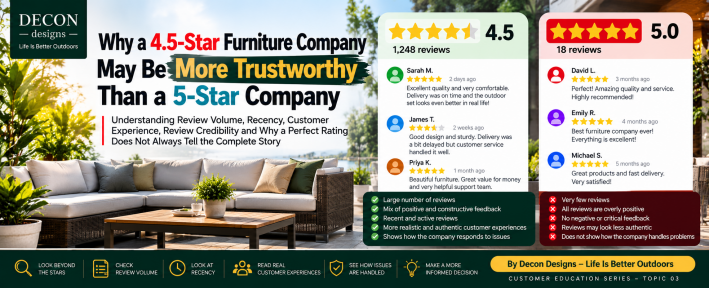
Understanding Review Volume, Recency, Customer Experience, Review Credibility and Why a Perfect Rating Does Not Always Tell the Complete Story
By Decon Designs – Life Is Better Outdoors | Customer Education Series | Furniture Reviews | Google Reviews | FurniReviewology | Customer Trust | Online Reputation | Furniture Buying Decisions | Hospitality Furniture | Digital Transparency
A furniture company with a perfect five-star rating looks impressive.
But does five stars automatically mean that the company is better than a business rated 4.5 stars?
Not necessarily.
Imagine searching online for an outdoor furniture supplier in Malaysia.
Two companies appear in the results.
One has a perfect 5.0-star rating based on eight customer ratings.
The other has a 4.5-star rating supported by 350 customer reviews collected over several years.
Which company should you trust?
At first glance, the five-star business may appear superior.
But when you examine the reviews more closely, the second company may provide substantially more information about product quality, customer service, delivery performance, after-sales support and long-term customer satisfaction.
The difference is not simply mathematical.
It is about the depth, relevance and credibility of the available evidence.
A perfect rating tells you the average score. A credible review history helps you understand the business behind that score.
In the furniture industry, where purchases can involve substantial investments, complicated delivery arrangements and long-term product expectations, this distinction matters.
At Decon Designs – Life Is Better Outdoors, a furniture brand serving Malaysia’s outdoor and hospitality furniture market for more than two decades, we believe customers should look beyond star ratings and examine the complete purchasing experience.
Whether researching a patio set, outdoor sofa, dining table, parasol, hotel lounger, restaurant chair or commercial furniture supplier, customers benefit from understanding how online reputation should be evaluated.
This article explains why a 4.5-star furniture company may sometimes inspire greater confidence than a five-star company—and why neither rating should be judged in isolation.
1. What Does a Five-Star Rating Actually Mean?
Most online review platforms use a numerical rating system, often ranging from one to five stars.
A five-star average generally indicates that the ratings submitted to the platform are highly positive.
However, the number alone does not reveal:
- How many people submitted ratings.
- Whether the ratings include written explanations.
- How recently the experiences occurred.
- What products or services were evaluated.
- Whether the customers purchased similar furniture.
- How the business handles complaints.
- Whether the feedback represents a broad customer base.
A company with three five-star ratings can display the same perfect average as a company with 300 five-star ratings.
Yet the amount of available evidence is very different.
That is why customers should never evaluate a supplier using the average rating alone.
2. The Difference Between Rating and Reputation
A rating is a numerical summary.
Reputation is a broader assessment of how a business is perceived and how it has performed over time.
A furniture company’s reputation may be influenced by several factors:
Product quality: Are the materials, construction and finishes suitable for the intended use?
Customer service: Does the company communicate clearly and professionally?
Delivery reliability: Does it meet agreed delivery commitments?
After-sales support: Does it respond appropriately when customers need assistance?
Business experience: Does it have relevant experience with the products or projects involved?
Consistency: Does it deliver satisfactory experiences repeatedly?
Transparency: Does it communicate honestly about products, limitations and problems?
An online star rating may reflect parts of this experience.
But it cannot communicate all these dimensions on its own.
A high rating is one indicator of reputation—not a complete measurement of trustworthiness.
3. Review Volume: Why the Number of Reviews Matters
Review volume refers to the number of ratings or reviews a business has received.
It is one of the first factors buyers should examine.
Consider this hypothetical comparison.
| Factor | Furniture Company A | Furniture Company B |
|---|---|---|
| Average rating | 5.0 stars | 4.5 stars |
| Number of ratings | 8 | 350 |
| Review history | 2 months | 6 years |
| Written experiences | Limited | Many detailed reviews |
| Critical feedback | None visible | Some mixed and negative feedback |
| Business responses | Few | Responses to various concerns |
Company A may be an excellent supplier.
Company B may also be excellent.
The information does not establish which company is objectively better.
However, Company B provides a larger body of feedback for potential buyers to investigate.
More reviews can make it easier to identify recurring patterns.
For example, buyers may discover that customers consistently praise the company’s product quality while occasionally mentioning longer delivery times for customized furniture.
This is useful information.
But review volume should not be treated as proof of superiority.
A business with fewer reviews may simply be newer, smaller or more focused on business-to-business projects.
The correct question is not:
“Which company has the most reviews?”
It is:
“Which company provides the most relevant and credible evidence for the purchase I intend to make?”
4. Review Recency: Why Recent Customer Experiences Matter
A review written five years ago may describe a very different business from the one operating today.
Furniture companies can change over time.
They may introduce new product ranges, appoint different suppliers, improve quality control, expand delivery services or change management practices.
For that reason, buyers should examine the dates of reviews.
Recent Reviews Can Reveal Current Performance
Recent feedback may provide information about:
- Present product availability.
- Current customer service standards.
- Delivery performance.
- Existing product ranges.
- Current after-sales support.
Older Reviews Can Reveal Historical Consistency
Older reviews can also be useful.
They may demonstrate whether the company has maintained customer relationships over several years.
For example, a supplier with reviews spanning six years may provide more historical context than a company whose feedback appeared only last month.
However, an older positive review does not guarantee that the company performs equally well today.
Similarly, an older complaint may relate to a problem that has since been resolved.
The most useful approach is to read both recent and historical feedback, giving appropriate weight to current experiences.
5. Review Detail: Why Written Experiences Matter More Than Stars Alone
Compare these two reviews.
Review A
“Five stars. Excellent.”
Review B
“We purchased a six-seater outdoor dining set for our covered terrace. The supplier explained the material options, confirmed the measurements and arranged delivery within the agreed timeframe. The chairs are comfortable, and the table fits the space well. After four months of use, we are satisfied with the purchase.”
Both are positive.
But Review B contains significantly more information.
It describes:
- The furniture purchased.
- The intended application.
- The supplier’s communication.
- Delivery performance.
- Product comfort.
- The period of use.
- Overall satisfaction.
This information helps other buyers determine whether the experience is relevant to their own requirements.
A detailed four-star review may therefore be more useful than a five-star rating without explanation.
This does not make the four-star review automatically more accurate.
It simply gives readers more information to evaluate.
6. Why Negative Reviews Can Strengthen a Buyer’s Understanding
Many consumers instinctively avoid businesses with negative reviews.
But criticism can provide valuable context.
A company with a 4.5-star rating may have received some complaints about delivery delays, product expectations or after-sales service.
The existence of those complaints does not automatically mean the company is unreliable.
What matters is the nature, frequency and handling of the issues.
For example, a customer might write:
“The outdoor sofa was comfortable and matched the description, but delivery was delayed by three days. The company informed us of the revised date and completed delivery as promised.”
This review communicates both a weakness and a positive aspect of the company’s response.
Another customer might report a damaged table that was subsequently replaced.
Such experiences can help buyers understand what happens when a transaction does not proceed perfectly.
Trust is not necessarily demonstrated by the absence of problems. It can also be demonstrated by responsible problem resolution.
7. A Perfect Five-Star Rating Is Not Automatically Suspicious
It is important to avoid an unfair assumption.
A company with a perfect rating may genuinely provide excellent service.
Small furniture businesses, specialist workshops and newer suppliers may have relatively few customers who have posted reviews.
A business serving a limited number of commercial clients may also have a smaller public review history.
Therefore, a five-star rating should not automatically be dismissed.
The same principle applies to a 4.5-star rating.
A lower average does not automatically indicate greater honesty or credibility.
Both companies deserve fair evaluation.
The objective is not to reward businesses for having negative reviews.
It is to understand the evidence supporting their reputation.
8. How Review Credibility Influences Trust
Credibility refers to whether feedback appears genuine, relevant and reasonably supported.
A credible review often includes specific observations.
For example:
“The chairs were delivered fully assembled, and the powder-coated frames matched the finish shown in the showroom.”
This is more informative than a generic statement such as:
“Best furniture company ever!”
However, short reviews can still be genuine.
Buyers should avoid assuming that a review is fake simply because it lacks detail.
Instead, examine patterns across multiple reviews.
Potential warning signs of manipulated feedback may include:
- Numerous reviews with identical wording.
- Unexplained clusters of ratings.
- Reviews unrelated to the business.
- Repetitive promotional language.
- Claims that contradict verifiable product information.
None of these factors independently proves manipulation.
They are reasons to investigate further.
A fair assessment should distinguish suspicion from established evidence.
9. Customer Photographs and Videos: Additional Evidence Worth Examining
Furniture is a physical product.
Its appearance, dimensions, finish and construction can influence customer satisfaction.
Photographs included with reviews may help buyers understand how furniture looks in real environments.
For example:
A patio set photographed in a Malaysian garden may help customers evaluate proportions and colour.
A hotel lounger photographed beside a swimming pool may illustrate its actual application.
A dining chair photographed after installation may provide additional context about finish and design.
Customer videos may also help demonstrate functionality.
However, photographs and videos are not automatic proof of review authenticity.
Images can be edited, reused or presented without sufficient context.
Buyers should compare visual feedback with official product specifications and other reliable information.
10. The Importance of Business Responses to Reviews
A furniture company’s response to customer feedback can reveal aspects of its service culture.
Consider two hypothetical examples.
Company A: No Meaningful Response
A customer reports receiving a damaged chair.
The company provides no public response, and the review does not indicate whether the issue was resolved.
Company B: Professional Response
A customer reports receiving a damaged chair.
The company acknowledges the concern, requests the relevant order information through a private channel and explains that the matter will be investigated.
A professional response can be reassuring.
However, buyers should also remember that a public reply does not prove the promised resolution was completed.
Where possible, look for evidence of follow-through.
A business should be evaluated on its actions, not merely the politeness of its online responses.
11. Why a 4.5-Star Rating Can Sometimes Reflect a More Established Review History
As a business serves more customers, it may encounter a wider range of expectations.
Different customers may evaluate the same experience differently.
For example:
One customer may consider a dining chair comfortable.
Another may find it too firm.
One buyer may prioritize design.
Another may prioritize price.
A third may be more concerned about delivery speed.
A larger and more diverse customer base can produce a broader distribution of ratings.
This is not necessarily evidence of poor performance.
It may reflect the reality that customer satisfaction is influenced by individual preferences and circumstances.
A mature review history may therefore contain both enthusiastic praise and constructive criticism.
What matters is whether the overall feedback supports confidence in the supplier’s ability to meet the buyer’s requirements.
12. Furniture Reviews Must Be Relevant to the Product You Are Buying
A furniture company may sell many categories of products.
These could include:
- Outdoor dining sets.
- Patio sofas.
- Garden swings.
- Parasols and umbrellas.
- Pool loungers.
- Restaurant chairs.
- Office furniture.
- Commercial waiting-area furniture.
- Writing desks.
- Hospitality furniture.
A supplier may receive excellent reviews for one category but limited feedback for another.
For example, positive reviews about residential patio furniture do not automatically establish the company’s suitability for a large hotel procurement project.
Buyers should prioritize feedback relating to the specific product or service they require.
Relevance is often more important than the headline star rating.
13. Why Outdoor Furniture Buyers in Malaysia Should Look Beyond Ratings
Malaysia’s tropical climate creates particular challenges for outdoor furniture.
Strong sunlight, high humidity, heavy rainfall and environmental exposure can influence product performance.
A five-star review written immediately after delivery may describe attractive furniture and excellent service.
But it may not explain how the product performs after prolonged outdoor use.
For outdoor furniture, buyers should seek feedback about:
Material Performance
How have the frames, surfaces and finishes performed?
Cushion Durability
Have the cushions retained their comfort and appearance?
Weather Exposure
Was the furniture installed under cover or exposed to rain and direct sunlight?
Maintenance
What care has the customer provided?
Long-Term Satisfaction
Does the customer remain satisfied after several months or years?
A detailed long-term review can provide insights that an initial five-star rating cannot.
However, product performance must always be evaluated against the furniture’s intended use and maintenance requirements.
14. Hospitality and Commercial Buyers Need More Than Five-Star Ratings
Hotels, resorts, restaurants, cafés, offices and property developers face additional purchasing considerations.
A commercial furniture project may involve dozens or hundreds of products.
Supplier performance must therefore be evaluated across several dimensions.
These include:
Capacity: Can the supplier handle the required quantity?
Consistency: Will the products match approved specifications?
Delivery: Can the supplier meet the agreed project schedule?
Installation: Is assembly or installation support available where required?
Replacement: Can damaged or worn components be replaced?
After-sales support: What assistance is available after project completion?
Commercial experience: Has the supplier handled comparable requirements?
A 5.0-star rating from a handful of residential customers may be less relevant than detailed references from similar commercial projects.
Likewise, a 4.5-star company should not be selected automatically without verifying its capabilities.
Commercial buyers should combine review research with technical and contractual due diligence.
15. Google Reviews, FurniReviewology and Other Feedback Platforms
Furniture buyers may encounter reviews through several different channels.
Google Reviews
Google Reviews can help customers evaluate local furniture showrooms, retailers, suppliers and service providers.
Buyers can examine ratings, written experiences, photographs and business responses.
FurniReviewology
FurniReviewology is a furniture-focused review and reputation platform intended to serve the broader furniture industry ecosystem.
Specialist review environments can provide another channel for furniture-related customer feedback.
Online Marketplaces
Marketplace reviews may offer product-specific information about quality, packaging, delivery and assembly.
Company Testimonials
A furniture company’s own website may publish customer testimonials.
These can be useful, but buyers should recognize that testimonials are often selected for publication by the business.
Professional Recommendations
Architects, interior designers, hotel operators and other industry professionals may provide recommendations based on relevant experience.
Each information source serves a different purpose.
Using several credible sources can help buyers develop a more complete understanding of a supplier.
16. The Six Factors Every Furniture Buyer Should Evaluate
Before choosing a furniture supplier, consider six key factors.
| Factor | What to examine | Why it matters |
|---|---|---|
| Review volume | Number of customer ratings and reviews | Provides context about the amount of feedback |
| Recency | Dates of customer experiences | Helps assess current performance |
| Detail | Specific descriptions of products and services | Makes feedback more informative |
| Credibility | Authenticity and consistency of reviews | Helps identify potentially misleading information |
| Relevance | Similarity to your intended purchase | Makes feedback more applicable |
| Business response | Handling of complaints and questions | Offers insight into customer service practices |
These factors should be considered together.
No single factor can establish whether a furniture company is trustworthy.
17. A Practical Comparison: Which Furniture Company Would You Choose?
Imagine that you are purchasing outdoor dining furniture for a restaurant.
You have shortlisted two suppliers.
Supplier A
- 5.0-star average.
- Eight ratings.
- Limited written feedback.
- Most reviews concern residential furniture.
- No publicly documented restaurant projects.
Supplier B
- 4.5-star average.
- 350 ratings and reviews.
- Multiple detailed customer experiences.
- Reviews covering restaurant and hospitality furniture.
- Some complaints about delivery scheduling.
- Evidence of responses to customer concerns.
- Relevant commercial project references available for verification.
Supplier B may be the stronger candidate for further investigation because it provides more relevant information.
But this does not mean Supplier B is automatically the better choice.
The buyer should still compare:
- Product specifications.
- Material suitability.
- Price and total cost.
- Stock availability.
- Delivery commitments.
- Warranty terms.
- Commercial references.
The final decision should be based on overall suitability rather than a star-rating comparison alone.
18. Why Furniture Businesses Should Not Chase Perfect Ratings at Any Cost
A furniture business should aim to provide excellent customer experiences.
It should not attempt to manufacture the appearance of perfection.
Practices such as purchasing fake reviews, pressuring customers to leave positive feedback or selectively soliciting only satisfied customers can undermine trust.
A responsible review strategy should encourage genuine customer experiences.
Businesses can ask customers to provide honest feedback about:
- Product quality.
- Comfort.
- Service.
- Delivery.
- Installation.
- Maintenance.
- After-sales support.
The feedback may be positive, negative or mixed.
All three can provide useful information.
The objective should be better customer experiences—not simply higher numbers on a review platform.
19. How Furniture Companies Can Build a Credible Review History
A trustworthy review profile develops through consistent business practices.
Furniture companies should focus on:
Accurate Product Descriptions
Customers should understand what they are purchasing.
Realistic Delivery Expectations
Businesses should communicate stock availability and delivery commitments clearly.
Product Quality Control
Furniture should be inspected and supplied according to agreed specifications.
Professional Communication
Customer enquiries and concerns should be handled respectfully.
Transparent Warranty Information
Buyers should understand warranty coverage, exclusions and claim procedures.
Genuine Review Collection
Customers should be invited to share authentic feedback without pressure to provide a particular rating.
Continuous Improvement
Repeated customer concerns should be investigated and addressed.
A strong reputation is built through operational performance.
Reviews are one way that performance becomes visible.
20. Decon Designs: Customer Trust Is More Than a Star Rating
At Decon Designs – Life Is Better Outdoors, we believe customer confidence should be built on real experiences, transparent communication and suitable furniture solutions.
With more than two decades serving Malaysia’s outdoor and hospitality furniture market, we understand that customers have different priorities.
A homeowner may be looking for a comfortable patio set.
A restaurant operator may need durable dining furniture.
A hotel may require pool loungers and parasols.
A developer may be sourcing furniture for multiple properties.
These buyers should not make decisions based solely on online ratings.
They should examine the product, understand the materials, evaluate supplier experience and clarify important commercial terms.
We encourage customers to read both positive and negative reviews, compare credible information sources and ask questions before purchasing.
A perfect rating can be encouraging.
A detailed review history can be informative.
But genuine trust must ultimately be supported by the actual buying experience.
21. A Practical Furniture Buyer Checklist
Before making your next furniture purchase, ask:
- How many reviews does the company have?
- Are the reviews recent?
- Do they describe genuine purchasing experiences?
- Are the comments relevant to the furniture I need?
- Are there detailed reviews explaining product quality?
- Have customers shared photographs or long-term experiences?
- Are there repeated complaints about the same issue?
- Does the company respond professionally?
- Can the supplier provide appropriate product information?
- Are delivery and warranty conditions clearly explained?
- Have I compared other credible feedback sources?
- Does the supplier have experience relevant to my purchase?
If the purchase involves a large commercial project, request additional evidence of supplier capability.
This may include project references, samples, technical specifications and written commercial terms.
22. The Future of Furniture Reputation: Trust Must Be Earned, Not Manufactured
The furniture industry is becoming increasingly connected through search engines, review platforms, marketplaces, social media and digital business directories.
Customers can now compare suppliers more easily than ever before.
As this information becomes more accessible, businesses will need to demonstrate credibility through more than promotional claims.
They will need to show:
- What products they supply.
- How customers experience those products.
- How they handle service problems.
- Whether they communicate transparently.
- Whether they have relevant expertise.
- How consistently they meet expectations.
Ratings will continue to play a useful role.
But detailed, credible and relevant feedback can provide a stronger foundation for informed purchasing decisions.
The future of furniture reputation should not be a competition to display the highest possible number.
It should be about making genuine business performance easier for customers to evaluate.
Final Thoughts: Don’t Choose Furniture Suppliers by Stars Alone
A five-star furniture company may be excellent.
A 4.5-star furniture company may also be excellent.
Neither rating provides enough information to establish which supplier is more trustworthy.
What matters is the evidence behind the score.
How many customers have shared experiences?
How recently did they purchase?
What products did they buy?
What details did they provide?
Were there problems?
How did the supplier respond?
Are the experiences relevant to your own requirements?
These questions help customers move beyond superficial comparisons.
Five stars may create the first impression. Credible customer experiences help build lasting confidence.
At Decon Designs – Life Is Better Outdoors, we believe that better-informed buyers, genuine reviews and responsible business practices contribute to a stronger furniture industry.
Because the best furniture purchasing decision is not necessarily the one supported by the highest star rating.
It is the decision supported by the most relevant, reliable and complete information.
Decon Designs – Life Is Better Outdoors.