
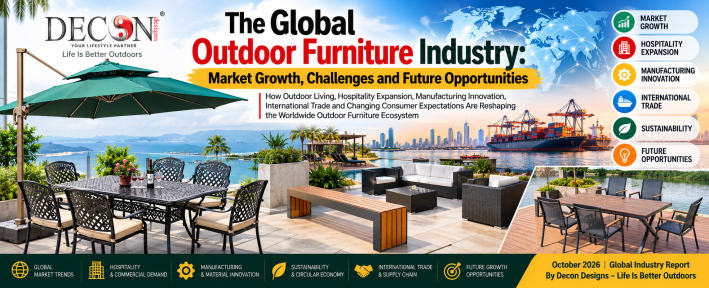
How Outdoor Living, Hospitality Expansion, Manufacturing Innovation, International Trade and Changing Consumer Expectations Are Reshaping the Worldwide Outdoor Furniture Ecosystem
By Decon Designs – Life Is Better Outdoors | Outdoor Furniture Industry | Global Market Intelligence | Furniture Manufacturing | Hospitality Furniture | Outdoor Living | Commercial Furniture | Sustainability | International Trade | Future Opportunities
October 2026 | Global Industry Report
The outdoor furniture industry is undergoing a significant transformation.
What was once considered a relatively specialized category of garden chairs, patio tables and occasional outdoor seating has evolved into an international industry serving residential, commercial, hospitality, tourism, property development and public-space markets.
Today, outdoor furniture is increasingly associated with lifestyle, comfort, architecture, property value, customer experience and commercial investment.
Homeowners are transforming balconies and gardens into functional living spaces.
Hotels and resorts are investing in poolside lounges, outdoor dining environments and guest relaxation areas.
Restaurants and cafés are expanding the role of terraces and open-air seating.
Property developers are incorporating outdoor amenities into residential and mixed-use developments.
Manufacturers are exploring new materials, production technologies and product designs to meet changing expectations.
Meanwhile, international suppliers, distributors and retailers are navigating a business environment shaped by material costs, logistics, sustainability requirements, digital competition and changing consumer spending.
These developments raise an important question:
Where is the global outdoor furniture industry heading, and what opportunities will emerge for manufacturers, suppliers, retailers, designers, property developers and buyers?
At Decon Designs – Life Is Better Outdoors, with more than two decades of experience serving Malaysia’s outdoor and hospitality furniture market, we believe understanding these developments is essential for businesses and consumers alike.
This report examines the global outdoor furniture ecosystem, market growth, regional opportunities, manufacturing and distribution structures, major industry challenges and the factors likely to shape its future.
1. Understanding the Global Outdoor Furniture Industry
The outdoor furniture industry encompasses the design, manufacturing, sourcing, distribution, retailing, installation and maintenance of furniture intended for exterior or semi-exterior environments.
These environments include:
- Residential gardens and patios.
- Condominium balconies.
- Rooftop terraces.
- Hotel and resort outdoor areas.
- Swimming pools and beach clubs.
- Restaurants and cafés.
- Commercial courtyards.
- Office campuses.
- Public gardens and recreational spaces.
- Holiday homes and short-term rental properties.
- Mixed-use developments and communal amenities.
The industry includes more than finished furniture.
Its supply chain also involves raw-material suppliers, fabric manufacturers, metal fabricators, timber processors, cushion producers, finishing specialists, logistics providers, wholesalers, distributors, project contractors and after-sales service companies.
This makes outdoor furniture an interconnected international business ecosystem.
A single outdoor sofa may involve an aluminium frame, synthetic wicker or rope, upholstered cushions, specialized fasteners, protective coatings, packaging and international transportation.
Each component represents a different commercial activity.
The industry’s economic significance therefore extends beyond furniture retail sales.
2. How Large Is the Global Outdoor Furniture Market?
Published market estimates indicate that outdoor furniture represents a substantial international market, although figures vary according to research methodology, product coverage and market definitions.
According to Grand View Research’s 2026 industry report, the global outdoor furniture market was estimated at US$53.3 billion in 2025, with a forecast of US$86.6 billion by 2033, representing a projected compound annual growth rate of 6.4% between 2026 and 2033.
Other research providers publish different estimates. For example, Global Market Insights estimates the market at US$49.8 billion in 2025, while The Business Research Company reports US$52.96 billion for the same year.
These differences reinforce the importance of treating commercial market estimates as research-based assessments rather than exact industry-wide sales totals.
Global Market Outlook
| Indicator | Grand View Research estimate |
|---|---|
| Global market size, 2025 | US$53.3 billion |
| Estimated market size, 2026 | US$56.1 billion |
| Forecast market size, 2033 | US$86.6 billion |
| Forecast CAGR, 2026–2033 | 6.4% |
| Largest regional market, 2025 | North America |
| Fastest-growing forecast region | Asia-Pacific |
Source: Grand View Research, Outdoor Furniture Market Report, 2026. Forecasts are projections, not guaranteed outcomes.
These figures suggest a sizeable long-term commercial opportunity.
However, growth will not necessarily be uniform across every country, furniture category or customer segment.
Economic conditions, housing activity, tourism investment, exchange rates and consumer confidence can influence demand.
For manufacturers and suppliers, the strategic opportunity lies in identifying which markets and product categories offer sustainable demand rather than assuming that every part of the industry will grow at the same pace.
3. The Five Major Forces Driving Outdoor Furniture Demand
3.1 Outdoor Living Is Becoming Part of Everyday Residential Life
Outdoor spaces are increasingly viewed as extensions of the home.
Balconies, terraces, patios and gardens can serve as additional areas for dining, relaxation, socializing and family activities.
This creates demand for furniture that combines comfort, attractive design and practical performance.
Product categories benefiting from this lifestyle orientation include outdoor sofas, dining sets, lounge chairs, benches, swings and compact balcony furniture.
For urban households, multifunctional and space-efficient designs can be particularly relevant.
3.2 Hospitality and Tourism Investment
Hotels, resorts, restaurants and leisure properties depend on comfortable and attractive environments.
Outdoor furniture contributes to the appearance and usability of poolside areas, terraces, gardens and dining spaces.
UN Tourism reported approximately 1.52 billion international tourist arrivals in 2025, an increase of 4% over 2024.
This reflects significant global travel activity, although tourist arrivals do not translate directly into furniture purchases.
The commercial opportunity emerges when tourism demand encourages property development, renovation, facility upgrades and replacement of existing furniture.
3.3 Property Development and Urban Amenities
Residential developments increasingly incorporate shared amenities such as rooftop lounges, landscaped courtyards and swimming-pool facilities.
These spaces require appropriate seating, dining furniture, loungers and shade products.
Outdoor furniture can therefore become part of the property-development procurement process.
3.4 Product and Material Innovation
Developments in frames, coatings, fabrics and manufacturing methods create opportunities to improve product design and performance.
Manufacturers are exploring modular construction, replaceable components, recycled materials and products designed for specific environmental conditions.
3.5 Digital Furniture Discovery
Buyers increasingly research furniture through search engines, online catalogues, marketplaces, social media and customer reviews.
This changes how suppliers attract customers and how purchasing decisions are made.
A company with suitable products may still struggle commercially if buyers cannot easily find reliable information about those products.
4. The Global Outdoor Furniture Ecosystem: From Materials to End Users
The outdoor furniture industry is supported by multiple interconnected business activities.
Raw-Material Suppliers
These businesses provide timber, metals, polymers, fabrics, foam, coatings and other inputs.
Component Manufacturers
They produce frames, fittings, fasteners, cushions, mechanisms and accessories.
Furniture Manufacturers
Factories convert materials and components into finished products.
Brand Owners
Brands develop product ranges, specifications, marketing strategies and distribution relationships.
Importers and Exporters
These businesses connect manufacturing locations with international markets.
Wholesalers and Distributors
They supply retailers, commercial buyers and project contractors.
Retailers and Showrooms
Retail businesses provide product access, customer consultation and local purchasing services.
Hospitality and Project Suppliers
These businesses coordinate furniture procurement for hotels, resorts, restaurants, developers and institutions.
Logistics and Installation Providers
They manage warehousing, transportation, assembly and installation.
Maintenance and Refurbishment Businesses
They support product repair, cleaning, replacement components and lifecycle extension.
Every stage creates commercial opportunities.
For this reason, industry growth should not be measured only by the number of finished products sold.
The wider ecosystem also includes employment, manufacturing investment, services, logistics and technical expertise.
5. Outdoor Furniture Manufacturing: A Global Production Network
Outdoor furniture manufacturing operates across multiple countries and production models.
China remains an important international manufacturing and sourcing centre for many furniture categories.
Southeast Asian countries, including Vietnam, Indonesia and Malaysia, participate in furniture manufacturing and export supply chains.
India also offers manufacturing capabilities across wood, metal and other furniture categories.
European producers maintain positions in design-led, premium and specialist furniture segments.
North American businesses participate through manufacturing, product development, branding and distribution.
These roles are not exclusive.
A single brand may source components internationally, manufacture in one country and distribute products through several regional markets.
Manufacturing Priorities
Competitive outdoor furniture manufacturing requires attention to:
- Material consistency.
- Product engineering.
- Construction quality.
- Surface finishing.
- Fabric and cushion performance.
- Production efficiency.
- Packaging.
- Quality inspection.
- Traceability.
- Delivery reliability.
Manufacturers must also respond to changing customer expectations.
Price remains important, but buyers increasingly need confidence in product suitability, maintenance requirements and after-sales support.
6. Outdoor Furniture Materials: What Is Changing?
Material selection is one of the industry’s most important competitive factors.
Different materials offer different combinations of appearance, weight, maintenance requirements, cost and environmental suitability.
| Material | Common applications | Important considerations |
|---|---|---|
| Aluminium | Dining sets, sofas, chairs, loungers | Frame design, coating quality, corrosion resistance |
| Teak and other suitable woods | Premium dining, benches, loungers | Sourcing, maintenance, weathering and construction |
| Synthetic wicker | Sofas, dining sets, lounge furniture | Weave quality, frame construction, UV exposure |
| Outdoor rope | Chairs, sofas, contemporary seating | Material specification, tension and environmental suitability |
| Steel | Tables, chairs, structural components | Protective finishes, corrosion risk and maintenance |
| Recycled polymers | Chairs, benches, tables | Material quality, strength, colour stability and recyclability |
| Outdoor fabrics | Cushions, upholstery, shade products | UV exposure, drying, cleaning and wear |
| Stone and composite surfaces | Tabletops and decorative elements | Weight, stability, maintenance and intended use |
No material is universally best.
The appropriate choice depends on product design, intended application, budget, exposure conditions and maintenance expectations.
For example, furniture used on a covered residential balcony may require different specifications from furniture installed at an exposed coastal resort.
Manufacturers that clearly explain these distinctions can help buyers make better decisions.
7. The Commercial Outdoor Furniture Market: Hospitality as a Strategic Growth Sector
Commercial outdoor furniture is a major component of the wider industry.
According to Grand View Research, the global commercial outdoor furniture market was estimated at US$22.7 billion in 2025 and is projected to reach US$37.7 billion by 2033.
The same research identifies hotels and hospitality as an important commercial end-use segment.
This reflects the role outdoor furnishings play in commercial environments.
Hotels and Resorts
Common requirements include pool loungers, parasols, outdoor sofas, dining sets and relaxation furniture.
Restaurants and Cafés
Operators may prioritize seating comfort, cleaning efficiency, space utilization and frequent-use durability.
Property Developers
Developers may require furniture for shared amenities, rooftops, gardens and recreational areas.
Corporate and Institutional Facilities
Outdoor seating can support staff recreation, visitor amenities and landscaped spaces.
Commercial customers often evaluate suppliers differently from residential buyers.
They may require project coordination, consistent specifications, quantity availability, installation services and replacement support.
The opportunity is therefore not simply to sell more furniture.
It is to provide reliable furnishing solutions for commercial environments.
8. The Hotel and Resort Furniture Opportunity
Outdoor furniture contributes to hospitality experiences.
A well-designed poolside area may encourage guests to spend more time using a hotel’s facilities.
Comfortable outdoor dining furniture can improve the usability of restaurant terraces.
Attractive lounge areas can support a property’s overall design identity.
However, hospitality furniture purchasing should not be driven by appearance alone.
Operators must consider:
- Product durability.
- Guest comfort.
- Cleaning and maintenance.
- Environmental exposure.
- Safety and stability.
- Replacement availability.
- Delivery schedules.
- Warranty conditions.
- Long-term operating costs.
A low initial purchase price may not represent the lowest total cost if products require frequent replacement.
Commercial buyers should evaluate expected service life, maintenance and replacement requirements.
9. Restaurants, Cafés and Outdoor Dining
Outdoor dining is an important application for commercial furniture.
Restaurants and cafés may use terraces, courtyards, sidewalks where permitted, rooftops and garden areas to create additional customer environments.
Furniture selection influences:
- Seating capacity.
- Customer comfort.
- Cleaning time.
- Staff movement.
- Layout flexibility.
- Storage requirements.
- Brand presentation.
Stackable chairs, compact tables and easily maintained surfaces may be useful for some operators.
Premium lounge seating may be more suitable for other concepts.
The correct product depends on the business model.
Manufacturers and suppliers that understand hospitality operations can differentiate themselves from businesses focused only on visual design.
10. The Residential Outdoor Furniture Market
Residential customers remain an important part of global demand.
Grand View Research estimates that residential applications accounted for 57.4% of its defined global outdoor furniture market in 2025.
This segment includes products for:
- Private gardens.
- Balconies.
- Patios.
- Terraces.
- Courtyards.
- Residential swimming pools.
- Holiday homes.
Consumer preferences vary considerably.
Some buyers prioritize affordability.
Others seek premium materials, coordinated collections or distinctive designs.
Urban households may prefer compact furniture.
Larger properties may support outdoor dining and lounge arrangements.
For retailers, understanding these differences is essential.
A successful residential product strategy should reflect how customers actually use their outdoor spaces.
11. Regional Outlook: Where Are the Opportunities?
North America
North America remains a major market for outdoor furniture.
Residential outdoor living, home improvement, hospitality and established retail networks support demand.
Suppliers competing in this region must consider consumer preferences, distribution costs, product differentiation and applicable requirements.
Europe
European markets offer opportunities across residential, hospitality and premium design categories.
Product longevity, design quality, materials and environmental considerations can influence purchasing decisions.
Asia-Pacific
Asia-Pacific presents opportunities linked to urbanization, tourism, residential development and commercial construction.
Countries such as Malaysia, Thailand, Indonesia, Vietnam, India, China, Japan and Australia have different consumer markets and supply-chain roles.
The region’s diversity means suppliers must adapt products to local climates, purchasing power and distribution structures.
Middle East
Hotels, resorts, tourism destinations, residential developments and commercial outdoor environments create opportunities for outdoor furniture.
However, heat, intense sunlight and environmental exposure require careful product selection.
Geopolitical conditions and project financing can also affect demand.
Africa
Urban development, hospitality investment, tourism and local manufacturing capabilities may create opportunities across selected markets.
Demand and supply-chain conditions differ considerably between countries.
Latin America
Residential outdoor living, tourism destinations, hospitality and commercial development offer potential demand.
Import costs, exchange rates, distribution networks and domestic manufacturing conditions can influence market opportunities.
Global suppliers should avoid treating an entire region as one uniform market.
Country-level research remains essential.
12. Malaysia’s Position in the Outdoor Furniture Industry
Malaysia has relevant capabilities in furniture manufacturing, retailing, hospitality procurement and international trade.
The country also has domestic demand for outdoor furniture across residential and commercial environments.
Potential customer segments include:
- Hotels and resorts.
- Restaurants and cafés.
- Residential homeowners.
- Condominium developers.
- Property management companies.
- Landscape designers.
- Architects and interior designers.
- Commercial project contractors.
- Holiday-home operators.
Malaysia’s tropical climate creates particular product requirements.
Outdoor furniture may need to withstand high humidity, heavy rainfall and strong sunlight.
Product suitability therefore depends on appropriate materials, construction, placement and maintenance.
Opportunities for Malaysian Businesses
Manufacturers can explore product development and export markets.
Retailers can improve customer education and product presentation.
Hospitality suppliers can strengthen procurement and after-sales capabilities.
Designers can integrate outdoor furnishing requirements earlier in project planning.
Businesses with experience in tropical outdoor environments may be well positioned to advise customers about appropriate product applications.
13. International Trade and Distribution: How Outdoor Furniture Reaches Buyers
Outdoor furniture moves through several distribution channels.
Direct Manufacturer Sales
Manufacturers may supply commercial customers, distributors or retailers directly.
Importers and Wholesalers
These businesses source products and supply local markets.
Furniture Retailers
Retailers sell through showrooms, websites and other customer-facing channels.
Project-Based Procurement
Hotels, resorts, developers and contractors may purchase through negotiated commercial arrangements.
E-Commerce
Online platforms provide product discovery, comparison and ordering opportunities.
Hybrid Distribution
Some businesses combine showrooms, digital catalogues, direct enquiries and project supply.
Distribution strategy can strongly influence profitability.
Outdoor furniture may be bulky, difficult to transport and expensive to store.
Packaging, warehousing, delivery damage and assembly requirements can affect costs.
For manufacturers, product design should therefore consider logistics as well as appearance and function.
14. Why Logistics Remains a Major Industry Challenge
International furniture supply chains are exposed to several risks.
These include:
- Freight cost fluctuations.
- Port congestion.
- Shipping disruptions.
- Customs requirements.
- Packaging damage.
- Currency volatility.
- Inventory management.
- Delivery delays.
Outdoor furniture can create additional logistical challenges because of product dimensions and packaging requirements.
Large dining tables, sofas and loungers may occupy substantial shipping volume.
Manufacturers can explore packaging optimization and modular construction where appropriate.
However, reducing shipping volume should not compromise product strength or quality.
Commercial buyers should also clarify delivery responsibilities, inspection procedures and damage-handling arrangements before confirming orders.
15. The Growing Importance of Product Durability
Durability is becoming an important competitive consideration.
Customers increasingly need to understand whether furniture is suitable for the intended environment and expected usage.
A product used occasionally in a private garden faces different conditions from furniture used daily at a busy resort.
Durability depends on multiple factors:
- Material selection.
- Structural engineering.
- Quality of joints and fittings.
- Protective finishes.
- Fabric and cushion construction.
- Environmental exposure.
- Maintenance.
- Frequency and intensity of use.
Businesses should avoid unsupported claims such as describing all products as completely weatherproof or maintenance-free.
Clear specifications and realistic care instructions are more useful.
For commercial buyers, durability should be evaluated as part of the total cost of ownership.
16. Sustainability and the Circular Outdoor Furniture Economy
Sustainability is influencing furniture industry discussions.
However, environmental performance should not be reduced to marketing language.
A product containing recycled material is not automatically environmentally superior in every circumstance.
Similarly, a natural material is not automatically sustainable.
Responsible evaluation may consider:
- Material sourcing.
- Manufacturing processes.
- Energy use.
- Product durability.
- Repairability.
- Replacement components.
- Transportation.
- Recyclability.
- End-of-life management.
The circular economy creates opportunities for furniture refurbishment, repairs, cushion replacement and material recovery.
For hospitality businesses, extending the useful life of suitable furniture can also reduce replacement costs.
Manufacturers may benefit from designing products with serviceable components rather than treating every damaged part as a reason to replace an entire product.
17. Climate-Ready Outdoor Furniture: A Strategic Manufacturing Opportunity
Outdoor furniture must perform in different environments.
A product designed for a mild climate may not be suitable for a tropical coastal location.
A material appropriate for a covered patio may require different care when exposed continuously to sunlight and rain.
Climate-related product development may therefore become an important area of differentiation.
Manufacturers can focus on:
- Suitable corrosion protection.
- Appropriate UV-performance specifications.
- Drainage-conscious construction.
- Moisture-management design.
- Replaceable upholstery.
- Clear maintenance guidance.
- Material selection for specific environments.
Buyers should understand that no single material or finish eliminates every environmental risk.
Product performance depends on the complete design and the conditions of use.
18. Technology and Innovation in Outdoor Furniture Manufacturing
Technology offers opportunities across design, production and customer service.
Digital Product Design
Computer-aided design and digital modelling can support product development and engineering.
Production Automation
Appropriate automation may improve manufacturing consistency and efficiency.
Product Visualization
Digital tools can help customers explore furniture configurations and finishes.
Inventory Systems
Better inventory management can improve stock visibility and purchasing coordination.
Digital Procurement
Commercial buyers can use digital catalogues and structured product information to compare suppliers.
AI-Assisted Operations
AI tools may support product discovery, customer enquiries, content organization and internal planning.
However, technology adoption should be evaluated according to business needs, cost and reliability.
A digital tool does not replace accurate product specifications or responsible customer service.
19. Why Digital Visibility Matters for Outdoor Furniture Companies
The global outdoor furniture industry includes manufacturers, exporters, distributors, retailers and project suppliers competing for buyer attention.
Many businesses offer capable products but struggle to communicate their value online.
Potential customers may search for:
“Outdoor furniture supplier Malaysia”
“Hotel pool lounger supplier”
“Commercial parasol supplier”
“Outdoor dining furniture manufacturer”
“Resort furniture procurement”
Businesses that provide clear and searchable information may be easier for relevant customers to discover and evaluate.
Important digital assets include:
- Accurate company information.
- Detailed product descriptions.
- Technical specifications.
- Product photographs.
- Project information.
- Customer reviews.
- Contact details.
- Relevant educational content.
Digital visibility should be supported by genuine business credibility.
Attracting enquiries is useful only when a company can meet customer expectations.
20. The Role of Customer Reviews and Supplier Reputation
Outdoor furniture buyers often face uncertainty.
They may be purchasing products they have not previously used.
They may be comparing unfamiliar suppliers.
They may need to assess product suitability without visiting a factory.
Customer reviews can help provide context.
Useful feedback may describe:
- Product quality.
- Comfort.
- Delivery performance.
- Supplier communication.
- After-sales service.
- Maintenance.
- Long-term satisfaction.
However, reviews should not replace technical verification.
A five-star rating cannot guarantee that a parasol is suitable for a particular installation.
Likewise, positive comments about residential furniture do not automatically establish a supplier’s commercial project capacity.
Buyers should combine reviews with product specifications, references and direct supplier communication.
21. The Major Challenges Facing the Global Outdoor Furniture Industry
Despite growth opportunities, the industry faces significant challenges.
Price Competition
Manufacturers and retailers compete across different price segments.
Excessive price competition can place pressure on quality, service and margins.
Raw-Material Costs
Changes in timber, metals, polymers, fabrics and other input costs can affect profitability.
Shipping and Logistics
International freight disruptions can influence delivery schedules and landed costs.
Quality Inconsistency
Inadequate production controls may lead to defects, returns and customer dissatisfaction.
Climate Suitability
Products must be appropriate for their intended environmental conditions.
Consumer Spending Uncertainty
Furniture purchases may be postponed when households or businesses reduce discretionary spending.
Project Delays
Hospitality and property-development demand can be affected by construction schedules and financing conditions.
Sustainability Expectations
Manufacturers may face increasing requests for material information, sourcing transparency and product lifecycle considerations.
Digital Competition
Businesses must compete for online visibility while maintaining accurate information and customer trust.
The companies best prepared for these challenges will be those that combine operational discipline with product differentiation and customer understanding.
22. The Opportunity in Replacement, Maintenance and Refurbishment
Outdoor furniture demand does not come only from new construction or first-time purchases.
Existing furniture may require maintenance, repair, refurbishment or replacement.
This creates recurring commercial opportunities.
Examples include:
- Replacement cushions.
- Upholstery renewal.
- Frame repairs where appropriate.
- Replacement fittings.
- Surface refinishing.
- Furniture cleaning.
- Product upgrades.
- Replacement of worn commercial furniture.
For hotels and resorts, planned maintenance can support asset management.
For suppliers, after-sales services may strengthen long-term customer relationships.
For customers, access to replacement components can influence the overall value of a purchase.
23. Why Total Cost of Ownership Is Becoming More Important
The cheapest outdoor furniture is not necessarily the most economical.
Consider two hypothetical commercial dining chair options.
One has a lower initial purchase price but requires frequent replacement.
The other costs more initially but may offer a longer useful life under the intended conditions.
The better choice depends on verified product performance and the total expected cost.
A practical assessment should include:
Initial purchase cost + Delivery + Installation + Maintenance + Repairs + Replacement costs
Commercial buyers should also consider disruption caused by furniture failure or replacement.
However, higher prices do not automatically guarantee better durability.
Product specifications, appropriate testing, supplier capability and actual usage conditions remain important.
24. Opportunities for Outdoor Furniture Manufacturers
Manufacturers can explore several strategic directions.
Specialization
Develop expertise in particular products, materials or customer segments.
Commercial-Grade Product Development
Design products for relevant hospitality and high-frequency-use applications.
Modular Furniture
Explore configurations that improve flexibility, storage or transport efficiency.
Replacement Components
Design products that can be maintained or repaired where practical.
Product Documentation
Provide clearer specifications, care instructions and technical information.
Export Market Development
Evaluate overseas opportunities based on actual demand, compliance requirements and distribution costs.
Digital Catalogues
Make products easier for buyers and procurement professionals to evaluate.
Stronger Quality Systems
Improve inspection, consistency and traceability.
Manufacturers that understand end-user requirements may be better positioned to differentiate themselves.
25. Opportunities for Retailers and Distributors
Retailers and distributors also have opportunities to strengthen their positions.
These include:
- Curating suitable product ranges.
- Providing knowledgeable customer guidance.
- Maintaining accurate inventory information.
- Offering showroom experiences.
- Improving delivery coordination.
- Supporting product maintenance.
- Developing commercial customer relationships.
- Publishing educational buying guides.
- Building trustworthy online reputations.
The future of furniture retail is unlikely to depend solely on displaying products.
Customers also need assistance understanding what they are buying.
Businesses that combine product access with relevant expertise can provide additional value.
26. Opportunities for Architects, Designers and Property Developers
Outdoor furniture should be considered during space planning rather than treated only as a final decorative purchase.
Early coordination can help address:
- Space requirements.
- Circulation.
- Seating capacity.
- Accessibility.
- Shade.
- Drainage.
- Storage.
- Cleaning access.
- Maintenance.
- Product dimensions.
Architects and designers can help clients select furniture suited to the intended environment.
Property developers can integrate outdoor furnishing requirements into amenity planning.
Suppliers can contribute practical product knowledge during procurement.
Better coordination can reduce purchasing mistakes and improve the usability of outdoor spaces.
27. The Future of Outdoor Furniture Design
Several design directions are likely to remain relevant.
Modular Configurations
Furniture that can adapt to different layouts and customer needs.
Multifunctional Products
Products that support more than one practical use.
Compact Urban Furniture
Space-efficient designs for balconies and smaller terraces.
Material Combinations
The use of wood, metal, rope, upholstery and other materials in coordinated collections.
Repairable Construction
Products designed with maintainable or replaceable components.
Hospitality-Focused Design
Furniture that balances appearance, comfort, cleaning and operational needs.
Customization
Options for finishes, fabrics and configurations where manufacturing capabilities permit.
These are strategic directions rather than guarantees of consumer demand.
Manufacturers should validate product decisions through market research, customer feedback and commercial testing.
28. The Next Decade: What Will Define Successful Outdoor Furniture Businesses?
The outdoor furniture industry is likely to remain competitive.
Future success may depend less on offering the largest number of products and more on delivering consistent value.
Businesses should consider seven strategic priorities.
1. Product suitability: Furniture should match its intended use.
2. Quality consistency: Manufacturing and supply processes should be reliable.
3. Customer education: Buyers should understand materials, dimensions and maintenance.
4. Operational efficiency: Inventory, logistics and delivery should be managed carefully.
5. Digital discoverability: Customers should be able to find accurate business and product information.
6. Sustainability: Environmental claims should be supported by credible evidence.
7. Long-term relationships: After-sales service and repeat customer trust should remain priorities.
Companies that strengthen these capabilities may be better prepared to respond to changing market conditions.
29. Decon Designs: Connecting Global Industry Developments With Malaysia’s Outdoor Furniture Market
At Decon Designs – Life Is Better Outdoors, we view outdoor furniture as more than a product category.
It is part of the wider relationship between architecture, hospitality, lifestyle, property development and customer experience.
With more than two decades serving Malaysia’s outdoor and hospitality furniture market, our perspective is shaped by the practical requirements of residential and commercial buyers.
A homeowner may need a suitable outdoor dining set.
A restaurant may require functional seating.
A resort may be evaluating loungers, parasols and relaxation furniture.
A property developer may need outdoor furnishings for communal amenities.
Each project involves different considerations.
These may include product dimensions, material suitability, budget, delivery, maintenance and after-sales requirements.
We believe buyers benefit from understanding these factors before purchasing.
We also believe manufacturers, suppliers and retailers benefit from understanding broader industry developments.
Market growth creates opportunities, but sustainable business performance depends on the ability to deliver appropriate products and dependable service.
For Malaysia’s outdoor furniture sector, opportunities exist not only in selling furniture but also in improving product knowledge, sourcing capabilities, commercial procurement and customer education.
30. Final Outlook: A Global Industry With Opportunities Across the Value Chain
The global outdoor furniture industry is positioned at the intersection of several important economic activities.
Residential outdoor living.
Tourism and hospitality.
Property development.
Manufacturing.
International trade.
Product design.
Sustainability.
Digital commerce.
After-sales services.
These activities create opportunities for businesses of different sizes and specializations.
However, the industry’s future will not be determined by market forecasts alone.
Manufacturers must manage costs and quality.
Suppliers must understand customer requirements.
Retailers must provide accurate information.
Commercial buyers must evaluate lifecycle costs.
Designers must consider product suitability.
Consumers must make informed purchasing decisions.
The businesses that respond effectively to these needs may be better positioned to compete in an evolving international market.
The future of outdoor furniture is not simply about placing furniture outside. It is about creating functional, comfortable and commercially valuable outdoor environments.
For Decon Designs, the message is clear:
Outdoor living is an important part of modern residential and commercial design.
The outdoor furniture industry offers opportunities across manufacturing, sourcing, retail, hospitality and property development.
And long-term success will depend on the ability to connect design, product performance, customer trust and responsible business practices.
Decon Designs – Life Is Better Outdoors.
Frequently Asked Questions About the Outdoor Furniture Industry
What is the outdoor furniture industry?
The outdoor furniture industry includes the design, manufacturing, distribution, sale and maintenance of furniture intended for gardens, patios, balconies, terraces, hospitality properties and other outdoor environments.
How large is the global outdoor furniture market?
Grand View Research estimates the global market at US$53.3 billion in 2025 and forecasts US$86.6 billion by 2033. Other research firms publish different estimates because of differences in scope and methodology.
What drives growth in outdoor furniture?
Important demand drivers include residential outdoor living, hospitality investment, property development, product innovation and commercial outdoor dining.
Which regions are important for outdoor furniture?
North America and Europe are significant markets, while Asia-Pacific is expected to offer substantial growth opportunities. Regional demand varies by country and customer segment.
What materials are commonly used?
Common materials include aluminium, suitable hardwoods, synthetic wicker, steel, rope, polymers, outdoor fabrics and composite surfaces.
Why is outdoor furniture important to hotels and resorts?
Outdoor furniture supports guest comfort and the usability of poolside, dining, garden and relaxation areas. Commercial buyers must also consider maintenance, durability and lifecycle costs.
What opportunities exist for Malaysian outdoor furniture businesses?
Opportunities include residential supply, hospitality procurement, commercial projects, product development, manufacturing, distribution and export-market participation.
What challenges does the industry face?
Major challenges include material costs, logistics, price competition, product quality, environmental suitability, changing consumer demand and supplier visibility.
Research Sources and Market References
The following sources support the market figures and tourism information discussed in this report. Readers should note that forecasts are subject to revision and that research providers may define markets differently.
- Grand View Research — Outdoor Furniture Market, 2026–2033: https://www.grandviewresearch.com/industry-analysis/outdoor-furniture-market
- Grand View Research — Commercial Outdoor Furniture Market, 2026–2033: https://www.grandviewresearch.com/industry-analysis/commercial-outdoor-furniture-market-report
- Global Market Insights — Outdoor Furniture Market, 2026–2035: https://www.gminsights.com/industry-analysis/outdoor-furniture-market
- The Business Research Company — Outdoor Furniture Global Market Report: https://www.thebusinessresearchcompany.com/report/outdoor-furniture-global-market-report
- UN Tourism — International Tourist Arrivals in 2025: https://www.untourism.int/news/international-tourist-arrivals-up-4-in-2025-reflecting-strong-travel-demand-around-the-world